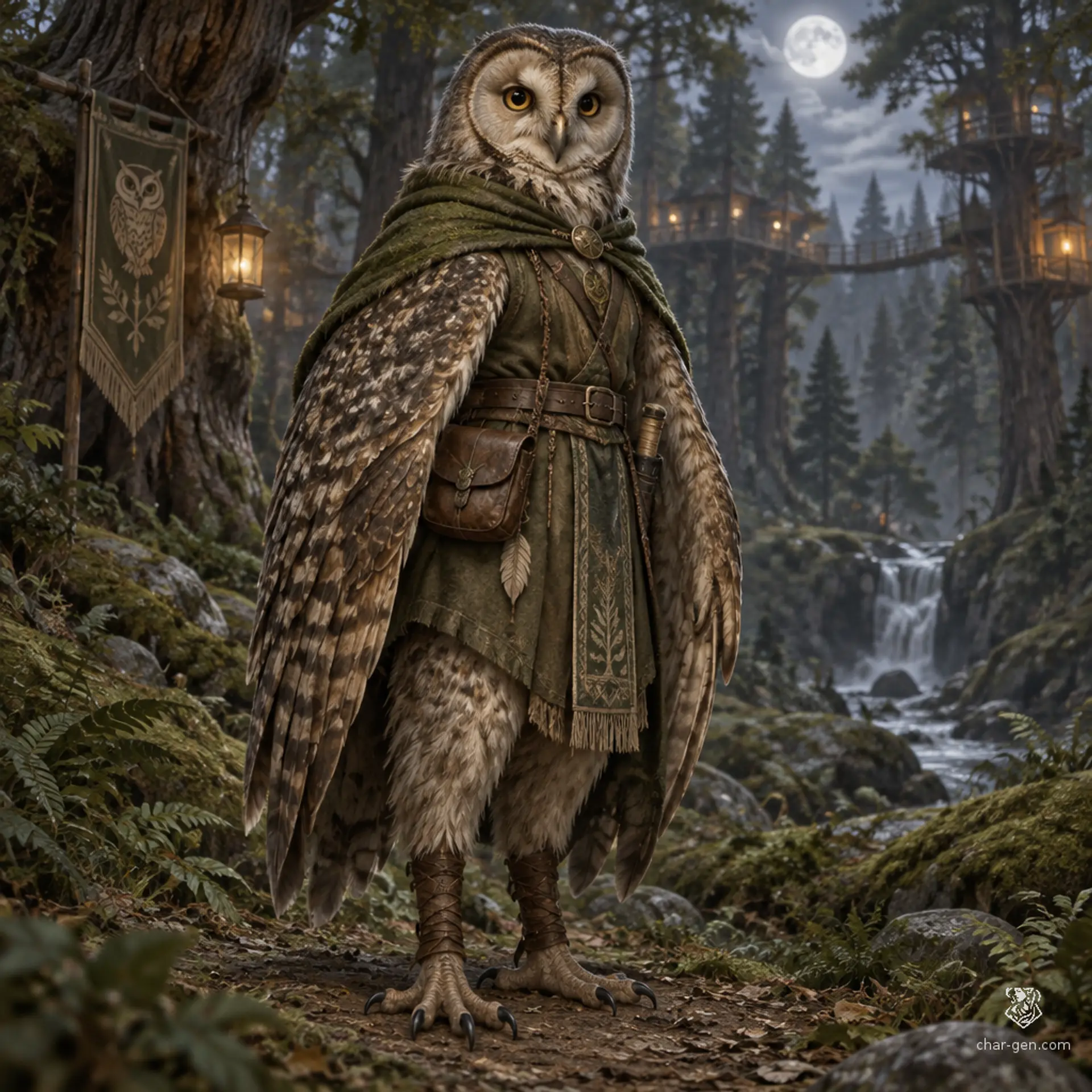
Noctivolans silvestris
Moonwatchers are silent-winged watchers of the forest canopy, respected among the peoples of the sky for their patient vigilance and keen eyes.
At a glance
Darkvision 60 ft. You can see in dim light within this range as if it were bright light, and in darkness as if it were dim light, perceiving only shades of gray.
Languages Common, One other language of your choice, often Sylvan
Height 4 ft. 8 in. to 6 ft. 2 in., varying considerably by lineage
Weight 75 to 145 lb., including broad wings and dense plumage
Lifespan 80 to 100 years, adult at 16
At the table
Your walking speed is 30 feet, and you have a flying speed equal to your walking speed. You can't use this flying speed while wearing medium or heavy armor.
You have proficiency in the Perception skill. Your forward-facing eyes and sensitive facial disc help you notice movement and judge its direction, especially in low light.
You have proficiency in either the Nature or Animal Handling skill. Choose the proficiency when you select this species.
Accustomed to starlit woods and night watches, you have Darkvision with a range of 60 feet.
These folk tend toward keen senses, patience, and physical resilience. If your table uses optional ability score increases, assign +2 and +1 wherever you wish.
Broad, rounded facial discs and mottled brown plumage suited to deep shade.
Barkshade Moonwatchers favor dense old forests, where their muted colors blend with trunks and shadow. They are often patient trackers and keepers of hidden woodland paths.
Moonwatchers are silent-winged watchers of the forest canopy, respected among the peoples of the sky for their patient vigilance and keen eyes. They keep night watches, carry warnings between distant groves, and regard a lie beneath the moon as a breach of trust no apology can easily mend. A Moonwatcher adventurer may leave the familiar watch to investigate a threat, fulfill a promise, or learn what their careful elders have overlooked.
Moonwatchers are owl-like people with a round, feathered facial disc that frames large, forward-facing amber eyes.
Their small hooked beaks, soft brown and gray plumage, and broad wings give them a striking resemblance to woodland owls. Fine, comb-like edges on their flight feathers break up the sound of moving air, allowing them to fly with remarkable quiet. Their legs and feet are strong, often feathered to the ankle, and their bodies vary in build across family lines.
Woodlands, especially mature forests with tall trees, sheltered roosts, and open glades for flight
Young enough to be entrusted with their first solitary watch, usually after years of training in observation and flight.
An adult in the eyes of their community, expected to keep their word and take responsibility for the safety of others.
A respected elder whose experience is measured in seasons of service and remembered dangers, not merely years.
A watch is both a practical duty and a form of communal care.
Young Moonwatchers learn to read weather, tracks, calls, and changes in the canopy; adults take turns keeping night vigil so no one family bears the burden alone. Their defining taboo is never to lie under the moon. They may remain silent, refuse a question, or speak in careful terms, but a deliberate falsehood in moonlight is considered a grave betrayal. This custom is not a magical compulsion, and an individual can break it.
Moonwatchers honor a range of forest and sky deities, local spirits, and ancestral traditions.
Some treat the moon as a sacred witness, while others understand the taboo against moonlit lies as a civic custom rather than a religious command. Their communities favor fairness and mutual responsibility, but individuals may be gentle, stern, lawful, or wholly unpredictable.
Moonwatchers are respected members of the winged peoples of the sky, often serving as scouts, messengers, and night sentries.
They value reliable cooperation and tend to judge neighbors by their conduct rather than their ancestry. Their quiet flight can unsettle people unfamiliar with them, so many make a point of announcing themselves when approaching a shared camp or settlement.
Their settlements are woven through the canopy: broad platforms, enclosed roost-houses, and lookout perches connected by ladders, bridges, and clear flight lanes.
They favor living trees where possible, building lightly to avoid scarring the forest. In mixed communities, they maintain ground-level halls for visitors and for those who cannot fly.
No images yet.
A high-res, share-ready sheet you can post or print.
