Cinerarius transitus
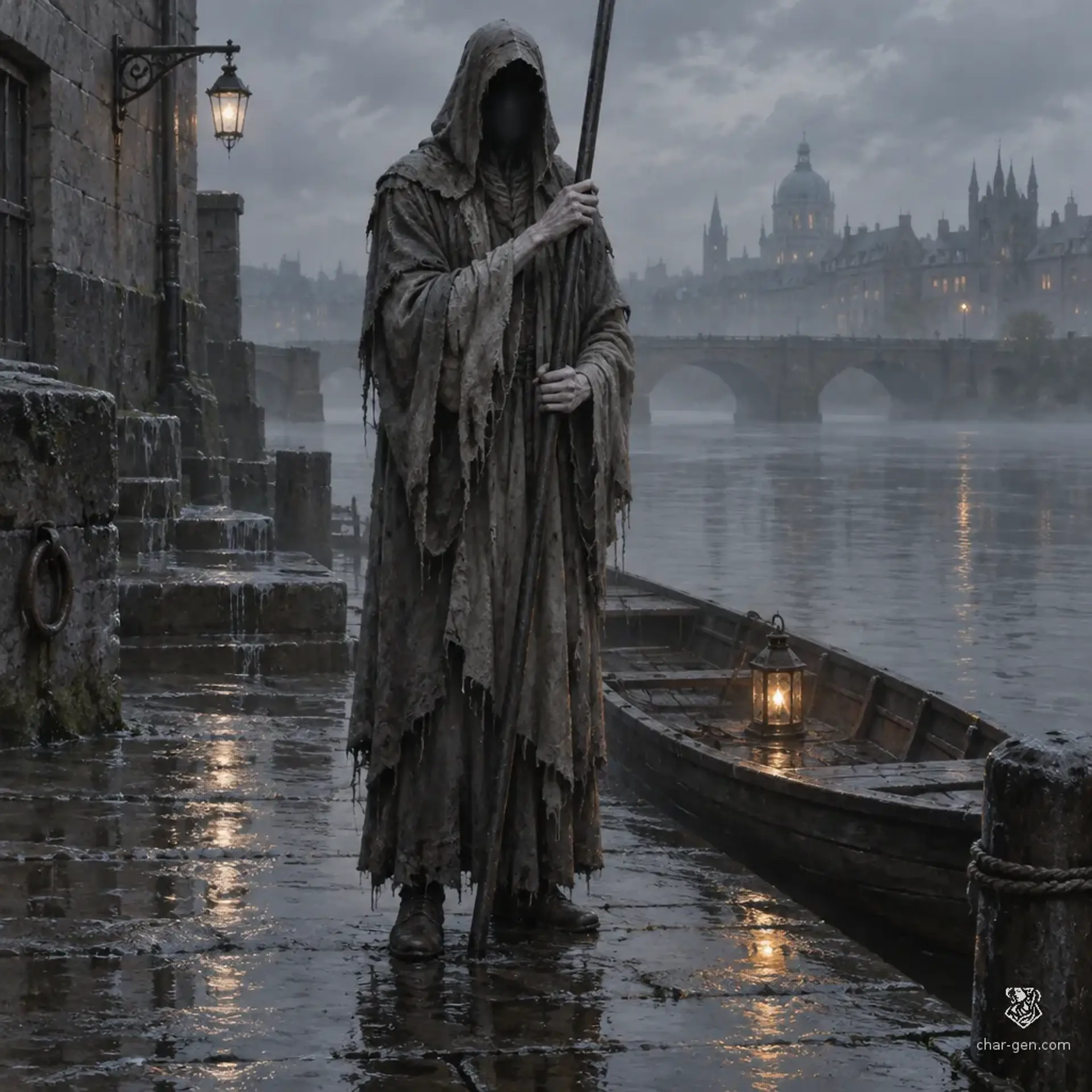
In the rain-dark streets beside the river, a narrow boat glides without a sound.
At a glance
Darkvision 60 ft.
Languages Common, Two other languages of your choice
Height 6 ft. 4 in.
Weight 150 lb., though the rags and shadow conceal any reliable measure
Lifespan The bearer does not age normally
At the table
Your walking speed is 30 feet. You have a swimming speed of 30 feet, and nonmagical difficult terrain caused by shallow water does not cost you extra movement.
You can see in dim light within 60 feet of yourself as if it were bright light, and in darkness as if it were dim light. In darkness, you perceive colors only as shades of gray.
You can communicate simple ideas to a corpse you touch, even if it cannot speak. The corpse cannot provide information it did not know in life, and its answers may be confused or incomplete. Once you use this trait, you cannot use it again until you finish a Long Rest.
As a Magic action, you conjure a narrow spectral skiff in an unoccupied space on a body of water within 10 feet of you. It can carry you and up to five willing creatures of your choice, moves across the water at 30 feet, and lasts for 1 hour, until you dismiss it as a Bonus Action, or until you conjure another skiff. It cannot travel across land or carry unwilling creatures. Once you use this trait, you cannot use it again until you finish a Long Rest.
You do not need to eat or drink, and you have Advantage on saving throws you make to avoid or end the Frightened condition. You still need to breathe and sleep, though meditation can replace sleep for you.
The Boatman tends toward Constitution and Wisdom, though players assign any ability score increases as they wish, such as +2 to one ability and +1 to another, or +1 to three different abilities.
In the rain-dark streets beside the river, a narrow boat glides without a sound. At its stern stands a tall figure in grey rags, face hidden beneath a hood, long pale hands resting on a pole. A single lantern burns low at the bow. The Boatman is the sole bearer of an old curse, bound to guide the dead across a river no living map records. Now, for reasons even it cannot explain, it has stepped ashore and joined the living.
The Boatman is a tall, narrow figure wrapped in grey rags that hang wet even in dry weather.
Its hood contains no visible face, only a depth of shadow in which a faint ripple may sometimes be seen. Long, pale hands rest upon a black pole, and the figure's weight makes no sound on stone. It travels in a slim wooden boat bearing one dim lantern. The flame never gutters, yet it casts little light beyond the boat's rim. The figure's form is tangible enough to touch, but its shadow often points toward the nearest river regardless of the light.
Urban
The curse first settles upon its bearer. Memories of an earlier life may remain, but they feel as distant as recollections of a stranger.
The bearer has learned the river's habits and the small courtesies that make a crossing possible. Their own identity grows harder to distinguish from the office they serve.
The bearer has guided countless dead beyond the mortal shore. Their movements are slow and deliberate, and even the river seems to pause when they speak.
There is no Boatman society.
The figure is one of a kind, bound to an office rather than born into a people. It has accumulated customs from the cities and river communities it has visited: a coin placed beneath the tongue, a name whispered to the current, a final cup left on the bank. It respects these practices but insists that no single custom is required for a crossing. The curse demands service, not worship. Some believe the Boatman is a person trapped in an endless duty; others suspect the person vanished long ago, leaving only the task behind.
The Boatman serves no known deity and does not claim to decide who deserves death.
It observes rites from many traditions, provided they help the dead depart in peace. Its outlook is usually lawful, shaped by an ancient duty, but its sense of justice is patient rather than punitive. It may be good, neutral, or evil according to how it interprets the curse and treats those in its care.
The Boatman is known to mourners, undertakers, river workers, and those who have returned from the edge of death.
Most people never see it directly, but its appearance is treated as a solemn sign. It does not claim authority over the dead and dislikes being mistaken for a judge or executioner. The living often approach it with bargains, prayers, or accusations. It receives all three with the same grave attention, though it cannot promise that any plea will change a passenger's destination.
The Boatman has no homeland in the ordinary sense.
It appears wherever a city is built beside a river that receives the dead, from crowded wharves to sealed underground channels. Its boat is narrow and unadorned, with no cabin or visible markings. In the rare places where it rests, the architecture is practical and temporary: a stone landing, a low mooring post, and a covered niche for the lantern.
No images yet.
A high-res, share-ready sheet you can post or print.
