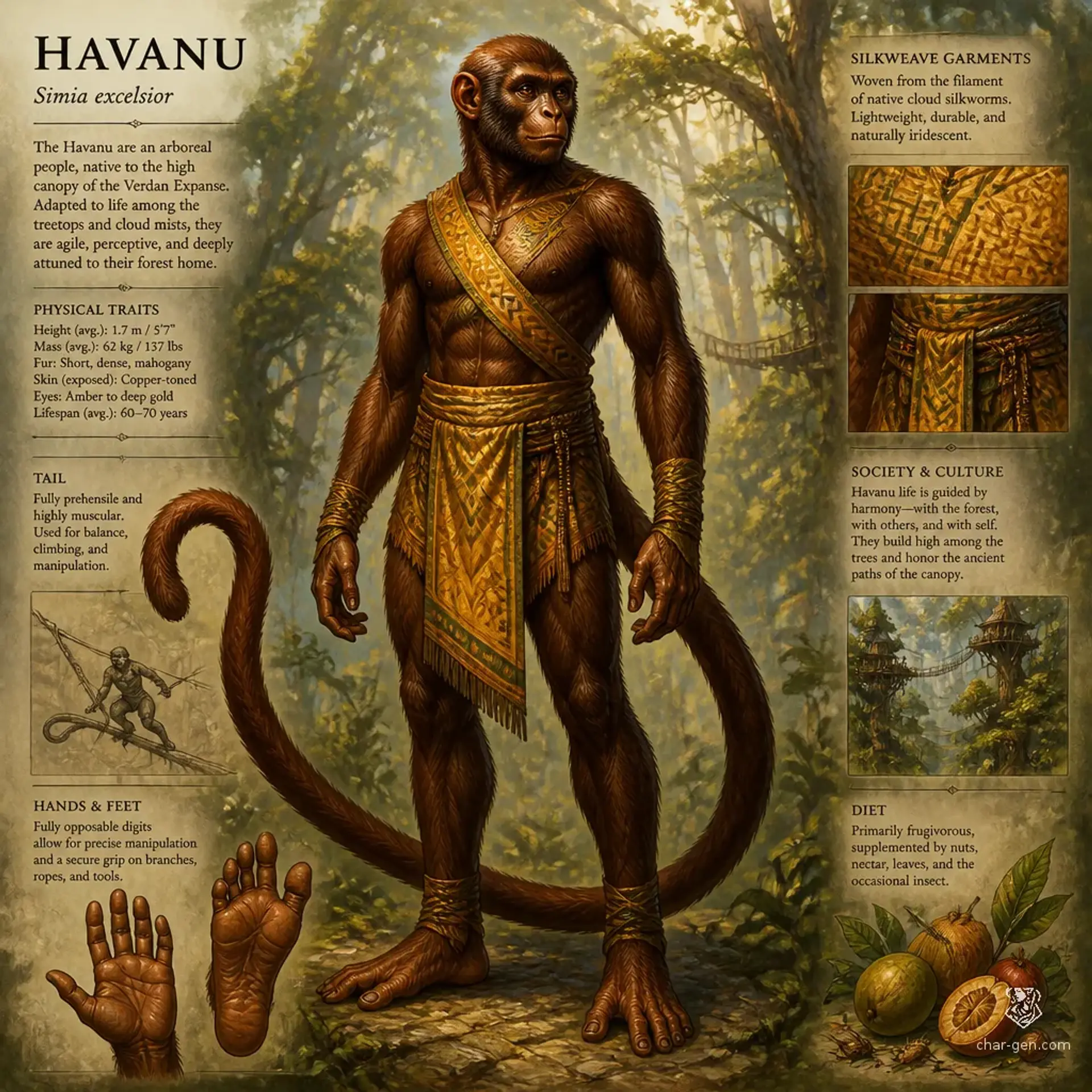
Simiiform sapientis
Masters of the canopy and clever tricksters of the wood, the Havanu are a simian-like people who view the world from a higher perspective.
Height 5'0" to 5'10"
At a glance
Darkvision 60 ft.
Languages Common, Havanu (a complex tongue of whistles and hand signals)
Resistances Poison
Height 5'0" to 5'10"
Weight 110 to 160 lbs.
Lifespan 150 to 180 years
At the table
You can use your tail to manipulate an object, open or close a door or container, pick up or set down a Tiny object, or retrieve an item. This tail cannot be used to wield weapons, shields, or perform the somatic components of spells.
You have a climbing speed equal to your walking speed. Additionally, you have advantage on any saving throw made to avoid falling from a height or to maintain your balance on narrow surfaces.
When you use the Disengage action, your jump distance is doubled until the end of the current turn, allowing you to leap away from danger with simian grace.
Acrobatics, Medicine, Weaver's Tools
Poison
Havanu are naturally nimble and possess a sharp, intuitive wit; players typically assign a plus two to Dexterity and a plus one to Wisdom, or any two scores of their choice as per modern character creation.
Master Weaver: You gain proficiency in Stealth and can use your Weaver's Tools to create a 50-foot silken rope over a long rest.
Dwellers of the high canopy who specialize in the harvest of exotic resins and silks.
Masters of the canopy and clever tricksters of the wood, the Havanu are a simian-like people who view the world from a higher perspective. With prehensile tails and a natural gift for navigation, they navigate the dizzying heights of forest cities with a grace that leaves ground-dwelling folk in awe. They are a culture of storytellers, silk-weavers, and philosophers who believe that every problem can be solved with a clever mind and a nimble grip.
Havanu possess lean, athletic frames covered in short, dense fur that varies in hue from deep mahogany and golden ginger to slate grey.
Their faces, palms, and the soles of their feet are bare, revealing skin that ranges from charcoal to warm copper. Most distinctive is their long, muscular tail, which is fully prehensile and capable of supporting their entire body weight during a climb. Their hands and feet both feature opposable digits, allowing them to grip branches or tools with equal facility, though they walk upright with a rolling, graceful gait.
Tropical jungles and high-altitude cloud forests
Infancy; young Havanu cling to their parents' fur for the first three years of life.
Adolescence; a decade of intensive training in acrobatics and history before being considered an adult at age 20.
Elder; once their fur turns silver, Havanu retire from physical labor to focus on governing the Knot.
Havanu society is built upon the concept of 'The Weave,' a philosophy stating that all individuals are strands in a greater tapestry.
They live in matrilineal clans known as Knots, where leadership is earned through wisdom and the ability to maintain harmony. They are famous for their arboriculture, growing giant trees into living homes, and their weaving, which produces silks as strong as iron. Competitive storytelling and acrobatic games are the primary ways they resolve disputes without resorting to violence.
Most Havanu follow the Way of the Empty Palm, a belief system focused on non-attachment and the preservation of natural balance.
They rarely build massive temples, preferring to sanctify high peaks or ancient trees. They tend toward Neutral Good or Chaotic Good, valuing individual freedom and communal welfare over rigid hierarchies or legalistic dogmas.
Havanu are generally welcoming but mischievous hosts.
They find the stubbornness of dwarf-like mountain folk amusing and the longevity of elf-like foresters relatable. They often act as intermediaries between terrestrial kingdoms and the secluded powers of the deep woods, though their tendency to answer questions with riddles can frustrate more literal-minded species.
The Havanu reside in the Cloud-Cradles, sprawling cities suspended hundreds of feet above the jungle floor.
Their architecture uses bioluminescent fungi for light and bridge-networks made of spider-silk and living vine. These 'Web-Halls' are designed to be inaccessible to those without the ability to climb or swing, protecting the Havanu from terrestrial predators.
No images yet.
A high-res, share-ready sheet you can post or print.
