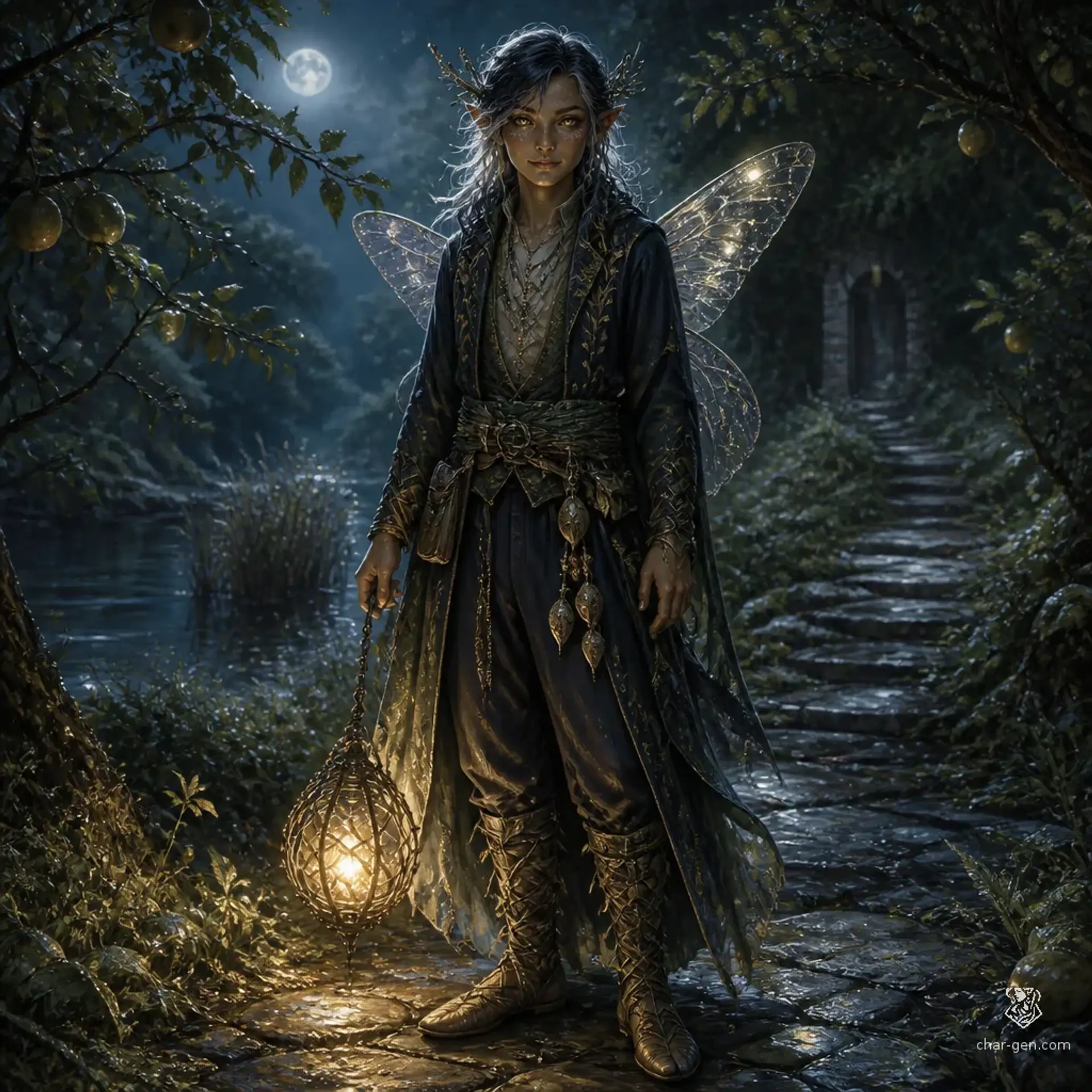
Lumenfae mireluna
Mirelune are the storybook-born cousins of moonlit groves and hidden bargains, a people who move between wonder and warning with equal ease.
At a glance
Darkvision 60 ft.
Languages Common, Sylvan
Resistances None inherent; some Mirelune traditions teach rites that ward the first sting of cold iron, but these are cultural rather than species-wide protections.
Height 3 to 4 feet tall
Weight 35 to 55 pounds
Lifespan 180 to 220 years
At the table
Your mind and body are tuned for stealthy grace, quick reactions, and social finesse. Mirelune typically feel most at home when they can move lightly, think quickly, and speak beautifully, though individual bloodlines vary widely.
You can see in dim light and darkness as if it were bright light out to 60 feet, though you cannot discern color in darkness.
You know one additional language of your choice, often learned from travelers, neighbors, or a bargain sealed in youth.
You are naturally at ease in places of beauty, secrecy, or emotional intensity. You may have innate talent for dance, persuasion, stealth, illusion, or simple uncanny luck, depending on your character concept and the story your table wants to tell.
Many Mirelune lineages manifest one small supernatural knack, such as sensing nearby emotions, leaving faint silver footprints on moonlit ground, or causing flowers to open when they pass. These are flavor-forward expressions of ancestry and can be handled narratively or by table agreement as minor magical flair.
Common, Sylvan
Mirelune folk are lithe, quick-minded, and keenly observant. Their bodies tend toward Dexterity and Charisma, though some lineages are remembered for steadier Constitution or sharper Wisdom. In play, a Mirelune character can place their +2 and +1 wherever they best suit the concept.
These Mirelune are most closely tied to wild orchards, riverbanks, and summer solstice rites. Their presence is often accompanied by the scent of blossoms and warm rain.
Bloomglade Mirelune are the most outwardly social of their people, often serving as emissaries, innkeepers, and celebrants. They tend to be generous, luminous, and dangerously persuasive.
Mirelune are the storybook-born cousins of moonlit groves and hidden bargains, a people who move between wonder and warning with equal ease. They are graceful, secretive, and profoundly alive to the moods of the world, whether that means soothing a wounded field, outwitting a cruel noble, or following a whisper through the dark until it becomes a road home. A Mirelune character like Mirelune feels made for play that mixes charm, mischief, and ancient fey mystery.
Mirelune are small fey folk with expressive faces, luminous eyes, and a body plan that seems designed for darting through flowers, rafters, and thorn gaps.
Their hair often carries impossible colors or silvered tips, and their skin may bear faint freckling like starlight, leaf-veins, or dew marks. Some have delicate wings that shimmer like gauze or insect glass, though these are more adornment of lineage than reliable flight. Their voices often ring with a musical clarity that can sound gentle one moment and commanding the next.
Woodland edges, lantern-lit villages, river marshes, abandoned orchards, old roads, and secret courts hidden between places people forget to watch.
Newborn Mirelune are tiny, bright-eyed, and treated as guests of the household rather than possessions. They learn voices, weather, and story before they learn tools.
Youngsters become unmistakably restless, often testing the edge of every boundary with harmless mischief and daring night walks.
By their teens they are considered capable of choosing a path, though they may still return to kin-circles for guidance during turning seasons.
Adults are fully responsible members of their people, trusted to negotiate with outsiders, tend old roads, and keep the bargains of the wild courts.
Elders often remain vivid and active for decades, but many take on a contemplative stillness, becoming keepers of names, rites, and ancestral memory.
Mirelune society is built around circles of reciprocity.
A child may belong to three households, a harvest rite may settle a border dispute, and a single favor can echo across generations. They keep careful track of who fed whom, who danced with whom, and which names were spoken under which moon. Their culture prizes wit, memory, craftsmanship, and the ability to make a place feel briefly enchanted. Public shaming is rare; public teasing is not. Storytelling is a civic duty, and forgetting an old debt is considered far worse than speaking a sharp truth.
Mirelune faith is rarely rigid.
They honor moon gods, hearth spirits, river patrons, season keepers, and local genius loci with equal sincerity, often treating worship as a series of relationships rather than doctrines. Their moral outlook tends to prize freedom, reciprocity, and the preservation of living beauty, which can lead them toward good or toward dangerous forms of self-justified whimsy. A Mirelune who falls cruelly astray is usually not heartless, but convinced their private code outranks all others.
Mirelune are often charming company, but never simple company.
They value hospitality, clever speech, and emotional honesty, yet their sense of time and obligation can seem maddeningly circular to outsiders. They usually get along well with other woodland peoples, traveling artists, druidic circles, and anyone who respects guest-right. They may mistrust industrial settlements, oathbreakers, and those who flatten the world into ownership lines and ledgers. When they love someone, they tend to love them in full, protective, and sometimes intrusive ways.
Mirelune homelands are rarely continuous territory.
They prefer braided settlements of glades, rooftop gardens, canal islands, and hollow hills connected by hidden paths and remembered landmarks. Their architecture favors curved beams, living vines, stained glass, hanging bridges, and bright thresholds marked with bells or woven ribbons so guests never cross unnoticed.
No images yet.
A high-res, share-ready sheet you can post or print.
