Floriscutum loredanae
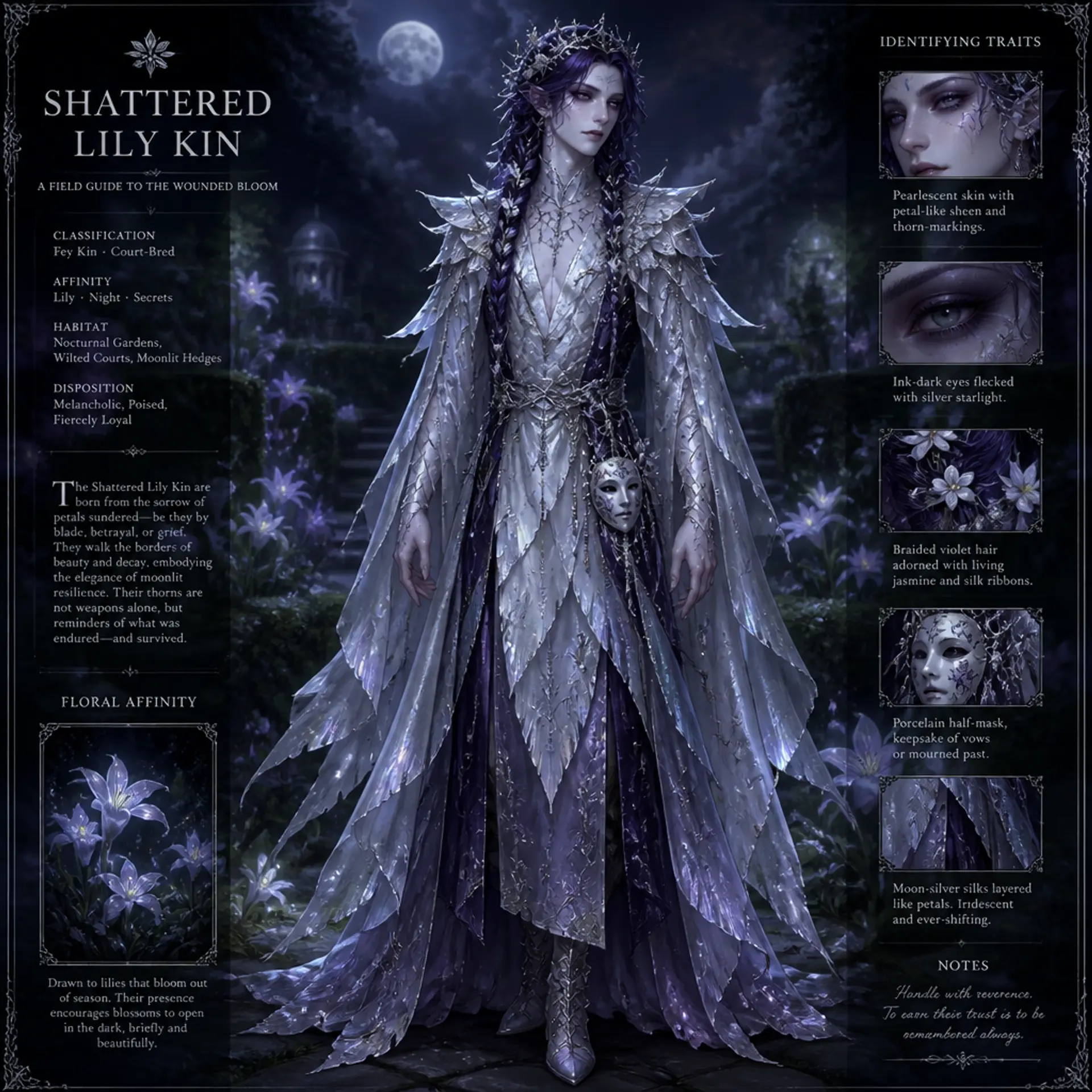
The Shattered Lily kin are fey-blooded courtiers, scouts, and oathkeepers whose beauty is never merely decorative.
At a glance
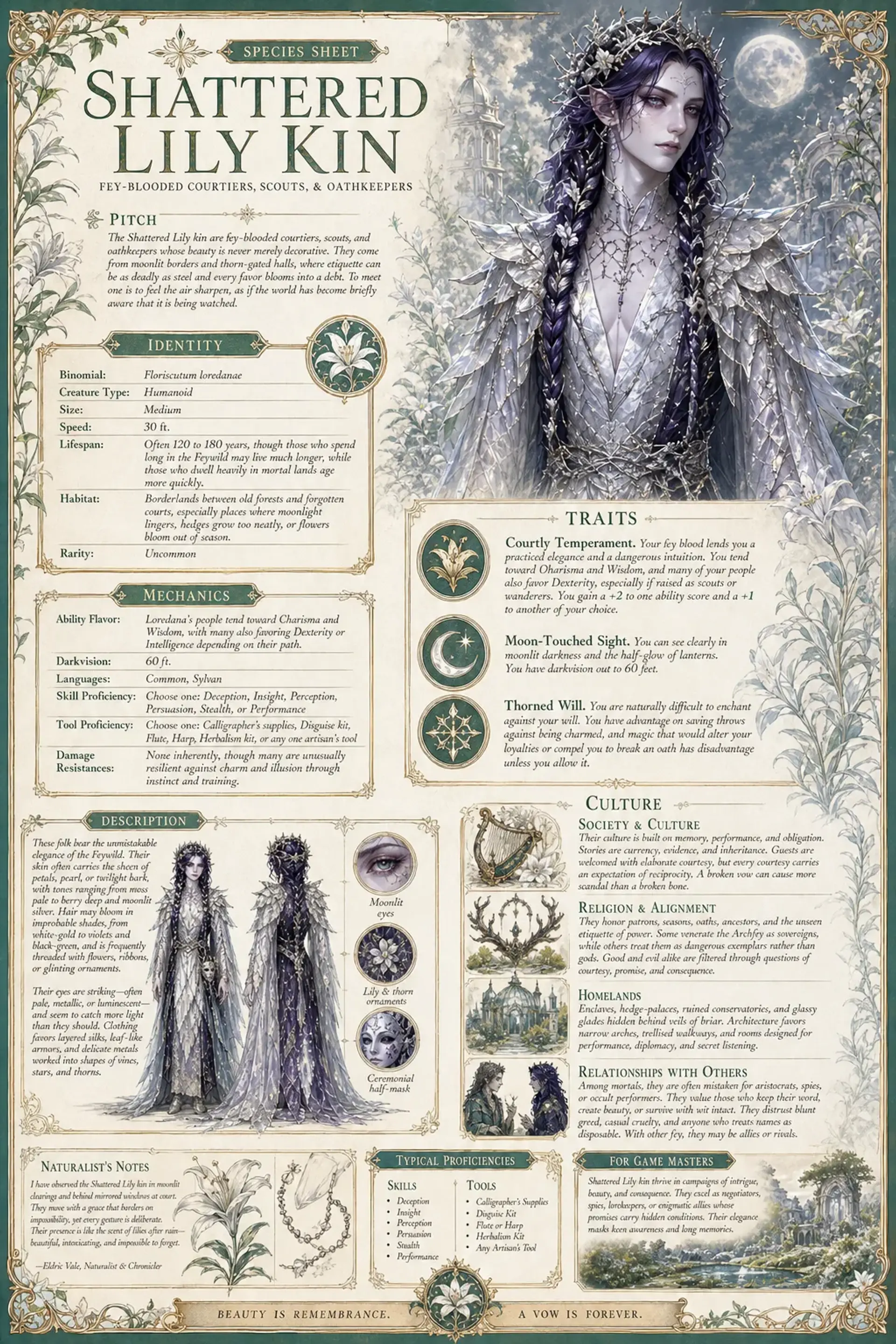
Darkvision 60 ft.
Languages Common, Sylvan
Resistances None inherently, though many are unusually resilient against charm and illusion through instinct and training.
Height 5 to 6 feet tall
Weight 110 to 180 pounds
Lifespan 120 to 180 years
At the table
Your fey blood lends you a practiced elegance and a dangerous intuition. You tend toward Charisma and Wisdom, and many of your people also favor Dexterity, especially if they were raised among hedges, rooftops, or the quieter edges of court life. In D&D 5E terms, players assign +2 and +1 as they wish.
You can see clearly in moonlit darkness and the half-glow of lanterns. You have darkvision out to 60 feet.
You are naturally difficult to enchant against your will. You have advantage on saving throws against being charmed, and magic that would alter your loyalties often finds your mind strangely well defended.
You can step through a brief fold in space when sunlight is dim and shadows are deep. As a magical flourish, you can slip from one concealed place to another within sight, provided the move feels like a stride through a veil rather than open travel. Exact mechanics are best handled by the table, but the talent is part of your folk’s innate folklore.
You know at least one extra way to communicate through the hidden courts of the world, such as whispered Sylvan phrases, coded floral signs, or a family cant understood by servants and spies.
Common, Sylvan
Loredana’s people tend toward Charisma and Wisdom, with many also favoring Dexterity or Intelligence depending on whether they are courtiers, wanderers, or keepers of old bargains. In 5E terms, players assign +2 and +1 as they wish, reflecting a lineage shaped by wit, presence, and a talent for reading the hidden grain of a room.
Their hair, skin markings, or eyes are tinged with dawn colors, and their magic often appears as petals, sunlight, or warm perfume. They are more likely to become emissaries, healers, or celebrants.
A brighter branch said to have been touched by spring courts and the memory of first blossoms.
The Shattered Lily kin are fey-blooded courtiers, scouts, and oathkeepers whose beauty is never merely decorative. They come from moonlit borders and thorn-gated halls, where etiquette can be as deadly as steel and every favor blooms into a debt. To meet one is to feel the air sharpen, as if the world has become briefly aware of being watched by something ancient and amused.
These folk bear the unmistakable elegance of the Feywild.
Their skin often carries the sheen of petals, pearl, or twilight bark, with tones ranging from moss pale to berry deep and moonlit silver. Hair may bloom in improbable shades, from white-gold to violets and black-green, and is frequently threaded with leaves, ribbons, or living blossoms. Their eyes can seem glassy, star-flecked, or ink-dark, and their expressions shift with theatrical precision. Many have subtle floral or thornlike markings along the temples, collarbones, or wrists. When emotional, their scent may change, carrying hints of rain, crushed herbs, cut roses, or winter soil.
Borderlands between old forests and forgotten courts, especially places where moonlight lingers, hedges grow too neatly, or flowers bloom out of season.
Children are unmistakably fey-touched, but their features are soft and changeable, as if they have not yet decided what shape the world will allow them to keep.
By this stage they are socially adult, and many begin taking on a chosen name, vow, or courtly title.
Their features settle into a distinctive grace, though their humor, accent, and mannerisms may still shift with strong emotion or moon phase.
Elders become more deliberate and strange, with voices like dry leaves or ringing glass, often serving as living repositories of memory and etiquette.
Their culture is built on memory, performance, and obligation.
Stories are not entertainment alone but currency, evidence, and inheritance. Children learn the shape of respect before they learn to braid flowers. Guests are welcomed with elaborate courtesy, but every courtesy carries an expectation of reciprocity. Public emotion is often stylized, as though life itself were a dance that must be perfected before it may be sincerely felt. They cherish masks, mirrored surfaces, living gardens, and archives of song. A broken vow can cause more scandal than a broken bone.
They rarely speak of religion in mortal terms.
Instead, they honor patrons, seasons, oaths, ancestors, and the unseen etiquette of power. Some venerate the Archfey as sovereigns, while others treat them as dangerous exemplars rather than gods. Their moral outlook is varied, but many are inclined toward personal codes, layered loyalties, and a taste for dramatic acts of mercy or revenge. Good and evil alike are often filtered through questions of courtesy, promise, and consequence rather than simple doctrine.
Among mortals, they are often mistaken for aristocrats, spies, or occult performers, and they frequently allow the misunderstanding to continue if it provides leverage.
They tend to value people who keep their word, create beautiful things, or survive with wit intact. They distrust blunt greed, casual cruelty, and anyone who treats names as disposable. With other fey, they may be either graceful allies or relentless rivals, depending on courtly history and the flavor of old slights.
Their homeland is often less a nation than a network of enclaves, hedge-palaces, ruined conservatories, and glassy glades hidden behind veils of briar.
Architecture favors narrow arches, trellised walkways, colored lanterns, and rooms designed for performance, diplomacy, and secret listening. Even humble homes tend to have one impractical beauty, such as a ceiling of painted constellations or a window that only opens toward the Feywild.
No images yet.
A high-res, share-ready sheet you can post or print.
