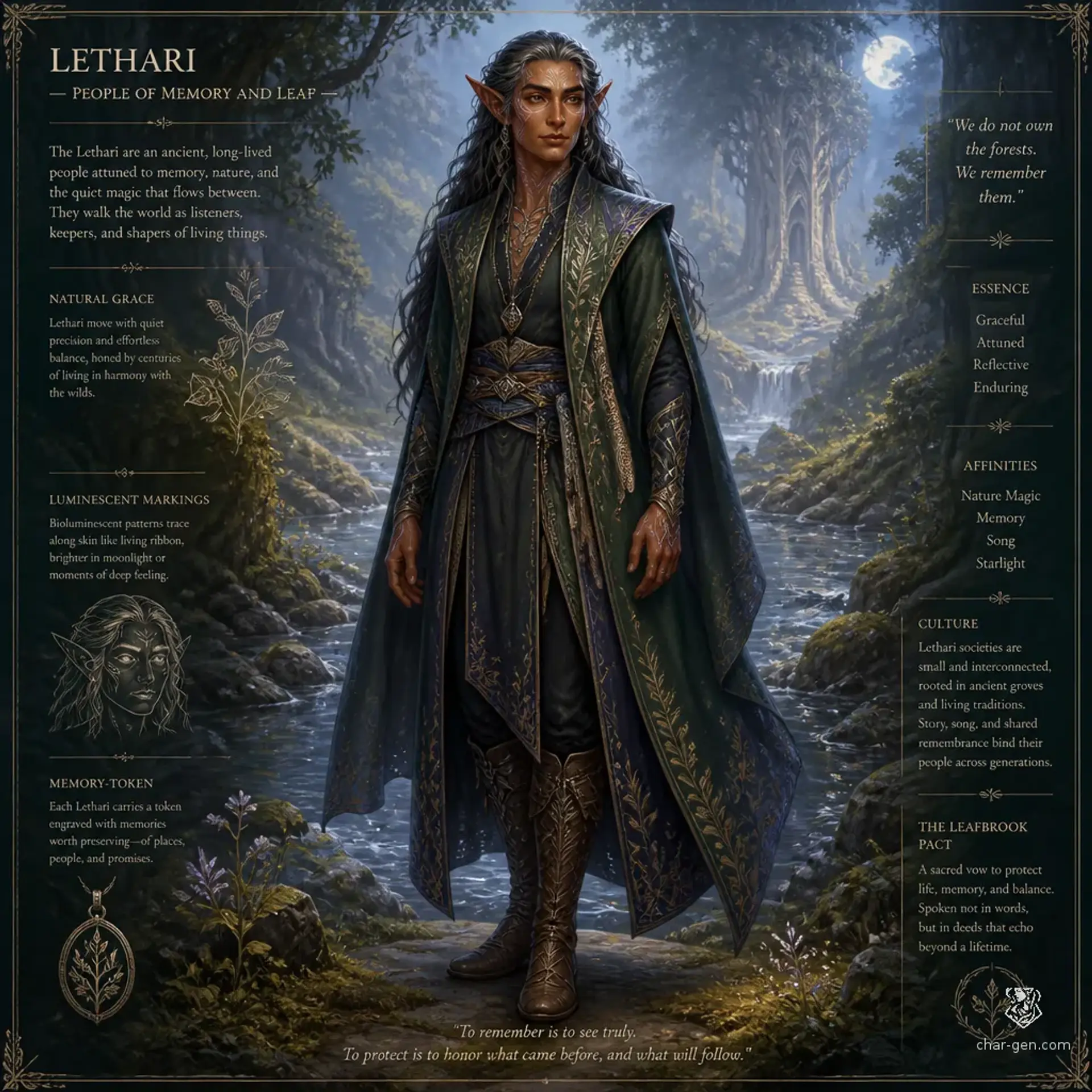
Aelthera memoria
The Lethari are long-lived wanderers and memory-keepers whose grace conceals an exacting will.
At a glance
Darkvision 60 ft.
Languages Common, Lethari, One additional language chosen from languages known in the campaign
Height 5 feet 6 inches to 6 feet 4 inches
Weight 110 to 190 pounds
Lifespan 300 to 500 years, adult at 25
At the table
You have proficiency in the Perception skill. Your keen senses are trained through generations of listening to distant movement, subtle changes in weather, and the voices of living things.
You have Advantage on saving throws you make to avoid or end the Charmed condition, and magic cannot put you to sleep. Lethari traditions teach the mind to recognize false harmony and resist enchantment.
When you finish a Long Rest, you can choose one skill or tool proficiency you lack. You retain that proficiency until you finish your next Long Rest, reflecting the Lethari gift for absorbing techniques through observation and practice.
You know one cantrip of your choice from the Druid or Wizard spell list. Wisdom or Intelligence is your spellcasting ability for it, chosen when you select this species.
You can meditate for 4 hours instead of sleeping during a Long Rest. While meditating, you remain semiconscious and experience vivid recollections called the inner road. Completing this meditation provides the same benefits as sleeping for the purpose of finishing the rest.
The Lethari tend toward Dexterity and Wisdom, reflecting their grace, perception, and disciplined movement. Players assign a +2 and a +1 to any ability scores as they wish, or assign a +1 to three different ability scores.
Their skin often bears faint green, gold, or amber undertones, and their hair tends toward leaf-black, copper, or mossy brown.
Greenward Lethari dwell in deep forests and consider themselves stewards of old growth, animal paths, and hidden springs. They are patient trackers, gifted herbalists, and cautious allies who prefer a quiet warning to an open feud.
The Lethari are long-lived wanderers and memory-keepers whose grace conceals an exacting will. They remember vanished kingdoms, mourn forests that became roads, and carry old promises into new ages. A Lethari adventurer may be a diplomat seeking peace, a scholar hunting the truth behind a half-remembered legend, a guardian of living wilderness, or simply someone determined to experience enough of the world to leave behind a memory worth keeping.
Lethari are tall, fine-boned humanoids with tapered ears, expressive brows, and eyes that often show unusual rings of color around the pupil.
Their complexions range from warm umber and copper to olive, rose-brown, ivory, and cool gray. Hair may be black, silver, chestnut, deep green, or pale gold, and it commonly grows in thick waves. A Lethari’s voice carries clearly even at a whisper, a trait once selected for communicating across forests and mountain halls. Their movements are economical and balanced, giving them a poised appearance even when exhausted or injured. Subtle luminous markings may appear along the hands, throat, or face during strong emotion, moonlight, or contact with ancient magic.
Ancient forests, misty river valleys, high mountain terraces, coastal groves, and secluded cities built around springs, living trees, or places of unusual magical resonance.
Lethari children are curious, quick to imitate, and taught through stories, music, and attentive observation. They are considered dependent but fully capable of forming lasting memories and loyalties.
Young Lethari are encouraged to travel, study a craft, and spend at least one season away from their birth-community. This period is marked by a personal vow known as a first telling.
Most Lethari enter recognized adulthood after completing their first telling, though many continue to regard themselves as inexperienced for decades afterward.
Elders become living archives of family memory, law, and song. Their advice carries great weight, but an elder who refuses to adapt may be gently excluded from public decisions.
The oldest Lethari are called Starwardens. They often serve as judges, keepers of dangerous lore, or guardians of places where the boundaries between worlds are thin.
Lethari who reach the end of their natural lives are traditionally buried beneath flowering trees. Their names are sung during the spring remembrance, when communities ask the dead to guide the living without ruling them.
Lethari culture prizes mastery, remembrance, and the deliberate cultivation of beauty.
A person’s reputation is measured less by wealth than by the quality of their attention: how well they listen, teach, repair, host, and remember. Most communities maintain circles of historians, gardeners, musicians, judges, and pathfinders, but these roles are open to anyone who demonstrates aptitude. Lethari debate can last for days, yet once a decision is reached, the community expects decisive action. Their festivals combine solemn recitation with exuberant dancing, because the Lethari believe grief and joy are not opposites but neighboring rooms in the same house.
Lethari religion is less concerned with obedience to individual gods than with maintaining a living conversation among ancestors, natural forces, and the stars.
Many honor a circle of spirits known as the Remembering Court, each associated with a virtue, season, or element of the natural world. Others follow mortal teachers, household ancestors, or philosophical traditions that reject divine authority entirely. Lethari communities tend toward good or neutral alignments, valuing balance and the protection of life, but individuals may become fiercely lawful, radically free-spirited, or dangerously nostalgic.
Lethari often serve as mediators because their long lives let them understand how quickly mortal politics can become ancestral hatred.
Their patience is respected by many human communities, though it can also be mistaken for condescension. Dwarf-like peoples frequently admire Lethari stonework while criticizing their reluctance to finish a project within a single generation. Goblin-kin cultures may find Lethari ceremonial manners amusing but often value their ability to remember agreements precisely. Relations with other elf-like peoples vary from close kinship to bitter disagreement over whether ancient customs should guide the future.
Lethari settlements are planned around continuity rather than conquest.
Homes are grown into trees, shaped from pale stone, or suspended between cliffs with bridges of wood and woven metal. Public buildings preserve open courtyards, reflecting pools, and galleries where history is recorded through murals, recited genealogies, and responsive chimes. Even a remote village may maintain a Hall of Returning, a place where travelers can hear the names of those who once passed through.
No images yet.
A high-res, share-ready sheet you can post or print.
