
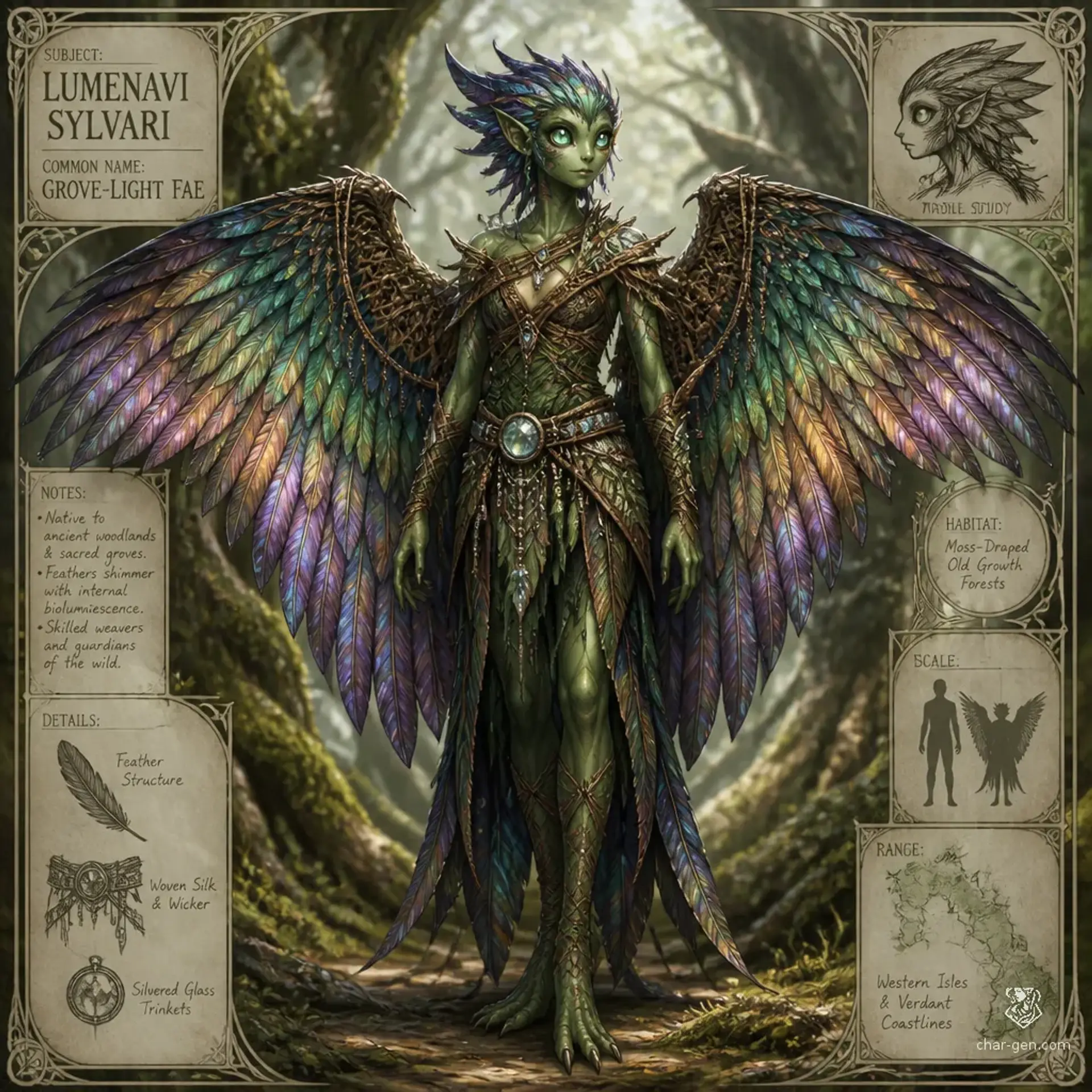
Volucris feyus sylvestris
At a glance
Darkvision 60 ft.
Languages Common, Sylvan
Resistances None
Height 5 ft. 2 in. to 6 ft. 0 in.
Weight 80 lbs. to 110 lbs.
Lifespan Sylvafowl mature at the same rate as humans but can live up to 250 years, their plumage becoming increasingly iridescent with age
At the table
You have Advantage on saving throws you make to avoid or end the Charmed condition.
You can use a Bonus Action to give yourself a flying speed of 30 feet until the end of your current turn. You can use this trait a number of times equal to your Proficiency Bonus, and you regain all expended uses when you finish a Long Rest.
You know the Druidcraft cantrip. Starting at 3rd level, you can cast the Feather Fall spell. Starting at 5th level, you can cast the Gust of Wind spell. Once you cast Feather Fall or Gust of Wind with this trait, you can't cast that spell with it again until you finish a Long Rest. You can also cast these spells using any spell slots you have of the appropriate level.
Your weight is halved, and you have Advantage on checks made to escape a grapple or navigate narrow spaces.
Common, Sylvan
Acrobatics, Nature
None
Due to their hollow bones and sharp fey senses, Sylvafowl tend toward high Dexterity and Wisdom. Players should assign a plus two and a plus one to any two attributes of their choice.
You gain proficiency in the Performance skill, and you know the Vicious Mockery cantrip, using Wisdom as your spellcasting ability.
Brightly colored and social, these Sylvafowl are masters of the daylight hours and melodic magic.
A graceful merger of avian elegance and fey whimsy, the Sylvafowl are guardians of the high canopy who bridge the gap between the material world and the chaotic beauty of the Feywild. They are often seen as omens of seasonal change, descending from their hidden tree-cities to trade songs, secrets, and silvered glass with those who respect the forest.
Sylvafowl possess light, slender frames supported by hollow bones.
Their most striking feature is a pair of powerful wings sprouting from their shoulder blades, which may appear as soft feathers or gossamer membranes depending on their lineage. Their skin often takes on the hues of the forest floor, such as mossy green or bark-brown, while their hair is a thick crest of feathers that sweeps back from their brows. Their eyes are oversized and reflective, capturing the dimmest light of the forest understory. They move with a bird-like twitchiness, constantly observant and ready to take flight at a moment's notice.
Ancient woodlands and fey-touched groves.
Birth to 15 years. Covered in soft down, they cannot fly and are guarded fiercely by the community.
15 to 25 years. This is the period of learning flight and finding their unique voice in the Great Harmony.
25 to 180 years. The prime of life, where Sylvafowl hunt, explore, and defend their groves.
180 to 250 years. Their feathers turn silver or translucent, and they serve as the spiritual memory of the tribe.
Sylvafowl culture is built around the concept of the 'Great Harmony,' a musical philosophy where every member of the community contributes a unique 'note' to the tribe's survival.
They are deeply communal, living in woven platform cities suspended in the highest branches of sentient trees. Their social hierarchy is often determined by the complexity of one's song or the beauty of their aerial acrobatics. While they enjoy celebrations, they are inherently private about their nesting habits, viewing the home as a sacred space away from the prying eyes of the 'ground-bound' races.
Most Sylvafowl lean toward Neutral Good or Chaotic Good.
They worship deities of nature, wind, and the moon, often performing intricate dance rituals during the equinox. They believe that their souls are fragments of the wind and that they must return to the sky upon death. They generally value personal freedom and the protection of natural beauty over rigid laws.
Sylvafowl are wary of dwarves and humans who practice heavy industry, fearing the smoke and the axe.
They find elf-kin to be kindred spirits but often tease them for being too 'rooted' to the earth. They maintain a respectful distance from most goblin-kin, though they have been known to trade enchanted feathers for rare metals or spices.
Known as 'Eyries,' Sylvafowl settlements are masterpieces of living architecture.
They use fey magic to encourage trees to grow into interconnected platforms and hollowed chambers. These cities are often invisible from the ground, hidden by illusions and thick foliage. They favor light, organic materials like silk, wicker, and reinforced leaves for their belongings.
No images yet.
A high-res, share-ready sheet you can post or print.