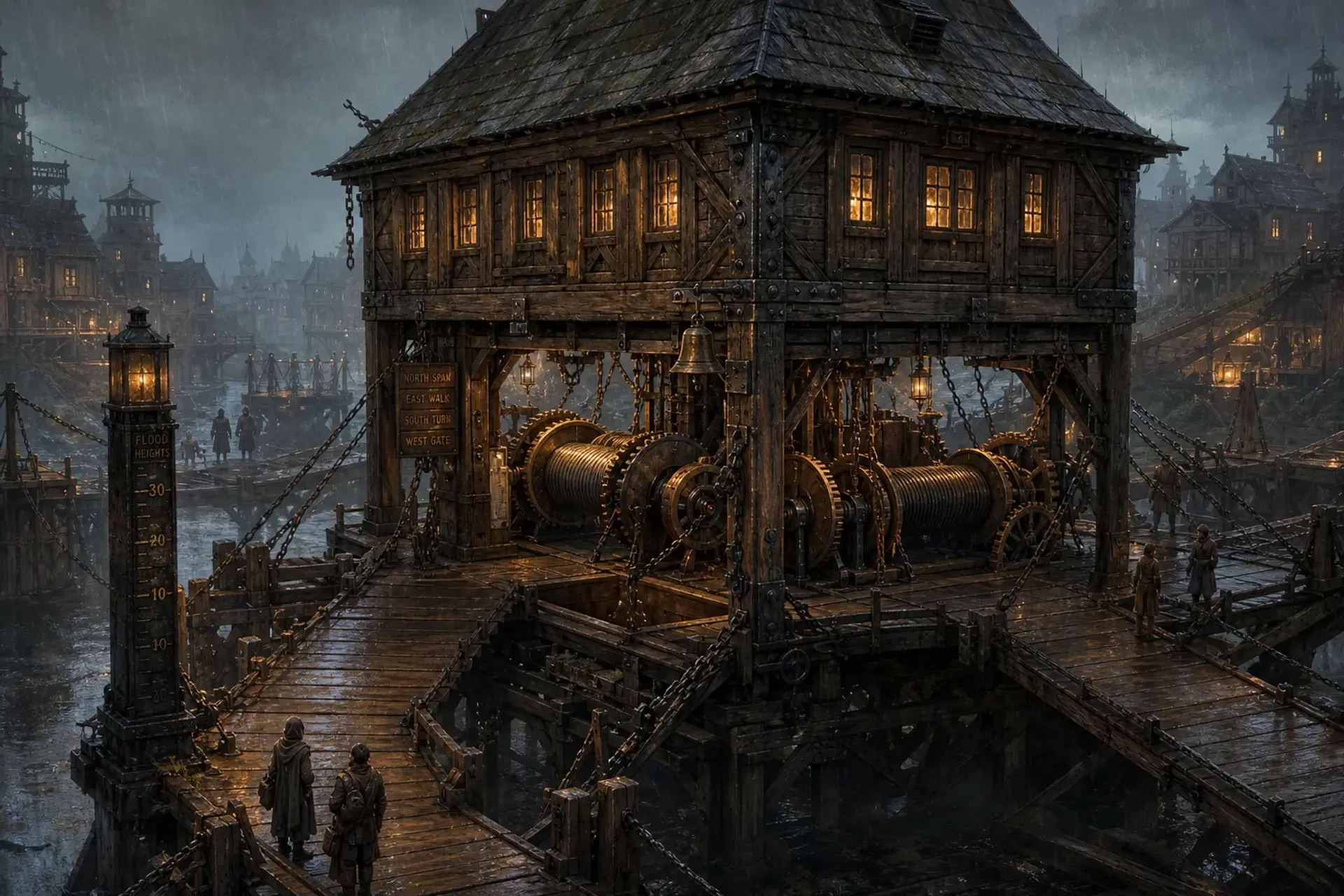
The Winch House
The Winch House stands beside the central junction of Silt's Warning, its square timber frame packed with geared winches that raise and swing sections of walkway. Narrow windows face the junction, giving the operators a clear view of nearly every route. The machinery is exposed enough to be understood by a practiced hand, but its crowded layout makes the building hazardous to anyone unfamiliar with the moving chains and counterweights.
The Winch House
- Type
- Industrial structure
- Condition
- Serviceable but heavily worn
- Size
- Medium
- Run by
- Tack
Overview
The Winch House stands beside the central junction of Silt's Warning, its square timber frame packed with geared winches that raise and swing sections of walkway. Narrow windows face the junction, giving the operators a clear view of nearly every route. The machinery is exposed enough to be understood by a practiced hand, but its crowded layout makes the building hazardous to anyone unfamiliar with the moving chains and counterweights.
Atmosphere
The Winch House never seems still. Chains rattle, gears clack, and the floor shivers whenever a span moves. Operators speak in short calls over the noise, while travelers below pause to watch the great wooden walkways shift into place.
Style
A practical square timber frame, reinforced at the corners with iron straps. The upper floor projects slightly over the junction, where narrow windows give the operators a broad view. A steep roof sheds rain, while the lower level is open around the machinery and crowded with gears, chains, and counterweights.
What stands out
History
The Winch House was built after a loaded span sagged into the silt and cut off the settlement's main crossing. Local carpenters and riggers raised the frame around a set of salvaged lifting drums, then added more winches as new walkways reached the junction. Its name has remained unchanged; residents say that renaming the house that keeps the crossings safe would invite another collapse.
- Winch Operations
Two operators work the main drum while a third watches the junction and calls which span to move. Each winch has a brake lever and a marked travel limit. The operators use bell pulls and hand signals to coordinate with people on the walkways; moving a span without a clear signal can leave travelers stranded or sweep them into the supports.
- Walkways and Traffic
The house controls the hinged walkway over the mud channel, the short swing bridge to the market platforms, and a lifting section used to admit loaded barges beneath the crossing. The central junction is kept open during the morning and evening rush. At other times, operators can close a route to slow crowds, isolate a damaged span, or make room for a rescue.
- Safety and Weak Points
The main drums are chained to counterweights in a braced pit beneath the floor. A jammed ratchet, severed control line, or forced brake can send a walkway dropping or swinging hard. Anyone trying to sabotage the works must contend with loud machinery, narrow stairs, and operators who can see most approaches from the upper windows.
People
4 peopleOwner and chief operator of the Winch HouseTack Methodical, blunt, and wary of improvisation. Tack will help anyone in immediate danger, but expects travelers and crew alike to obey signals without argument.
Owner and chief operatorTack A compact, hard-voiced former rigger with a missing fingertip. Tack trusts written checks and clear signals more than anyone's assurances, and keeps the operating roster in a locked drawer.
Signal keeperMidge A quick-eyed young operator who can spot a slipping chain from the upper windows. Midge is patient with nervous travelers but fiercely protective of the walkway crews.
Winch mechanicClasp A broad-shouldered mechanic who tends to the ratchets and brake assemblies. Clasp rarely speaks while a winch is moving and will stop work rather than risk a rushed repair.
Rumours
Secret
Media
0 imagesNo images yet.
Turn The Winch House into a sheet
A high-res, share-ready sheet you can post or print.
