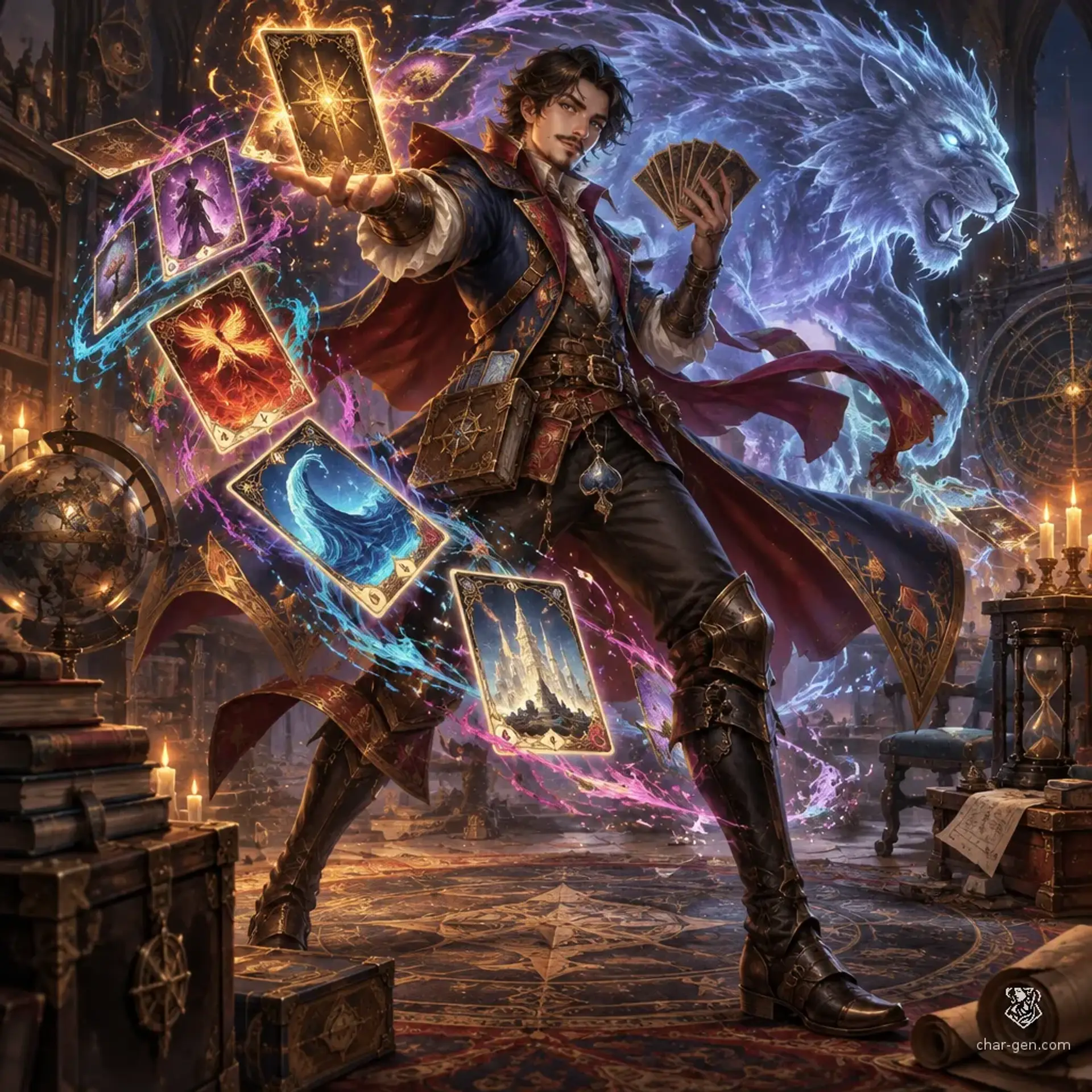
Cardwrights store magic in illustrated cards, turning a prepared deck into a spellbook, a stable of temporary allies, and a source of unpredictable improvisation. They are full spellcasters who excel at adapting their magic to a rapidly changing scene, with a distinctive ability to author original spells and empower allies through Wildcards.
Full caster, battlefield controller, flexible utility mage, and occasional summoner.
CCardwright
At a glance
Level
1
Proficiency
+2
bonus at this level
Wildcard
Hit die d6
PrimaryIntelligenceConstitution
Features
21, levels 1 to 20
1Level 1, reached
Spellcasting and Cardcraft
You gain spellcasting, a card deck as your spellcasting focus, and Cardcraft. At the end of a Long Rest, prepare a number of spells from your cardbook equal to your Intelligence modifier + your Cardwright level (minimum one); you can cast these spells using your spell slots. You can add a spell you find to your cardbook as a Wizard does, using the same time and gold costs.
First Wildcard
You learn to make one original spell called a Wildcard, chosen from the three effects in this feature: Flicker (teleport yourself up to 10 feet as a Bonus Action), Guard (when hit, use your Reaction to gain +2 AC against that attack), or Jolt (as an action, one creature within 30 feet makes a Dexterity save or takes 1d8 force damage). You can use your Wildcard a number of times equal to your Proficiency Bonus per Long Rest; Jolt damage becomes 2d8 at level 5, 3d8 at 11, and 4d8 at 17.
2Level 2
Three Faces of a Deck
You can mark spells in your cardbook as Spellcards and spells that conjure or summon creatures as SummonCards. Once on each of your turns when you cast a prepared spell using your card deck as the focus, you can draw, reveal, or stow one card without using an action; this has no extra mechanical effect but lets you handle your deck as part of casting.
3Level 3
Cardwright Subclass
Choose a Cardwright subclass. Your subclass grants features at levels 3, 6, 10, and 14.
4Level 4
Ability Score Improvement
5Level 5
Refined Improv
Your Wildcard uses improve: Flicker’s distance becomes 20 feet, Guard grants +3 AC against the triggering attack, and Jolt’s range becomes 60 feet. You also regain one expended Wildcard use when you finish a Short Rest.
6Level 6
Subclass Feature
You gain your subclass feature.
7Level 7
Ink-Surge
When you cast a spell from a Spellcard or SummonCard, you can add your Proficiency Bonus to one damage roll or one healing roll of that spell. You can do so once per turn.
8Level 8
Ability Score Improvement
9Level 9
Twin Illustration
You can maintain concentration on two spells at once, provided one of them is a SummonCard spell of level 3 or lower. If you fail a Constitution saving throw to maintain concentration, you lose concentration on both spells.
10Level 10
Subclass Feature
You gain your subclass feature. In addition, you can use a Wildcard when you roll Initiative, without expending a use, if you have no uses remaining; you regain this free use when you finish a Long Rest.
11Level 11
Masterwork Card
Once per Long Rest, when you cast a prepared spell of level 5 or lower, you can cast it without expending a spell slot. The spell must have a casting time of an action or Bonus Action.
12Level 12
Ability Score Improvement
13Level 13
Rapid Recomposition
When you finish a Short Rest, you can replace one prepared spell with another spell in your cardbook. You can also use a Wildcard as a Bonus Action instead of its normal action, if it normally takes an action.
14Level 14
Subclass Feature
You gain your subclass feature.
15Level 15
Lucky Draw
When you cast a spell using a spell slot of level 1 through 5, roll 1d6. On a 6, the slot is not expended. Once this restores a slot, you cannot benefit from this feature again until you finish a Long Rest.
16Level 16
Ability Score Improvement
17Level 17
Grand Illustration
When you use Ink-Surge, you can apply its bonus to two damage or healing rolls of the spell instead of one. You can also regain all expended Wildcard uses when you finish a Short Rest.
18Level 18
Silent Reveal
You can cast one prepared spell of level 1 or 2 without verbal or somatic components, provided you use your card deck as the focus. You can do this a number of times equal to your Intelligence modifier per Long Rest.
19Level 19
Epic Boon
You gain the Ability Score Improvement feat or another feat for which you qualify, and you gain an Epic Boon feat or another feat for which you qualify.
20Level 20
The Living Deck
Once per Long Rest, you can cast any spell in your cardbook of level 8 or lower without expending a spell slot. Afterward, you cannot cast spells of level 6 or higher until you finish a Long Rest.
Core traits
Hit die
d6
Primary
IntelligenceConstitution
Saves
IntelligenceWisdom
Hit pointsHit Die: per Cardwright level. Hit Points at Level 1: 6 + your Constitution modifier. Hit Points at Higher Levels: (or 4) + your Constitution modifier per Cardwright level after 1st.
ArmorLight armor.
WeaponsSimple weapons.
ToolsCalligrapher’s supplies or playing-card set (choose one).
SkillsChoose two from Arcana, Deception, History, Insight, Investigation, Performance, Sleight of Hand, and Persuasion.
ResourceSpell slots for Spellcards and SummonCards; Wildcard uses equal to your Proficiency Bonus per Long Rest (recovering one on a Short Rest at level 5 and all on a Short Rest at level 17).
MulticlassingPrerequisite: Intelligence 13. You gain no armor or weapon proficiencies from multiclassing into Cardwright. Spell slots follow the multiclass spellcaster rules; Wildcard uses and Cardwright features are not shared with other classes.
Spells and options
How it casts
Full spellcasting progression, using Intelligence as your spellcasting ability.
You prepare spells from a cardbook and cast them with the standard spell slots for a full caster; the selected spells are represented by Spellcards or SummonCards. You can record canonical spells and original spells in your cardbook, subject to the DM’s approval for original creations. Spell save DC = 8 + your Proficiency Bonus + your Intelligence modifier; spell attack modifier = your Proficiency Bonus + your Intelligence modifier.
1st-level spells
2nd-level spells
3rd-level spells
4th-level spells
5th-level spells
Subclasses
3
Bestiary Deck
A creature waits behind every painted border.
Level 3: Improved SummonCards and a bonded companion.
Level 6: Direct your summoned creature with a bonus action.
Level 10: Protect allies near your summon.
Level 14: Temporarily manifest a mighty signature summon.
Arcana Atelier
Every spell is a draft; every battle is the final edit.
Level 3: Strengthen damage and control Spellcards.
Level 6: Recast a modest spellcard through a burst of ink.
Level 10: Bend a spell’s area to spare chosen allies.
Level 14: Unleash a devastating signature spell.
Unbound Hand
The blank card is the most dangerous one in the deck.
Level 3: Expand and refine Wildcard tricks.
Level 6: Share defensive Wildcards with an ally.
Level 10: Twist chance when a card’s effect falls short.
Level 14: Create a scene-changing Wildcard once per rest.
Playing one
What it is
Cardwrights store magic in illustrated cards, turning a prepared deck into a spellbook, a stable of temporary allies, and a source of unpredictable improvisation.
They are full spellcasters who excel at adapting their magic to a rapidly changing scene, with a distinctive ability to author original spells and empower allies through Wildcards.
How to play one
You play like a full caster with the breadth of a spellbook and a small reserve of flexible Wildcard tricks.
Choose spells for the situation, use SummonCards to shape the battlefield, and save your strongest slots for decisive turns; your level 9 concentration feature is powerful but risky.
Make one
Personality
I narrate my plans as if revealing a card in a performance.
Ideal
Invention. A spell is only the beginning; the best magic is the spell you make your own.
Bond
A card in my deck bears the signature of someone I have never met, and I need to learn why.
Flaw
I treat every crisis as a chance to test a new card, even when caution would be wiser.
Quirk
Flicks a card across the knuckles while thinking.
Personality
I narrate my plans as if revealing a card in a performance.
I am delighted when someone asks how a spell works.
I keep a different card for every mood and insist the art matters.
I make a show of confidence even when I am improvising.
Ideals
Invention. A spell is only the beginning; the best magic is the spell you make your own.
Freedom. No deck, law, or tradition should decide what a person is allowed to become.
Care. If I can put power in my hands, I can use it to protect someone who has none.
Bonds
A card in my deck bears the signature of someone I have never met, and I need to learn why.
I carry the last surviving deck of my teacher, whose final card has never revealed its face.
My companions are the first people I trust to hold one of my cards.
Flaws
I treat every crisis as a chance to test a new card, even when caution would be wiser.
I am possessive of my deck and struggle to let anyone else handle it.
I keep revising my best work instead of trusting that it is finished.
Quirks
Flicks a card across the knuckles while thinking.
Names every original card as if introducing a cast member.
Uses elaborate flourishes to draw a card, even when alone.
Keeps blank cards tucked into every pocket.
Apologizes to cards before burning or tearing them.
In the world
Training
Most cardwrights begin as apprentices to a spellcaster, calligrapher, stage magician, or cardwright family.
Initiation means making a first card that holds a stable spell; the mentor tests both the student’s control and their judgment before entrusting them with a working deck.
How others see them
People often find cardwrights charming until a card produces a creature, a storm, or a spell no one recognizes.
In regulated cities they are respected professionals; in suspicious regions, an unusual deck can be treated as contraband.
Famous practitioners
CardwrightMira VellA daring cardwright whose famed rescue deck is said to contain a different escape for every locked door.
CardwrightOrren QuillA meticulous scholar who records spells in cards that rearrange themselves to answer new questions.
Factions
The Open Hand
An itinerant fellowship that exchanges original spellcards and teaches safe methods of spell invention.
The Gilt Registry
A conservative archive that licenses cardwrights and seals spells judged too dangerous to circulate.
The Velvet Shuffle
A loose network of performers who disguise practical magic as stagecraft and smuggle forbidden cards across borders.
Regions
The Glassward Cities
Dense city-states where licensed colleges teach cardcraft alongside practical wizardry.
The Seven Market Roads
Caravan routes where itinerant cardwrights trade spells and teach by apprenticeship.
The Ash Marches
Borderlands where authorities ban magical decks after old wars, driving cardwrights underground.
Character hooks
You made a card to save your village, but it now contains a voice that knows your name.
A celebrated cardwright vanished after asking you to deliver a sealed deck to a rival college.
You inherited a deck whose cards depict events that have not happened yet.
Your first self-made spell accidentally bound a spirit to a card; it insists it is your partner, not your property.
You were trained as a stage magician until a real spell escaped the trick and changed your life.
A faction wants your research because your cards can reproduce magic thought impossible to record.
Media
0 images
No images yet.
Visual sheet
Turn Cardwright into a sheet
A high-res, share-ready sheet you can post or print.

 Intelligence
 Constitution
 Wisdom