Skip to content
CreatePricing
The Hollow Saint - AI-generated fantasy Monster

The Hollow Saint

The temple's priests claimed that sacrifice sealed a spreading plague beneath the region. In truth, the ritual transferred the plague and the victims' suffering into a spiritual vessel. The Hollow Saint was that vessel. Monster 1 was appointed as its jailer and later concealed the truth. Quest 1 should uncover records proving that the seal merely postponed the disaster. NPC 0 fears the saint because it speaks with the voice of someone they failed to save. NPC 1 carries a bloodline, relic, or mark that makes them an ideal vessel. NPC 2 can identify the living descendants of those who funded the sacrifices. Region 7 is now developing the same mold and sleepwalking symptoms that preceded the temple's original collapse.

Medium undead · High, escalating regional threat · Unique

The Hollow Saint

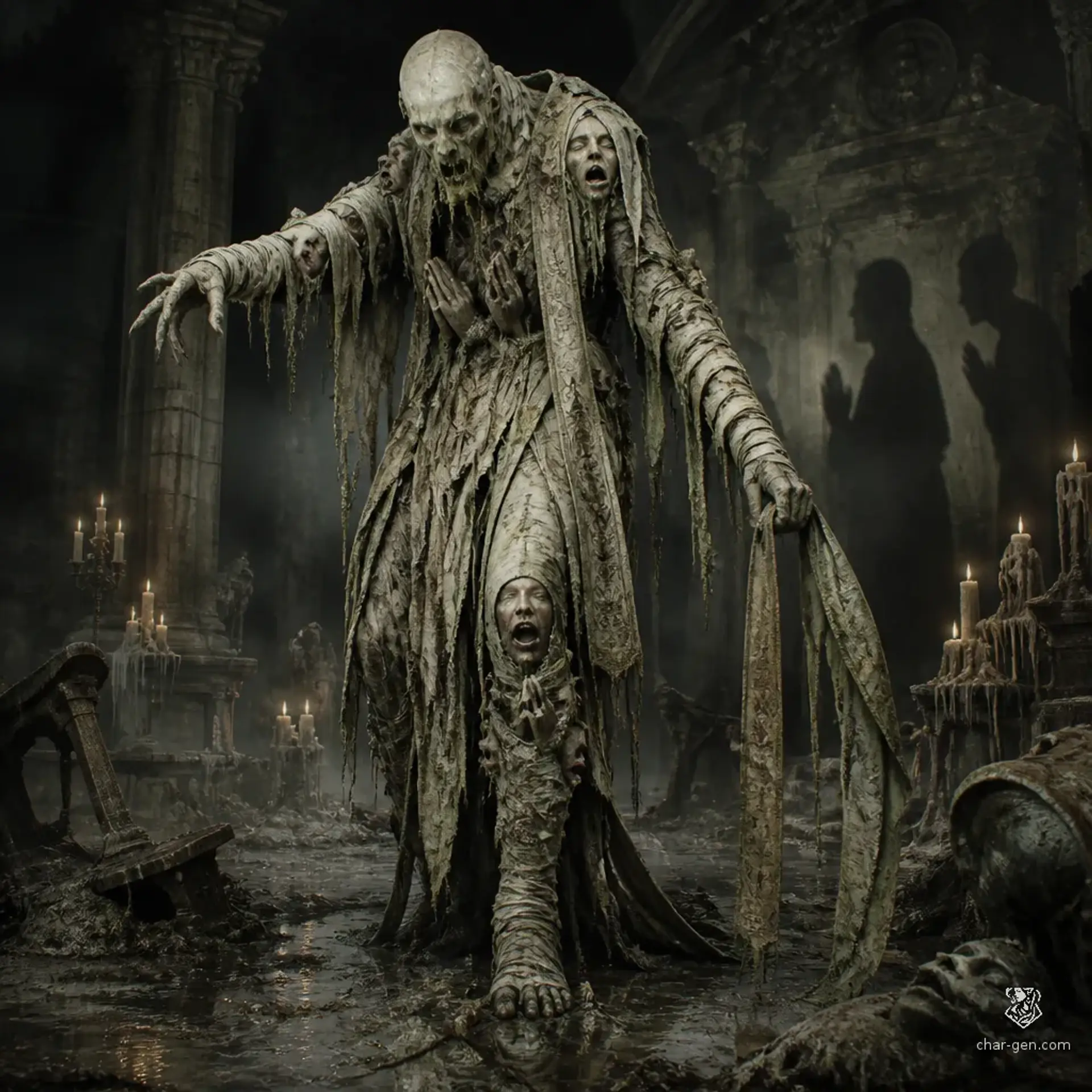
The Hollow Saint, a plague spirit born from the temple's failing seal and the accumulated suffering of those sacrificed to maintain it. The seal did not cure the region. It compressed grief, rage, disease, and stolen identity into a single hungry intelligence.
AC16
HP136/136
CRHigh, escalating regional threat
Init
STR
DEX
CON
INT
WIS
CHA
ConditionsNone

Combat

AC 16 · HP 136 · High, escalating regional threat

The Hollow Saint

Medium undead (spirit of plague, sacrifice, and stolen identity), lawful evil, bound by ritual and grievance
Armor Class16, natural armor
Hit Points136 (16d8 + 64)
Speed
30 ft.,
Climb 30 ft.,
Incorporeal movement through cracks and porous stone, but not through solid metal or consecrated barriers
STR
DEX
CON
INT
WIS
CHA
Saving ThrowsDexterityWisdomCharisma
SkillsDeceptionInsightPerceptionStealth
Damage Resistances
bludgeoning, piercing, and slashing damage from nonmagical attacks,
cold,
fire,
lightning,
thunder
Immunities
necrotic damage,
poison damage,
charmed,
exhaustion,
frightened,
poisoned
Weaknesses
Consecrated ground prevents the saint from using Incorporeal Passage through its boundaries.
Speaking the true names of three or more victims within 30 feet gives the saint disadvantage on saving throws against being appeased or separated from a host.
Returning the stolen remains disables Unfinished Death once all major remains are restored.
The original sacrificial bell can command the saint for 1 round when rung by a creature who knows the full history of the temple.
The saint cannot willingly possess a creature that carries a personal relic belonging to one of its victims.
Senses
Darkvision 120 ft.,
Truesight 30 ft.,
Passive Perception 14
Languages
Common,
Celestial,
Infernal
ChallengeHigh, escalating regional threat
Proficiency Bonus+3
Spell Save DC15
Spell Attack Bonus+7
Experience3,900 XP
Passive Perception14
Incorporeal Passage. The saint can move through other creatures and objects as if they were difficult terrain. It takes 5 () force damage if it ends its turn inside an object.
Horror in Familiar Shapes. The saint has advantage on Dexterity (Stealth) checks made in dim light, darkness, ruins, or among corpses and effigies.
Feast on Delay. At the end of a long rest, if any creature within 1 mile has sleepwalked under the saint's influence, the saint regains 15 hit points and gains one additional use of Spores of the Sealed Grave, up to three additional uses.
Stolen Voices. The saint can perfectly imitate any voice it has heard. A creature that hears the imitation can identify it as false with a successful Wisdom (Insight) check.
Unfinished Death. The saint cannot be permanently destroyed while the temple's seal remains active and the stolen remains remain scattered. If reduced to 0 hit points under those conditions, it collapses into wax and reforms after 7 days.
Bound to the Seal. The saint has advantage on saving throws against spells and other effects that turn undead. It also has advantage on saving throws against being banished while within the abandoned temple.

Spells

Minor Illusion (cantrip, illusion). The saint creates a sound or voice it has heard within 60 feet, lasting up to 1 minute.
Sleep (level 1, enchantment). The saint marks a sleeping or unconscious creature, creating a link for later possession.
Detect Thoughts (level 2, divination). The saint detects thoughts and surface memories, especially memories associated with guilt, grief, or fear.
Darkness (level 2, evocation). The saint creates a 20-foot-radius sphere of darkness that it can see through.
Fear (level 3, illusion). The saint frightens one creature by forcing it to see the face of someone it failed to save.
Dominate Person (level 5, enchantment). The saint attempts to possess a marked or vulnerable creature, represented by its Wear the Living action.

Actions

Multiattack. The hollow saint makes two Face-Taking Touch attacks, or one Face-Taking Touch attack and one Dirge of Unmaking attack.
Face-Taking Touch. Melee Spell Attack: to hit, reach 10 ft., one creature. Hit: 13 () necrotic damage, and the target must succeed on a Constitution saving throw or become marked by a stolen face for 24 hours. While marked, the target cannot regain hit points except by magic, and the hollow saint can mimic the target's voice perfectly. A marked creature that drops to 0 hit points rises at the start of its next turn as a sleepwalking thrall under the saint's control, unless it succeeds on a Wisdom saving throw.
Dirge of Unmaking. The hollow saint sings through every stolen mouth on its body. Each creature of the saint's choice within 30 feet that can hear it must make a Wisdom saving throw. On a failure, a creature takes 18 () psychic damage and is frightened until the end of its next turn. On a success, it takes half damage and is not frightened. A frightened creature that fails this save by 5 or more must use its reaction to move up to half its speed toward the hollow saint.
Spores of the Sealed Grave. The saint exhales a cloud of gray spores in a 20-foot cone. Each creature in the area must make a Constitution saving throw. On a failure, the creature is poisoned for 1 minute and begins sleepwalking at the start of its next turn. A sleepwalking creature is incapacitated, its speed is halved, and it moves toward the nearest marked corpse or temple relic by the safest available route. The creature can repeat the saving throw at the end of each of its turns, ending the effect on itself on a success.
Wear the Living. The hollow saint targets one creature it can see within 60 feet that is marked by a stolen face, unconscious, or sleepwalking. The target must succeed on a Charisma saving throw or become possessed for 1 minute. The saint vanishes into the target's body, and the target is incapacitated and loses control of its body. The saint controls the body but cannot force it to harm itself. At the end of each of the target's turns, it repeats the saving throw, ending the possession on a success. When the possession ends, the saint appears in an unoccupied space within 5 feet of the target.
Corrupt Ground. The hollow saint chooses a point it can see within 60 feet. For 1 minute, a 15-foot-radius area around that point becomes corrupted terrain. The area is difficult terrain. When a creature enters the area for the first time on a turn or starts its turn there, it must succeed on a Dexterity saving throw or take 7 () necrotic damage and fall prone. Holy water, a named grave marker, or a successful Religion check made as an action suppresses one corrupted area for 1 minute.

Reactions

Correct the Prayer. When a creature the saint can see within 30 feet succeeds on a saving throw against one of the saint's effects, the saint forces the creature to repeat the save. The creature must use the new result.

Legendary Actions

Funeral Drift. The saint moves up to half its speed without provoking opportunity attacks. During this movement, it can move through a creature's space, treating that space as difficult terrain. A creature whose space it enters must succeed on a Dexterity saving throw or take 5 () necrotic damage.
Whispered Name (costs 2 actions). One creature affected by the saint's Marked by a Stolen Face, Spores of the Sealed Grave, or possession makes one additional saving throw against that effect.
Waxen Grasp (costs 2 actions). The saint causes one corrupted terrain area within 60 feet to surge. Each creature in that area must succeed on a Dexterity saving throw or take 9 () necrotic damage and become restrained by wax until the end of its next turn.
Congregation of the Dead (costs 3 actions). The saint uses Dirge of Unmaking, if available, or immediately uses Spores of the Sealed Grave without expending an action.
Role
Ambush controller and possession horror
Built for
Four characters of approximately 8th level

Gear

  • Reliquary of Stolen Names (Wondrous object, Priceless to the victims' descendants)A cracked reliquary containing fragments of the first sacrificed victims. Returning these remains gives the party advantage on checks to appease the saint.
  • Veil of the Failing Seal (Ritual relic, 50 gp as an antiquity, though its true value is historical)A blackened ceremonial veil bearing the temple's original seal. Destroying it prevents the saint from using Wear the Living for 24 hours.
  • Choir Masks (Cursed evidence, No mundane sale value)A bundle of wax masks molded from the faces of sacrificed villagers. Each mask whispers a fragment of the temple's history.

Feats

Ambusher in darkness
Can imitate any voice it has heard
Can squeeze through spaces as narrow as 2 inches while in mist form
Can communicate through nearby corpses, wax effigies, or possessed sleepers

Notes for the game master

The listed spells are thematic references and are represented by the monster's custom actions where appropriate.
The hollow saint is intended as a serious encounter for four characters around 8th level, especially when supported by terrain or sleepwalking victims.
If the party is lower level, remove legendary actions and reduce hit points to 100. If the party is higher level, increase hit points to 170 and allow two uses of Spores of the Sealed Grave per encounter.
The saint's possession should create danger and drama, not remove a player's agency for an extended period. Give the possessed player clear internal choices, sensory information, or opportunities to resist.

Tactics

  1. Opening

    It begins hidden among wax effigies, corpses, or sleeping villagers. It opens with Spores of the Sealed Grave against clustered targets, then uses Wear the Living on a frightened or marked character.

  2. Mid-fight

    It spreads corrupted terrain, isolates the weakest-willed character, and uses possession to turn the party's formation against itself. It retreats behind walls, through cracks, or into sacrificial pits when exposed to concentrated radiant damage.

  3. End of the fight

    It possesses a marked or unconscious character, then uses that body to reach the seal, destroy evidence, or force the party to choose between pursuing it and saving sleepwalking villagers.

  4. Retreat

    The hollow saint retreats if the stolen remains are returned, its true name is spoken, or its jailer, Monster 1, is destroyed. If reduced below 35 hit points without such a resolution, it abandons the fight and escapes through the nearest shadow connected to the temple.

How it fights

Begin with deception and environmental clues rather than immediate combat.
Use corrupted terrain to divide the party and force movement toward the sacrificial pit.
Possess characters who are already marked, frightened, or unconscious.
Use voices of loved ones to bait isolated characters into dark rooms or narrow passages.
Retreat through walls when losing, leaving behind a false face or sleepwalking victim.
Reserve legendary actions for movement, restraint, and extending possession pressure.

Who it attacks first

Marked or sleepwalking creatures
Characters carrying recovered temple relics
Healers and characters capable of ending possession
NPC 1 if available as a vessel
Any character attempting to restore the seal instead of exposing its history

Works well with

Monster 1 can force the saint into predictable paths or renew the seal at great cost.
Sleepwalking villagers create cover, host bodies, and moral pressure.
NPC 1's vessel potential can increase the saint's range and durability if left unprotected.
Region 7's blight can turn ordinary terrain into corrupted terrain during later encounters.
Recovered temple records and stolen remains weaken the saint before the final confrontation.

How to beat it

Bright light and open ground make its ambushes harder to stage.
Restoring stolen remains, naming the dead, or exposing the original profiteers weakens its motivation and can end combat without killing it.
Remove curse, protection from evil and good, and similar magic suppress possession or mark effects at the GM's discretion.
A creature that spends an action speaking a victim's name and presenting a recovered personal relic has advantage on its next saving throw against the saint.

Ways to avoid a fight

Appease it by returning stolen remains to their families or the sacrificial pit.
Give it a true name assembled from the temple records and the names of its victims.
Separate it from a host by using a consecrated threshold, a recovered personal relic, and a successful DC 16 Religion or Persuasion check.
Redirect it toward the original profiteers by presenting evidence, naming their descendants, or offering access to the temple's sealed archives.
Negotiate a temporary truce in exchange for stopping Monster 1 from renewing the seal.

Ecology

A tall, emaciated figure wrapped in funerary cloth and rotting ceremonial vestments. Its head is a smooth, pale skull of wax, but stolen human faces continually push through its shoulders, ribs, and hands. Each face mouths a different silent prayer while one central throat sings in the voices of the sacrificed. Gray mold blooms from its joints, and its shadow resembles a kneeling congregation.

Behavior

The hollow saint stalks roads, wells, barns, and bedrooms near the abandoned temple. It rarely kills immediately. Instead, it steals faces from corpses, imitates loved ones, and causes villagers to walk toward the temple while asleep. It grows bolder whenever the party delays, and its attacks become more direct after each new sleepwalking incident.

How it lives

The hollow saint has no natural ecology. It feeds on interrupted sleep, unresolved grief, and the psychic residue of ritual violence. Mold and pale wax spread wherever it lingers. Animals avoid its territory, while insects gather around its discarded faces and whispering relics.

Lair

The hollow saint's lair is the abandoned temple's sealed undercroft, where walls sweat gray moisture and every candle burns with a human silhouette inside the flame. The lair contains the original sacrificial pit, stolen remains, and a bell whose tone causes nearby sleepers to rise.

Habitat
Abandoned temples, plague villages, crypts, desecrated shrines, ruined roads, flooded burial grounds, and settlements affected by supernatural sleepwalking.

Signs that it is near

Villagers found asleep while standing, often facing the temple.
Wax fingerprints on windows, wells, and locked doors.
Gray mold growing in the shape of open mouths.
Dead animals positioned in circles around old roads.
Familiar voices calling from empty rooms.
Candles that burn with a dark wick and no visible flame.

Tags

undead,
spirit,
horror,
possession,
plague,
temple,
ambusher,
controller,
regional threat,
sleepwalking

Lore

The temple's priests claimed that sacrifice sealed a spreading plague beneath the region. In truth, the ritual transferred the plague and the victims' suffering into a spiritual vessel. The Hollow Saint was that vessel. Monster 1 was appointed as its jailer and later concealed the truth. Quest 1 should uncover records proving that the seal merely postponed the disaster. NPC 0 fears the saint because it speaks with the voice of someone they failed to save. NPC 1 carries a bloodline, relic, or mark that makes them an ideal vessel. NPC 2 can identify the living descendants of those who funded the sacrifices. Region 7 is now developing the same mold and sleepwalking symptoms that preceded the temple's original collapse.

What drives it

The hollow saint wants the seal broken, the stolen dead restored, and the people who profited from the sacrifices exposed or punished. It cannot distinguish justice from vengeance unless someone gives it a name, acknowledges the victims, and offers a credible path to restitution.

After the fight

If destroyed without addressing the seal, the hollow saint reforms in 7 days from the next sleepwalking victim or stolen relic. If appeased, separated from its host, or redirected toward the original profiteers, the blight recedes over several weeks, though the temple remains a dangerous place of memory and unfinished judgment.

“In truth, the ritual transferred the plague and the victims' suffering into a spiritual vessel.”
From its lore

Variants

Pale Choir: Replace Face-Taking Touch with a 15-foot-radius swarm attack that deals psychic damage to every creature in the area, and give the creature resistance to piercing damage.
Bell-Mold: Replace stolen faces with fungal bells. Add a 60-foot ranged sonic pulse that can stun a sleepwalking creature for 1 round on a failed Constitution save.
Hollow Martyr: Remove possession and increase direct combat power. The saint gains resistance to radiant damage, a 10-foot reach, and a reaction that deals necrotic damage to creatures that heal nearby allies.
Unbound Saint: If Monster 1 is defeated, the saint gains a flying speed of 40 feet, increases its corrupted terrain radius to 20 feet, and can use Spores of the Sealed Grave as a bonus action once per round.

Hooks

Plot hooks

A village elder asks the party to investigate why respected citizens are sleepwalking toward the abandoned temple.
NPC 0 hears a dead relative calling from wells, chimneys, and locked rooms.
NPC 1 begins losing memories whenever the saint appears and may become its preferred vessel.
NPC 2 possesses a ledger proving that local nobles financed the sacrifices and can bargain with the saint if protected.
Monster 1 claims the saint is an irredeemable demon, but its records reveal that the jailer helped maintain the cycle.
Region 7's crops develop pale fungal rings shaped like kneeling congregations.
The party finds a procession of sleepwalkers carrying wax masks toward the temple while the saint watches from a distant bell tower.

How to use it

Use it as the escalating threat for Quest 0, with each delay adding another sleepwalking victim or extending the blighted region.
Introduce it before the temple through false voices, stolen faces, disturbed graves, and villagers found standing barefoot at crossroads.
Make Quest 1 reveal that the temple's seal was a containment ritual, not a cure, and that every sacrifice strengthened the thing below.
Let NPC 0 recognize a face or voice from a personal nightmare, making the monster a direct fear rather than a distant rumor.
Use NPC 1 as a possible vessel, especially if the party must protect that NPC while investigating the seal.
Give NPC 2 knowledge of the families, officials, or merchants who profited from the sacrifices. The saint can be bargained with using that information.
Reveal that Monster 1 is the saint's jailer, guardian, or ritual custodian, creating a three-way conflict rather than a simple boss fight.
Tie the monster to Region 7 by allowing its gray mold to spread through wells, root systems, livestock, and abandoned shrines.

Treasure

The Reliquary of Stolen Names, which can serve as proof of the temple's crimes.
The Veil of the Failing Seal, useful for suppressing the saint's powers or repairing the seal.
Temple records naming the profiteers behind the sacrifices.
A black pearl worth 300 gp hidden inside the sacrificial bell.
Personal relics belonging to the victims, valuable primarily for social and spiritual restitution.

Media

0 images

No images yet.

Visual sheet

Turn The Hollow Saint into a sheet

A high-res, share-ready sheet you can post or print.