Skip to content
CreatePricing
Crypt Warden - AI-generated fantasy Monster

Crypt Warden

When the necropolis was consecrated, tomb guardians were sworn to defend the dead from theft, blasphemy, and unlicensed awakening. The Crypt Warden is what remains of that oath after centuries of silence and one recent cult breach. It no longer remembers names, only duties. That makes it dangerous in a very specific way: it cannot be reasoned with, but it can be redirected by sacred symbols, old passwords, or the same burial protocols the cult has begun to exploit. Its cracked armor and bone-latticed body are a visible hint that the floor's undead are being assembled, not merely disturbed.

Medium undead · Moderate · uncommon

Crypt Warden

An early-floor undead tomb guardian awakened by cult intrusion, built to teach the necropolis is defended by old duties as well as restless dead.
AC16
HP67/67
CRModerate
Init
STR
DEX
CON
INT
WIS
CHA
ConditionsNone

Combat

AC 16 · HP 67 · Moderate

Crypt Warden

Medium undead (undead), lawful neutral
Armor Class16 (funerary armor, bone splints)
Hit Points67 (9d8 + 27)
Speed
Walk 30 ft.,
Can move through spaces occupied by Medium or smaller undead allies without squeezing, as if they were difficult terrain only for others.
STR
DEX
CON
INT
WIS
CHA
Saving ThrowsWisdomConstitution
SkillsPerceptionInsightAthletics
Damage Resistances
necrotic,
bludgeoning, piercing, and slashing from nonmagical attacks
Immunities
poison,
exhaustion,
poisoned
Weaknesses
Radiant damage suppresses its Dust-Sense until the start of its next turn.
If its funerary sigil core is shattered, it loses Ritual Obedience and takes 1d6 extra damage from bludgeoning attacks for 1 minute.
Holy water or consecrated salt can briefly disable its threshold reaction if applied as an action.
Senses
darkvision 60 ft.,
tremorsense 10 ft. while on stone floors,
passive Perception 10
Languages
Understands the languages it knew in life but cannot speak,
Understands Cult Cant if bound by ritual sigils
ChallengeModerate
Proficiency Bonus+2
Oath of the First Seal. The warden has advantage on saving throws against being turned while within 10 feet of a sealed tomb or sarcophagus.
Dust-Sense. The warden can see and hear through its own grave dust as long as at least one creature remains inside an area affected by Ossuary Burst.
Ritual Obedience. If a cultist bearing the correct sigil is adjacent to the warden, the warden does not attack that cultist unless the cultist harms it or desecrates a tomb in its reach.

Actions

Sarcophagus Slam. Melee Weapon Attack: to hit, reach 5 ft., one target. Hit: 8 () bludgeoning damage plus 3 () necrotic damage. If the target is Large or smaller, it must succeed on a Strength saving throw or be pushed 10 feet away from the warden.
Ossuary Burst. The warden tears loose a handful of bone slivers and grave dust in a 10-foot-radius cloud centered on a point it can see within 30 feet. Each creature in the area must make a Constitution saving throw, taking 7 () necrotic damage on a failed save, or half as much damage on a successful one. The area becomes lightly obscured until the start of the warden's next turn. A creature that fails the save also cannot take reactions until the start of its next turn.
Raise the Dead Quiet. The warden animates bone fragments from nearby remains or broken funerary statuary in a 15-foot radius centered on itself. Until the start of its next turn, the area is difficult terrain for enemies, and the first time each turn an enemy enters the area or starts its turn there, it takes 3 () piercing damage. The bones crumble after 1 minute or if the warden is destroyed.

Reactions

Interdict the Threshold. When a creature the warden can see moves into a space within 5 feet of a sealed tomb, sarcophagus, or stone door, the warden makes one Sarcophagus Slam attack against that creature.
Role
defender
Built for
2-4

Gear

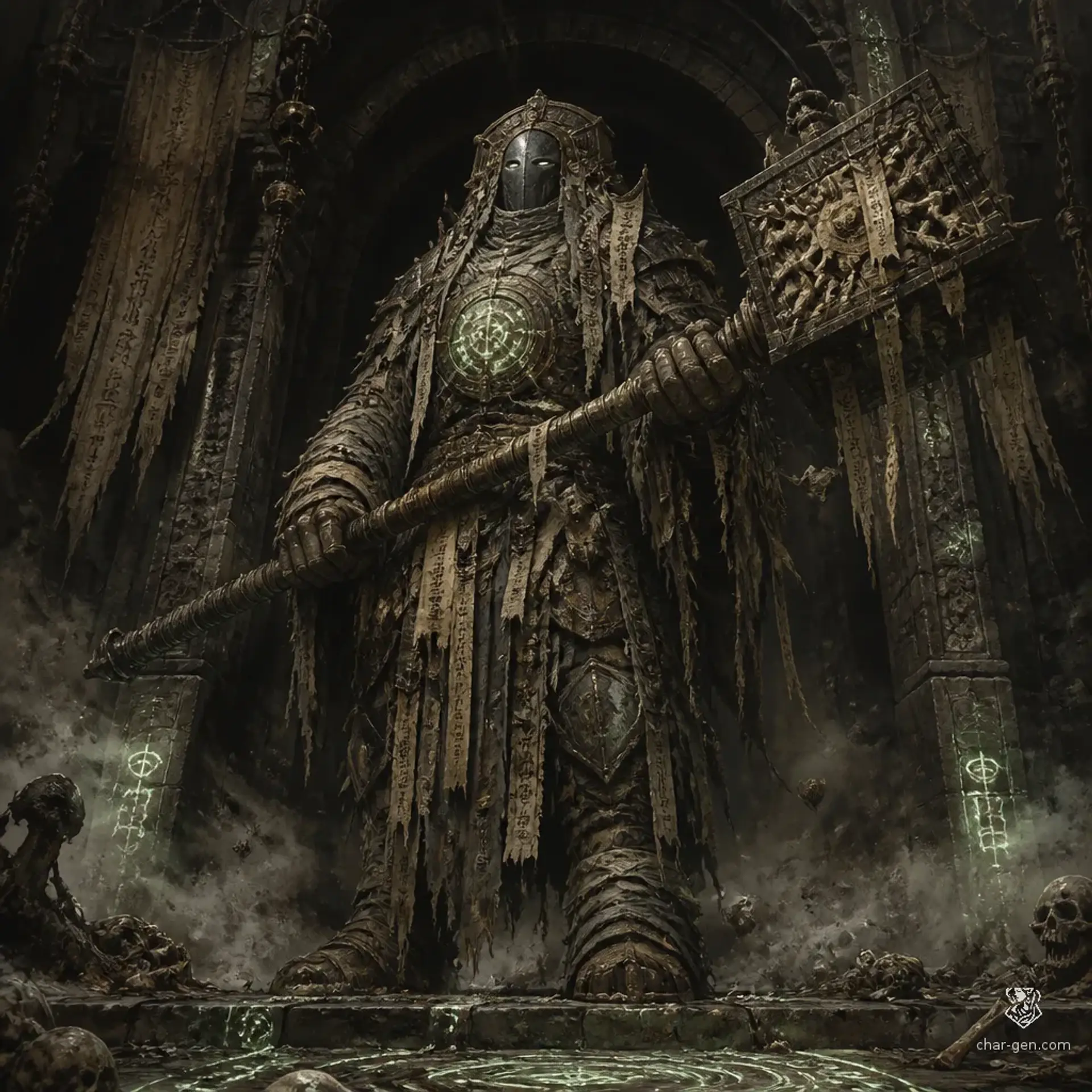
  • Funerary Armor (armor, broken but serviceable)Cracked bronze breastplate etched with faded funerary prayers.
  • Tomb Smasher (weapon, simple)Shard-studded mace or slab-like burial hammer used to strike lids and intruders alike.

Feats

Threshold Guardian: The warden has advantage on saving throws and checks to resist being shoved, knocked prone, or moved against its will while it is within 10 feet of a sealed tomb, sarcophagus, or stone door.
Grave Dust Veil: Opportunity attacks against creatures that have moved through its Ossuary Burst area are made with disadvantage until the start of the warden's next turn.

Augmentations

Ritual sigil binding that suppresses its aggression toward marked cultists
Ossuary mesh reinforced with bone splints and bronze funerary plates

Notes for the game master

The warden's control abilities are strongest in narrow spaces and around tomb furnishings.
Raise the Dead Quiet creates battlefield clutter, not a full summoning engine, so it stays suitable for an early-floor encounter.
It counts as undead for effects that target undead creatures.
If the cult's sigils are erased or disrupted, the warden loses any special tolerance for cultists and treats all non-guardian creatures as intruders.

Tactics

  1. Opening

    It rises from a sealed alcove or slides out of a broken sarcophagus lid, then marks the nearest group with a low, grinding chant of duty. Its first move is usually to create difficult terrain with Raise the Dead Quiet or to slam the front line back from the tomb entrance.

  2. Mid-fight

    It alternates between Sarcophagus Slam and Ossuary Burst, trying to push foes into chokepoints or onto bone-strewn ground. It prefers to stand in the center of a corridor or threshold and punish anyone who tries to rush past it.

  3. End of the fight

    If reduced below 25% hit points, it fights to keep enemies off sealed tombs rather than chasing fleeing targets, using its body to block corridors and buying time for any nearby cult ritual to finish.

  4. Retreat

    It does not retreat unless a cult sigil commanding it is broken or its master ward is removed. If somehow compelled to withdraw, it backs into the most defensible doorway and seals itself behind fallen stone or lid fragments.

How it fights

Hold the narrowest passage available.
Push enemies into each other or back into the party's rear rank.
Use grave dust to break line of sight and disrupt ranged attackers.
Stand over tomb seals to trigger its threshold reaction.

Who it attacks first

Intruders attempting to open sealed tombs
Spellcasters concentrating on movement or radiant denial
Anyone carrying lanterns, holy symbols, or relics stolen from the dead

Works well with

Works well alongside cult bone-tenders, gravedirt shamans, or skeletal laborers that can exploit the difficult terrain it creates.
Pairs naturally with any undead that prefer to fire from behind cover or swarm enemies held in place by its control effects.

How to beat it

Radiant damage and Turn Undead effects can quickly force it out of its control posture.
Freedom of movement, teleportation, or forced movement that ignores difficult terrain reduces the value of its corridor control.
Blunt damage from heavy weapons is effective against its bone splints and funerary armor.
The cult's own ritual sigils can be turned against it if the party learns the command marks.

Ways to avoid a fight

Can be bypassed if the party presents authentic burial tokens, restores a broken seal, or re-aligns the chamber's sigils.
Can be turned into a temporary ally by redirecting it toward a greater tomb violation or by invoking its oath with the correct funerary phrase.
May reveal hidden passages if the party calms it and follows its body language around sealed walls and secondary vaults.

Ecology

A hulking guardian stitched from burial wrappings, bound bone splints, and cracked funerary armor, the Crypt Warden moves with the stiff precision of a temple sentinel. Its face is a smooth funerary mask lacquered black by age, with only a crack of pale light behind the eye slits. Prayer strips hang from its ribs like shredded banners, and every step sheds grit, fragments of old mortar, and the smell of dry graves. Cult sigils carved into its breastplate glow dimly when it recognizes the living as intruders or the cult as authorized desecrators.

Behavior

The Crypt Warden is mute, relentless, and obsessed with threshold defense. It ignores most cultists if they carry the proper sigils, but it reacts violently to anyone who cracks tomb seals, steals burial goods, or carries living flame too close to the ossuary. In combat, it behaves like an area-denial sentinel, not a berserker, and it tries to split the party, obstruct lanes, and keep enemies from reaching deeper chambers.

How it lives

The warden is one of the necropolis's oldest threshold constructs, made from a condemned guardian or animated from the remains of sworn temple servitors. In healthier times it would have stood watch over initiates and funerals alike. Now the cult has discovered that its old obedience can be bent, making it an ideal first-floor defender while deeper chambers gather more specialized undead into a growing army.

Lair

If encountered in its own lair, the Crypt Warden's chamber is a sealed antechamber lined with stacked sarcophagi, broken incense braziers, and old grave-sand channels that can be disturbed into choking drifts. The cult may have painted command sigils on the floor, turning the room into a crude relay point for their reanimation rites.

Habitat
Outer crypts, threshold chambers, entrance corridors, sarcophagus aisles, burial vestibules, and cracked tomb galleries.

Signs that it is near

Dust-free footprints that stop abruptly at tomb thresholds
A grinding scrape like stone dragged over stone from deep within the crypt
Freshly disturbed grave dust laid in a crescent around sealed doors
Bone chips arranged in a defensive ring around old coffins
Dim glyphs that flare when living creatures approach sealed burial chambers

Tags

undead,
necropolis,
cult,
summoning,
guardian,
early-floor,
terrain-control,
dungeon

Lore

When the necropolis was consecrated, tomb guardians were sworn to defend the dead from theft, blasphemy, and unlicensed awakening. The Crypt Warden is what remains of that oath after centuries of silence and one recent cult breach. It no longer remembers names, only duties. That makes it dangerous in a very specific way: it cannot be reasoned with, but it can be redirected by sacred symbols, old passwords, or the same burial protocols the cult has begun to exploit. Its cracked armor and bone-latticed body are a visible hint that the floor's undead are being assembled, not merely disturbed.

What drives it

To preserve sealed tombs, obey surviving ritual commands, and destroy intruders who violate burial law.

After the fight

If the cult is using the necropolis as a recruitment ground, the Crypt Warden's destruction often reveals that it was not the oldest thing in the chamber. Behind the sealed tomb it guarded may be a fresh ritual breach, a list of names marked for reanimation, or an untouched ossuary cache that the cult intended to strip for parts. Its collapse leaves behind a hush of settling dust and a faint pulse of burial magic that can lead the party deeper into the floor's undead assembly.

“The Crypt Warden is what remains of that oath after centuries of silence and one recent cult breach.”
From its lore

Variants

Griefbound Guardian: replace necrotic damage on Sarcophagus Slam with psychic damage, and it gains a mournful aura that imposes disadvantage on fear saves within 10 feet.
Ossuary Sentinel: increase AC to 17 and replace Raise the Dead Quiet with a more aggressive bone shield that grants it half cover until broken.
Crypt Warden of the Black Seal: CR 4 version with 85 hit points, stronger cult obedience, and a once-per-day corpse reanimation burst.

Hooks

Plot hooks

A cultist ledger mentions 'the Warden at the First Seal' as both gatekeeper and supply source for bone shards.
The party hears funeral bells underground, but the sound is actually the Warden striking its hammer against a tomb lid to warn off trespassers.
A stolen relic is hidden in a vault the Warden protects, and recovering it requires either defeating the guardian or proving the relic belongs to the dead.
Fresh undead deeper in the necropolis bear the same bronze prayer strips, suggesting the cult is copying the Warden's design to build an army.

How to use it

As a corridor guard that introduces the necropolis's defensive terrain and shows the cult's ritual influence.
As a sarcophagus-aisle sentinel whose presence warns the party that sealed tombs are part of the dungeon's resource economy.
As a threshold boss for a small side room, burial vault, or entrance chamber before the party reaches the deeper cult operations.

Treasure

A funerary key that opens one deeper sealed vault
1d4 silver prayer strips wrapped around a bone charm
A broken cult sigil that can be used to command lesser undead once

Media

0 images

No images yet.

Visual sheet

Turn Crypt Warden into a sheet

A high-res, share-ready sheet you can post or print.