
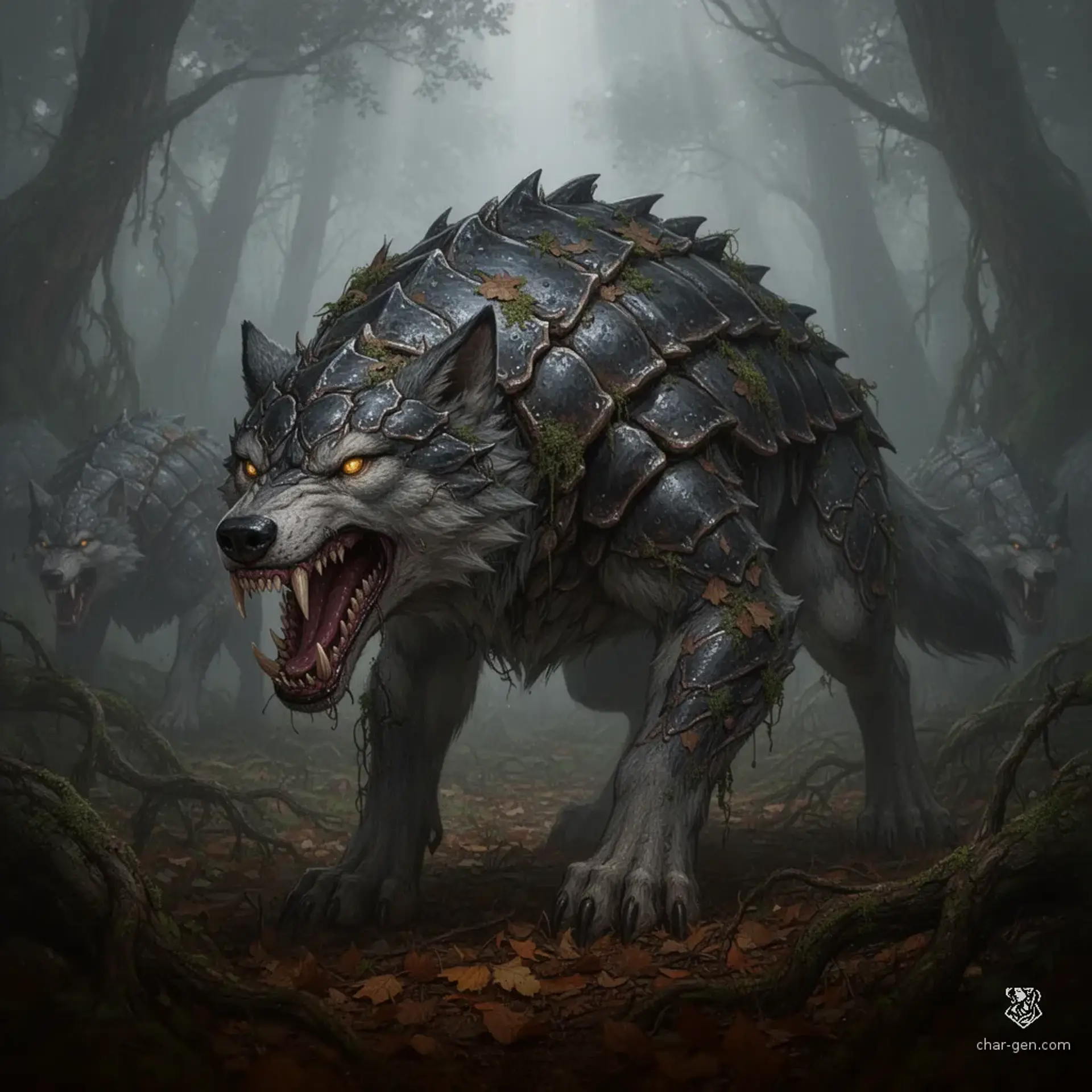
Carapace Wolf
Hunters tell of wolves whose backs shimmer like beetle shells and whose jaws seem to fold into themselves. Folktales say they were bred by a hermit who bound stray spirits to wild canines, but more pragmatic trackers believe they are a product of corrupted woodlands where the normal rules of nature fray.
Carapace Wolf
Combat
AC 14 · HP 45 · CR 1Carapace Wolf
Actions
Reactions
- Role
- Minion
- Built for
- 2
Notes for the game master
Tactics
Opening
The pack scouts keep at a slight distance, then surge in together to gain advantage from Pack Tactics. A hunting pair attempts to knock down or lock a weaker target early to split the party.
Mid-fight
Use terrain and pack tactics to flank and surround the party. Grapple a single target to pin it while other wolves harry other characters. Prioritize targets that try to escape or heal.
End of the fight
Finish pinned foes quickly with Mandible Snap and focus on any wounded or isolated party members. If enemies are reduced, consolidate to bite and hold the most dangerous foe to neutralize them.
Retreat
If two or more wolves are slain or their alpha is killed, the remaining wolves disengage and melt back into underbrush. A pack that loses half its members will usually disengage unless cornered or desperate.
How it fights
Who it attacks first
Works well with
How to beat it
Ways to avoid a fight
Ecology
A large lupine form with segmented, glossy chitin plates overlapping like scales along its back and shoulders. Its maw is a nested pair of mandibles; a smaller inner set snaps like a vise while a larger outer jaw rakes and holds. Dark moss and leaf litter stick to its shell, and its eyes glow faintly amber.
Behavior
Highly social and coordinated, carapace wolves hunt in tight packs using coordinated charges and grappling maneuvers to isolate and pin prey. They are cunning in a bestial way, using cover, scent trails, and bursts of speed to herd prey toward traps or ambush positions.
How it lives
Carapace wolves appear where ambient aberrant energies or long-forgotten fae rot have altered normal beasts. They fill the predator niche in corrupted forests, preying on deer, humanoid travelers, and corrupted fey. Packs are often territorial and will mark trails with shredded carapace and small carved bone totems.
Lair
A hollowed root circle or collapsed hill chamber lined with slick moss. The pack nests in chambers where a narrow entrance funnels prey; traps of sharpened chitin and mandible components are sometimes incorporated. Lair areas are littered with shed chitin and gnawed bones.
- Habitat
- Forest, especially shadowed, mossy woodlands and corrupted groves
Signs that it is near
Tags
Lore
Hunters tell of wolves whose backs shimmer like beetle shells and whose jaws seem to fold into themselves. Folktales say they were bred by a hermit who bound stray spirits to wild canines, but more pragmatic trackers believe they are a product of corrupted woodlands where the normal rules of nature fray.
What drives it
Hunt to feed the pack and protect territory. Strong drive to recover fallen packmates and defend den sites.
After the fight
Carapace wolf carapaces are prized by hunters and tinkerers for light, flexible chitin armor and jaw components that can be fashioned into crude but effective traps. A dead pack left in the open will attract carrion-eaters quickly, and packs often reclaim fallen kin if the body is left accessible.
Variants
Hooks
Plot hooks
How to use it
Treasure
Media
0 imagesNo images yet.
Turn Carapace Wolf into a sheet
A high-res, share-ready sheet you can post or print.