Skip to content
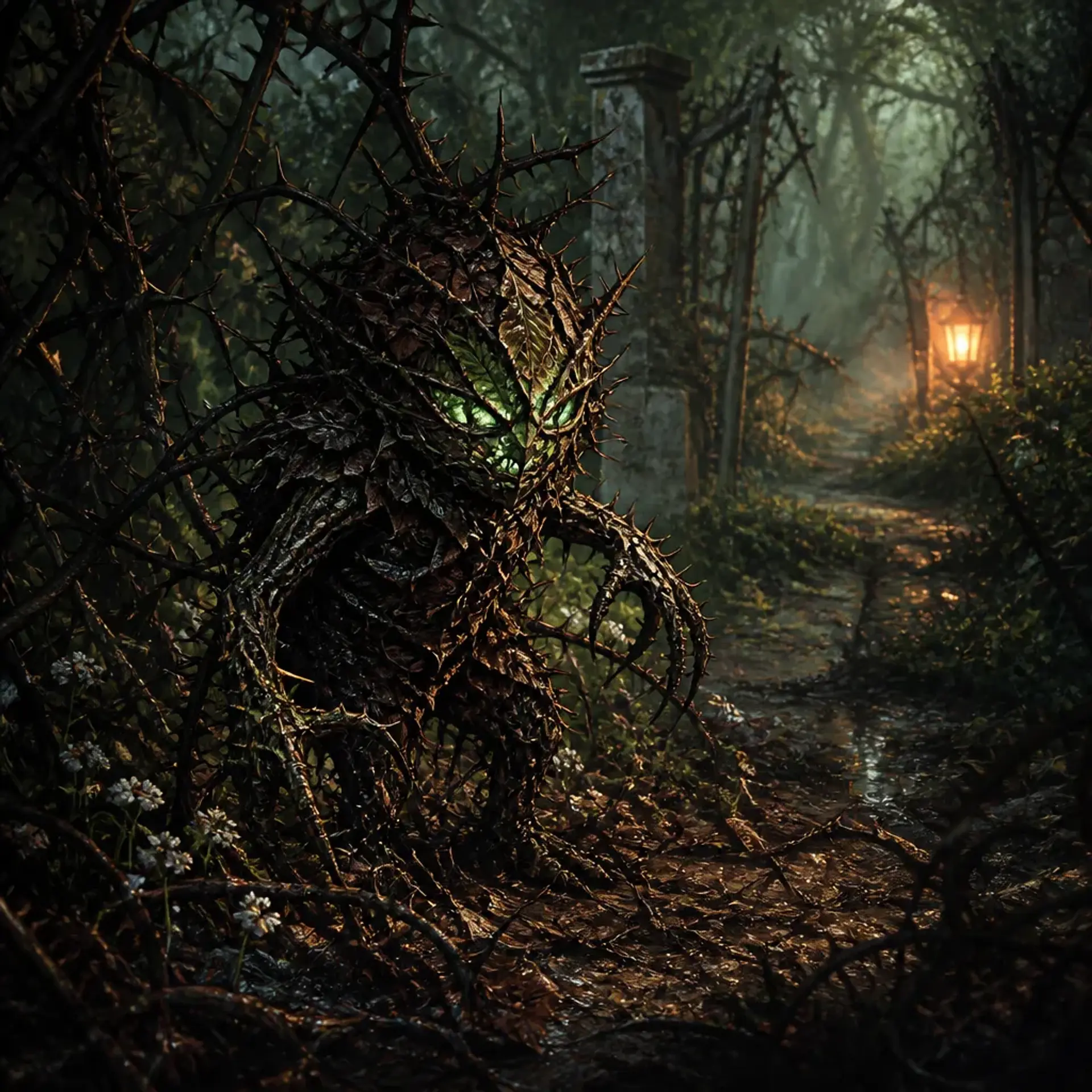
Thornling - AI-generated fantasy Monster

Thornling

Thornlings are minor servants grown by hedge witches, corrupted druids, and fey outcasts. They are not born in the usual sense. A master plants a splinter of enchanted heartwood in a place where travelers have died, then feeds it blood and whispered commands. The resulting creature retains only a crude instinct to hide, surround, and wound.

Small plant · Low individually, dangerous in groups · Uncommon

Thornling

A sinister briar homunculus used as a disposable ambusher along the Thornpath.
AC13
HP7/7
CRLow individually, dangerous in groups
Init
STR
DEX
CON
INT
WIS
CHA
ConditionsNone

Combat

AC 13 · HP 7 · Low individually, dangerous in groups

Thornling

Small plant, neutral evil
Armor Class13 (natural armor)
Hit Points7 (2d6)
Speed
20 ft.,
Climb 20 ft.
STR
DEX
CON
INT
WIS
CHA
SkillsStealth
Weaknesses
Vulnerability to fire damage,
Poor durability,
Limited intelligence,
Cannot speak or effectively negotiate without guidance from its creator
Senses
Darkvision 60 ft.,
Passive Perception 10
Languages
Understands Common and Sylvan but cannot speak
ChallengeLow individually, dangerous in groups
Proficiency Bonus+2
Passive Perception10
False Appearance. The thornling has advantage on Dexterity (Stealth) checks made to hide in vegetation, and it is indistinguishable from an ordinary clump of brambles while it remains motionless.
Claws. The thornling's claws are natural weapons. It can use its claws to make melee weapon attacks.
Vulnerability to Fire. The thornling has vulnerability to fire damage.

Actions

Claws. Melee Weapon Attack: to hit, reach 5 ft., one target. Hit: 3 () slashing damage.
Role
Minion
Built for
Levels 1 to 3

Notes for the game master

The thornling is intended to be used in groups and has low durability.
Its fire vulnerability makes torches, lantern oil, and fire spells especially effective.
False Appearance applies only while the thornling remains motionless.

Tactics

  1. Opening

    The thornlings remain perfectly still among roadside brambles until a creature passes within reach. They attack from multiple directions, aiming to surround the rearmost traveler.

  2. Mid-fight

    They scatter after their first attack, circle through brush, and focus on creatures separated from the group. They avoid open ground whenever possible.

  3. End of the fight

    The thornlings swarm an isolated target, attempting to drag the victim into dense undergrowth or beneath a thorn-covered trail marker.

  4. Retreat

    If half the group is destroyed, the remaining thornlings retreat into the undergrowth. They do not surrender, but they may abandon the ambush if exposed to sustained fire.

How it fights

Begin hidden and attack the character who walks nearest the edge of the path.
Use multiple thornlings to impose pressure from different directions rather than attacking the same target every round.
Climb trees or bramble walls to approach from unexpected angles.
Avoid fighting in open terrain unless the party is already divided.
Use their small size to slip through gaps, under wagons, or between roots.

Who it attacks first

Isolated characters
Wounded creatures
Characters carrying exposed light sources
Spellcasters who appear unable to respond quickly

Works well with

A controller or grappler can hold victims in place while thornlings surround them.
Fog, darkness, and dense vegetation make it easier for thornlings to exploit False Appearance.
A thorn witch, corrupted treant, or hostile dryad can provide the larger threat while thornlings occupy the party.

How to beat it

Fire damage bypasses much of the thornling's durability because of its vulnerability.
Bright light, careful searching, and characters moving slowly can reveal suspicious vegetation.
Forced movement and area effects can prevent the thornlings from surrounding isolated targets.
A creature that reaches open ground is much harder for thornlings to threaten.

Ways to avoid a fight

A thornling can remain motionless for hours while posing as a clump of dead brush.
It can use its claws to scratch warnings, crude maps, or symbols into tree bark.
If captured, it may be coaxed into revealing the direction of its master through repeated references to the Thornpath.

Ecology

A knee-high humanoid knot of briars, thorny roots, and dried leaves. Its clawed hands are made from hooked branches, while a pale green glow burns behind a mask of overlapping leaves. When motionless, it looks like an ordinary tangle of roadside brambles.

Behavior

Patient and nearly silent, thornlings imitate harmless vegetation until prey is close. They communicate through faint clicks in their branches and instinctively protect the territory claimed by their master.

How it lives

Thornlings form where malicious druidic magic, spilled blood, and ancient hedge roots mingle. They require little nourishment beyond moisture and decaying organic matter, but they become more aggressive near wounded creatures.

Lair

Thornlings nest beneath tangled roots, collapsed trellises, and thorn-choked trail markers. Their lairs are marked by carefully arranged piles of bones and small white flowers.

Habitat
Forests, overgrown roads, ruined gardens, hedgerows, and abandoned druidic sites.

Signs that it is near

Fresh scratches on tree trunks at knee height.
White flowers growing from old bloodstains.
Briar clusters arranged in unnaturally symmetrical patterns.
Small animal bones threaded onto thorn branches.

Tags

plant,
ambusher,
minion,
thorn,
fey-touched,
forest

Lore

Thornlings are minor servants grown by hedge witches, corrupted druids, and fey outcasts. They are not born in the usual sense. A master plants a splinter of enchanted heartwood in a place where travelers have died, then feeds it blood and whispered commands. The resulting creature retains only a crude instinct to hide, surround, and wound.

What drives it

Obey the commands of its creator, defend a claimed stretch of the Thornpath, and spread the fear that makes travelers easier to control.

After the fight

When defeated, the thornling collapses into a heap of brittle vines and black leaves. Within an hour, its remains sprout tiny white flowers that point toward the path its master used.

“A master plants a splinter of enchanted heartwood in a place where travelers have died, then feeds it blood and whispered commands.”
From its lore

Variants

Bramble Thornling: Replace its Climb speed with a burrow speed of 10 ft. through loose soil.
Blossom Thornling: Once per day, when reduced to 0 hit points, it releases a cloud of pollen. Each creature within 5 feet must succeed on a DC 10 Constitution saving throw or be poisoned until the end of its next turn.

Hooks

Plot hooks

A missing courier's blood has been used to grow a new cluster of thornlings beside a frequently traveled road.
The thornlings are only the outermost scouts of a hedge witch building a living maze around a village.
A druid asks the characters to capture an intact thornling so its corrupted heartwood can be purified.
The Thornpath Ambush occurs because the thornlings are protecting a hidden prisoner beneath the roots.

How to use it

Use 3 to 8 thornlings as ambushers along a narrow forest path.
Place thornlings among ordinary brambles, dead hedges, or piles of cut branches to showcase False Appearance.
Pair them with a stronger thorn-themed creature that directs the ambush.
Use the encounter to teach players that environmental clues and fire can matter as much as attack rolls.

Treasure

A defeated thornling leaves behind a fist-sized piece of enchanted heartwood worth 5 gp to a druid, herbalist, or fey scholar.
Its pale flowers can be brewed into a bitter tea that grants advantage on one check to identify plant creatures, but the effect ends after 24 hours.

Media

0 images

No images yet.

Visual sheet

Turn Thornling into a sheet

A high-res, share-ready sheet you can post or print.