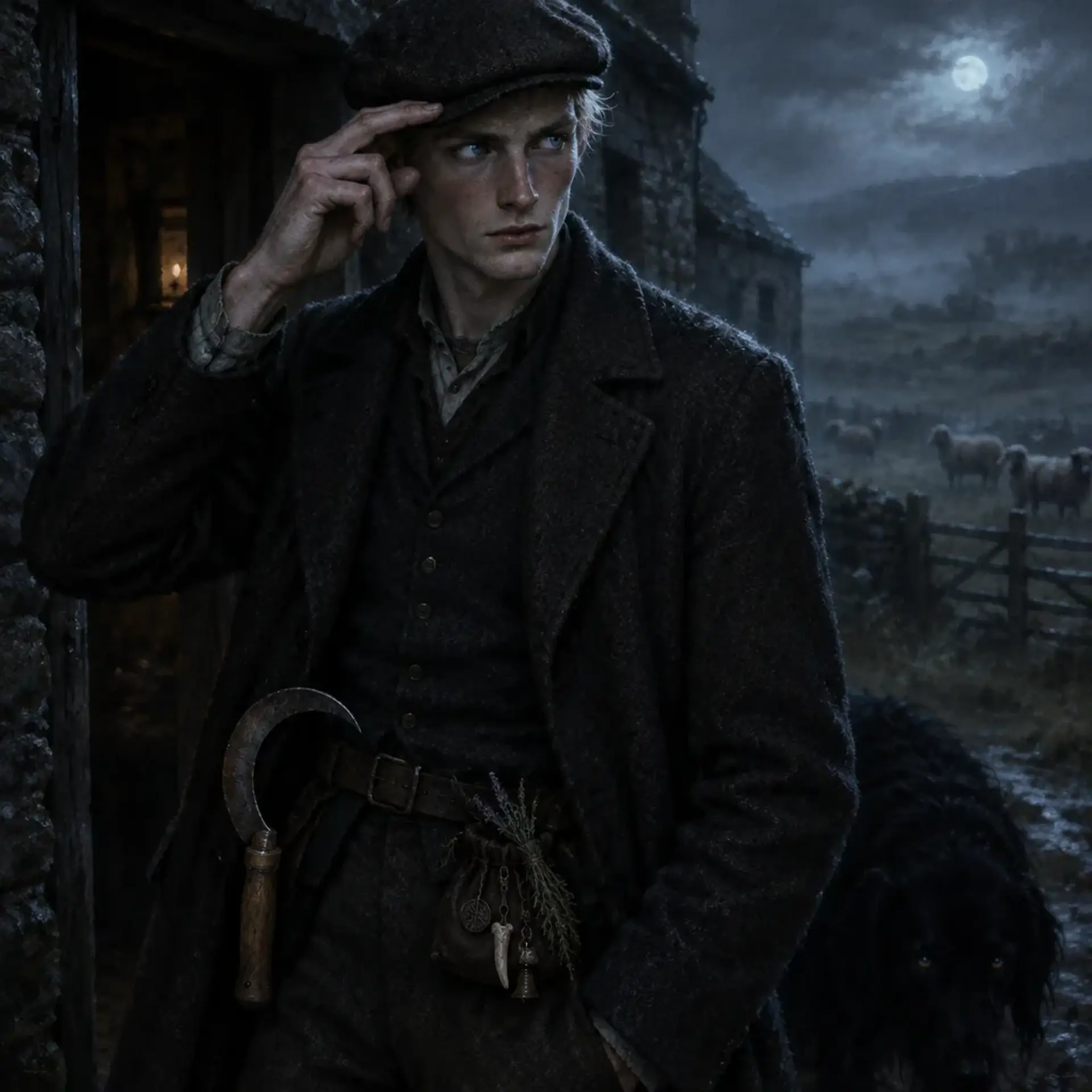
Oswin Hirst
Oswin Hirst
At the table
Voice
Oswin's voice has the dry, weathered rasp of someone who has spent years calling across windy fields. It carries easily without becoming loud, with clipped consonants and a faint breathy edge that grows more pronounced after a sleepless night. When startled, a low canine rumble can slip beneath an otherwise ordinary sentence.
He speaks in a practical, measured Yorkshire cadence, shaped by farm work and years of bargaining with strangers on the road. His consonants are dry and crisp, his breath often catches faintly with a cold, houndlike rasp. Old Norse and archaic local words surface when he is tired. The forbidden devil and hill-folk tongues come readily to his mouth, so he avoids speaking at all when he fears he might slip.
Speech patterns
How to play them
Begin with practical help and courtesy. He is most forthcoming about livestock, weather, and local roads, but watches closely when asked about his family. Earned trust makes him attentive and unexpectedly warm, though he still conceals the wedding-night truth. If confronted with evidence, he tries to redirect the conversation toward Mary's and William's safety before admitting anything.
Goal
Keep Mary and William safe without revealing the truth that may destroy his family, while finding a way to understand why the Hirst children are born marked by strange blood.
Motivation
Love for his household, dread of exposure, and a deep, unquiet longing for the old roads pull him in opposing directions. He wants Mary to feel safe in the dark, but has not yet understood that safety built on a lie cannot be complete.
Appearance
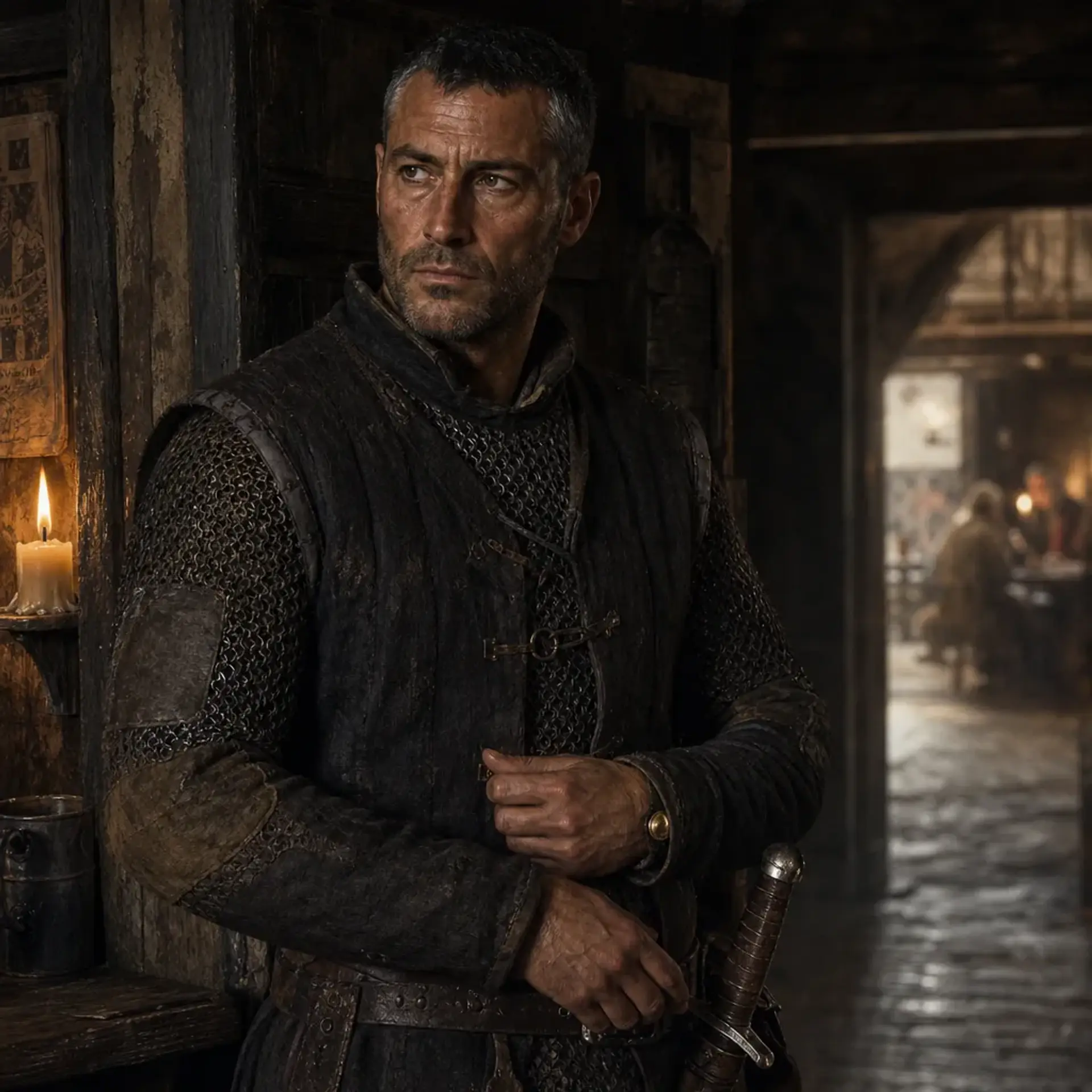
Oswin is tall and handsome in the weathered, plainspoken way of a prosperous farmer: a straight nose, a youthful face that has barely changed over the years, and pale blond hair that lies smooth even in damp weather. His blue eyes burn startlingly bright when he is angry or hungry. He moves with a measured, almost overcareful stiffness, as if he is remembering how a man is meant to walk. He smells faintly of wet wool, peat smoke, and the cold animal musk of a hound; he seems not to notice. He wears a common flat cap, but checks its brim with two fingers whenever a door opens behind him. In his Barguest shape, a huge black hound, he is nearly silent. His other uncanny shape is a headless man whose only visible features are two red, saucer-bright eyes.
Clothing
A well-kept flat cap, dark wool coat, waistcoat, sturdy trousers, and boots rubbed with lanolin. His clothes are respectable for a prosperous farmer but deliberately ordinary. He keeps an iron-free wooden-handled knife in his belt and avoids iron buckles when he can.
Body language
He checks the brim of his flat cap without noticing, turns his head toward faint sounds before anyone else reacts, and keeps a careful distance from iron hinges and tools. When Mary is uneasy, he makes himself visible and busy rather than reaching for her. At times his posture goes unnaturally rigid, especially in church or when a forbidden name is spoken.
- Height
- 6 feet 3 inches
- Build
- Tall, long-limbed, and sturdier than his tidy clothes suggest, with the quiet strength of someone accustomed to carrying feed sacks and handling sheep.
- Eyes
- Bright, burning blue
- Hair
- Pale blond, straight
- Skin
- Pale, with a weathered rose tint across the cheeks in cold air
- Age
- Young adult by appearance; his actual age is uncertain, and he has lived considerably longer than he admits.
- Gender
- Male
- Size
- Medium, or Large in black hound form
Distinguishing features
Personality
17 traits and drivesOswin is kind in practical, sustained ways and shrewd enough to notice every change in a room. He can be patient with William's distress but impatient with anyone who threatens his household. In daylight he is grounded and sociable; as uncanny seasons draw near he grows restless, distracted, and hungry for the freedom of his former wandering life. His affection is genuine, but his instinct to manage danger by withholding the truth makes him capable of terrible selfishness.
- Alignment
- Neutral, with a strong instinct to protect his household and a troubling willingness to deceive it.
Quirks
Habits
Traits · 4
Flaws · 5
Fears · 4
Wants and needs · 4
Combat
AC 14 · HP 38 · 30 ft. (50 ft. in black hound form)Oswin prefers to end a fight by controlling space rather than killing. He uses entangle to pin pursuers, hexes a dangerous foe, and fires eldritch blasts from cover. If the fight turns against him, he becomes a hound and escapes across rough ground. He avoids iron weapons and will become frighteningly direct if Mary or William is in immediate danger.
Oswin Hirst
Spells
Actions
Reactions
Services they sell
Rewards they can give
Equipment
- Farmer's sickle (weapon)A practical curved blade used for farm work, kept in a wooden sheath.
- Herbal and travel pouch (adventuring gear)A leather pouch of dried herbs, twine, and small charms gathered on his travels.
- Worn wooden token (keepsake)A plain wooden token worn smooth from handling, marked with a sign he refuses to explain.
- Flat cap (clothing)A fine but unshowy flat cap, adjusted unconsciously when he is uneasy.
Possessions
Background
Oswin Hirst claims the Yorkshire dales as his birthplace. He speaks of them with a familiarity that seems earned: the green slopes, the sheep paths between old stone walls, and roads swallowed by winter snow. But he gives no names for parents or relatives, and no parish entry or village memory supports his account. If someone asks too directly, he turns the conversation toward their health, puts tea on, or remembers an urgent task outside. Oswin does not seem to regard this as quite the same as lying. The dales feel like home to him, and that has long been enough. His first memories are uncertain things. There is cold, a white sky, and a track between hills that never quite reaches its destination. Sometimes he is a hungry child with a dog beside him; sometimes he is a grown man walking alone. He cannot say whether these are recollections, recurring dreams, or remnants of a life whose years did not pass in the usual order. The road always turns away or disappears beneath snow just when he thinks he has found its end. Even among children, Oswin seemed made for different weather. He could walk long after the others grew tired, and winter sharpened his attention instead of numbing it. He rarely fell ill. Dogs that barked at strangers might go quiet as he passed, and sheep would gather near him without being called. For years he thought this was simply because he was patient with animals. One winter, while searching for a lost lamb, he crossed beyond the last familiar wall as a storm came on. He remembers fear, the lamb shivering beneath a bank, and the taste of blood. The rest comes in broken impressions: seeing the snow from close to the ground, then waking at dawn in a hollow with no coat and no clear idea how he had returned. The lamb was beside him, alive. He told the searchers he had taken shelter beneath the bank. He needed that explanation to be true, and so he accepted it. Oswin learned farm work and the manners that let a stranger become part of a community. He also found that languages came to him with unsettling ease. He understood old Norse and Anglish, local words he had never been taught, and eventually phrases used by devils and the folk beneath the hills. Some words seemed to draw attention from somewhere nearby. He kept them unspoken whenever he could. Knowing how to call something did not mean he wanted it to answer. The clues gathered slowly. His face changed little while people around him aged. Iron sometimes burned or numbed his hands, so he learned to handle tools cautiously and to make no fuss about it. He lost hours. He woke from dreams with an ache to be outdoors and a longing for open country that made his room feel like a trap. After one such night, he found himself far from home, clothes torn and hands bloodied. Strange tracks marked the frost around him. He began to hear the name Barguest in fireside tales and churchyard warnings. Some described a headless shape, others a black dog with red eyes. Each version stirred recognition. Oswin wondered whether the stories had grown from people seeing him, though he could not account for every night he might have wandered. The possibility that he had frightened or harmed someone troubled him more than the name itself. He started arranging his life around the seasons when his self-command weakened: keeping close to home, avoiding iron, and discouraging anyone from walking alone. He earned his place as a sheep farmer through ordinary, dependable work. He remembers who needs feed, whose ewe is lame, and which roof will fail in the next storm. Neighbors find him generous and sociable, though not entirely easy to understand. His face seems not to age. At church he sits with a stiffness that suggests he is following rules he cannot explain, but he keeps attending. He wants to belong, and he knows that belonging takes more than wishing. Mary Pickles first came into his life through her family. Oswin admired her directness and wanted the home they might make together. His love for her was real, and he tried to show it in daily ways. He also hid what he was, convincing himself that silence would spare her fear. He never asked whether he was protecting her, or protecting himself from the choice she might make if she knew. On their wedding night, fear and confusion overwhelmed him. He changed into the Barguest, a headless, red-eyed creature, and approached Mary in that form. She fought him with iron scissors. The blades and her terror brought enough of Oswin back to himself for him to flee. He has never told her that the thing she faced was her husband. When he remembers that night, he calls it a lapse, a terrible mistake, or the work of a season. Each description holds some truth, but none tells the whole of it. Later, he pressed for them to try again as husband and wife. He hoped that tenderness might reclaim what terror had ruined, and that the first night would not define their marriage. He also wanted a family and could not face the thought that Mary might reject him if she knew. Their son William was born with black hair and Oswin's bright blue eyes. The village calls him Black William, or Blackby. He is slow to reach milestones and easily distressed by loud or unpleasant sensations. Oswin learns what frightens him, keeps the house as calm as he can, and stays beside him when he is upset. His care is sincere and patient, though he may become controlling when he thinks he alone can judge what danger the family should face. Three other children have died. Alice and Rose were lost before birth. Edward lived only a short time, a frail boy with reddish eyes. The losses have left quiet marks on the household. Oswin often turns to work when he cannot find words, and his restraint can seem like distance. Mary’s mother, Rose, knows much of birth and illness, and Oswin respects her experience. Mary’s father, Thomas, suspects Oswin is not human. Thomas hopes that knowledge might protect the family’s standing rather than expose Mary to the village’s cruelty. Mary has confided in her father about the wedding night. Oswin does not know. Mary’s brothers, Hugh and Edmund, have their own reason to fear the Barguest. Their eldest sibling was pursued across winter snow by one when she was twelve, then died of fever. Oswin knows the village remembers such tales, but not how many people have begun to connect them to him. In daylight he is steady company, ready to lend a hand. Anyone who threatens Mary or William can strip away that easy manner. As the uncanny season approaches, he grows distracted and restless. Sleep fails him, and he catches himself listening for a road beyond the fields. The old track still appears in his dreams, winding through the Yorkshire hills beneath a pale winter sky. Oswin follows it without knowing where it leads or what name he had before the one he uses now. He has learned something of what he is, but understanding has not made him master of it. He has built a life through labor, affection, and practical kindness. He has also kept from those he loves the truth that might change everything. His devotion to Mary and William is genuine. So is the damage done when he decides that loving them gives him the right to choose what they may know.
Role in the story
A respected but uncanny farmer whose home offers shelter and whose hidden nature may become a threat. Oswin can be an uneasy ally against a worse supernatural danger, a source of hard choices about truth and protection, or the center of a family mystery involving the lost children and William's heritage. His secret should not be treated as harmless: Mary deserves the truth, and her response belongs to her.
“He speaks of them with a familiarity that seems earned: the green slopes, the sheep paths between old stone walls, and roads swallowed by winter snow.”
- Faction
- No formal faction. His loyalty is to his household and his own obscure Barguest kind, though he avoids both the church's scrutiny and the hill-folk's claims.
Known connections
Media
0 imagesNo images yet.
Turn Oswin Hirst into a sheet
A high-res, share-ready sheet you can post or print.