Joss
Joss
At the table
Voice
In ordinary circumstances there is no voice to hear. If he sings, the sound is rough-edged and breath-worn, shaped by dock work and years of silence, but steady enough to carry a simple family round.
Joss does not speak at all. He communicates with small gestures, nods, and marks made in dirt or charcoal. In the unusual circumstance that The Latch Song is played gently, he can hum and sing, despite his otherwise complete silence.
Speech patterns
How to play them
Approach slowly and without crowding him. Keep voices calm, leave him an easy route away, and use simple gestures rather than expecting speech. An offered meal or an ordinary task can build trust. Do not force him toward the river or treat his silence as an invitation to speak for him.
Goal
To remain near Thistlefield and, someday, find a way to show Eira that he is sorry without demanding that she forgive him.
Motivation
To live quietly without causing Eira more pain, while carrying the hope that he might one day make amends.
Appearance
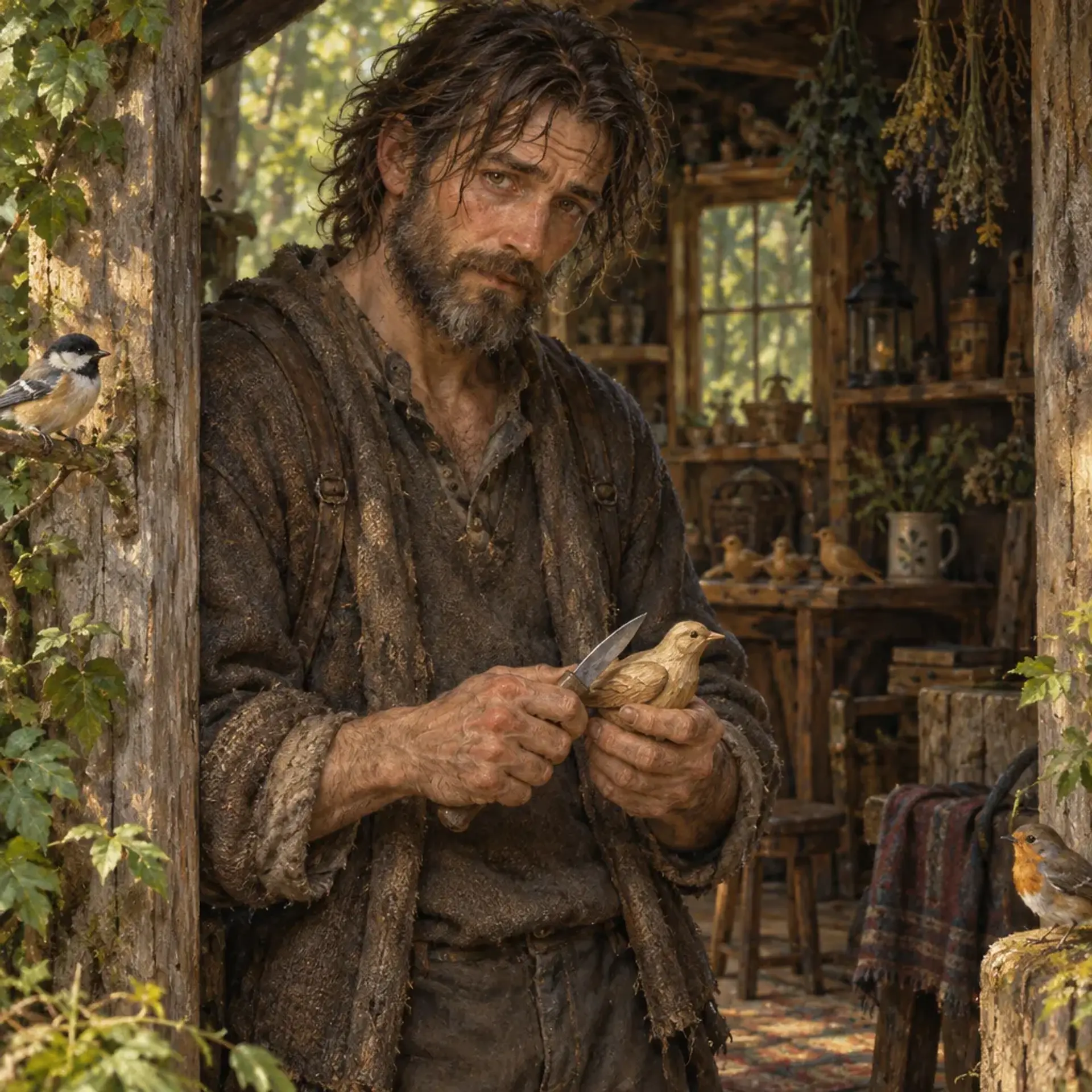
A gaunt, weathered man who seems to fold himself into the doorway of his hut, leaving the path clear for anyone approaching. His shoulders still have the broad set of a dockworker, but hunger and years of solitary living have drawn them thin. His dark hair and beard are plainly abandoned, uneven and wind-tangled, while the hut behind him is kept almost unnervingly neat. His large hands are rough, nicked from whittling, and careful with every small thing they touch. He moves with a slow, watchful economy, as if trying not to disturb the air around him. People often remember that he makes room for them before they have even asked.
Clothing
Plain, patched work clothes in faded brown and gray, a loose wool shirt, worn trousers, and scuffed boots. He keeps his clothes clean and mended even though they are old.
Body language
Joss keeps his shoulders rounded and his hands close to his body, making himself smaller despite their size. He meets a person's eyes briefly, then looks down toward their hands or the ground. He flinches at raised voices, the smell of drink, and the sound of rushing water. A few careful finger taps on his knee can mean yes; a palm turned outward means stop. When he feels safe, he sets his whittling down and turns his whole body toward the person listening.
- Height
- About 5 feet 10 inches
- Build
- Broad-shouldered from years of dock work, now gaunt and stooped, with large rough hands.
- Eyes
- Dull hazel, usually lowered.
- Hair
- Dark brown, unkempt and threaded with a little gray.
- Skin
- Weathered, pale tan with a ruddy cast from years outdoors.
- Age
- 37
- Gender
- Male
- Size
- Medium
Distinguishing features
Personality
13 traits and drivesJoss is gentle and wary at once: he offers food or help through small gestures, yet retreats if the kindness is returned too directly. He is patient with birds and careful with objects, but cannot stay present when a person is angry. In safe company he watches with quiet attention; near water, drink, or raised voices he becomes rigid and distant.
- Alignment
- Neutral Good
Quirks
Habits
Traits · 3
Flaws · 3
Fears · 3
Wants and needs · 4
Combat
AC 10 · HP 4 · 30 ft.Joss is a noncombatant. He does not attack, threaten, or pursue anyone. He retreats if possible and freezes if trapped or confronted with sudden violence.
Joss
Actions
Reactions
Rewards they can give
Equipment
- Whittling knife (tool)A plain whittling knife with a worn wooden handle, used for carving small birds and household repairs.
- Kindling (possession)A small bundle of dry kindling, kept stacked beside the hearth.
- Household basics (possession)A patched wool blanket and a few pieces of simple crockery.
Possessions
Background
Joss grew up in the cottages below the old river landing in Thistlefield. His parents worked the docks, and so did he, but music belonged to their hours at home: his mother, his father, Joss, his sister Eira and their little brother made up songs and sang rounds for the pleasure of hearing their voices meet. Their favorite was The Latch Song, a song for the end of the day with a verse for each person coming home. A week before midsummer, when Joss was seventeen, the Wend flooded in the night. The family was singing at home; he had just written a new last verse and was singing it for the first time when the water came. Joss escaped. His parents and little brother drowned. Eira, his twelve-year-old sister, had been sleeping at a friend's house uphill and survived. In the aftermath, Joss drank, drifted from place to place, and left Eira to be raised by neighbors. Neither sibling sang The Latch Song again. Years later, during a high-water anniversary, Joss returned to Thistlefield and learned that his family walked along the bank at night. Drunk and not understanding what they wanted, he went to the old landing. Their haunting song paralyzed him, he was too drunk to shake it off, and he stood inside it until dawn, when they returned to the river. It broke his mind, and he has not spoken since. He has not drunk since either. Now he lives alone in a tidy hut in the wood north of the fields, whittling and feeding birds. Villagers leave food at the wood's edge. Eira, now the village luthier, brings some too, less often than she thinks she should; she has not forgiven him for leaving her. Joss wants to make amends, but has no way to ask for them and does not believe he deserves them.
Role in the story
A tender, noncombatant survivor whose silence and the recurring river haunting connect the party to Thistlefield's grief. His hidden ability to sing the final verse can resolve the dead family's demand, but discovering it should come through patience and care rather than coercion.
“Their favorite was The Latch Song, a song for the end of the day with a verse for each person coming home.”
- Faction
- None.
Known connections
Media
0 imagesNo images yet.
Turn Joss into a sheet
A high-res, share-ready sheet you can post or print.