Andrew
Andrew
At the table
Voice
A quick, slightly breathy voice shaped by long days talking over pumps, ventilation fans, and crowded shelter noise. His consonants are crisp when giving directions; when he is tired, a rasp gathers at the edge of his words. He pauses in conspicuous places, not because he has run out of things to say, but because he is deciding what to let through.
He speaks rapidly in a bright, conversational rhythm, with Californian vowels softened by years of hurried conversation in crowded shelters. His pauses are conspicuous and deliberate, especially around personal subjects. His voice carries a slight breathy rasp after exertion, and dry air makes it rougher.
Speech patterns
How to play them
Meet his friendliness with straightforward respect. Offer practical choices rather than sympathy, and ask before touching his uniform or gills. Trust builds when people acknowledge that he can appreciate help while still hating what was done to him.
Goal
Keep Bunker 14's damp-area ventilation working, find credible information about Tavi, and build a life that is not defined by the genome therapy.
Motivation
To be welcomed without being reduced to his altered body, and to make Bunker 14 safer for people who are easy to overlook.
Appearance
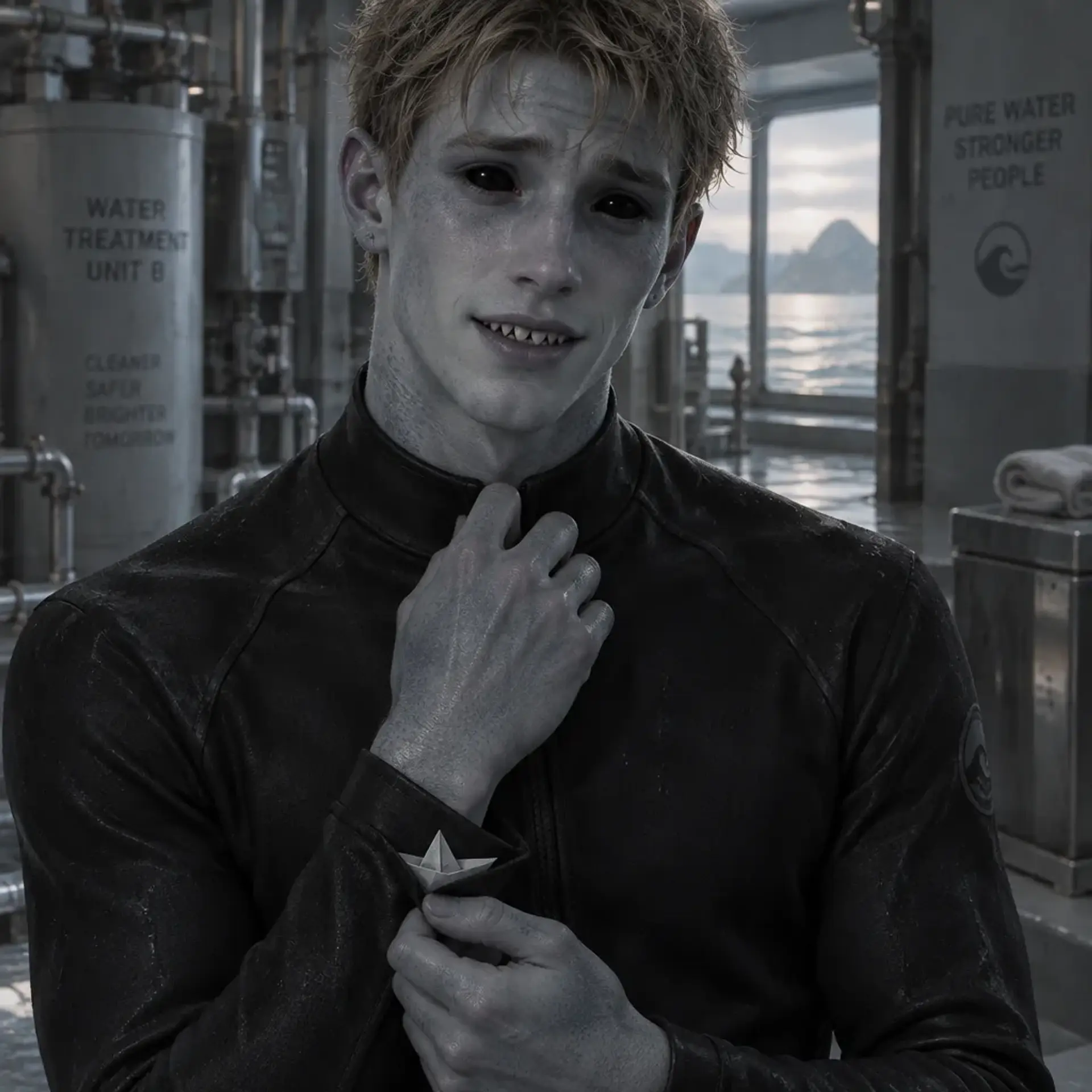
Andrew occupies a little more space than his slight frame suggests. He approaches people readily, then angles his shoulders aside as if apologizing for being there. His skin is smooth and slick, with a faintly pebbled texture along his temples and neck; under bunker lights it catches a damp shine like seal-polished stone. He has short, dark hair clipped close at the sides, black eyes that reflect almost no visible color, and rows of narrow, shark-like teeth that show when he smiles. Fine gill slits lie beneath his jaw and along his neck, where the skin flutters faintly when he is winded. His movements are quick and fluid, with sudden stillness at odd moments. Unexpectedly, he keeps a tiny folded paper flower tucked in his uniform cuff, carefully remade from ration wrappers whenever it tears.
Clothing
A sleek black, close-fitting thermal-style uniform that covers him to the neck, made from synthetic moisture-retaining fabric rather than wool. It protects his gills and keeps his skin from drying; from a distance it looks almost conventional. He wears a dark blue cross on a white armband, the only conspicuous mark on his clothes. The black garment itself has no insignia.
Body language
He leans forward when listening and uses his hands to include others in a conversation. His shoulders often turn sideways in narrow halls, a habit that reads as politeness but also keeps people from crowding him. At conspicuous moments he becomes perfectly still, then resumes talking as if the pause had been an ordinary punctuation mark.
- Height
- 5 ft. 8 in. (173 cm)
- Build
- Lean, compact, and springy, with a swimmer's economy of movement rather than conspicuous muscle.
- Eyes
- Black
- Hair
- Dark brown, cut short at the sides and slightly longer on top.
- Skin
- Pale gray with a cool, bluish undertone and a damp sheen.
- Age
- 18
- Gender
- Male
- Size
- Medium
Distinguishing features
Personality
16 traits and drivesAndrew is sociable by choice and guarded by necessity. He can talk rapidly through a room, bridging introductions and making sure a newcomer knows where the water station is, yet he lets conspicuous silences open whenever a conversation approaches the therapy or his family. His warmth is not fake; it is a skill he cultivated because he remembers how frightening it feels to arrive somewhere and be treated as a problem. Still, warmth is also a screen. He will make another person feel welcome while deciding how much they are allowed to know. In an ordinary mood, he is quick with practical questions and small jokes. He enjoys being useful, especially when usefulness does not require him to explain his body. When someone is lonely, he offers company without demanding a confession. When someone is boastful or dismissive, he can become unexpectedly blunt. He dislikes being praised for surviving the treatment, because praise can make his suffering sound like proof that the treatment was worthwhile. His anger rarely arrives as a dramatic outburst. More often, his words accelerate, then stop at a precise and uncomfortable point. He may leave rather than argue, then return later with a repair part or a clear statement of what he objected to. His grief is less controlled: a casual mention of San Francisco or a familiar ration-wrapper craft can make him go distant. He can resent people who offer easy reassurance and still long for reassurance from them. He wants independence but notices keenly when nobody offers help. Andrew has a generous instinct and a defensive streak that pull against each other. He will take a risk to help a frightened child, yet resent being called brave afterward. He wants the residents around him to trust one another, yet tests people with incomplete truths before trusting them himself. He sometimes mistakes privacy for safety and kindness for a debt he must repay. On better days, he can laugh at this contradiction; on worse ones, he performs cheerfulness until he is exhausted and then avoids everyone who might notice.
- Alignment
- Neutral good, though grief and distrust sometimes make him seem withdrawn.
Quirks
Habits
Traits · 4
Flaws · 4
Fears · 4
Wants and needs · 4
Combat
AC 10 · HP 6 · 30 ft.Andrew is not a trained combatant and tries to avoid fights. He puts barriers between danger and bystanders, uses a shove to create an escape route, and retreats toward a damp, sheltered area if his gills become irritated. If trapped, he bites once to break contact and then flees.
Andrew
Actions
Reactions
Services they sell
Rewards they can give
Equipment
- Moisture-retaining uniform (clothing)A fitted synthetic layer that retains moisture and protects the gill slits from dry air.
- Cross armband (personal item)A dark blue cross on white cloth, worn on his upper arm.
- Repair pouch (tools)A small kit of salvaged seals, tubing, and a blunt tool for minor water-system repairs.
- Paper flower (keepsake)A paper flower made from an old ration wrapper, flattened and carefully folded.
Possessions
Background
Andrew grew up in San Francisco, in a neighborhood where fog slipped between apartment blocks and the smell of saltwater reached the streets on certain mornings. Before the therapy, he was an ordinary teenager with a talent for making newcomers feel included. He remembered birthdays, carried spare snacks, and could tell when a joke had left somebody behind. His mother worked long shifts maintaining water systems; his father had already been absent from his life for years. Andrew's closest friend, Tavi, shared his habit of turning scraps into decorations and insisted that the city still belonged to its people, even when people had to leave it. When illness and food shortages made survival increasingly uncertain, Andrew's family accepted a place in a genome-therapy program. The adults described it as a chance to adapt to a changing world. Andrew understood that he was being asked to trust them, and he did. The treatment was not a single dramatic moment but a succession of appointments, tests, waiting rooms, and assurances. At first the changes were small: an unusual sensitivity to dry air, a strange tightness under his jaw, a new slickness to his skin. Then the gills became unmistakable, his eyes darkened, and his teeth changed. The program staff called his results promising. Andrew heard that word as a verdict on a body he no longer recognized. The formative event came during a transfer between facilities. A power failure shut down the ventilation system in a crowded transit shelter. Andrew struggled to breathe while a younger child panicked beside him. He could have pushed toward the open service hatch, but instead stayed long enough to guide the child to it. An attendant later praised his bravery and called the incident proof that the therapy had prepared him for hardship. Andrew hated the praise. He had helped because the child was terrified, not because he was grateful for what had been done to him. That distinction became one of the things he protects most fiercely. He was eventually assigned to Austin and placed in Bunker 14 as a Resident. He learned the routines, the ration lines, the names of the people who disliked being asked questions, and which corridor stayed damp enough to ease the irritation in his gills. His welcome is genuine. He makes introductions, explains where supplies are kept, and notices when a resident has been left out of a conversation. But he also learned that being likable makes people careless around you. He gives people comfort without giving them the whole of himself. Andrew still exchanges messages with his mother when the network allows it. Their conversations are warm until the treatment comes up, at which point both reach for explanations that satisfy neither. Tavi has gone missing somewhere in the evacuation system; Andrew keeps a brittle paper flower Tavi made from a ration wrapper, and he cannot decide whether searching for them is hope or an excuse to avoid building a life here. He has also become quietly useful to Bunker 14's water-maintenance crew, despite never claiming to be a technician. He knows how to spot leaks, remembers which pumps make which sounds, and has persuaded people to take gill irritation seriously as a health issue rather than a nuisance. His present conflict is practical as much as emotional. Bunker 14's damp-area filters are failing, and the person responsible for repairs has delayed replacing them. Andrew has begun collecting discarded seals and tubing without permission. He fears that a formal complaint will make him seem ungrateful or difficult, while silence could leave him and other residents struggling to breathe. He wants his body treated as his own, not as evidence that a program succeeded. He also wants the settlement to work. These desires clash whenever he has to ask for help from people who still describe him as a useful outcome.
Role in the story
A friendly Resident who helps newcomers settle into Bunker 14, while quietly confronting the failing ventilation and the unresolved grief of being altered by genome therapy.
“Before the therapy, he was an ordinary teenager with a talent for making newcomers feel included.”
- Faction
- Resident of Bunker 14; informally assists its water-maintenance crew.
Known connections
Media
0 imagesNo images yet.
Turn Andrew into a sheet
A high-res, share-ready sheet you can post or print.