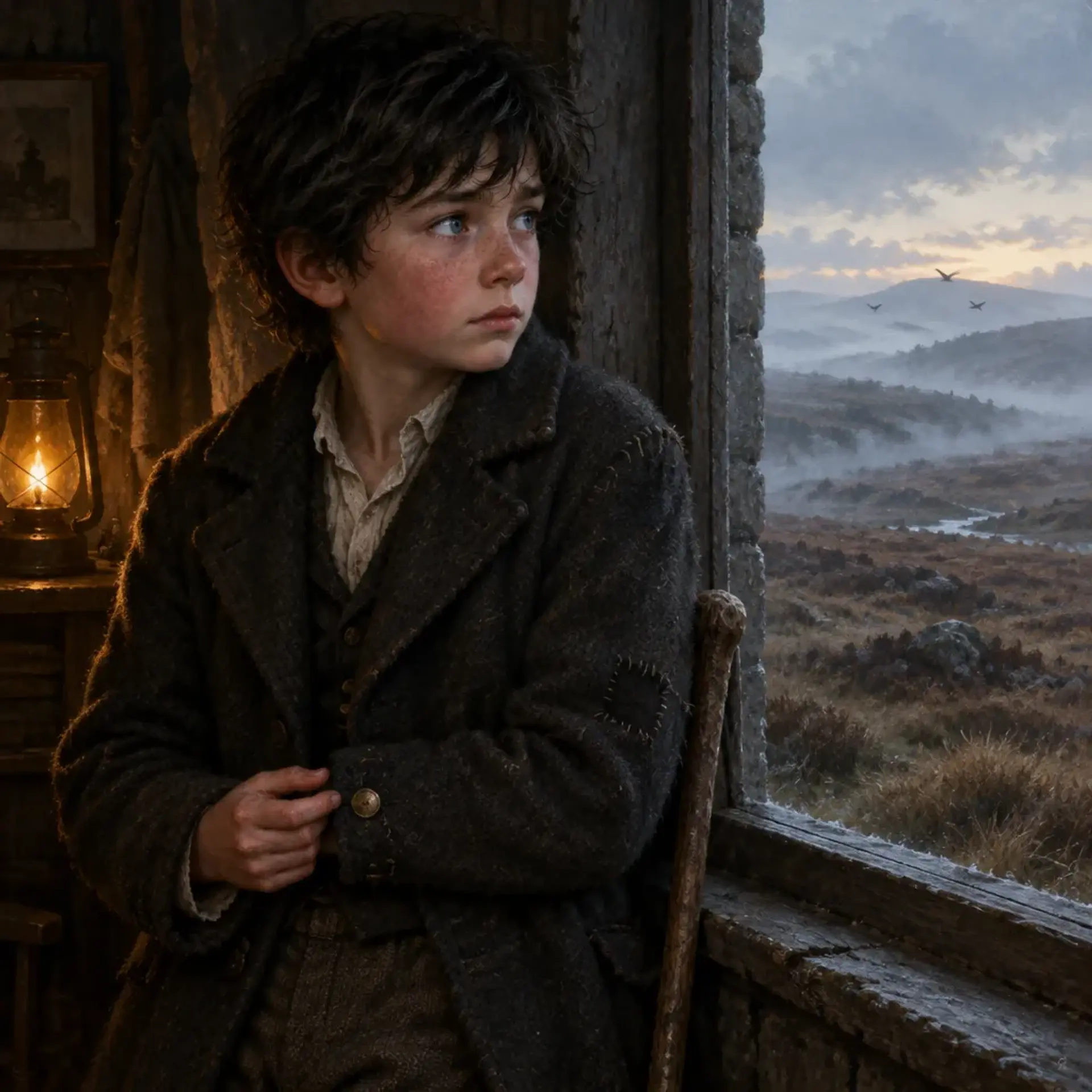
William Hirst
William Hirst
At the table
Voice
His voice is youthful and a little rough from cold mornings and calling after sheep across open ground. Words emerge carefully, with small catches where he searches for the right one. When he speaks about the moor, his delivery becomes more assured, though never loud.
William speaks in plain, concrete phrases. His thoughts often arrive before their words, so he pauses, starts again, or points to what he means. He gives fuller answers when talking about animals or the moor than when speaking about himself.
Speech patterns
How to play them
Give William time to answer and speak to him directly rather than discussing him over his head. He responds to practical tasks and patient company, especially outdoors. Do not demand that he explain the dawn calling immediately; let trust build through shared work.
Goal
Earn enough trust to take responsibility for part of the farm and prove that his quiet way of understanding the land is a strength, not evidence that he is unfit.
Motivation
To be trusted without being hurried, pitied, or treated as a question of succession before he is treated as a person.
Appearance
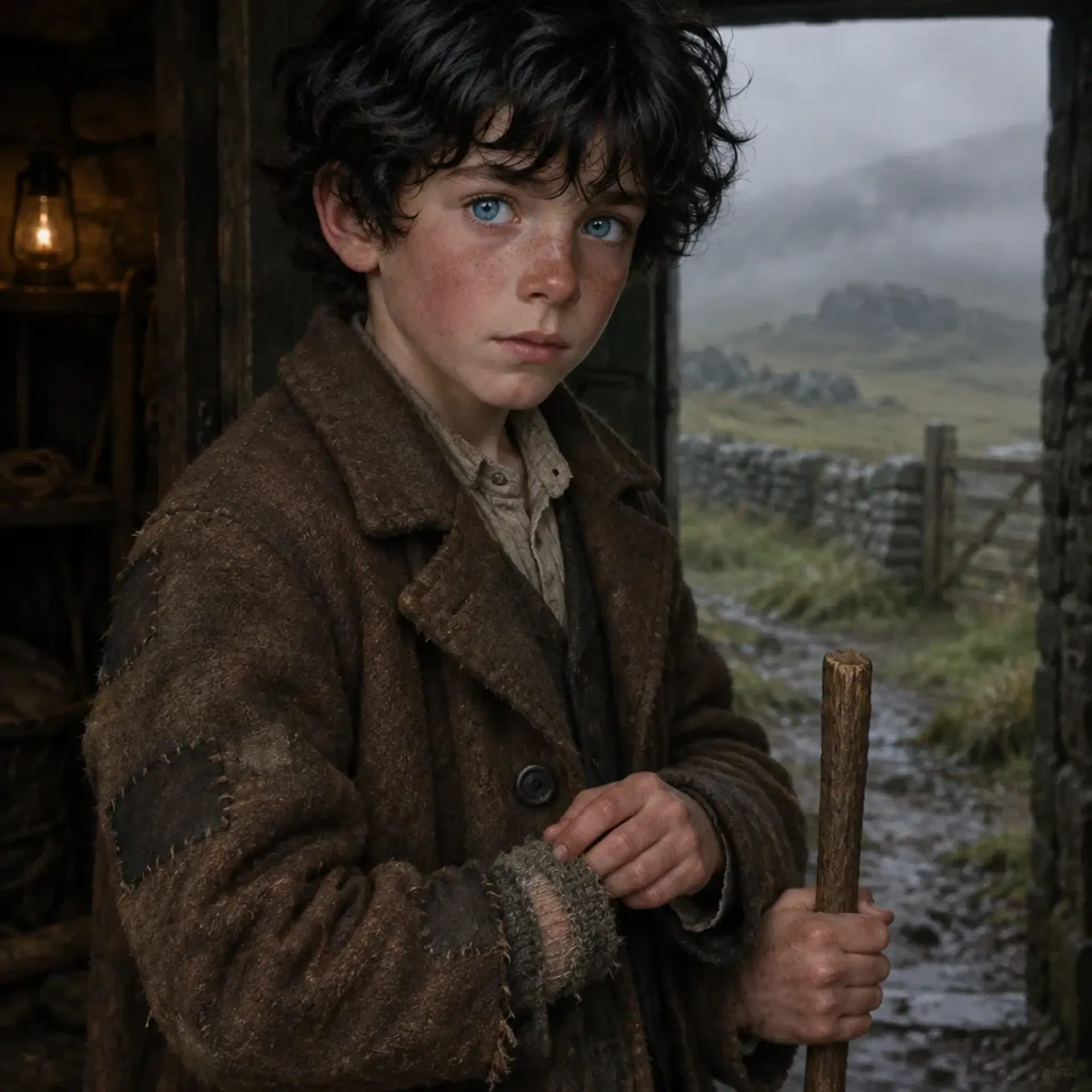
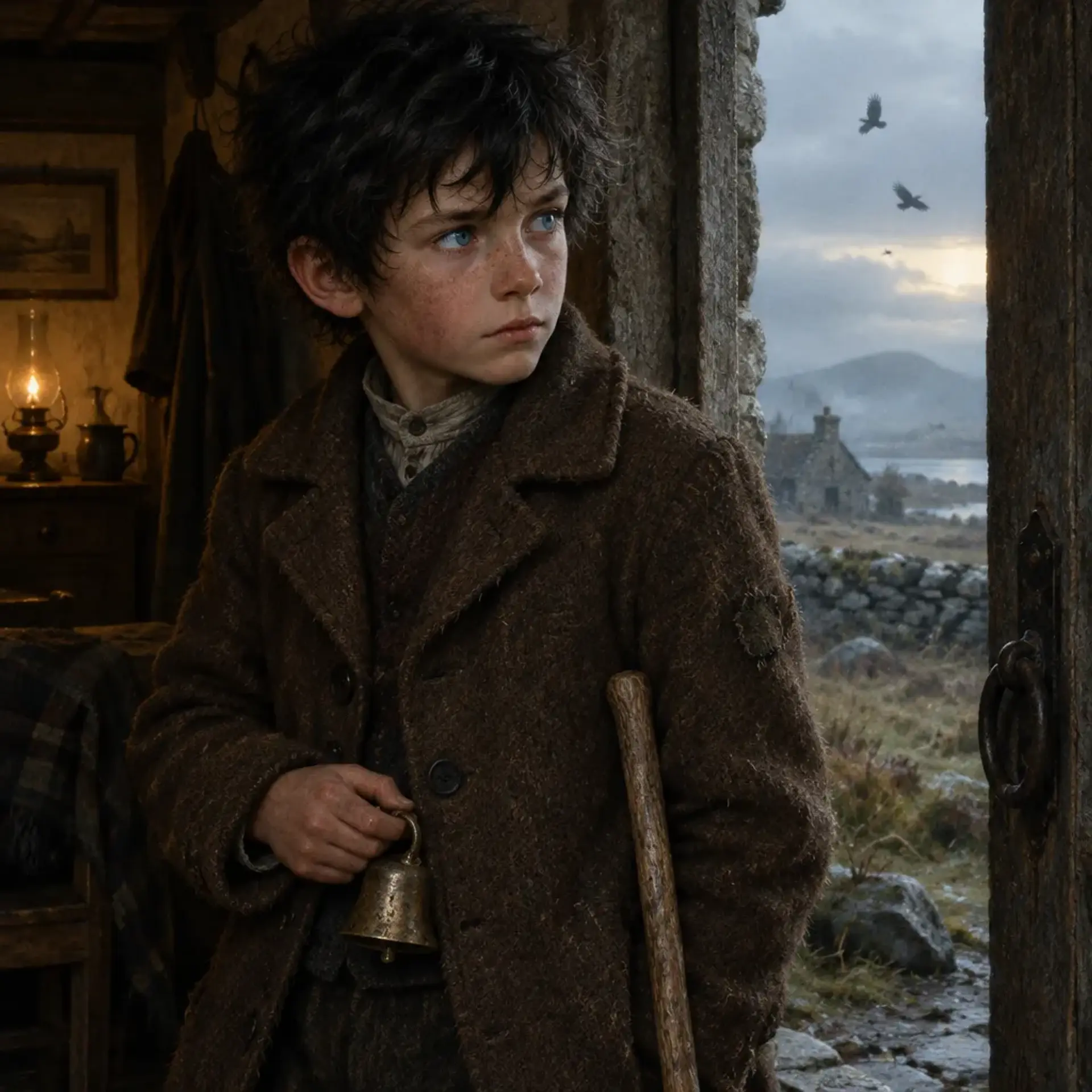
William is a slight, watchful child with a thick fall of black hair that refuses to lie flat, even after it has been combed. His bright blue eyes catch lamplight sharply, giving his still face an unexpectedly alert look. His cheeks are often wind-reddened, and the hems of his clothes carry dried grass and pale moor mud. He moves cautiously indoors, as if the house has too many eyes, but crosses open ground with unhesitating, economical steps. Within a minute, people notice him rubbing the worn brass button at his cuff whenever adults discuss him as if he were absent.
Clothing
A carefully mended dark wool coat, a pale linen shirt, sturdy breeches, and mud-marked boots. His clothes are chosen for warmth and farm work, with a brass button at one cuff worn smooth from constant rubbing.
Body language
In crowded rooms he folds inward, shoulders raised and fingers worrying the brass cuff button. Under scrutiny, his gaze drops and his jaw sets. Outdoors, his posture settles; he turns his whole body toward a sound and walks with the sure-footed care of someone reading every patch of earth.
- Height
- 4 feet 5 inches
- Build
- Small and lightly built, with the wiry frame of a child who spends time outdoors rather than a trained fighter.
- Eyes
- Bright, clear blue
- Hair
- Thick black
- Skin
- Fair, usually wind-reddened across the cheeks and nose
- Age
- 10 years old
- Gender
- Male
- Size
- Small
Distinguishing features
Personality
15 traits and drivesWilliam is observant and gentle with anyone who gives him time, yet stubbornly guarded when he feels examined. He longs for his mother's comfort but resists being fussed over; he craves his father's approval but dislikes the sharpness that often accompanies it. Among patient companions he can be quietly funny. Under family scrutiny he becomes nearly mute, while in open country he is decisive and self-possessed.
- Alignment
- Neutral Good
Quirks
Habits
Traits · 4
Flaws · 3
Fears · 4
Wants and needs · 4
Combat
AC 10 · HP 4 · 25 ft.William avoids combat and tries to get behind a trusted adult or reach open ground. If cornered, he uses his walking stick to fend off an attacker, throws a stone to distract, and calls for help. His moorwise awareness helps him notice nearby hazards, but he is a child with no formal combat training.
William Hirst
Actions
Reactions
Services they sell
Rewards they can give
Equipment
- Walking stick (tool)A plain, knotted stick used for walking over rough ground and, if forced, keeping danger at arm's length.
- Stone pouch (personal keepsake)A small cloth pouch of pebbles collected from streams and hills; he knows where each came from.
- Farm coat (clothing)A mended wool coat with one cuff button worn smooth by his thumb.
Possessions
Background
William Hirst entered the world after a labor so difficult that, for several days, the household feared Mary would die. She lay feverish in a darkened room while servants carried water and kept the fire alive. Oswin, a man accustomed to giving orders, took his newborn son in his arms with startling care, supporting the infant’s head as though nothing else mattered. The older servants still tell the story. Mary hears tenderness in it. Oswin prefers to leave it in the past. Mary’s care never faltered. She watched William’s color when he came in from the cold, made sure he ate, and noticed every cough and scrape. He loved the warmth of her hand and the quiet way she could settle him without demanding an explanation. But her concern could leave little room for his own choices. If a visitor asked what he wanted, she often answered first. If he hesitated, she offered a decision for him. William rarely objected. He lowered his eyes and let the moment pass, then wondered whether anyone had wanted to hear his answer. Oswin offered a different kind of attention. When William was old enough to ride safely, his father took him across the fields to check the sheep. He taught him to read the weather over the hills, to distinguish rain from mist, and to spot a ewe favoring one leg. William admired Oswin’s confidence and wanted his approval more than he liked to admit. Praise from his father could carry him for days. So could a sharp question. When William paused before speaking, Oswin sometimes filled the silence with a command, leaving the boy’s carefully rehearsed answer stranded in his mind. Out on the open moor, William was more sure of himself. Away from listening relatives and the pressure to explain every thought, he could pick a sound path through rough ground, turn a horse from a hidden patch of bog, or notice a sick animal before anyone else saw the trouble. His judgment came to him whole. When asked how he knew, he usually shrugged. Oswin praised a sound decision, then asked him to account for it. That could make William falter, even when he remained certain he had seen rightly. Oswin also began to restrict where William went. He wanted him close to the farm and its familiar fields, not wandering into the dales or exploring strange places beyond the old tracks. A request to take a distant path could bring an abrupt refusal. Sometimes Oswin offered a practical reason, such as bad ground or weather turning. At other times he gave no reason at all. “Stay on ground you know,” he would say, or, “There is no need to go poking about in the dales.” William could not tell whether his father feared an accident, resented the questions such journeys might invite, or knew something about those places that he would not explain. The prohibition only sharpened William’s awareness of the hills and the paths that led away from home. When William was small, he wandered from the house and remained missing long enough for a search party to spread across the fields. They found him beside a spring, dry and unharmed, sitting among the stones as if he had been waiting. Ravens gathered nearby. When the searchers approached, the birds lifted in a black rush and scattered across the moor. No one could say how William had reached the spring. He was too young to describe the route, and the ground offered no clear trace of his passage. Some called it luck. Others said he must have followed a familiar track. A few thought the ravens an ill omen. Mary held him tightly when they brought him home. Oswin questioned him until his answers dwindled into silence. Afterward, the story became another reason for Mary’s vigilance and Oswin’s rules. It also gave William’s maternal uncles, Edmund and Huge, more cause to doubt him. They already questioned whether he was fit to inherit, speaking about the succession as though it were a matter to settle without him. William caught scraps from behind doors: that he was hesitant, too easily led, too strange in his habits. No one explained the dispute plainly. He pieced it together from a measuring glance, a sudden pause, and the quiet that fell when he entered a room. There were older sorrows in the family, too. William learned in fragments that two children had been lost before birth and that a baby brother had died soon after he was born. He understood that the deaths had marked his parents, but not how. Mary’s grief could make her hold him close when he wanted space. Oswin became unreadable whenever the dead children were mentioned. William wanted to ask what had happened, but feared what the answer might tell him about why he had survived. The cruelest fragment came from an uncle who let slip a tale about Mary’s wedding night and a barghest. William never learned whether it was true, distorted, or told only to wound. He knew the name made adults exchange looks, and that his father’s silences afterward felt more threatening than before. William never asked Oswin directly. When Mary tried to draw him into the subject, he turned away, not because he blamed her, but because he could not bear to watch her face as she spoke. The rumor settled in his thoughts without becoming certainty, another closed door in a house full of them. As he grew older, William learned to appear not to listen. He noticed which cousins received a warm welcome, which servants avoided the unlit passage near the old rooms, and how the livestock’s moods shifted with the wind. With patient companions, he could be quietly funny, making a dry remark when everyone else was tense. Under family scrutiny, the humor disappeared. His answers shortened until he seemed sullen or stubborn to people who did not understand that every response felt like a test. Church was another place where William found himself watched, though he could not say by whom. He attended faithfully, knew the prayers, and took his obligations seriously, yet he grew quiet and surly inside the church. He offered the necessary responses and little more. Familiar words sometimes seemed to press against him instead of bringing comfort. He disliked the attention of other worshippers and left with his jaw tight, but he never stopped going. He held to the service with stubborn discipline, even when its closeness unsettled him. Oswin was no more at ease there. He attended when duty required it, but seemed out of place beneath the church roof. He kept his movements deliberate, avoided lingering, and watched the doors or the people around him rather than joining the congregation’s quiet. At times he stood through the service with the rigid patience of a man enduring something he could not challenge. If a priest addressed him, Oswin answered briefly and turned the conversation toward farm matters. William noticed that his father seemed more guarded in church than in any other room, and that he was especially watchful of William there. Neither of them spoke about it. William also noticed things about Oswin that no one else seemed willing to name. His father did not seem to age. Years passed, William grew taller, and the servants’ faces changed, yet Oswin’s features remained strangely fixed. William told himself that memory had made his father’s face seem the same. When he looked too long, Oswin met his gaze and spoke of ordinary things: lambing, a broken gate, the weather. The effort to make everything ordinary reassured William less than it made him feel watched. Other signs resisted explanation. Oswin avoided iron when he could, turning aside from a tool or fastening as though it were merely inconvenient. If William asked why, his father offered nothing. Sometimes he spoke with unnerving bluntness: “Do not take that beyond the old boundary,” or, “If you hear your name from the hill after dark, do not answer.” On other occasions he dismissed a strange sound as wind, a missing hour as poor sleep, or William’s questions as a boy’s imagination. He might warn William away from a path one day, then insist the same stretch of moor was perfectly ordinary the next. William could not decide whether Oswin was protecting him, warning him, or trying to keep him from recognizing something already plain. The changes sharpened as the seasons turned. At certain times of year, familiar paths seemed subtly misplaced and the old boundaries felt less certain. Oswin grew restless and watchful. His attention strayed toward the hills, and he sometimes left the house after dark, returning with mud on his boots and no explanation. At other times he became sternly deliberate, telling William exactly where not to go and what not to touch. His objections to William’s trips into the dales grew strongest then. He would forbid a journey without naming the danger, or insist that William remain near the farm until the season had passed. Mary noticed these shifts as well, though she rarely spoke of them. One evening, before such a turning of the season, Mary placed a small iron cross in William’s palm. She told him to carry it, then fussed over his collar and asked whether he had been sleeping. He kept the cross. The care in her gesture frightened him nearly as much as the warning it seemed to contain. Lately, sleep has become harder to find. Before dawn, William wakes with the conviction that something beneath the hill is calling through the earth. It is not a voice he can repeat or a sound he can prove he heard. It is pressure in his bones, a pull toward the dark slope beyond the pasture. Some mornings he sits upright before he is fully awake, already certain of where he must look. He has tried to dismiss it as a dream, but the certainty returns. He has told no one what he thinks it means. He knows how quickly unease becomes gossip, and how gossip becomes another reason to watch him. Mary has noticed his tiredness and worries over his health. Her questions are loving, but the fussing makes him withdraw. Oswin has also been searching the grounds on nights when something in his own nature seems to draw him into the dark. William has seen him return from the hills without asking where he went. His father still forbids William from venturing into the dales or other unfamiliar country, especially after nightfall. Neither father nor son has asked the other what he knows. Meanwhile, Edmund and Huge press their doubts about the inheritance, and old suspicions are sharpening into present danger. William wants a real responsibility on the farm, something he can claim because he has earned trust rather than because he is being tested. He wants his mother’s comfort without being treated as fragile, and his father’s approval without fearing the next sharp word. Beyond the house, the moor waits, and the forbidden paths through the dales draw his attention. William feels more certain in open country than anywhere else, while the call beneath the hill grows harder to ignore.
Role in the story
A child heir caught between family politics and an unexplained connection to the moor. William can be a vulnerable ally, a source of local insight, and the first sign that something beneath the hills is stirring. Protecting his agency matters as much as protecting his life.
“She lay feverish in a darkened room while servants carried water and kept the fire alive.”
- Faction
- The Hirst household and farm; no formal political faction.
Known connections
Media
0 imagesNo images yet.
Turn William Hirst into a sheet
A high-res, share-ready sheet you can post or print.