Oruv
Oruv
At the table
Voice
A low, dry resonance, like a wooden door speaking from the far end of a stone passage. His consonants click faintly, shaped by an immense age spent learning mortal speech one word at a time. Under pressure he does not raise his volume; he strips away every unnecessary word.
His voice sounds like a door's low wooden resonance carried through a stone corridor, with dry clicks at the ends of some consonants. It carries the measured patience of someone accustomed to hearing testimony and the blunt economy of a being who remembers when language was new. He does not whisper when angry; his words become shorter and more literal.
Speech patterns
How to play them
Treat Oruv as a patient negotiator, not a tempter who relies on trick wording. He explains any pact in terms the listener can understand and waits for an answer. Players can bargain, refuse, question the history behind a claim, or seek evidence that a pact was not truly informed. He respects clever objections and will honor a corrected agreement, but does not casually waive a clearly accepted price.
Goal
Learn whether a soul can choose to give itself away and later change its mind without making the original choice meaningless.
Motivation
To preserve the meaning of choice by ensuring that every pact is freely understood, accepted, and honored, while discovering whether an irrevocable consequence can coexist with a change of heart.
Appearance
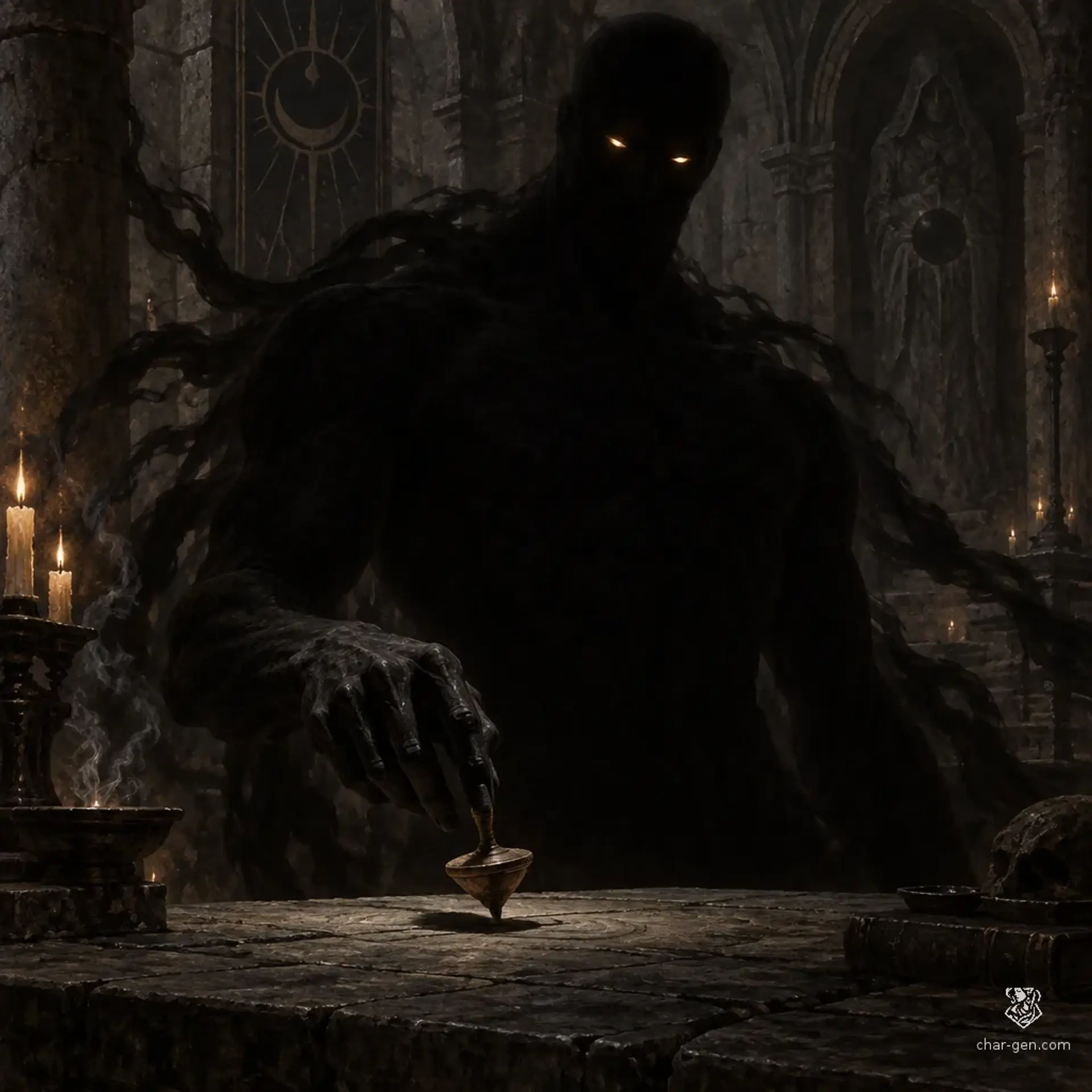
Oruv appears as a human-shaped absence, a standing patch of complete shadow whose edges drink in nearby light. Two round yellow eyes burn within it, steady as lamps seen through smoke. The darkness has a faint grain, like velvet rubbed against the nap, and it shifts a fraction later than his movements, as if the world is slow to agree he has moved. He stands with the stillness of a closed door, then crosses a room in one clean, soundless glide. Within a minute of meeting him, most people notice a smell of cold extinguished candles and wet stone. Oruv seems unaware of it. Unexpectedly, he carries a small wooden spinning top and idly sets it turning whenever a bargain is refused.
Clothing
He wears no discernible garments. At times, a few strips of shadow hang from his shoulders like the memory of a formal mantle, but they are part of his shape, not fabric.
Body language
His silhouette never fidgets, but the yellow eyes track small movements with unnerving precision. When listening, he angles his head as if measuring the distance between a person's words and their intention. He sets his wooden top spinning before answering a refusal, and watches it until it falls.
- Height
- Approximately 7 feet tall.
- Build
- A tall, broad-shouldered outline with no visible anatomy; his apparent mass seems to deepen when he is displeased.
- Eyes
- Glowing yellow, like lamplight behind smoked glass.
- Hair
- None visible.
- Skin
- None visible; his entire form is an opaque shadow.
- Age
- Ancient beyond any calendar; he existed before the world had a sky.
- Gender
- Male
- Size
- Large
Distinguishing features
Personality
15 traits and drivesOruv is scrupulously patient with anyone deciding whether to trust him, but ruthlessly exact once a bargain is accepted. He is fascinated by mortal acts of selflessness, yet regards most unpriced generosity as a dangerous refusal to understand consequences. In a calm conversation he is almost conversationally practical; when threatened, he becomes direct and implacable rather than louder or more theatrical.
- Alignment
- Lawful evil, though his sense of law is the exact keeping of freely accepted terms.
Quirks
Habits
Traits · 4
Flaws · 4
Fears · 3
Wants and needs · 4
Combat
AC 20 · HP 300 · 40 ft., fly 40 ft. (hover)Oruv begins by offering a way out, especially to anyone who has already accepted a pact. He uses darkness and positioning to separate opponents, then targets healers and spellcasters with Eclipse Bolt. He avoids attacking a willing vessel unless the host has knowingly agreed to fight alongside him. Against a determined group, he uses Before the First Dawn to disrupt the formation, reserving legendary actions to move or strike between turns. He withdraws if the fight threatens to destroy a host he values or expose the terms of an ancient pact.
Oruv
Spells
Actions
Reactions
Legendary Actions
Services they sell
Rewards they can give
Equipment
- The Queen's Top (keepsake)A worn wooden top from the vanished queen's bedside. Its whirling sound cannot be heard, but its motion casts a tiny, sharply defined shadow.
- Pact Stylus (custom wondrous item)A plain iron stylus used to mark the terms of pacts on any surface. It leaves no mark unless both parties have agreed.
Possessions
Background
Before there was a world to cast a shadow, Oruv was the dark around the unmade things. He remembers the first star as a wound in the night and the first living mind as a question that did not know it was asking. When the planes settled into their present order, he found that creation had given its inhabitants one resource he had never possessed: a finite life, and therefore a choice that mattered. He learned to bargain for souls, not because he needs them to survive, but because a freely offered life is the one thing the first darkness cannot make for itself. In the mortal world he once offered a dying queen enough years to finish a war. She accepted his price, then spent those years building hospitals instead of armies. Her choice changed his understanding of what a soul could contain. He kept his side of the pact and, secretly, preserved the queen's last memory in his wooden spinning top. Since then, he has sought willing vessels rather than treating bodies as property. That restraint is sincere, but it is not kindness: he believes a choice is sacred precisely because its consequences must remain real. He currently courts the trust of Ilyet Vask, a mortal archivist who has found evidence that Oruv's earliest pacts were written before mortal languages existed. Ilyet wants to expose the terms of those bargains and free the dead. Oruv has become attached to her stubborn questions, while knowing that the truth could dissolve the oldest claim he still holds. Meanwhile, the star-priesthood of Kett Var is hunting him, convinced that destroying him will restore the souls he has claimed.
Role in the story
A powerful patron, uneasy antagonist, or cosmic negotiator whose offers create genuine moral choices. Oruv can provide a costly route to victory, become an ally against a worse threat, or stand against characters who try to break a pact without addressing the promise behind it.
“He remembers the first star as a wound in the night and the first living mind as a question that did not know it was asking.”
- Faction
- No allegiance to the Nine Hells or any mortal faction. The star-priesthood of Kett Var considers him an enemy; a scattered body of claimed souls considers him their custodian.
Known connections
Media
0 imagesNo images yet.
Turn Oruv into a sheet
A high-res, share-ready sheet you can post or print.