Charlie Frost
Charlie Frost
At the table
Voice
A lightly rough voice with a dry, breathy edge, shaped by outdoor work and years of speaking over wind and livestock. His words carry an uneven rural cadence: easy and warm when he is at home, clipped and factual when he is describing danger. When an old memory surfaces, he sometimes loses the rhythm of his sentence and leaves a space where a name ought to be.
His speech is plain and work-shaped, with the measured phrasing of someone used to giving instructions over wind, animals, and machinery. He gives strange events practical names, such as 'the lights over the east field' or 'the voice in the pump shed.' His Shropshire roots show in his vowels and local turns of phrase, though long years and interrupted memories have blurred his accent. He uses short sentences when frightened and gives excessive detail when trying to convince himself of something.
Speech patterns
How to play them
Approach him without ridicule, give him time to explain what he saw, and ask specific questions about locations, dates, and physical evidence. He responds well to practical help and poorly to being told his memories are nonsense. If he is frightened, offer a concrete task and keep him away from isolated crossroads or places where he feels watched. Do not assume his alien theory is the whole truth.
Goal
Recover enough of his lost memories to understand who took him, while keeping his family safe from whatever follows him.
Motivation
To feel that his life belongs to him, to learn what his family has hidden, and to keep the people he loves from being drawn into the strange lights and voices.
Appearance
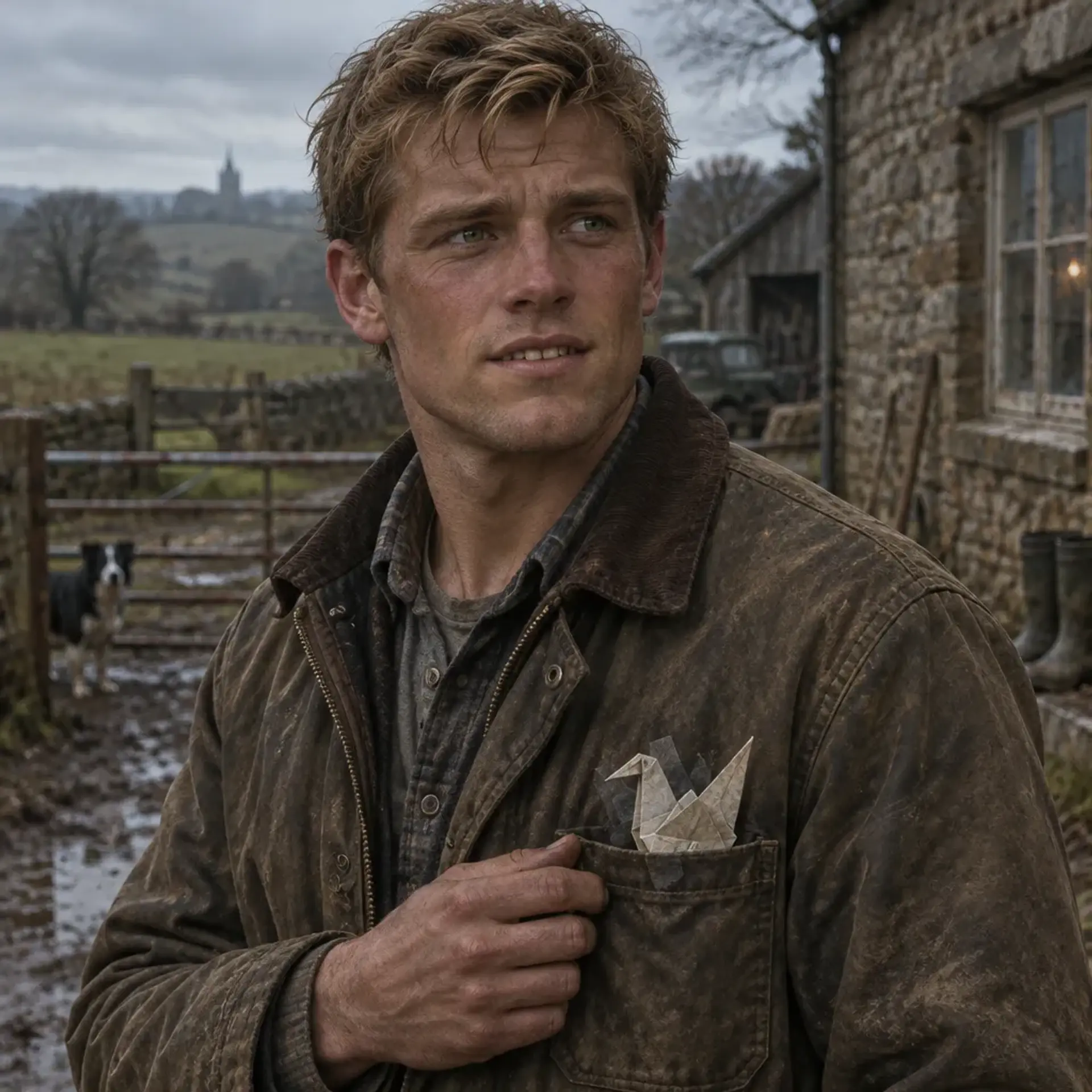
Charlie Frost is a fine-looking young man of about five feet ten, broad through the shoulders without looking sculpted, with the compact strength of someone accustomed to lifting sacks and turning stubborn soil. His blond-brown hair is coarse and wind-ruffled, usually falling forward in a lock he pushes back with the heel of his hand. His green eyes have a clear, ordinary brightness until a strange light appears; then they seem to hold its reflection after it has gone. His skin is weather-browned, with pale lines at the wrists from years of shirt cuffs and field work. He moves with a veteran's economy: feet placed quietly, back turned to walls only after checking the room, and a habit of testing the ground before trusting it. In laughter, he shows a slightly crowded upper row of teeth and a square jaw that shifts as though he is working a tough crust. A small, oddly unexpected detail for a farmer and veteran is the folded paper bird he keeps tucked in his breast pocket, carefully repaired at its creases and never explained. People remember the combination of capable young farmer and watchful man who seems to be listening to a second conversation.
Clothing
Practical 2026 country clothing: work trousers, a weathered jacket, boots with dried mud in the seams, and a plain shirt. He keeps an old folded paper bird in his breast pocket. In colder weather he wears a wool scarf that smells faintly of lanolin and woodsmoke.
Body language
He plants his feet as if testing soil, rubs a thumb along the seam of his pocket, and watches doorways without turning his head. When frightened, he smiles too quickly and sets his jaw. When the boggart impulse rises, he leans forward and becomes suddenly nimble, as if the room has become a game.
- Height
- 5 feet 10 inches
- Build
- Sturdy, work-hardened, and compactly muscular.
- Eyes
- Green
- Hair
- Blond-brown
- Skin
- Weather-browned, with lighter bands at the wrists.
- Age
- Appears 20; his true age is uncertain and may span centuries.
- Gender
- Male
- Size
- Medium
Distinguishing features
Personality
17 traits and drivesShorpy is warm in an unshowy way and suspicious in a way he dislikes about himself. He will mend a fence, carry a heavy sack, or sit through a relative's bad mood without demanding thanks, yet he can turn cold if someone laughs at his account of the lights. He wants to believe people are basically decent, but his years of conflict have taught him to look for the exit and count the people in a room. In company he can be easygoing and dryly funny. Alone, he checks his notes, listens for sounds no one else hears, and worries at the gaps in his memory. He is not simply brave or timid. In a practical emergency he can act with startling calm, especially if someone else needs help. Afterward, when the danger is over, he may shake, become irritable, or insist that it was nothing. He tolerates pain better than uncertainty. A wound has a cause; a voice in an empty room does not. He can discuss military hardship with blunt detachment, but becomes evasive around family stories and childhood. When a dream touches a lost memory, he sometimes grows unexpectedly tender, then covers the tenderness with a joke. His belief in aliens is sincere but not stable. Some days he speaks of visitors as a plain fact, drawing diagrams on scraps of paper and explaining the lights as if he were describing a broken tractor. Other days he admits that the word is only a label for things he cannot explain. He is embarrassed by that uncertainty and can become stubborn when people press him. He does not want to be treated as a fool, yet he fears that a professional examination would confirm that something is wrong with him. He sometimes tests other people by mentioning a small, strange detail and watching whether they dismiss it. He regrets doing this afterward. Shorpy's strongest tenderness is for family, although he is not always good at showing it. He worries about his siblings and tries to help them without asking permission. He understands that Mary is practical rather than magical, but he sometimes lets his brothers' teasing about her being a witch amuse him, then steps in when it goes too far. He admires Philp's work ethic while finding his bragging exhausting. He feels a kinship with Wilt that can become resentment: Wilt denies his own strange nature, while Shorpy is consumed by his. He is cautious around Thumber's scar and old border stories because they make his own war memories feel too close. He wants to know what their father knows, but is afraid that asking would make him answer. There is a childish streak in him that is not merely immaturity. He can be delighted by a well-made paper figure, a muddy puddle, an animal's absurd expression, or a joke that makes no sense to anyone else. This quality makes him approachable, but it has a dangerous underside. When the boggart nature rises, delight becomes a hunger to disrupt. He may feel joy at the thought of making a house creak, hiding an object, or frightening someone who has done nothing to deserve it. He can recognize that the impulse is wrong and still find it difficult to resist. The joy is not a lack of conscience; it is a force that temporarily makes consequences feel distant and other people's fear seem like part of the entertainment. He dislikes authority when it speaks with false certainty. He is more likely to cooperate with someone who admits what they do not know than with someone who claims to understand him after one conversation. He responds to direct kindness, especially when it is practical and unadorned. A meal, a ride, or help fixing a gate will reach him more quickly than praise. He dislikes being pitied and may answer sympathy with a joke that sounds harsher than he intended. When calm, he is patient, observant, and surprisingly good at listening. He remembers the small facts people mention, though he may forget what day it is. When angry, he does not become quiet or polite. His words grow blunt, his jaw works, and he starts naming practical consequences: who will have to repair the thing, who will be frightened, and who will be blamed. He can be frighteningly matter-of-fact. Once anger passes, he often tries to make amends through work rather than apology. He wants a normal life but does not know what normal would mean for someone who may not age as others do. He is proud of being useful and ashamed of needing help. He can be fiercely protective, but protection can turn into secrecy. If he believes a strange event threatens his family, he may leave without telling them, convinced that distance is safer. This can make the people he means to protect feel abandoned. The Christmas mirror incident increased his distrust of his own senses. Before it, he could tell himself that the lights and voices were external visitors. The reflection showed him a version of himself that felt older and more intimate than any alien. He has never settled on what it meant. He is careful around mirrors now, but not so afraid that he avoids them altogether. Sometimes he looks into one deliberately, hoping the truth will show itself again. Afterwards he is ashamed of the hope. The three days around May Day pull these contradictions into a single dangerous pattern. Shorpy feels elated and clever, as if the world has finally stopped being heavy. He becomes quick to laugh and quick to act. He may lead people on a harmless chase, then discover too late that he has taken them somewhere frightening. He can still feel affection during this period, but affection becomes possessive and playful rather than careful. He is not proud of the things he does. Once the period ends, he may remember an event clearly and still feel that it belonged to someone else. He wants his family to hold him accountable without treating him as a monster, a balance that neither he nor they have mastered.
- Alignment
- Not applicable as a Call of Cthulhu statistic. Shorpy is protective, erratic, and capable of cruelty when his boggart nature takes hold.
Quirks
Habits
Traits · 4
Flaws · 4
Fears · 5
Wants and needs · 4
Combat
HP 13 · Human walking and running pace; use standard Call of Cthulhu 7E movement rules for a human adult.Avoids violence if possible and uses cover, distance, and a clear escape route. If cornered, he fights with the grim economy of a veteran, using a farm tool or firearm rather than grand gestures. He does not understand his supernatural nature well enough to use it deliberately; during the May Day episode he may make reckless choices instead of tactical ones.
Charlie Frost
Actions
Reactions
Services they sell
Rewards they can give
Equipment
- Work jacket (clothing)Worn country jacket with deep pockets, practical and weather-stained.
- Paper bird (personal keepsake)Folded and repeatedly repaired paper bird, kept close and treated as precious.
- Service rifle (weapon)Old service rifle, only carried when circumstances make him expect serious danger. Use the appropriate Call of Cthulhu 7E weapon listing for exact firearm damage.
- Notebook (personal)A pocket notebook filled with dates, sketches of lights, and notes about dreams. Several pages are missing.
Possessions
Background
Shorpy's history is not a clean sequence of dates. It is a chain of fields, winter quarters, houses abandoned in haste, and family names he remembers as if they belonged to neighbors. He says he was born in Shropshire during a time when the kingdom of Merica fought the Welsh kings. The story changes in its details but not its central images: a mother who grew weaker after giving birth, a father who was a brutal raider rather than the woman's husband, and a child treated as an unfortunate bastard before anyone had time to decide what else he might be. He remembers smoke near a byre, a wet wool blanket, and his mother's breathing. He cannot say whether those are memories, inherited stories, or things he has learned to dream. He has always felt that Shropshire was more than the name of a place. In the oldest layer of his memory, the land itself is a body under his feet: fields, hills, churchyards, and border tracks held together by old arguments. He grew up among siblings who seemed to move forward through time while he did not. They became adults, changed their clothes, changed their voices, and lost the unguarded quality of childhood. Shorpy stayed slight and childlike in his manner and appearance for years, then at some point became the young man people see now. He cannot account for the transition. When he asks relatives about it, they remember different versions or change the subject. He worked as a farmer and sheep hand, and fought in wars whose names he sometimes knows and sometimes confuses. He remembers a campaign as mud, fever, bad bread, and a friend gone missing during a night march. He remembers a different conflict as a line of men walking toward a ridge beneath a sky full of cold sparks. That memory may be the beginning of his present explanation for the impossible: aliens. The word gives him a framework. Strange lights are craft, voices without bodies are transmissions, and missing hours are abductions. He has repeated the explanation so often that he sometimes sounds convinced. When the fear breaks through, he admits he does not know what took him, or whether anything did. At some point after losing his first family, he was taken by the fae. Shorpy does not recognize this account as true. His mind has furnished a different story: visitors came, lights moved over the fields, and he was carried away by beings from beyond the sky. He has gaps where the taking should be. Iron hurts him unpredictably, and certain old thresholds or crossroads make him feel watched. He has woken in places he cannot remember entering, with mud under his nails and a sense that he has just finished a joke that nobody else heard. When asked about his nature, he says he is human, though he accepts that he is unusual. He does not know he is a boggart changeling, nor that the story of being born human and later taken may be more than a way to describe trauma. His dreams sometimes open passages into memories he cannot consciously reach. One recurring dream begins in a narrow room with a low ceiling and a cold hearth. A woman lies beneath a grey blanket. Shorpy is small enough to be carried, and the room smells of milk, damp wool, and crushed mint. Someone outside laughs once, then stops abruptly. A man with mud on his boots says the child is not his. The dream does not end there. A second figure appears at the doorway, too tall for the frame, with a face that keeps changing as Shorpy tries to look directly at it. The figure offers a bowl of porridge. In the dream, the woman takes it and tells him not to follow. He wakes with his hands clenched and a strong taste of iron in his mouth. He has not told the family the whole dream. In 2026 he goes by Charlie Frost, a name that suits official forms and lets him move through ordinary life without explaining centuries of contradictions. He has a new family: other personifications of English counties, his brothers and sisters, who know that kinship does not always make people safe for one another. Their father is a sorcerer, and by county tradition Shorpy avoids him. Shorpy has not made peace with that rule. He feels the pull of family and the suspicion that the father knows what happened to him. His siblings include Wiltshire, called Wilt, a black-haired man of about his height whose eyes look like a pond under a full moon. Wilt denies being a changeling, even in the face of things neither brother can explain. Northumberland, or Thumber, is a blond border man with dark blue eyes and a scar from old fighting; he has fought both with and against others. Cumberland, called Cyril, is a shorter-tempered presence with light reddish-brown hair, freckles, and green eyes. Westmoreland, called Mary, is a practical northern woman with red hair and freckles, kind enough to mend a family's clothes and sharp enough to dislike being called a witch by her brothers. Hampshire, called Philp, has worked at sailing, ship labor, and metalwork; now that he has money, he works long hours to keep it and brags about his progress. Kent, called Ken, is a gardener for wealthy people who is middle-class and keen to pass for higher status. Shorpy's current problems are practical as well as supernatural. He is trying to keep a steady life while memories interrupt it. He is trying to find out whether Wilt and Ewan were taken as well, though he treats Ewan's possible alien nature as an open question. He wants the family to stay together, yet he fears that being near them makes the strange events worse. He has had to explain unexplained noises, lights, and absences to people who would rather call him tired or unwell. He is afraid that a record of his disappearances would put him under someone's scrutiny, but he also keeps notes because he fears forgetting again. One Christmas party with his current family changed the way he thought about the mirror. The gathering was loud with food, arguments, old jokes, and a fire that kept threatening to smoke. Shorpy was carrying a tray past a tall mirror when the room behind him appeared to shift. In the glass he did not see a young man in a worn shirt. He saw something shorter and older in its wrongness, a shadow-limbed figure with a shifting outline, too much dark in its mouth, and a face that seemed to borrow the features of whatever family member looked back at it. The reflection smiled when he did not. His hand tightened on the tray until the crockery rattled. When he turned around, everyone was still in the room. When he looked again, the mirror showed Charlie Frost. He made a joke about the lighting, but Wilt noticed his hands shaking. Mary quietly put the tray down before he dropped it. Shorpy has never told them exactly what he saw. May Day is worse. For three days around the old spring festival, the first three days hit him like a hammer to a nail. He feels a pressure in his chest and skull, followed by a giddy, unnatural joy that makes every rule seem like a challenge devised for his amusement. The world becomes vivid and full of possibilities. He wants to make a gate open the wrong way, hide a neighbor's tools, spook a horse, and laugh when someone tries to catch him. Sometimes the impulse turns darker: an urge to lure someone off a familiar path or frighten a family until they leave a house. He knows these urges are not kind. He has tried to lock himself in a room and has tried to spend the days with Mary, who will not let him pretend that the delight is harmless. Afterward he is exhausted and ashamed, often with incomplete memories. He tells himself it is a seasonal illness or a response to the lights. He has not yet connected the joy to the boggart nature he refuses to see.
Role in the story
A troubled ally, witness, and possible source of supernatural danger. Shorpy can help investigators connect strange lights and missing time to older folklore, but his own memories are unreliable and his May Day episodes may endanger the people trying to help him.
“It is a chain of fields, winter quarters, houses abandoned in haste, and family names he remembers as if they belonged to neighbors.”
- Faction
- The family of English county personifications. He has no formal investigative or occult organization affiliation.
Known connections
Media
0 imagesNo images yet.
Turn Charlie Frost into a sheet
A high-res, share-ready sheet you can post or print.