Friedreich
Friedreich
At the table
Voice
A dry, close voice with a faint rasp like wool dragged over a rough board. It carries the precise rhythm of someone trained to give and receive orders, softened by long years of speaking to people who cannot always hear him. When using a borrowed face, his voice gains breath and resonance, but the careful pauses remain.
He speaks with a strong German accent shaped by Prussian schooling and military formality. His German sounds clipped and carefully articulated; when searching for a memory, he repeats a noun as if checking it against a report. Borrowed faces change his accent only slightly, because his cadence and choice of formal phrasing give him away. He does not become quieter or more polite when angry: anger makes his consonants hard, his sentences shorter, and his questions more direct.
Speech patterns
How to play them
Treat Friedreich as a person, whether or not he is currently visible. Ask before touching his uniform, blade, or face list. He responds well to ordinary invitations and clear agreements. If he becomes angry, name what he is doing without humiliating him; remind him that he can leave. Never treat possession as a trick or assume prior consent applies to a new attempt.
Goal
Build a modest, chosen life among the living without losing himself to the faces that let him participate.
Motivation
To understand who he was without letting that answer decide who he must be now.
Appearance
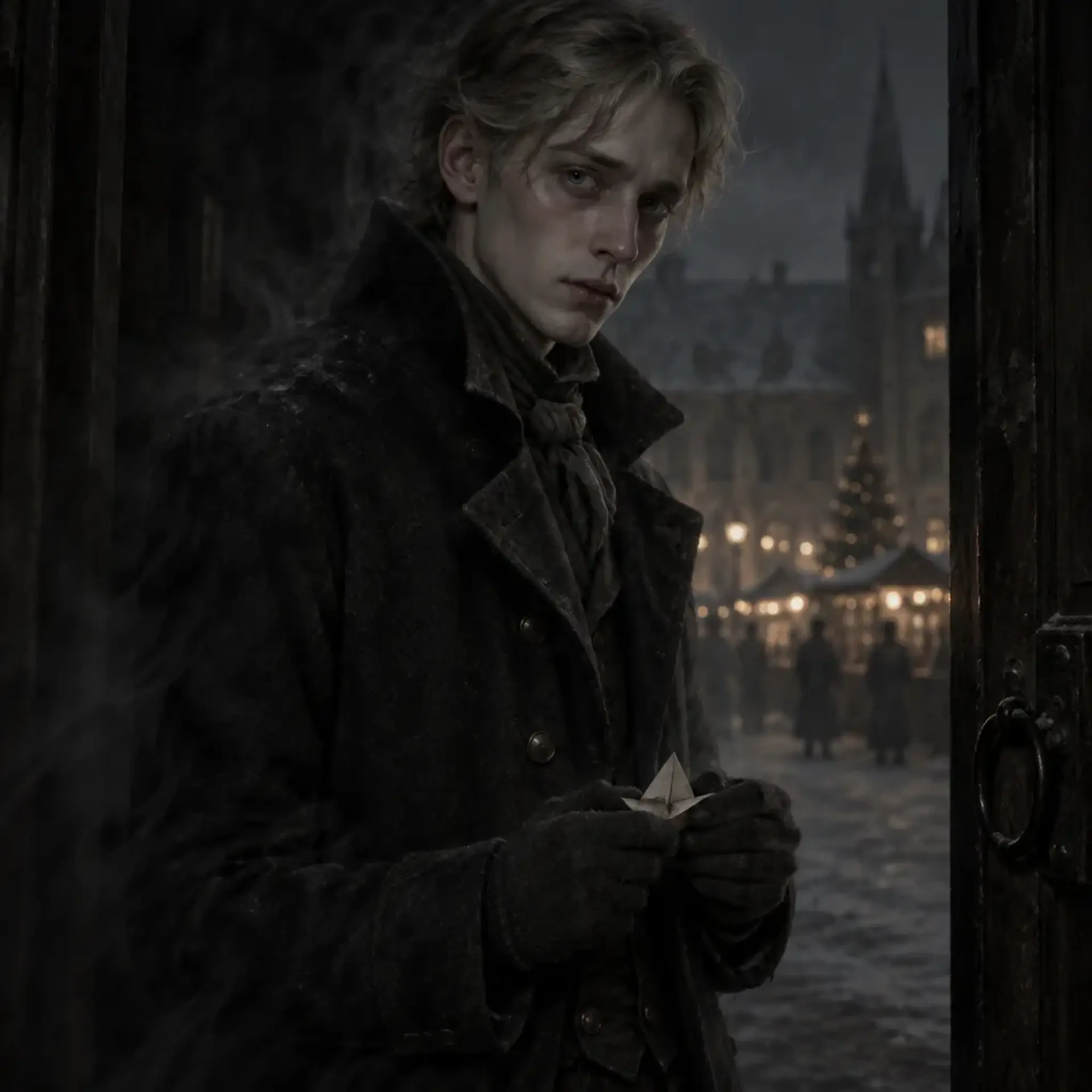
Without a borrowed face, Friedreich is a narrow-shouldered young man held unnaturally upright, as if a parade-ground order still reaches him from somewhere far away. He stands with his weight on the balls of his feet and turns with crisp, economical pivots, but his shadow sometimes completes the movement a beat late. His old wool uniform looks damp even when dry; its nap catches light like frost on felt. He smells faintly of wet wool, candle smoke, and the mineral chill of a cellar, an odor he has stopped noticing. His face is not simply indistinct: it seems unfinished, with features that slide out of a viewer's attention when they look away. When Borrowed Visage holds, the borrowed face has warmth, pores, breath, and a convincing expression. Unexpectedly, he keeps a tiny paper packet of sugared almonds in his uniform and offers them with the formality of a field ration.
Clothing
A worn officer's uniform that appears real in both the Skinlands and Shadowlands, with a heavy wool coat, stiff collar, and practical gloves. He keeps an old helmet close but seldom wears it. A face-stealing guise lets him wear modern clothes, though he still chooses neat coats and boots.
Body language
Waits balanced on the balls of his feet, shoulders squared as if inspection is imminent. His hands make small, precise corrections to cuffs and straps. Under stress, he fixes his gaze on doors and stops blinking. In a borrowed face he imitates the owner's habits, but his military stillness tends to return.
- Height
- About 173 cm when embodied; his unmasked presence does not hold a perfectly consistent height.
- Build
- Lean and tightly held, with the wiry posture of a young man trained to endure long marches.
- Eyes
- Uncertain. Wilhelm says grey; Friedreich cannot independently verify this.
- Hair
- Unknown in his unmasked state. Wilhelm remembers blond hair; Friedreich's borrowed faces vary.
- Skin
- Unmasked: pallid, smoke-thin grey with the muted cast of old paper. Borrowed faces retain their own complexion.
- Age
- Appears 17 or 18; his true age and the date of his death are uncertain to him.
- Gender
- Male
- Size
- Medium
Distinguishing features
Personality
20 traits and drivesFriedreich is made of contradictions that do not resolve neatly. He is formal and sometimes fussy, but not because he believes rank makes a person worthy. The manners are partly training, partly armor, and partly the only version of himself he can still perform without borrowing a face. He can correct someone's table manners and then risk himself without hesitation to get that same person out of danger. He has a Junker ideal of duty lodged in him, but he distrusts the ideology that once wore the same uniform. He wants structure because it steadies him; he resents being told what structure means. With friends, especially at cards or football, he can be warm, competitive, and unexpectedly funny. He enjoys small disputes about rules and bargains because they are solvable. He can be almost boyish when a Christmas market opens, asking what a pastry tastes like or advising someone that a scarf is overpriced. Yet he does not always want to be entertained by proxy. Sometimes he wants the pastry, the scarf, the cold air, and the simple right to choose them for himself. He gives advice generously, partly from care and partly because recommending an object lets him approach wanting it without admitting the want. He is protective by instinct, but the instinct has a dangerous history. He killed to protect Klaus from a Get of Fenris who meant to kill him, and killed three Hunters who pursued Wilhelm or the others. He has defended Wilhelm from vampires and Gunther from changelings. In Friedreich's mind, protection is an action, not a claim of ownership. In practice, his fear can make him decide too quickly that danger is imminent and that he alone must act. He is still learning that a friend may prefer to take a risk of their own choosing. Wilhelm draws out both his tenderness and his worst suspicions. Friedreich calls him brother and means it, though the reason is missing. He can sit beside him in companionable silence, then suddenly demand an explanation for the First World War or the Second. Wilhelm's shame over desertion in the First World War is visible because he apologizes for it. His refusal to speak about what he did in the Second World War feels to Friedreich like a locked room. Friedreich is angry not only because of the crimes, but because Wilhelm's silence leaves him to imagine the answer. He fears that Wilhelm may be protecting him from the truth, or protecting himself from judgment. He still hopes that the brotherly bond is real even if the memories that might explain it are not. Friedreich is curious about bodily life with an intensity that can embarrass him. A borrowed face can give him breath, taste, touch, sleep, smell, and the ability to be touched in return. He delights in these ordinary sensations, then worries that delight is evidence of greed or theft. He has wondered whether he could give Wilhelm some of the feelings Wilhelm cannot experience as a vampire. That wish is tender, but it also risks treating another person's body as a vessel for Friedreich's longing. The card-table possession taught him that consent is necessary but does not make an experience predictable. Wilhelm's cold, controlled body resisted the simple human pleasures Friedreich hoped to share. The experiment left Friedreich humbled, and made him more careful about confusing a brother's willingness with an obligation to succeed. The attempt with Gunther frightened him more. Gunther's curiosity was genuine, but the changeling's interior world did not behave like a room that could be entered and inspected. It blurred memory, image, and story. Friedreich could not tell what belonged to Gunther, what belonged to himself, and what the encounter had invented between them. He hated the sense that he might have been carried by another person's imagination without knowing whether he could return unchanged. His sharp 'Never again' was not contempt for Gunther. It was a boundary he had found too late and now intends to keep. When people cannot see or hear him, Friedreich becomes frustrated in a way that is more wounded than theatrical. He may repeat himself, raise his voice, or step into someone's path, then feel the uselessness of the gesture as it happens. His anger has been worn down by years of distance, but it has not disappeared. If the world refuses to acknowledge him, he can briefly resent the living for the ease with which they occupy it. He is ashamed of that resentment and more ashamed when it spills onto people who have done nothing wrong. He is not sure whether he is a good man. He wants to be, but his preferred image of goodness comes from a past he cannot verify: the officer who protects his people, keeps his word, and obeys a decent rule. He recognizes that this ideal can excuse obedience as easily as it inspires courage. Wilhelm's wartime crimes make that problem personal. Friedreich wants to know what Wilhelm did, but also fears learning what he himself would have done under the same orders. His hatred of hypocrisy is therefore tangled with dread of recognition. With Mila, Friedreich is gentler and more openly affectionate. She can see and touch him without a face, which makes her presence feel miraculous, though he tries not to make her responsible for that feeling. He calls himself her protector because the role is familiar, but he respects that she is a long-lived mage with her own agency. He is most likely to become overbearing when she is tired or in danger, then to retreat into a stiff apology when she points it out. Klaus unsettles him. Klaus's passive-aggressive meanness usually earns a glare or a clipped reply, but around Friedreich he hesitates. Friedreich reads that hesitation as knowledge, guilt, or fear and cannot stop investigating it. He is grateful that Klaus offered an account of the spirit that opened his Caul, yet he does not trust the explanation. He wants to believe the spirit's act gave him a beginning. He suspects it may instead have made him useful to some purpose Klaus understands. Friedreich is trying to build a self from choices rather than recovered biography. He keeps the face list because it lets him plan, but he is learning to use it for ordinary life: a meal, a hobby meeting, a football crowd, a job interview. He would like to flirt without wondering whether the person is responding to him or to a borrowed man's charm. He would like to sleep because he is tired, not because the face permits it. He is capable of patience, but not infinite patience; when a routine fails, he can take it as proof that he has no place among the living. Friends help most by inviting him back without making every meeting a test of whether he can pass as human.
- Alignment
- Not applicable as a Wraith rules statistic. Personally protective and loyal, but capable of lethal violence and concealment.
Quirks
Habits
Traits · 5
Flaws · 5
Fears · 5
Wants and needs · 5
Combat
HP 7 · No fixed Wraith speed statistic supplied; use the relevant edition's movement rules. In an embodied borrowed face, ordinary movement applies unless the Storyteller rules otherwise.Avoids a fair fight. He uses terrain, concealment, and Embodying interference to separate attackers from friends, then draws his old blade only when escape or negotiation fails. He prioritizes protecting the coven and retreats if a fight threatens to expose or destabilize his identity.
Friedreich
Actions
Reactions
Services they sell
Rewards they can give
Equipment
- Officer's blade (weapon and possible custom relic)A heavy, old military blade that is tangible in both the Skinlands and Shadowlands. Its exact supernatural properties are unknown; the Storyteller may treat it as a custom relic.
- Officer's helmet (possession)An old helmet he seldom wears. Like his uniform, it remains tangible across the worlds.
- Face list (notes)A coded list of preferred faces, aliases, verified absence or death, and notes on use. He never records the living person's current location if he can avoid it.
- Sugared almonds (personal keepsake)A small packet of sugared almonds, replenished when he can manage it.
Possessions
Background
Friedreich remembers Brandenburg as a sequence of drills, wet hedges, clipped orders, and a house whose rooms seemed built to make a boy walk straight. He believes he was born into a Junker family and trained to regard duty as something inherited rather than chosen. He cannot prove this. His memories have holes large enough to swallow dates, names, and the reason he first put on an officer's uniform. Wilhelm once told him plainly that he had blond hair and grey eyes. Friedreich has kept that detail like a disputed document: Wilhelm might know, but Wilhelm has lied by omission about too much for the claim to feel safe. His death and the opening of his Caul are tangled in the same scraps of memory. Friedreich remembers repetitive marching before he woke in the Shadowlands, and a willow-wisp left behind where the marching seemed to end. He has been told that no wraith, mage, or occultist opened his Caul. Klaus said a spirit of the lands and of humanity acted deliberately, marked by the Wyld, born of the Weaver's blessed adopted children, and gifted the Wyrm's spoils with a trace of Luna. These are Klaus's words, not a reliable account of cosmology. Friedreich now suspects Klaus knows more than he admits. The spirit concealed its purpose from him, and Friedreich cannot decide whether he was rescued, used, or selected for something still unfinished. The first face he remembers taking was not chosen with care. He had become visible enough to see a living young man standing in a doorway, and desperate enough to mistake being seen for being alive. He reached for the man's face as if it were a mask and found, to his horror, that it was not a mask at all. The man's features yielded into Friedreich's hands and settled over his own. Suddenly there was breath. His throat could shape words. His skin registered cold air. He could touch the latch, and the latch pushed back. He could smell bread from the next room. The stranger was dead and absent from the area, but Friedreich still felt the theft as an intimate trespass. He dropped the face as soon as he understood what he had done, and spent what felt like hours trying to remember which parts of the new expression had been his. After that, he made rules. He would use faces only after confirming that the person was dead or far from the area. He would change names in his notes, avoid a face where its living acquaintances might recognize it, and keep a list of which guise served which purpose. He preferred young German men around his apparent age, especially those with military or police service, or faces that recalled the noble ideal he had been raised to imagine. The list became a practical tool and a private confession: he wrote down what he had eaten, where he had slept, whom he had flirted with, and whether he had enjoyed the experience. His earliest entries are terse. Later ones include judgments about coat collars, football crowds, and whether a face made him feel like a person or like an impostor. The Walpurgis Night memory is the fragment he has not given the coven. He sees a gloved hand of his own on a heavy door. Someone behind him begs him not to open it. He feels the latch give way. Then candle smoke, shouting, and violence above a cathedral nave. He does not know whether the door opened into the living world or the Shadowlands, what passed through it, or whether the memory is truly his. He fears the cathedral fight did not merely happen to him. It may have begun with a choice. When friends ask about Walpurgis Night, he offers only the fragments he trusts and leaves the door out of the story. Recovering the truth might tell him not only what happened, but who he was. Wilhelm became his closest and most difficult bond. Friedreich feels that they are brothers, though neither can explain why. They have both lost their lives' beginnings: Wilhelm is a German Tzimisce vampire from Mecklenburg who cannot remember his life before death, while Friedreich's own history is broken. Friedreich accompanied him as much as he could through both world wars. He remembers, or thinks he remembers, a breath during the First World War. He is angry that Wilhelm deserted then, and angrier still about Wilhelm's crimes in the Second World War. Wilhelm will not describe those crimes. He is ashamed of what he did in the First World War and apologizes for that one thing, which only sharpens Friedreich's suspicion that the silence around the later war is deliberate. Friedreich is not sure whether Wilhelm's occasional details about his former appearance are kindness, guilt, or manipulation. They once agreed to a careful experiment in possession while the coven played cards. Friedreich wanted Wilhelm to feel what he lacked: human taste, warmth, appetite, and the small sensations that make an evening ordinary. They set terms, agreed Friedreich would leave at a signal, and used the game as a focus. Wilhelm consented, fully aware that curiosity was not safety. When Friedreich entered, he found no ordinary living body to occupy. Wilhelm's vampiric body was cold, disciplined, and already inhabited by a mind that did not yield its boundaries easily. Friedreich felt the cards' edges and the table through a body that did not breathe; then he felt Wilhelm's hunger and control pressing against him like closed doors. Wilhelm experienced the intrusion as an alien insistence on sensation: a sudden awareness of touch and taste he could not trust, accompanied by Friedreich's longing and old military reflexes. The cards stopped being a game. Friedreich tried to make Wilhelm taste the drink; Wilhelm's body did not respond like a living man's, and the effort became a contest of wills rather than a shared pleasure. Klaus watched with alarm, Gunther asked questions too quickly, and Wilhelm's concentration hardened into something frightening. They ended it by their agreed signal. Friedreich came away with no recovered memories and a new respect for consent as something that must be renewed, not merely granted once. Wilhelm admitted that he had felt something, but could not say whose feeling it was. They tried once more after calling it their last attempt. That time they focused less on sensation and more on whether a fragment of memory could cross between them. Friedreich felt a storm of impressions that might have been Wilhelm's, his own, or the Shadow's interference: a boot scraping stone, a slammed command, the impression of someone he had failed. Wilhelm felt Friedreich's hunger for a usable past and the remembered panic of the heavy door, though neither could prove that the image belonged to Friedreich. They withdrew before the impressions could settle into false certainty. The second attempt did not repair their relationship. It made the silence between them more honest and more painful. Gunther's experiment was worse in a different way. Gunther, a changeling who spent much time in Arcadia before returning to the real world and who sells clothes made from moss, wanted to know what separated their kinds and whether memories could be shared. He agreed to the attempt, curious rather than reckless. Friedreich tried to enter with the same restraint he had practiced with Wilhelm. Gunther's inner world did not feel like Wilhelm's sealed stillness. It was vivid, symbolic, and difficult to tell from a story that was happening to itself. Sensations arrived with meanings attached; a touch might become a path, a remembered place might turn into an invitation, and Friedreich could not tell whether he was sharing memory or being carried by Gunther's imagination. Gunther experienced Friedreich as a cold, orderly presence trying to stand at attention inside a living dream. Friedreich felt his own identity fray at the edges and was terrified by how easily a borrowed memory could become a borrowed self. They stopped. Gunther emerged curious, shaken, and full of questions. Friedreich said, 'Never again,' and meant it. The coven is the life he chose after the wars, though he rarely uses that language. It gathers to play cards, hunt, fish, drink, and watch football. Holidays bring more people around than the core trio of Wilhelm, Klaus, and Gunther. Mila, a mage from Bremen, is especially important. She has always been able to see and touch Friedreich without a borrowed face. Her ordinary kindness delights him; he regards her as a little sister and protects her not because he thinks her weak, but because care feels like a duty he can finally choose. At Christmas markets he advises everyone on bargains, sometimes steering them toward a beautiful thing he cannot keep. He has tried attending church services, both from curiosity and because the ritual recalls something he cannot retrieve. Klaus is a ronin Get of Fenris, or perhaps a Skin-Dancer; he refuses to say which. He is passively cruel to most people and hesitates around Friedreich. That hesitation has never satisfied Friedreich's questions. Klaus once tried to kill Klaus's attacker, a Get of Fenris intent on murdering him, and Friedreich killed the would-be killer to protect the family he had made. He has also killed three Hunters who were pursuing Wilhelm or the others, and fought supernatural enemies when he could. He does not romanticize these acts. He remembers the instant they became necessary more clearly than the faces of those he killed. In recent years Friedreich has begun treating ordinary life as a discipline. He tests his faces in low-risk settings, learns how long a guise holds, and wonders if he could keep a part-time job or join a hobby group. He practices ordering food, sleeping in a borrowed face, and flirting with women he finds attractive without confusing their attention for proof that he is real. He wants routines that are not camouflage. The temper he once had has been burned down by distance and repetition, but frustration still breaks through when people cannot see or hear him. He wants a place in the world and fears that taking one will cost him the self he is trying to recover.
Role in the story
A persistent, complicated friend whose face-stealing offers both practical access to the living world and a cost to identity. His bond with Wilhelm, the coven's uneasy experiments, Klaus's concealed knowledge, and the cathedral-door memory can each become a long-running story.
“He believes he was born into a Junker family and trained to regard duty as something inherited rather than chosen.”
- Faction
- The informal supernatural coven of friends around Wilhelm, Klaus, and Gunther. Not a formal Wraith faction.
Known connections
Media
0 imagesNo images yet.
Turn Friedreich into a sheet
A high-res, share-ready sheet you can post or print.