Skip to content
Szelavor - AI-generated fantasy NPC

Szelavor

Custom divine being, once human · Cleric 16, Grave Domain · Level 16

Szelavor

Sovereign and judge of the dead
AC19
HP225/225
Init
STR
DEX
CON
INT
WIS
CHA
ConditionsNone

At the table

Voice

A low, clear voice with a dry rasp that suggests river mist and old stone. His breath is steady, and his speech has the practiced cadence of a judge who has spent ages listening before answering. When telling a story from his mortal life, the rhythm loosens and a faint warmth comes through.

He speaks with careful diction shaped by centuries of hearing testimony and a mortal childhood spent around water and working boats. His consonants are clean and measured, with a faint breathy rasp at the ends of long sentences, like air passing through a stone arch. He does not use grand titles unless a ceremony requires them.

Speech patterns

He asks a person's name before discussing their crime, grief, or bargain.
He describes death as a crossing, a door, or an appointment, never as an enemy to be conquered.
He uses precise, plain sentences in court and warmer, more rambling stories with children and the bereaved.
When amused, he answers a question with a gentle question of his own.

How to play them

Meet threats with formal courtesy and honest terms. Ask what the visitor wants, what they are willing to give, and whose name they are prepared to speak aloud. He respects courage and accountability, but distrusts anyone who calls another person's life expendable. He may offer a bargain, a hearing, or safe passage before considering force.

Goal

Find his sister's missing soul without weakening the laws that protect every other soul's passage.

Motivation

Keep death from becoming a tool of the powerful, and make the last passage gentler than the life that preceded it.

Secret · GM only

Appearance

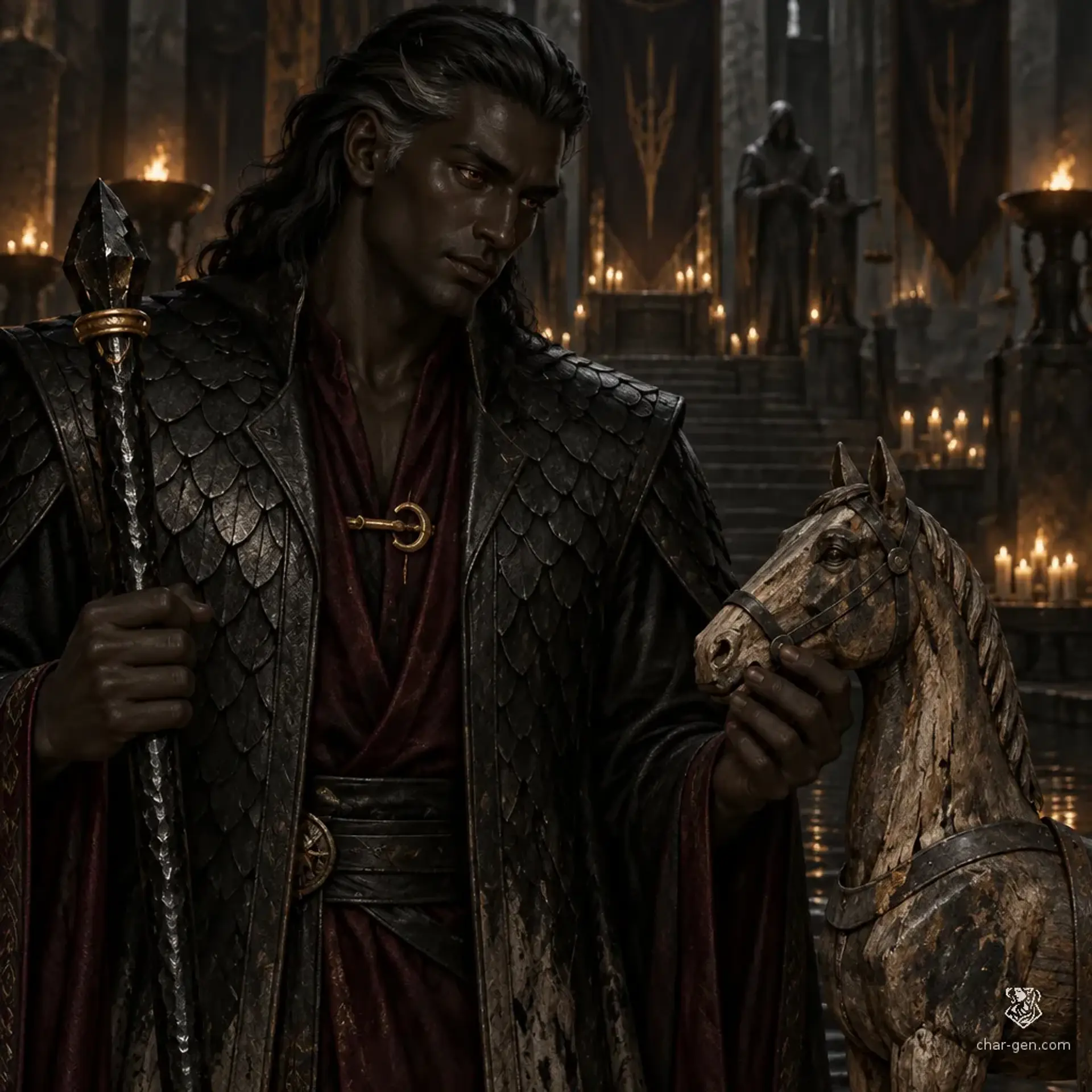
Szelavor is striking in the way a sealed tomb is striking: handsome, composed, and difficult to stop looking at. His skin has the smooth, cool sheen of dark polished basalt, with faint ash-gray lines at his temples that show when he smiles. He is tall and broad-shouldered, with a relaxed, deliberate way of moving that makes even a turn of his head feel like a decision. In a room, his eyes go first to the exits, then to the people standing nearest them, as if quietly accounting for who might need a way out. A small, battered wooden horse is always in his left hand; its nose is worn almost flat from his thumb. The unexpected detail is that he remembers every lullaby he has ever heard and hums them while inspecting battle plans.

Clothing

A close-fitted black coat of layered scale-like plates over a deep wine-colored tunic, clasped with a plain gold hook. The hem is dusted with pale grave-soil, and he wears no crown unless presiding over judgment.

Body language

He stands with his weight balanced as if on a boat deck, even on solid stone. His hands are usually still, except for his thumb rubbing the flattened nose of the wooden horse. When someone lies about a death, he turns his whole body toward them and waits without blinking.

Height
6 feet 5 inches
Build
Tall, powerful, and proportioned like a carved statue softened by a little mortal warmth.
Eyes
Deep amber, like lamplight seen through old honey.
Hair
Black, worn to the shoulders and brushed back; a few strands have the dull silver of grave ash.
Skin
Basalt-black with a smooth, cool sheen and subtle ash-gray lines at the temples.
Age
Appears to be in his early forties; has ruled the dead for longer than any living calendar can count.
Gender
Male
Size
Medium

Distinguishing features

His gaze checks exits and vulnerable bystanders before settling on the person speaking.
He carries a small driftwood horse with its nose worn nearly flat from years of thumb-rubbing.
Ash-gray lines at his temples become visible when his composure breaks.
His shadow sometimes falls toward the nearest grave, regardless of the light.

Personality

12 traits and drives

Szelavor is tender toward the grieving but merciless toward those who exploit grief. He can be wry and unexpectedly playful in private, yet in court he is exacting enough to make an apology feel like sworn testimony. He wants to believe every soul can change, while knowing that some people use mercy as another weapon.

Alignment
Lawful neutral

Quirks

He hums lullabies while studying maps of battlefields.
He turns cups so their handles point toward the nearest door.
He asks a dead person's name before asking how they died.
He leaves a bite of bread beside empty chairs, then insists it is a court custom.
He thanks doors after closing them.

Habits

When hearing a petition, he gives the speaker his full attention and asks for the name of the person they mourn before asking what they want.
He walks the boundary halls alone after difficult judgments, touching the doorframes as if checking that each one still holds.
In council, he lets others finish even when he has already decided; in a crisis, he becomes startlingly direct.
He offers food and a chair to living visitors, though neither is necessary in his court.

Traits · 3

He makes room for grief, but never confuses grief with innocence.
He enjoys ordinary pleasures such as warm bread and river stories, though he claims these are merely useful customs.
He is patient with fear and impatient with cruelty disguised as necessity.

Flaws · 3

He sometimes grants too much time to the remorseful, even when their victims cannot afford to wait.
He treats his own grief as a private inconvenience and refuses help until it becomes a danger.
He is tempted to bend the rules for those who remind him of his sister.

Fears · 3

That his sister's soul was destroyed rather than merely lost.
That his preference for mercy will become an excuse for cruel rulers to escape judgment.
That he has begun to treat every living person as a future subject instead of a person in the present.

Wants and needs · 3

Wants to learn what happened to his sister's soul.
Needs allies who will challenge his judgments before they harden into habit.
Wants the living to stop treating resurrection as a way to erase consequence.

Combat

AC 19 · HP 225 · 30 ft.

He begins by separating enemies and forcing them to confront the consequences of their violence, using Grave-Tide to pin down groups and Call the Final Due against those who threaten the vulnerable. He fights with the scepter only when a foe closes in or refuses surrender. He prefers to incapacitate, question, and judge rather than kill; if someone attacks a petitioner or attempts to steal a soul, his restraint ends.

Szelavor

Medium humanoid (custom divine being, once human), lawful neutral
Armor Class19
Hit Points225
Speed30 ft.
Level16
STR
DEX
CON
INT
WIS
CHA
Saving ThrowsConstitutionWisdomCharisma
SkillsInsightPerceptionReligionPersuasionHistory
SensesDarkvision 120 ft., passive Perception 20
Languages
Common,
Celestial,
Infernal,
Undercommon,
The custom tongue of the dead, understood by any creature that has died at least once
Custom feature. Keeper of the Last Door. Szelavor cannot be magically compelled to leave the Underworld, and he knows when a creature dies within 1 mile of him.
Custom feature. Crown of the Unburied. Undead within 60 feet of Szelavor have advantage on saving throws against being turned. He can speak telepathically with any undead he can see within that range.
Custom feature. Death Ward. Szelavor has advantage on saving throws against effects that deal necrotic damage or reduce his hit point maximum.
Spellcasting. Szelavor is a 16th-level spellcaster. Wisdom is his spellcasting ability (spell save , to hit with spell attacks). He has cleric spell slots: 4 first-level, 3 second-level, 3 third-level, 3 fourth-level, 2 fifth-level, 1 sixth-level, 1 seventh-level, and 1 eighth-level slot. His prepared spells are represented in the spells list.
Custom feature. Sovereign Passage. Szelavor can move through nonmagical difficult terrain made of earth, stone, or bone without extra movement. He can also move through creatures' spaces, but cannot end his turn there.

Spells

Cause Fear (level 1, necromancy). A visible creature within 60 feet makes a Wisdom saving throw or becomes frightened for up to 1 minute. It can repeat the save at the end of each of its turns.
Prayer of Healing (level 2, evocation). Up to three creatures regain hit points, increased by for each slot level above 2nd.
Gentle Repose (level 3, necromancy). A creature's corpse is protected from decay and cannot become undead for seven days.
Greater Restoration (level 5, abjuration). Touch a creature to restore 70 hit points, end one disease or one condition among blinded, deafened, paralyzed, or poisoned, or remove one effect reducing its hit point maximum.
Raise Dead (level 5, necromancy). A creature that died within the last century returns to life with 1 hit point, provided its soul is willing and free.
Warding Bond (level 6, abjuration). You touch a willing creature and place it in a state of suspended animation. It appears dead to casual inspection and is immune to poison and disease while the spell lasts.
Resurrection (level 7, necromancy). A creature you touch that died within the last 10 days returns to life with all hit points. This spell cannot restore a creature that died of old age.
Regenerate (level 7, transmutation). A creature you touch regains all its hit points. The spell also ends blindness, deafness, and any diseases affecting it.
True Resurrection (level 8, necromancy). A creature you touch returns to life if it died within the last 200 years, did not die of old age, and its soul is free and willing.

Actions

Multiattack. Szelavor makes two Sepulchral Scepter attacks. Melee Weapon Attack: to hit, reach 10 ft., one target. Hit: 14 () bludgeoning damage plus 18 () necrotic damage.
Sepulchral Scepter. Melee Weapon Attack: to hit, reach 10 ft., one target. Hit: 14 () bludgeoning damage plus 18 () necrotic damage. The target must succeed on a Constitution saving throw or its hit point maximum is reduced by the necrotic damage taken until it finishes a long rest. A humanoid killed by this attack rises at the next midnight as a wight under Szelavor's command, unless its body is blessed or its soul is elsewhere.
Call the Final Due. Szelavor presents his palm and names a debt. Each creature of his choice within 30 feet that can hear him must make a Wisdom saving throw. On a failure, it takes 36 () necrotic damage and is frightened until the end of its next turn. On a success, it takes half damage and is not frightened. A creature that has died and returned to life has disadvantage on this save. Once used, this action cannot be used again until Szelavor finishes a short or long rest.
Grave-Tide. Szelavor chooses a point he can see within 120 feet. Each creature in a 20-foot-radius, 40-foot-high cylinder centered on that point must make a Dexterity saving throw. On a failure, a creature takes 45 () necrotic damage and is restrained by grasping grave hands. On a success, it takes half damage and is not restrained. A restrained creature can use its action to make a Strength check, ending the effect on itself on a success. The hands vanish after 1 minute. This is a custom spell-like ability.
Spellcasting. Szelavor casts a spell of 1st through 8th level from his prepared spells list, expending a spell slot as normal.

Reactions

Not This One. When a creature Szelavor can see within 30 feet makes an attack against a creature other than him, he imposes a grave hush on the attacker. The attacker must make a Wisdom saving throw. On a failure, it must choose a different target or the attack misses. Undead and creatures immune to being frightened are immune to this effect. Once used, Szelavor cannot use this reaction again until the start of his next turn.

Legendary Actions

Graveward Step. Szelavor moves up to half his speed without provoking opportunity attacks.
Scepter Strike. Szelavor makes one Sepulchral Scepter attack.
Deny the Return (costs 2 actions). One creature Szelavor can see within 60 feet must succeed on a Wisdom saving throw or be unable to regain hit points until the end of its next turn.

Services they sell

Hear petitions from the dead and rule on disputed passage.
Grant safe conduct through the Underworld to those who have a just cause.
Offer a limited audience with a willing deceased person.
Investigate curses, undeath, and souls diverted from their proper destination.

Rewards they can give

A single safe passage through a haunted or sealed boundary, if the petitioner has earned his trust.
A hearing for a soul trapped outside the normal cycle of death.
A black-gold token that allows its bearer to ask one question of a deceased person, provided that person is willing to answer.

Equipment

  • Sepulchral Scepter (custom magic weapon)A black stone staff capped with a plain gold ring. Its touch feels like cool river rock.
  • Sister's Horse (keepsake)A battered driftwood toy horse, carefully repaired at one leg with dark thread.
  • Gate-Clasp (wondrous item)A clasp bearing the seal of his office, used to open the court's boundary doors.

Possessions

Sepulchral Scepter
Sister's Horse
Gate-Clasp
A book of names of the dead who have no one left to remember them

Background

Szelavor was born mortal, the second son of a ferryman who carried mourners across the black-water inlet beneath a cliffside town. As a boy he kept a wooden horse his sister carved from driftwood, and insisted it could carry the dead safely across. His life changed during the winter of the Bell-Fall, when a landslide buried the town's lower quarter. He heard trapped survivors calling from under the rock and could save only a handful before the tide came in. Among those he failed to reach was his older sister, who had gone back to rescue a neighbor's child. Szelavor refused to let the dead be forgotten, and spent years learning the rites, names, and promises that keep grief from becoming a haunting. The old underworld sovereign chose him as successor after Szelavor negotiated the release of a whole generation of restless dead without bargaining away a single soul. He now rules from a basalt court beneath the world, while trying to keep the dead's passage fair and prevent mortal rulers from turning death into a weapon. His closest living contact is Bramm, a former ferryman who smuggles petitions into the court; his most persistent rival is Kest, a court minister who believes mercy makes the realm weak. Szelavor is also quietly searching for the child his sister saved, now long dead, whose soul never arrived at his gates.

Role in the story

A formidable patron, judge, or final moral adversary whose court can grant passage, uncover the fate of the dead, or expose the cost of a bargain. He is not inherently hostile to the living, but his laws and personal grief can put him in conflict with a party that tries to cheat death.

“As a boy he kept a wooden horse his sister carved from driftwood, and insisted it could carry the dead safely across.”
From their background
Faction
Sovereign of the Underworld Court, an ancient institution devoted to receiving and judging the dead.

Known connections

Bramm, a living former ferryman, brings petitions and news from the surface. He is loyal to Szelavor but wants his own name removed from an old death record.
Kest, a court minister and political rival, argues that the Underworld should claim every soul without exception.
Ildra, a departed healer who once served the Bell-Fall survivors, helps Szelavor counsel newly dead children.
His older sister, whose soul has never reached his court, remains the absence around which his private life turns.
Major secret · GM only
Minor secrets · GM only

Media

0 images

No images yet.

Visual sheet

Turn Szelavor into a sheet

A high-res, share-ready sheet you can post or print.