Walter
Walter
At the table
“the people with the crosses”
Voice
A young, clear voice with a little rasp from cold and a slight catch when he has been awake too long. His breath sometimes carries the damp, mineral smell of the pool where he was found. He does not perform confidence; when he is worried, the words come faster and the Kentucky vowels become more pronounced. He sounds most like himself when making a dry observation or asking someone to repeat an answer they tried to evade.
Walter speaks in clear, careful American English, with a faint Kentucky/Appalachian trace in a few vowels that becomes more noticeable when he is tired or discussing home. He learned to make himself understood to adults without sounding demanding, so his questions are often framed politely even when they are pointed. He clips words when anxious and repeats key names exactly. His voice is still young, with occasional cracks when he tries to sound more certain than he feels.
Speech patterns
How to play them
Offer him a small, concrete choice and answer questions plainly. Avoid treating him as a mascot or demanding gratitude. Walter responds best to people who admit uncertainty and keep promises. If the investigators ask about his past, he may share details but will become guarded if they insist that a memory is false. Someone who mentions Kentucky, wheat, or a blue-eyed boy may earn his attention immediately.
Goal
Find out what happened to his brother and why the genome-therapy recipients react as though they know Walter from before he woke in the pool.
Motivation
To make his memories trustworthy, find his brother, and understand whether the people around him are protecting him or keeping him in the dark.
Appearance
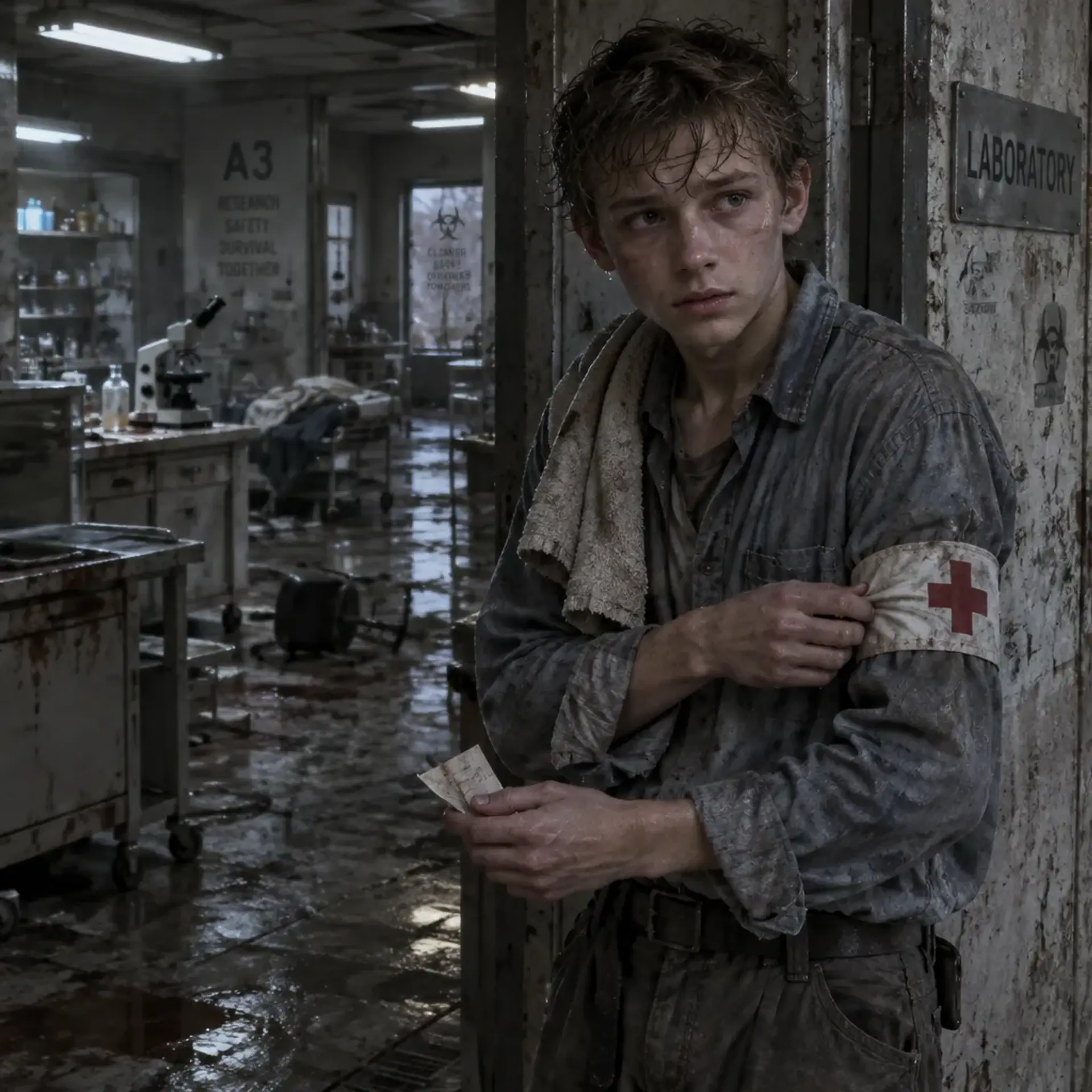
Walter is a slight fourteen-year-old with the tentative, held-in posture of someone who has spent too long trying to take up less room. His blond hair is so dark it nearly reads as brown, and lies in damp, uneven points around his forehead after his rescue from the pool. His light-brown eyes look ordinary until he fixes on a person; then his gaze becomes remarkably steady, as if he is checking details against a memory he cannot reach. Water has left his skin pale and puckered at the fingertips, and the exposed parts of him carry the dry, wind-chapped texture of a child who has been outside without proper shelter. He smells faintly of stagnant pool water, wet cotton, and the sharp antiseptic of the ruined lab, a combination he notices but cannot wash away. He walks carefully, toes first over unfamiliar ground, and turns his whole body when someone speaks behind him. The unexpected detail is that he folds and refolds any scrap of paper he is given into a precise little square, an orderly habit that seems incongruous with his soaked clothes and bewilderment. People remember him less as a helpless child than as a quiet, watchful boy who looks at them as though they have forgotten something important.
Clothing
A borrowed, slightly oversized shirt and practical trousers supplied by George, with a towel often slung over one shoulder. His white armband with a red cross is worn where it can be seen, though he sometimes covers it with his sleeve when Austin is not nearby.
Body language
He keeps his shoulders slightly raised and his hands close to his chest when strangers are near. When he trusts someone, he begins to stand beside them rather than behind them. He stares at people who seem familiar, then looks away abruptly when they notice. His fingers are almost always folding paper, worrying a sleeve, or checking that his armband is still in place.
- Height
- Approximately 5 feet 2 inches (157 cm)
- Build
- Slight and under-muscled, with the narrow shoulders and long limbs of a growing adolescent.
- Eyes
- Light brown
- Hair
- Dark blond, nearly brown
- Skin
- Fair, currently pale from cold and water; exposed skin is slightly wind-chapped.
- Age
- 14
- Gender
- Male
- Size
- Small adolescent human; use SIZ 45 as his Call of Cthulhu characteristic, not a D&D size category.
Distinguishing features
Personality
19 traits and drivesWalter is observant but not worldly, polite but not meek, and curious in ways that can become inconvenient. He has learned that adults often use reassurance to end a conversation rather than answer it. So he listens for omissions, watches faces, and asks the question again in a different form. This can make him seem suspicious or stubborn, though what he wants most is a stable answer he can rely on. He is not naturally brave in the heroic sense. He is frightened of the ruined world and of the people who do not look like people, but he is more frightened of being abandoned without knowing why. When those fears collide, he keeps asking questions rather than running. His manner changes according to how safe he feels. With Austin, he is formally attentive and quietly challenging. He recognizes that Austin saved him, and that gratitude complicates his distrust of the Android's scripted manner. Walter pays close attention to the moments when Austin's expression fails to match his words. He sometimes asks questions he knows Austin will not answer, less to obtain information than to see whether the refusal is personal or programmed. With George, who has been kind in practical ways, Walter permits himself to be more openly needy. He will ask for food, a dry blanket, or help with a confusing object, then act as though the request was no trouble at all. He is careful around Alexander, whose need for order irritates him because it feels familiar. Walter appreciates having supplies arranged and also resents being told where every item belongs. He can obey Alexander's system while muttering about it under his breath. Andrew unsettles him in a more complicated way. Walter is fascinated by the sharklike recipient's constant stream of information, but Andrew's pauses draw more attention than his explanations. Walter can sit through a long account of the facility's rules while waiting for the one word Andrew avoids. He does not yet understand that adults may hesitate for reasons other than deceit, and he sometimes interprets concern as evidence of concealment. Elmer's direct intervention has impressed him. Walter has not decided whether to trust Elmer, but he values that Elmer corrected Alexander without pretending the exchange had been friendly. He is especially affected by Elmer's vivid blue eyes, which feel familiar in a way Walter cannot explain. Walter has a careful sense of fairness, especially about names and possessions. He dislikes being treated as an object to be handed between adults, and the armband incident has made him defensive about anyone touching his things without asking. At the same time, he may share his pencil, notebook, or clothes if another person is clearly in need. He struggles to accept generosity without looking for a hidden cost. A small kindness can move him more than a grand promise, but he may not show it immediately. He remembers who gave him a towel, who returned his band, and who spoke over him. When relaxed, Walter has a dry, understated sense of humor. It appears in short observations rather than jokes: he might remark that the facility has more rules than working lights, or that Alexander could organize the dust if given time. He can be funny without meaning to be, especially when he takes an adult's grand statement literally. When embarrassed, he gets brisk and factual. When angry, he does not become louder by default; he becomes persistent, repeats the unanswered question, and may stop using a person's name. If someone threatens his brother or says the memory is imaginary, his self-control can break. He may shout, shove, or run toward danger in an attempt to prove the memory matters. He is also capable of sudden softness. A frightened younger child, a hurt animal, or even one of the altered people being mocked can draw out a protective instinct. Walter does not understand the genome recipients as a category. He sees frightening teeth, wings, feathers, scales, and unnatural eyes, but he also sees George bringing a towel and Elmer returning a stolen band. His fear and sympathy coexist without resolving into easy acceptance. He may flinch from a talon and still ask whether its owner is cold. His need for order is quieter than Alexander's but real. Walter records things because he believes that writing can prevent them from disappearing. He folds scraps of paper into precise squares, lines up his few belongings, and checks that his armband is still there. These habits become more pronounced when he is tired or confused. If his notebook is taken, he may appear composed for a moment and then become sharply distressed. He fears that his memories will vanish; the notebook is a substitute for the continuity he has lost. Walter's greatest contradiction is that he wants the truth but fears what it might cost. He asks for answers, studies the people who know more than they admit, and pushes at the limits of their patience. Yet when someone offers a plausible explanation of his past, he may reject it because accepting it would mean surrendering the version he still hopes is true. The image of his brother remains a source of comfort and a threat. Walter wants to find him alive, but he is beginning to suspect that the others' silence has a reason. He can be brave enough to keep asking, but he is still a child who needs shelter, protection, sleep, and somebody who will stay when the questions become difficult.
- Alignment
- Not applicable in Call of Cthulhu. Walter is frightened, perceptive, and trying to decide whom he can trust.
Quirks
Habits
Traits · 5
Flaws · 4
Fears · 5
Wants and needs · 5
Combat
HP 9 · Move 8, using Call of Cthulhu 7th Edition movement notation for a human with DEX 60 and STR+SIZ 80.Walter avoids fights. He looks for cover, a clear exit, and an adult who can intervene. If cornered, he shoves, runs, or makes noise to draw attention. He does not knowingly attack the genome-therapy group.
Walter
Actions
Reactions
Rewards they can give
Equipment
- Red-cross armband (identification)A plain white band marked with a red cross, identifying him as an ordinary human within the local system. The band is a social marker, not armor or a guaranteed safeguard.
- Notebook (personal item)A small notebook containing dates, names, fragments of memory, and questions he does not yet know how to ask.
- Stub pencil (writing tool)A pencil worn short from writing and sharpening.
- Dry clothes and towel (clothing)Borrowed clothes and a towel provided by George.
Possessions
Background
Walter's surviving memories begin in Kentucky, where he remembers wheat-colored fields, a house he can no longer place on a map, and a brother his own age. His brother had brown hair and blue eyes. Walter remembers this with such certainty that he sometimes doubts everything else. He remembers the two of them arguing over something small, then laughing, then being told to come inside. He cannot recover the brother's name. He is not sure whether the memory belongs to last spring, years ago, or a life that has been altered beyond recognition. His next clear memory is water. He woke in a pool inside a damaged facility in Washington, D.C., cold enough that his teeth knocked together and too confused to understand why his clothes clung to him. He had no useful explanation for how he arrived there. A tall young man with brown hair and brown eyes pulled him out. The stranger introduced himself as Austin, showed Walter a white armband marked with a pinkish-red cross, and said he was the designated Android assigned to the area. Austin looked human in nearly every way, except for the white glow in his pupils, like a screen seen through a dark window. He spoke in the smooth, declarative cadence of a public-service announcement. Walter heard the words, but also noticed the strain beneath them: Austin's smile was often a fraction late, and his attention wandered whenever he mentioned his orders. Austin said that he was programmed to provide care for the remaining citizens of the United States, whether or not he personally gave a damn. He described a new system of ordinances and people selected for genome therapy, a process he called genetic rewiring. Walter asked whether he had been selected. Austin laughed and said probably not, then moved on before Walter could ask what that meant. Outside the facility, Austin warned him about biological horrors and ordered him to stay close. Walter went along because he was fourteen, soaking wet, and had no better plan. The warning sounded absurd until he saw the ruined streets and the figures that moved among them. Austin brought him to a group of people gathered in what Walter took to be a laboratory or emergency ward. The people wore white bands marked with different colored crosses. Some were outwardly human; others bore subtle but unmistakable changes. Austin named the most striking ones as if reading labels from an inventory. Alexander, marked with a dark-purple cross, was a tall blond man with blue, owl-like eyes, pale feathering along his face, and great grey-owl wings. Andrew, marked with dark blue, was a shorter blond man with slick, sharklike skin, black eyes, and teeth that showed whenever he smiled. George had red hair, pale skin with faint yellow scales, and eyes in a curious mix of pink, red, and yellow; Austin said he had received the alligator treatment. Elmer, with an orca's black-and-white skin and vivid blue eyes, wore a blue-grey cross. Walter was given a white armband with a red cross. Austin announced, loudly enough for everyone present, that it identified Walter as a normal human, and threatened to kill anyone who harmed him. The speech had the polished emphasis of propaganda and the blunt obscenity of a man who was tired of repeating it. Austin patted Walter on the back as if reassuring a nervous customer, then left to attend to what he called important work. Alexander immediately took Walter's band and offered his own dark-purple one in exchange. Walter asked for his band back as politely as he could manage. Alexander stiffened, apparently insulted. Elmer intervened, smacked Alexander, and told him to return it. Alexander answered with a foul word in a New York accent. Elmer gave Walter his armband back, then returned Alexander's. The exchange was so ordinary in its bickering that Walter felt a strange, aching familiarity. He could not explain why. The others looked at Walter as if they knew him, or someone he had been, but each one stopped short of saying so. George was the first to make the place feel survivable. He found Walter a towel and clothes that fit poorly but were dry. His lazy, reptilian manner did not prevent him from checking that Walter had eaten. Andrew began talking almost at once, pouring out details about the facility, the therapies, and the rules, but he repeatedly paused before certain facts. Each pause sounded deliberate. Walter has not decided whether Andrew is protecting him, manipulating him, or trying to confess something without having the courage to do it. The facility is better organized than the ruined city outside. Alexander is obsessive about order despite having no official authority. He sorts supplies, corrects labels, and insists on assigned places for everything. Walter finds this annoying and reassuring in equal measure. The instinct feels familiar, as if he once had the same argument with someone he loved. At night he tries to rebuild his memories from little pieces: wheat in Kentucky, the brother's blue eyes, water, the lab's fluorescent glare, Austin's threat, Elmer's sharp gaze. He writes what he can in a small notebook, not because he trusts the words, but because the act of recording them makes them harder to lose. Walter's current problem is not simply surviving the next attack. He has to learn why the group recognizes him, why they refuse to say it, and what happened to the brother he remembers. He is wary of Austin's official explanations, but Austin is also the person who pulled him out of the water. He distrusts Andrew's pauses, yet listens for them. He does not know whether the colored crosses represent protection, rank, medical history, ownership, or all four. Above all, he fears that recovering his memory will prove that the people around him have good reason to hide it.
Role in the story
A vulnerable witness and emotional anchor for the genome-therapy group. Walter's missing memories, the brother he remembers, and the recipients' unexplained recognition of him create a mystery that can draw investigators into the history of the facility. He should remain a person with agency, not a puzzle object: he asks questions, makes judgments, and can refuse to cooperate.
“Walter remembers this with such certainty that he sometimes doubts everything else.”
- Faction
- A civilian under the local protection system administered by Austin. His red-cross armband marks him as an ordinary human; he has no formal authority or confirmed membership in the genome-therapy program.
Known connections
Media
0 imagesNo images yet.
Turn Walter into a sheet
A high-res, share-ready sheet you can post or print.