Chenghiz Batochir
Chenghiz Batochir
At the table
“Excellent. That is one fewer mistake between us and the truth.”
Voice
A dusty, papery rasp shaped by years of reading aloud in sealed chambers and calling over wind-scoured stone. His consonants scrape and click, and the sound of his breath catches briefly before long words. He projects without hesitation when explaining history, but when reading his own notes he falters and restarts as if listening for an error in the page.
His speech has the dry rasp of a throat used to dust and old parchment, with clipped consonants that become startlingly forceful during a lecture. He pauses to test unfamiliar names against his memory, then launches into explanations with the confidence of a guide who has walked the same stones many times.
Speech patterns
How to play them
Approach him with curiosity, a historical question, or evidence from a ruin. He warms quickly to people who treat artifacts as evidence rather than treasure. If challenged, he may bluff at first, but a good argument earns his respect and often a tavern round. Avoid threatening his notebook or attempting to remove an object from a ruin without discussion.
Goal
Recover and interpret the Vask foundation inscription, then publish a reliable account that gives the dead their proper place in history.
Motivation
To preserve the context and testimony of the past, and to make his scholarship worthy of the people whose lives were lost for it.
Appearance
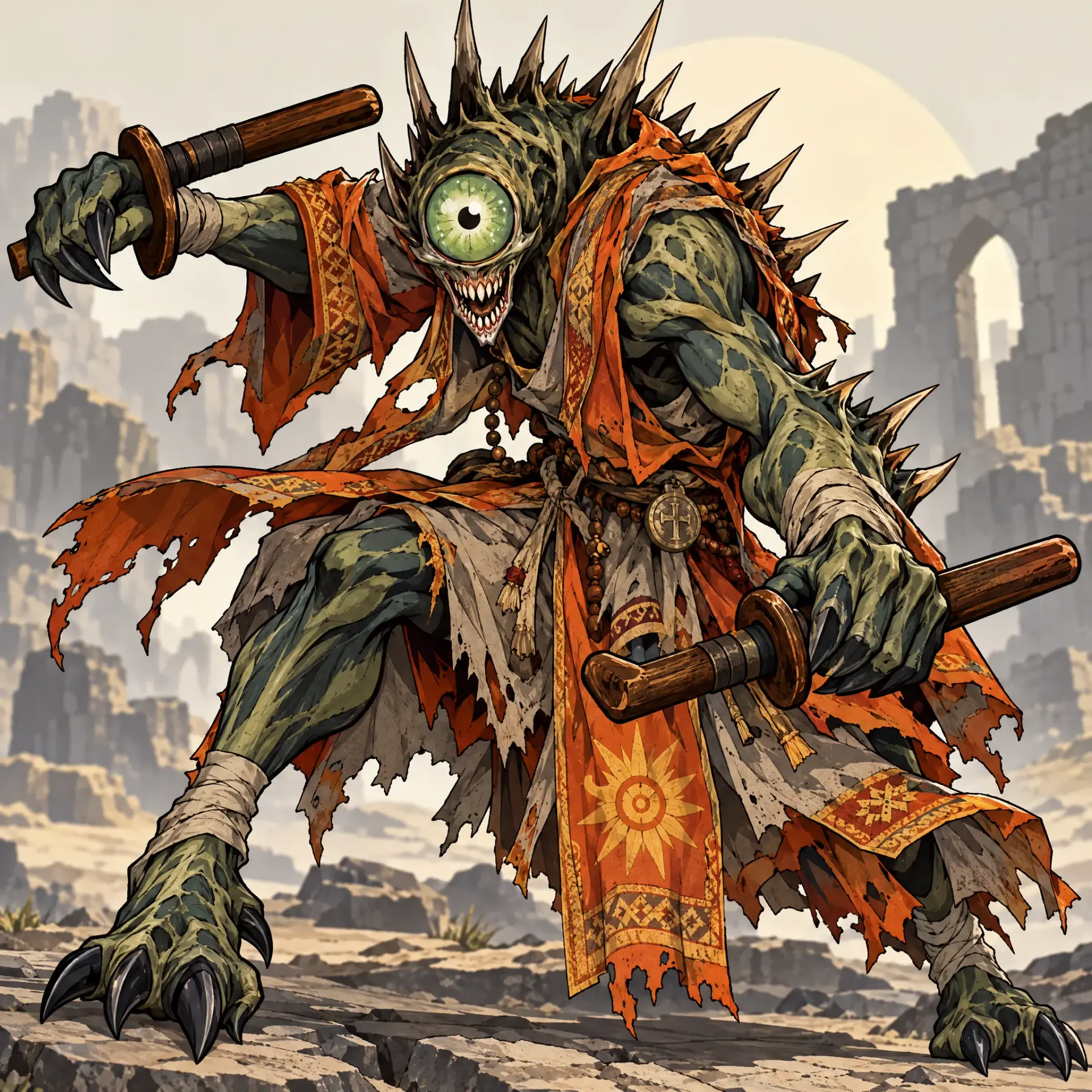
Chenghiz is gaunt but rope-muscled, with a hunched silhouette that unfolds into startling speed when he moves. His mottled hide shifts between dry olive-brown (#968b5e) and damp, mineral teal (#0b826e), with a pebbled texture along his shoulders and slick patches at the joints. One large, unblinking muted-green eye dominates his face; when he laughs, his jaw opens too far and exposes crowded, needle-sharp teeth. Long spines ridge his arms and back, clicking softly against the wall when he squeezes through narrow passages. He moves with a low, careful glide, then snaps into sudden, precise turns. Unexpectedly, he keeps one small brass button polished bright and sewn to the inside of his robe, where only he can see it.
Clothing
Ceremonial robes inspired by 12th-century Russian dress, torn and patched with mismatched grey cloth. Their original sunburst-orange panels have faded unevenly, while the cuffs are carefully re-stitched with teal thread. A short grey mantle catches on his back spines, and he has cut two slits in it rather than risk tearing it further.
Body language
He angles his large eye toward whoever is speaking, keeping his head slightly lowered as if studying the ground between them. His spines lift when startled. When embarrassed, he folds his tonfas together and taps their ends in a careful, even rhythm.
- Height
- 5 feet 8 inches when standing fully upright; usually appears shorter because of his hunch
- Build
- Gaunt, hunched, and visibly muscular beneath the robes; long-limbed, with a narrow waist and powerful shoulders
- Eyes
- Muted green
- Hair
- None
- Skin
- Mottled olive-brown (#968b5e) and mineral teal (#0b826e)
- Age
- Adult, approximately 46 years by the reckoning of the people who raised him
- Gender
- Male
- Size
- Medium
Distinguishing features
Personality
14 traits and drivesHe is brash and generous when discussing the histories of other people, yet cagey and almost apologetic about his own notes. In a ruin he becomes patient, exacting, and protective; in a tavern he is jovial and willing to be corrected, provided the correction comes with evidence. When frightened, he turns loud and bossy, then later writes an unusually honest account of what went wrong.
- Alignment
- Neutral good
Quirks
Habits
Traits · 4
Flaws · 3
Fears · 3
Wants and needs · 4
Combat
AC 16 · HP 38 · 40 ft.He avoids killing when possible, using mobility, feints, and precise tonfa blows to disable a threat or make space for retreat. He keeps a wall or pillar near his back so enemies cannot easily exploit his spines. He uses Unsettling Glimpse against a dangerous foe, then spends Focus defensively if surrounded. He prioritizes protecting companions and fragile ruins over winning a fair fight.
Chenghiz Batochir
Actions
Reactions
Services they sell
Rewards they can give
Equipment
- Twin tonfas (weapon)A matched pair of hardwood tonfas wrapped in worn grey cloth at the grips; use club statistics.
- Field notebook (tool)A waxed notebook full of careful transcriptions, uncertain dates, and small diagrams of masonry joints.
- Survey kit (tools)A hand lens, chalk, soft brushes, a folding measure, and small paper sleeves for labeled fragments.
- Hidden button (keepsake)A small polished brass button that belonged to his dead teacher.
- Explorer's supplies (adventuring gear)A sealed flask of water, travel rations, and a coil of fine cord.
Possessions
Background
Chenghiz was once a monastery archivist's assistant, tolerated because his uncanny eye could notice details others overlooked. He learned to read old boundary stones by touch and to distinguish layers of repair in ruined walls. During a winter expedition to the collapsed shrine of Vask, a ceiling fall trapped his teacher and two fellow students. Chenghiz chose to save a bundle of inscriptions first, convinced the records would guide rescuers; by the time he returned, his teacher was dead. The survivors never blamed him aloud, which has been worse than accusation. He left the monastery and became an adventurer, determined to bring histories into the light without letting them become loot. He travels with Toma, a pragmatic human guide who still trusts him, and trades research notes with Ketta, a miller's daughter and self-taught antiquarian who insists that his dates are often wrong. His current problem is a fragment of the Vask shrine's foundation inscription, which he believes may prove the monastery concealed the shrine's true purpose. He is loudly certain about local history and privately worried that his own copied notes have corrupted the evidence.
Role in the story
A knowledgeable but fallible ruin expert who can guide the party through ancient sites, identify historical clues, and create moral tension when preservation conflicts with immediate need.
“He learned to read old boundary stones by touch and to distinguish layers of repair in ruined walls.”
- Faction
- Former assistant to the Vask monastery archive; currently unaffiliated, though he still exchanges research with its surviving students
Known connections
Media
0 imagesNo images yet.
Turn Chenghiz Batochir into a sheet
A high-res, share-ready sheet you can post or print.