William Hirst
William Hirst
At the table
Voice
A boy's voice still roughening at the edges, with a faint rasp from cold mornings and shouting across fields. He shapes words carefully and has the clipped practicality of someone used to calling to shepherds over wind. The name William, when he says it himself, comes out plain and firm; when adults call him Blackby, his mouth tightens before he answers.
William speaks in short, concrete phrases and often pauses before answering, as if sorting a view of the whole situation into words one piece at a time. He is more fluent when describing sheep, tracks, weather, or paths than when speaking about himself. Under pressure he falls silent rather than raising his voice.
Speech patterns
How to play them
Give William time to answer, speak to him rather than over him, and ask about something he knows from the fields. He becomes more forthcoming with a patient companion or a familiar servant. Do not force him to disclose family rumors in public; he will shut down. If treated as an equal without being pushed into adult decisions, he may share what he has noticed about Oswin's strange habits.
Goal
Earn the right to be trusted with the farm by demonstrating judgment in his own way, while discovering what Oswin is and whether that secret has anything to do with him.
Motivation
To be trusted for what he sees and does, not judged as a fragile child or as the possible product of his father's hidden nature.
Appearance
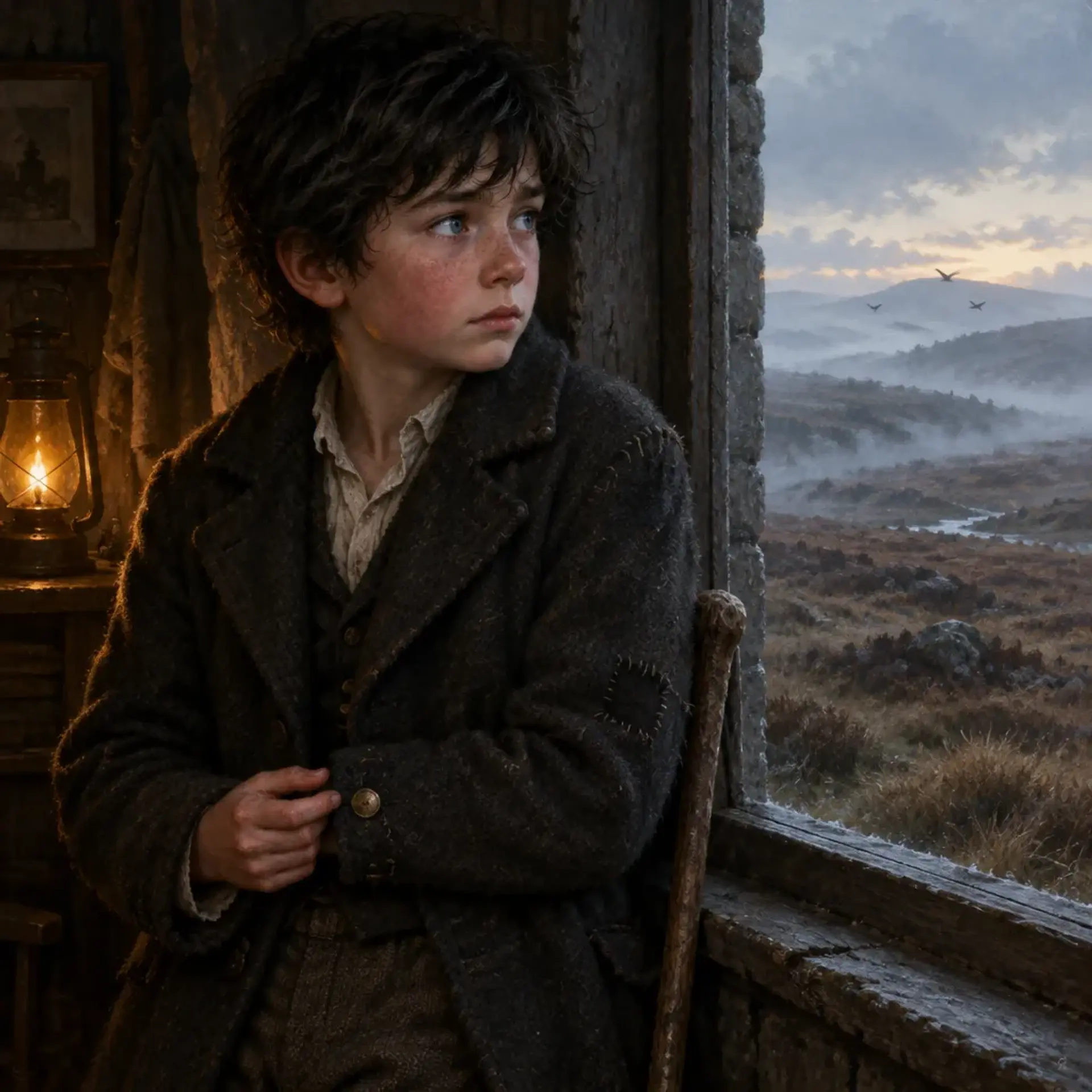
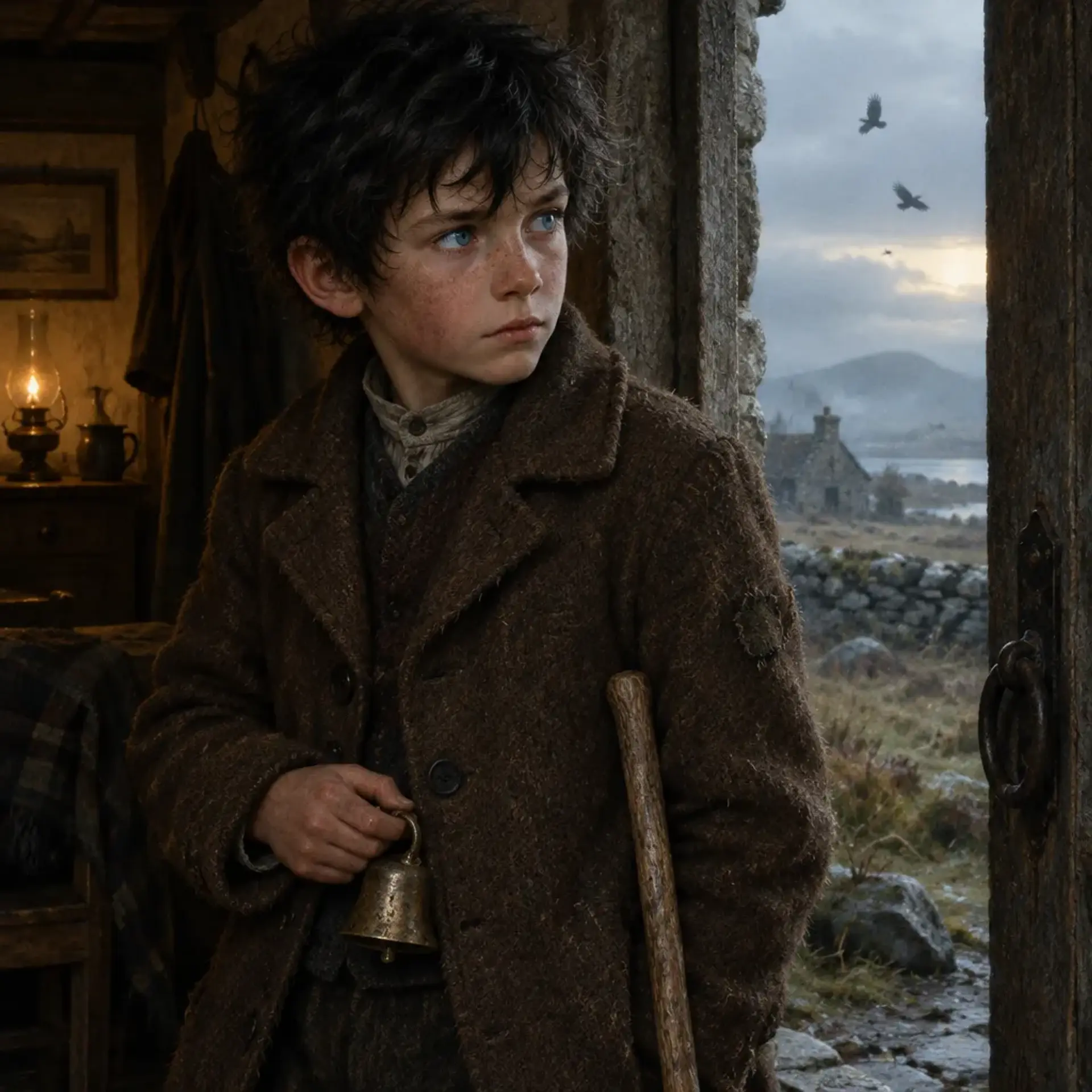
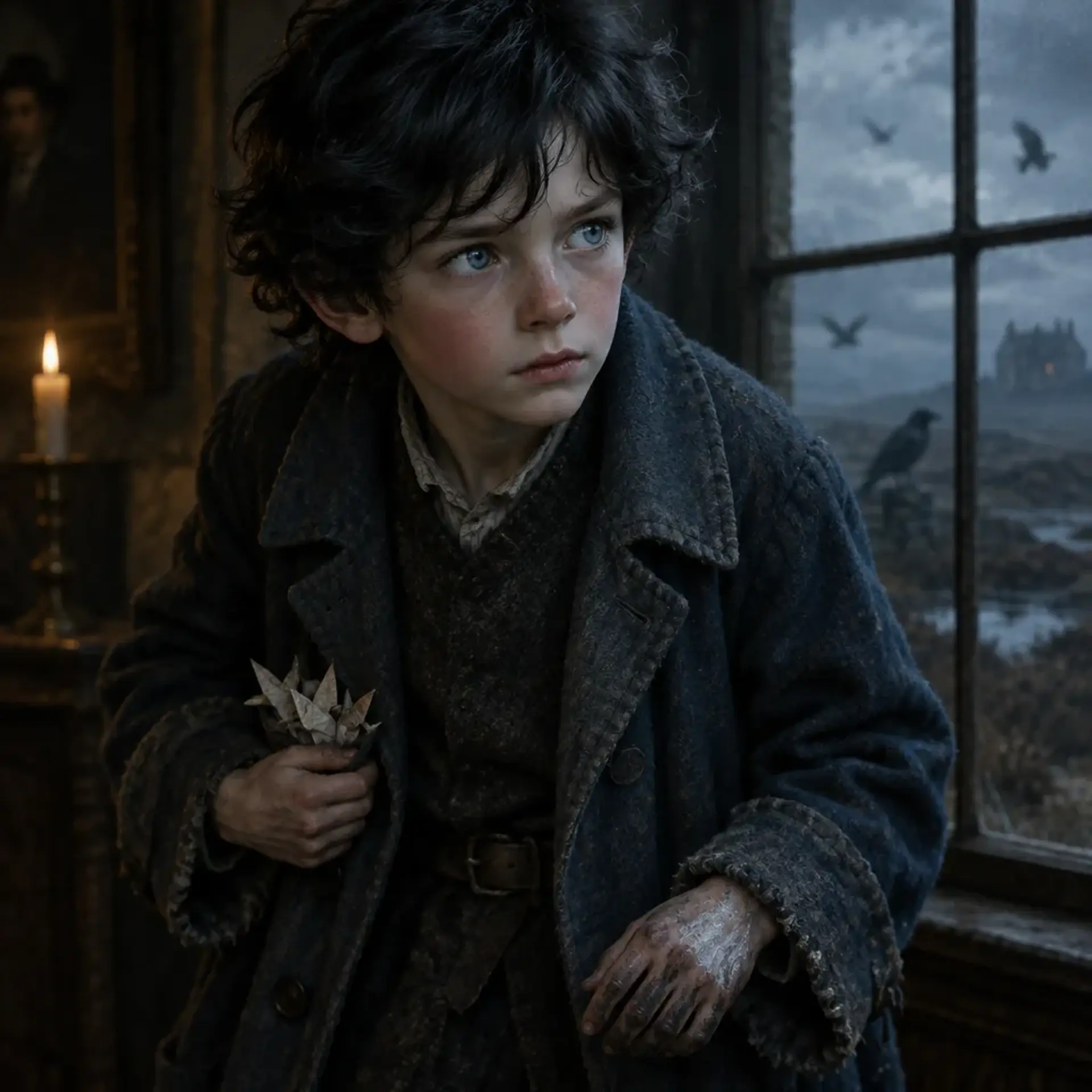
William is a small, long-limbed farm child with an unusually still way of standing, as if he is waiting for the hillside to finish speaking. His thick black hair grows in stubborn, soft-looking waves that refuse to lie flat, and his bright blue eyes catch lamplight with an almost startling, glassy shine. His cheeks are often wind-roughened; the skin at his nose reddens after a day outdoors. He walks carefully over uneven ground, placing each boot as though he has already noticed the loose stone or hidden rut. Within a minute of meeting him, most people notice him rubbing the frayed edge of a little wool cuff between finger and thumb. The cuff belonged to a lamb he helped save, and its nap has been worn smooth in one narrow strip. He is unexpectedly good at whistling through a blade of grass, though he stops if anyone praises him for it.
Clothing
A patched brown wool coat, a homespun shirt, knee-breeches, thick stockings, and muddy boots repaired at the toe. His coat cuffs are too long, and one has been carefully darned by Mary. He wears the frayed wool cuff of a lamb's old tether looped around his wrist beneath his sleeve.
Body language
William keeps his shoulders slightly raised around unfamiliar adults and gives them a brief, measuring look before answering. He rubs the worn edge of his wool cuff when thinking, angles his body toward exits when family arguments begin, and watches the ground when ashamed. Outdoors, his chin lifts and his steps become sure; when a sheep or person is in immediate trouble, he moves first and finds the words afterward.
- Height
- 4 feet 8 inches
- Build
- Small for his age, wiry rather than frail, with narrow shoulders and the early strength of a child accustomed to walking fields.
- Eyes
- Bright, clear blue, startlingly like Oswin's
- Hair
- Thick, unruly black
- Skin
- Fair, wind-reddened across the cheeks and nose, with a few faint freckles at the bridge of his nose
- Age
- 11 years old
- Gender
- Male
- Size
- Small
Distinguishing features
Personality
17 traits and drivesWilliam is observant but slow to speak, and his silence can look like either fear or stubbornness. He wants independence, yet takes comfort in the routines and protection of home. With patient people he is unexpectedly dryly funny; under family scrutiny he withdraws and remembers every slight. He is tender toward animals and alert to danger, but resents being treated as though his judgment cannot be trusted.
- Alignment
- Neutral Good, though anxious and guarded when adults turn him into a subject of debate.
Quirks
Habits
Traits · 4
Flaws · 4
Fears · 4
Wants and needs · 5
Combat
AC 10 · HP 4 · 30 ft.William avoids fighting. He retreats toward adults, livestock, or cover, warns others of hazards, and uses his walking stick only if cornered. He is not a soldier or a spellcaster, and his statistics represent an ordinary child with practical country awareness.
William Hirst
Actions
Reactions
Services they sell
Rewards they can give
Equipment
- Walking stick (tool)A plain wooden stick used for walking among the fields and, reluctantly, for defense.
- Lamb's wool cuff (keepsake)A worn strip of wool from a lamb's tether, carried under his sleeve and worried between his fingers.
- Lesson slate (personal item)A small slate and chalk for lessons; the slate has a chipped corner from being dropped on the yard stones.
Possessions
Background
William Hirst was born after a punishing labor that left his mother, Mary, feverish and exhausted. His father, Oswin, a man accustomed to command, held the newborn with a solemn gentleness the midwife never forgot. William inherited Oswin's startling blue eyes, but his dense black hair resembles neither parent. Mary recovered slowly, and William grew up noticing the small signs of her pain: two fingers at her temple, a measured breath before rising, and the extra effort she made to welcome visitors. Her care was tender, but sometimes she answered for him or kept him from relatives whose scrutiny frightened her. Oswin made time for his son despite the work of the Hirst farm. He taught William to read a flock, notice a lame sheep, judge weather, and find a gap in a hedge. In the fields, William often understood what needed doing before he could explain how he knew. At home, where lessons and questions demanded quick answers, he was slower. Oswin could mistake that pause for hesitation and cut him off; a rare nod of approval mattered more to William than he admits. He resents being handled as fragile, yet longs for both parents' protection. As a child, William once wandered too far onto the moor and found a ewe and her lamb trapped beyond a broken boundary in gathering fog. He led them home by following the wind and the faint sound of the farm bell. The family welcomed him back in relief, then argued over whether the rescue proved anything about his fitness to inherit. That day taught him that being right does not mean people will trust him. His maternal uncles Edmund and Huge, and his maternal grandparents, have made their doubts about the succession increasingly public. Mary challenges them when she can; Oswin watches William closely but seldom explains what he is thinking. William has also heard rumors that two of his mother's pregnancies ended before birth and that a baby son died soon after arriving. One uncle let slip the family's more painful story: a barghest violated Mary by accident on her wedding night. William does not know what to believe about the account, but fears his own birth is being treated as evidence in a family argument. He has noticed that Oswin seems not to age, avoids iron, stiffens in church, and becomes unnervingly formal at certain boundary-crossing seasons and hours. At night, William has glimpsed a tall houndlike shadow near his father. The household calls these odd hours or bad dreams. Locals call William Black William, or Blackby, when Oswin is not close enough to hear. William wants to become capable on his own terms, protect his mother from the family quarrel, and learn what his father is without letting the answer decide what he is.
Role in the story
A child heir whose quiet competence is obscured by a family succession dispute and the uncanny secret of his father. William can guide the party through the farm's boundaries, notice signs of danger, and reveal the emotional cost of the household's silence. He is not a quest-giver by nature, but his observations may become vital if the barghest secret or the family's inheritance conflict comes to a head.
“His father, Oswin, a man accustomed to command, held the newborn with a solemn gentleness the midwife never forgot.”
- Faction
- The Hirst household and farm; he has no formal role in any wider faction.
Known connections
Media
0 imagesNo images yet.
Turn William Hirst into a sheet
A high-res, share-ready sheet you can post or print.