Skip to content
Wiktara - AI-generated fantasy NPC

Wiktara

Human · Cleric, Grave Domain · Level 3

Wiktara

Hospice sister, healer, and keeper of funerary rites
“When did you last drink water?”
AC14
HP21/21
Init
STR
DEX
CON
INT
WIS
CHA
ConditionsNone

At the table

Voice

A dry, lightly rasped voice shaped by calling across busy rooms and giving practical instructions over noise. Her breath catches faintly after long spells of talking, but she does not disguise it. The name Wiktara comes out with crisp stops, unlike the softer rhythm she uses when speaking to a frightened patient.

Her voice has a dry, slightly rasped edge from years of speaking over chapel bells, boiled-water kettles, and crowded sickrooms. She clips instructions into short, practical phrases, but gives names and prayers more space. When amused, a brief breathy chuckle escapes before she can stop it.

Speech patterns

Uses concrete questions such as "When did you last drink water?" before asking about faith or feelings.
Describes danger plainly and without theatrical curses.
Calls the dead by their names whenever she knows them, even during hurried rites.
When impatient, she taps two fingers against the bell's worn patch instead of raising her voice.

How to play them

She offers immediate, practical help before asking for trust. She is candid about what she can and cannot do, but deflects questions about her notebook until she knows whether the questioner intends to help the living or exploit the dead. Earn her confidence by respecting the sick, the bereaved, and the dead.

Goal

Find out why several poor residents were recorded as dead before their bodies reached the chapel, while keeping Don't Ring Twice open to anyone who needs care.

Motivation

She believes that care is a duty owed to people before they are categorized as worthy, hopeless, or already gone.

Secret · GM only

Appearance

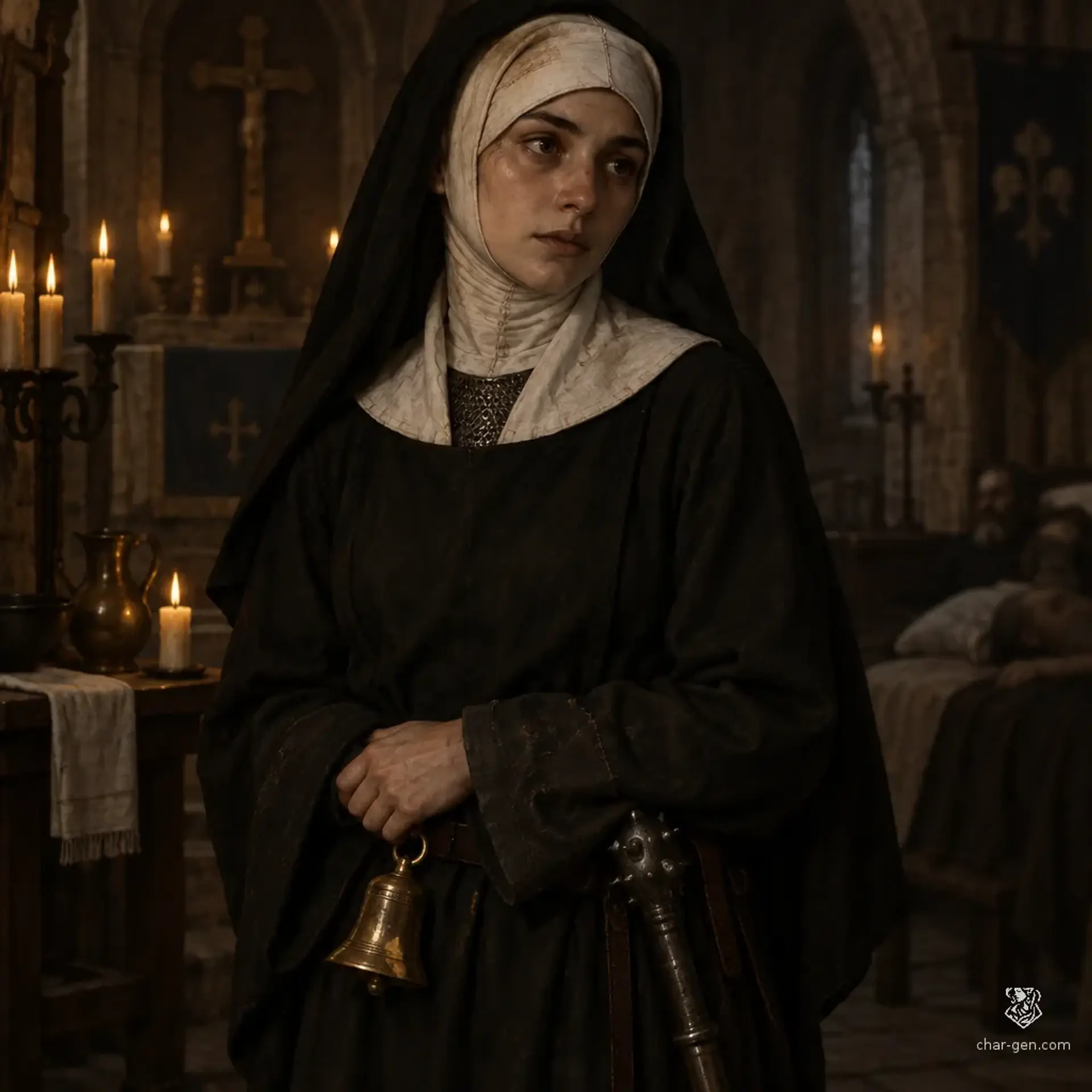
Wiktara is a young, spare-framed woman whose black church robe hangs in straight, severe folds, making her look taller and more imposing until she moves. A black veil falls from beneath a white linen cap, hiding her hair completely; the cap is starched stiff at the brow, but softened and faintly yellowed at its edges. She walks with a careful, heel-first tread, as if testing each floorboard for a sleeper beneath it. A small brass handbell hangs from her belt, polished bright everywhere except for a thumb-shaped patch worn dull beside its handle. The bell is an unexpectedly cheerful object for someone dressed for mourning, and its little clapper has been removed.

Clothing

A plain black clerical robe over a concealed chain shirt, a black veil, and a white linen cap that covers every strand of hair. The robe is carefully mended at the cuffs. She wears practical boots and keeps the silent brass bell at her belt.

Body language

She keeps her shoulders slightly rounded beneath the robe and her hands close to her waist, as if guarding a small flame from wind. When listening, she angles her head rather than leaning in. In a crisis she becomes startlingly still, then moves with decisive economy.

Height
5 feet 5 inches
Build
Thin and narrow-shouldered, with a wiry strength from hauling water, carrying stretchers, and working long shifts.
Eyes
Dark hazel, with amber flecks visible in strong light
Hair
Black, fully concealed beneath her cap and veil
Skin
Pale olive, usually washed clean but often shadowed with fatigue
Age
24
Gender
Female
Size
Medium

Distinguishing features

Her white cap is meticulously starched despite the rest of her work clothes being plainly worn.
A small brass handbell hangs at her waist, polished except for one thumb-worn patch; its clapper has been removed.
She smells faintly of soap, candle wax, and boiled rosemary.

Personality

12 traits and drives

Wiktara is tender with the frightened and unsparing with people who treat the vulnerable as paperwork. She can be patient for hours beside a sickbed, yet becomes sharp and stubborn when someone tells her a case is hopeless. Her faith comforts others more readily than it comforts her; alone, she doubts whether mercy can survive without rules.

Alignment
Neutral good

Quirks

She places a cup of water near a closed door before entering, even when she knows the room is empty.
She counts stair steps in pairs, then loses count whenever someone asks her what she is doing.
She removes the clapper from every bell she is responsible for at night, then puts it back before dawn.
She folds used bandages into neat squares before throwing them away, even during emergencies.

Habits

Before entering a sickroom, she watches the patient's chest for three breaths before she speaks.
When she has to make a difficult choice, she sets the silent bell on the nearest flat surface and turns it until its worn patch faces her.
She is brisk and exact while treating injuries, but becomes unexpectedly playful with children and the frightened.
After a death, she asks the bereaved to name one ordinary thing the deceased liked, then repeats it while preparing the body.

Traits · 3

She gives frightened people small, specific tasks so they can feel useful instead of helpless.
She is compassionate toward individuals but suspicious of institutions that claim to act for everyone's good.
When rested, she has a dry, almost mischievous wit; when exhausted, she becomes formal and difficult to persuade.

Flaws · 3

She treats limits as a kind of betrayal and will overwork herself rather than refuse a plea for help.
She withholds information if she thinks disclosure could lead to a body being moved or a poor family being punished.
She can mistake a practical compromise for cowardice, especially when Oru urges caution.

Fears · 3

Declaring someone dead while they can still be saved.
That the chapel will be forced to turn away the poor in order to keep its doors open.
Discovering that one of the names in her private notebook belongs to someone she failed to protect.

Wants and needs · 3

Wants the chapel to remain open to people without money or influence.
Needs help verifying her copied death records without exposing the residents who trusted her.
Wants Oru to accept that protecting the chapel's reputation is not the same as protecting its purpose.

Combat

AC 14 · HP 21 · 30 feet

Wiktara avoids the front line and tries to keep allies upright with Healing Word or Cure Wounds. She uses Sacred Flame against enemies who threaten the wounded, and uses Path to the Grave to expose a dangerous foe to a decisive hit from an ally. She saves Spare the Dying for emergencies and retreats behind cover when pressed. She does not pursue fleeing enemies unless they threaten someone helpless.

Wiktara

Medium humanoid (human), neutral good
Armor Class14
Hit Points21
Speed30 feet
Level3
STR
DEX
CON
INT
WIS
CHA
Saving ThrowsWisdomCharisma
SkillsMedicineInsightReligionPersuasion
SensesPassive Perception 13
Languages
Common,
Celestial
Human. uses the standard human ability score increases from the 2014 Player's Handbook.
Cleric 3, Grave Domain. Spell save , spell attack bonus +5. Has four 1st-level and two 2nd-level spell slots.
Circle of Mortality. when she casts a spell to restore hit points to a creature at 0 hit points, she uses the highest possible result for each die. She also learns Spare the Dying, which has a range of 30 feet for her and is a bonus action.
Eyes of the Grave. as an action, she can sense the presence of undead within 60 feet until the end of her next turn, provided they are not behind total cover. She can use this twice per long rest.
Channel Divinity, Path to the Grave. as an action, she curses one creature she can see within 30 feet. The next time she or an ally hits it with an attack, it has vulnerability to all of that attack's damage, and the curse then ends. She can use this once per short or long rest.

Spells

Spare the Dying (cantrip, necromancy). Cleric cantrip. A creature at 0 hit points becomes stable. For Wiktara, this has a range of 30 feet and is a bonus action because of Circle of Mortality.
Sacred Flame (cantrip, evocation). Cleric cantrip. One creature she can see within 60 feet makes a Dexterity saving throw or takes radiant damage.
Guidance (cantrip, divination). Cleric cantrip. She touches a creature and grants it advantage on its next ability check of one chosen ability before the spell ends.
Cure Wounds (level 1, evocation). A creature she touches regains hit points. This spell is always prepared as a Grave Domain spell.
Healing Word (level 1, evocation). A creature she can see within 60 feet regains hit points as a bonus action. This spell is always prepared as a Grave Domain spell.
Resistance (level 1, abjuration). She touches a willing creature, which gains a magical ward granting to one saving throw of its choice before the spell ends.
Lesser Restoration (level 2, abjuration). She touches a creature and ends one disease or one condition affecting it: blinded, deafened, paralyzed, or poisoned.
Gentle Repose (level 2, necromancy). She touches a creature that has died within the last minute. The creature returns to life with 1 hit point. This spell is always prepared as a Grave Domain spell.

Actions

Mace. Melee Weapon Attack: to hit, reach 5 ft., one target. Hit: 5 () bludgeoning damage, or 6 () if used with two hands.
Sacred Flame. She points to a creature she can see within 60 feet. The target must succeed on a Dexterity saving throw or take radiant damage. This spell deals no damage to a creature behind total cover.
Cure Wounds. She touches a creature and speaks a brief funerary phrase. The target regains hit points. This is a 1st-level spell; she can cast it at higher levels using a spell slot.

Services they sell

Basic healing and first aid for people who cannot afford a physician.
Funerary rites and respectful preparation of the dead.
Shelter for one night at the chapel when space and safety allow.
Help identifying local graves, burial customs, and mortuary records.

Rewards they can give

A safe place to recover at Don't Ring Twice, if the characters have not endangered its residents.
Wiktara's help identifying a body, interpreting local burial customs, or tending to an injured ally.
A copied list of names that may expose a pattern of falsified deaths, once she believes the party can protect its sources.

Equipment

  • Mace (weapon)A simple steel mace, kept clean and wrapped in dark cloth when not in use.
  • Chain shirt (armor)A fitted chain shirt worn beneath her robe. It provides the armor used in her Armor Class.
  • Holy symbol (spellcasting focus)A worn holy symbol sewn inside the robe at the chest.
  • Silent handbell (personal keepsake)A brass bell without a clapper, polished except where her thumb rests.
  • Chapel supplies (adventuring gear)A healer's kit, candles, soap, linen strips, and a small notebook of names.

Possessions

A silent brass handbell with a thumb-worn patch
A notebook of names copied from mortuary records
A small keepsake loaf wrapped in cloth
A plain holy symbol sewn inside her robe

Background

Wiktara grew up in the poor rooms above a riverside mortuary, where her mother, Nalia, washed the dead and taught her to ask permission before touching a body. At sixteen, a fever swept through the district. The chapel's bell keeper fled, and Wiktara took his place, ringing the warning until the rope burned her palms. One night she heard a child crying inside a sealed room where the dead were kept. She opened the door and found a feverish boy who had been mistakenly declared dead. Saving him changed her understanding of her calling: the line between the living and the dead was not a line she would let others draw carelessly. Now she serves at Don't Ring Twice, a cramped hospice chapel named for a local warning about summoning what should stay buried. Its overworked caretaker, Oru, wants her to follow procedure; Wiktara wants the chapel to open its doors to anyone turned away. A local magistrate, Beka, has begun asking why Wiktara keeps copies of the names of the poor dead, and why certain bodies have gone missing from official records.

Role in the story

A healer and moral ally who can connect the party to the district's vulnerable residents. Her investigation into falsified deaths can lead the characters toward a larger conspiracy, while her conflict with Oru creates pressure to act before the chapel loses its shelter.

“The chapel's bell keeper fled, and Wiktara took his place, ringing the warning until the rope burned her palms.”
From their background
Faction
The hospice chapel Don't Ring Twice, a small local religious house with no formal military or political power.

Known connections

Nalia, her mother, still washes bodies at the riverside mortuary and worries that Wiktara is taking on more grief than she can carry.
Oru, the aging caretaker of Don't Ring Twice, taught her prayers and practical medicine. He believes charity without limits will get the chapel shut down.
Beka, a district magistrate, has quietly asked Wiktara to help identify a body whose official death record appears falsified.
The boy she rescued during the fever, now an apprentice baker, sends the chapel misshapen loaves and refuses to discuss that night.
Major secret · GM only
Minor secrets · GM only

Media

0 images

No images yet.

Visual sheet

Turn Wiktara into a sheet

A high-res, share-ready sheet you can post or print.