Mary Bell
Mary Bell
At the table
Voice
Mary's voice has a slightly dry edge from early mornings, smoke, and calling children from one room to another. She speaks clearly when giving instructions and trails off when discussing what she wants for herself. As Kent, the same voice seems more resonant because Mary stops qualifying every statement; a local place-name can come out with the weight of something personally remembered. The name 'Kent' itself lands bluntly, like a word spoken into a cold room.
Mary speaks in a matter-of-fact English shaped by household work and the need to be heard over children. She clips instructions when busy, apologizes when asking for anything herself, and uses dry humor when she trusts someone. Kent's speech comes through the same mouth but feels more declarative: fewer qualifications, more references to roads, ground, weather, and what belongs where. Mary does not acquire a separate theatrical voice; the difference is in certainty and word choice.
Speech patterns
How to play them
Approach Mary through practical help, particularly help that does not make her feel indebted. Do not demand a confession in front of her family. She responds to people who notice her workload without treating her as helpless. If Kent appears, speak plainly and respectfully about the place you are in; avoid assuming he is merely a disguise or a separate, fully understood person.
Goal
Find the missing heart, learn what it can do before Henry does, and secure a life in which caring for her siblings is a choice rather than her only possible future.
Motivation
Mary wants to give her siblings safety and ordinary childhoods, while quietly discovering whether a life beyond compulsory care is possible. Kent's presence seems drawn toward the land itself and toward a freedom that Mary has rarely had.
Appearance
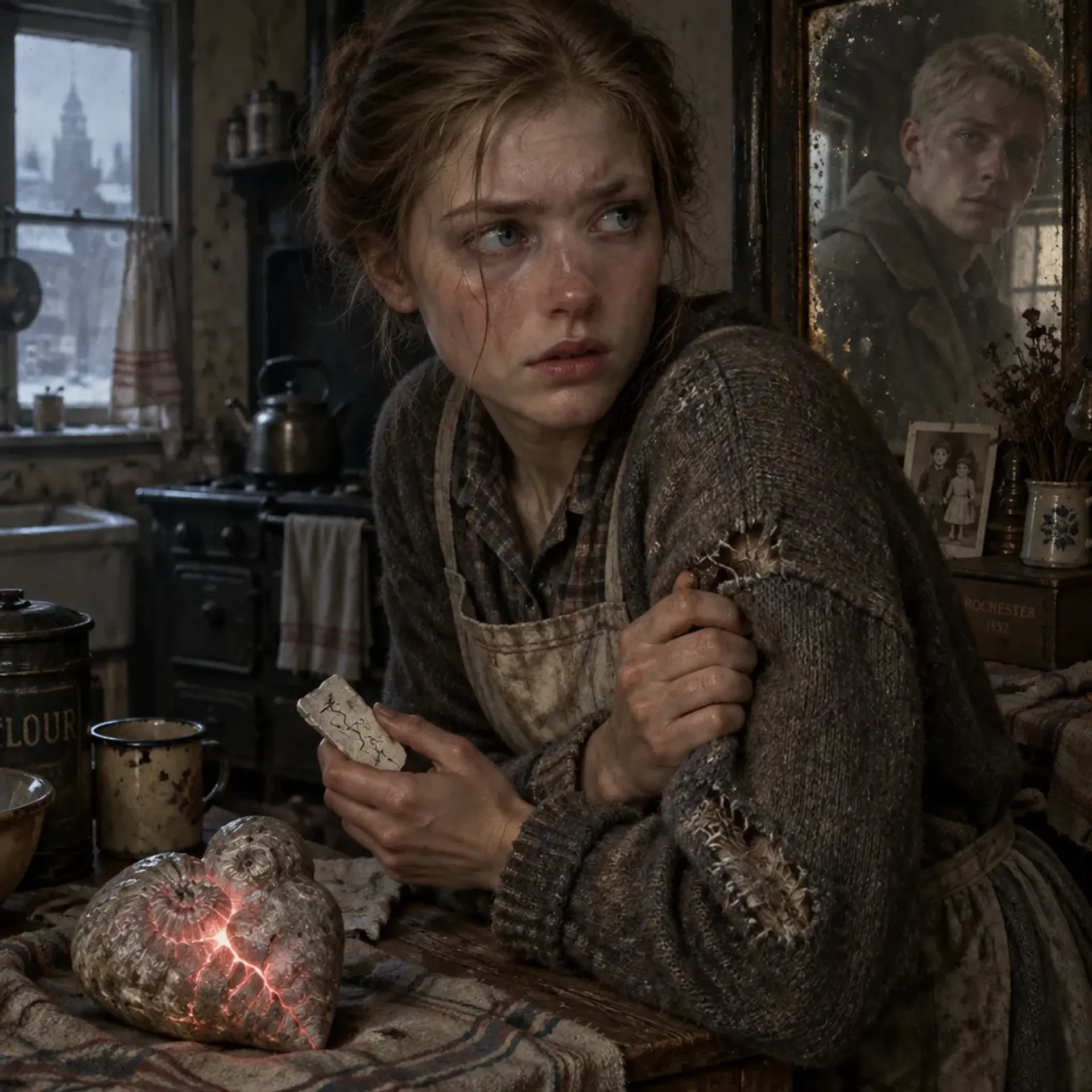
Mary is a sturdy, tired-looking young woman whose dark-blond hair is usually pinned up with whatever is at hand. Wisps escape around her temples and catch the grey daylight like straw. Her blue-grey eyes are quick to check the room, then slow to settle on a person. Her clothes are mended, practical, and often slightly damp at the cuffs from washing or carrying water. She moves with the economical, half-hurried precision of someone who expects to be called away from a task at any moment. When Kent comes over her, her familiar outline seems subtly to lengthen: her posture opens, her face takes on the reflection's handsome, short-blond-haired aspect, and her eyes appear malachite-green. It is not a clean transformation. For a moment, windows and mirrors disagree about who is standing there. Mary smells faintly of soap, wet wool, and the hearth; the heart, when present, adds salt and a cold, mineral tang. The unexpected detail: Mary has a habit of keeping tiny, carefully labeled paper packets of seeds, though she has almost no time or space to garden.
Clothing
Worn skirts, blouses, a knitted cardigan, practical shoes, and an apron when working at home. Her clothes are mended rather than decorative. Kent's improvised outfit is usually a borrowed shirt, trousers, and coat, chosen for concealment and warmth, not a deliberate costume.
Body language
Mary keeps her elbows close and her weight ready to turn toward the next demand. She rubs a thumb over a seam when holding back anger. As Kent, her shoulders square, her chin lifts, and she takes up more space; the effect feels less like swagger than a landscape refusing to be moved.
- Height
- Average as Mary; Kent's reflected form appears taller.
- Build
- Compact and work-strong from domestic labor, with a habitual forward lean that eases when Kent's presence comes through.
- Eyes
- Blue-grey as Mary; malachite-green in Kent's reflected appearance.
- Hair
- Dark blond; Kent's reflected appearance has short, bright blond hair.
- Skin
- Fair, with a work-worn, slightly flushed look after chores.
- Age
- 18
- Gender
- Female
- Size
- Human-sized
Distinguishing features
Personality
20 traits and drivesMary is dutiful but not naturally meek. She has spent so long being the person who notices an empty plate, a wet blanket, or a child's silence that she can seem composed even when she is furious. In ordinary company she is careful, mildly funny, and reluctant to claim attention. With her siblings she becomes energetic and invents small games to make chores bearable, though she may snap when they add to a burden she has not admitted is too heavy. She resents her parents' failures but dislikes being asked to declare that she hates them; she can remember Malinda's small kindnesses even while cleaning up after her drinking, and can miss Simon while dreading his return. Her protectiveness is strongest toward Matilda, because Mary recognizes how easily a helpful girl becomes the household's next unpaid worker. She wants Matilda to have choices, yet sometimes speaks for her too quickly. Mary's gratitude is sincere, but it can make her accept help with strings attached. Trudy's practical kindness unsettles her because it suggests that care need not be earned through exhaustion. Mary is curious about odd stones and local places, but curiosity has always been a luxury she postpones. The heart forces her to confront what she would rather set aside. Kent's influence pulls against her habitual self-erasure. Through him she may feel an unearned confidence, a sense that the land itself has a claim to be heard, and a readiness to enter places Mary would avoid. This does not make her fearless. It makes her more likely to act first and worry later, especially when someone insults or damages a place. In a frightened mood, Mary becomes practical and brisk; in private, she may tremble only after the danger has passed. When angry at an adult who is using a child, she can be blunt enough to surprise people. When angry at herself, she becomes busy. She does not yet think of Mary and Kent as two lives. She thinks of the changes as a strange bodily condition that sometimes gives her a chance to go out. That distinction matters: she is not deliberately pretending to be a man, nor has she decided that Kent is a separate person. She is trying to get through the day while something vast and local presses its feelings and knowledge through her. Her affection is practical: a cup set by the bed, a button resewn, a child walked home. She wants independence, but fears the guilt of leaving. She wants to understand the heart, but fears that every answer will place another responsibility on her. She can be generous and resentful in the same breath, brave in an emergency and avoidant once the danger becomes a conversation. She is not a saintly caregiver. She sometimes wishes the house would go quiet and stay quiet, then feels ashamed for thinking it. The central contradiction in her is that she wants to be needed less, yet has built much of her sense of worth around being the one who is needed.
- Alignment
- Not assigned; Mary is a young woman making difficult choices under pressure, not a moral category.
Quirks
Habits
Traits · 5
Flaws · 5
Fears · 5
Wants and needs · 5
Combat
HP 1 · Ordinary walking pace; no verified system movement statistic supplied.Mary is not a trained combatant and avoids fights. She puts furniture, doorways, and other people between herself and danger, prioritizing escape and the safety of children. Kent may act with startling decisiveness to block a threat or lead someone toward a safe route, but this is custom narrative behavior, not a verified Secret Histories combat rule.
Mary Bell
Actions
Reactions
Services they sell
Rewards they can give
Equipment
- Everyday clothes (clothing)A mended cardigan and practical household clothes, often with pockets full of thread, a scrap of paper, or a child's small possession.
- Seed packets (personal keepsake)A small collection of folded seed packets, each marked in Mary's careful handwriting.
- Heart of England (missing anomalous object)The carved, barnacled heart is currently missing. It can be damp, salt-streaked, and faintly red-pink beneath its chalky surface when active.
Possessions
Background
Mary Bell is eighteen, the oldest of eight children, and has learned to measure a day by what will go undone if she stops. Her home is a worn, isolated house in Rochester, Kent, where the work of feeding, washing, minding, and soothing children falls most heavily on her. Her parents, Malinda and Simon Bell, are alive but unreliable in different ways. Malinda drinks and can be loving, funny, and frighteningly careless within the same evening. Simon takes work far from home, returning unpredictably and bringing the weight of old arguments with him. Neither parent set out to make Mary responsible for the household, but years of neglect and necessity have made her so. Mary loves her siblings, particularly Matilda, who tries to help her, and little Oswald, who follows her with his blanket. She fears that Matilda will be made her replacement and pushes back whenever the adults treat a child as unpaid labor. Henry, fourteen, has become sharp-tongued and cunning, sometimes resentful of Mary and sometimes ashamed of it. Chrissy, Olympia, Belladonna, Abigail, and Jonas each have their own needs and loyalties. The family is complicated by Simon's son Jonas and by the uncertain parentage and old resentments surrounding some of the children. Mary tries not to make the children pay for the adults' failures. Her birthday was marked by a small, imperfect party. Malinda brought home a queer stone she had found in a log, knowing Mary liked unusual rocks. Mary accepted it because the gift mattered, even if its shape did not appeal to her. The object looked like a human heart carved from a piece of Dover chalk, with barnacles and sea grass clinging to its ridges. Beneath the crust, a faint red-pink color seemed to sit in the stone, like light seen through a closed eyelid. Its history was already troubled. Bartholomew Golden, an amateur alchemist, had once presented it as the Heart of England, a supposed fossilized living heart forged of heart and scale. He claimed it could bring servants from man's shadow, from chalk cliffs and borderlands, laborers born of the land rather than human. He left it as payment for entry to the Hush House, wrapped in newspaper. He was never permitted near Brancrug again. The heart was thrown into the sea, washed ashore, and found by Abraham Groff, who carried it home. It beat beneath his coat on the train. He found that it seemed to die when displayed to company, and wake again when immersed in water. It brought haunting sounds and movement to his house: voices in empty rooms, doors shifting, steps on stairs. Abraham became attached to it, then frightened, and sold it to William Windon, a local boy of seventeen. William hid it in a log and struck it with a hammer. The blow stopped its heartbeat. Malinda found the stone there and brought it to Mary. Mary did not know any of that. At first the heart only seemed odd. Then, while Mary held it, its pulse began to match her own. The first sign in her reflection was a young man with short bright-blond hair, malachite eyes, and an unusually handsome, taller face. Mary thought it was a cruel trick of glass or exhaustion. The reflection did not always copy her. It looked away when she looked directly at it; it wore expressions she had not chosen. Mary had no time to investigate. She had children to feed and a part-time job to keep. The change first became undeniable after a bad dream. She woke feeling that she was in someone else's body. The reflection's face had replaced hers, and for a few confused minutes she could not make her hands feel like her own. Then she discovered she could go outside. The first night as Kent began with a practical decision, not a revelation. The children were asleep, the house was unbearable, and the unfamiliar body could slip past the bedroom mirror without waking anyone. Mary pulled on borrowed clothes that nearly fit, left the heart behind, and went out into the damp dark. Kent was not a second mind speaking in sentences. He was more like a change in the pressure of Mary’s thoughts: a reaction that did not feel entirely hers, a sudden certainty about a lane, a pull toward the river, knowledge of which gate would squeal. She walked to the shore, climbed a tree, and explored an abandoned building, startled by how much joy came from moving without someone needing her. She returned before dawn, exhausted and unable to explain the experience even to herself. In the weeks that followed, the changes were spontaneous, sometimes at night, sometimes in daylight. Mary learned to improvise: a coat on the wrong peg, a hurried excuse, a change of clothes hidden where she could reach them. She did not call this a double life. To her, Kent was a strange, sometimes useful way to get air. That convenience made the danger easier to ignore. The first difficult return happened when Simon came home earlier than expected. Mary had gone out as Kent, expecting to be back before morning. Simon appeared on the journey home, and Mary had to get past him without letting him see the impossible face or ask why she was dressed for a boy. The trip home became a tense exercise in making ordinary explanations: a missed connection, a borrowed coat, a friend's errand. Simon's suspicion was not supernatural insight. He was tired, irritated, and observant enough to notice that the story did not quite fit. Mary reached home shaken, changed back, and was left wondering whether Simon had seen more than she admitted. Another time, Malinda was drunk and awake when Mary tried to slip out as Kent. Malinda's affection turned clinging and her questions came in loops: where was Mary going, why did she look so strange, why had she left her mother's present lying about? Mary could not safely explain. She kept her voice level, steered Malinda away from waking the little ones, and let herself be called ungrateful rather than reveal the transformation. The incident left Mary with a sharper sense that the secret could hurt the people she was trying to protect. The pub adventure came after Mary, as Kent, followed a local street into a pub where the warmth, smoke, and noise made him seem almost ordinary. He listened more than he spoke, and answered questions with a blunt confidence that was not Mary's usual manner. He noticed a man had dropped a key and returned it without comment; he also challenged a boastful customer who mocked the county as nothing but mud, roads, and old stones. Kent's pride was quiet but unmistakable. He treated the land as kin, not scenery. The episode ended not with a fight but with a moment of alarm: a man recognized the face from a reflection he had seen on the train, though he could not say where. Kent left by the back door, taking a long route home. Mary found the man's words more frightening than any threat. Trudy, a short, skinny young woman with dirty-blond hair and hazel eyes, calls herself a rebel and dresses in an alternative style that draws looks in the early Cold War era. She sees how tired Mary is and helps with the children when she can. One afternoon Trudy noticed Mary losing track of herself in a shop window. Rather than demand an explanation, she walked beside her, spoke loudly about a silly picture in the glass, and gave Mary cover to leave. Later she helped Mary find clothes that could pass as Kent's without making the secret a public performance. Trudy's kindness is not naïve: she knows Mary is withholding something, and has decided that the right to tell it belongs to Mary. The daytime change happened early one morning at home, while Mary was minding the very young children. The house was cold and close, the kettle not yet boiling. Mary bent over Oswald, who had woken with his blanket tangled around his feet, and saw Kent's face in the darkened kettle. The change began in the reflection. Abigail was asking for water, Jonas was fussing, and Oswald had both arms around Mary's skirt. Mary could not run or hide. She continued the ordinary work while her face and posture shifted in every polished surface. She used a shawl, a turned chair, and a made-up story about a bad night's sleep to keep the children calm. Oswald clung to her, apparently recognizing the comfort rather than the face. Mary kept everyone fed and safe until the change passed. That morning taught her that the phenomenon was not simply an escape route. It could arrive while others depended on her. The heart later went missing. Henry said he had stolen and sold it, and Mary believed him because she was angry, frightened, and too busy to search every hiding place. She does not know whether he sold it, hid it, or has learned anything about what it can do. In truth, Henry can use the heart to influence Kent and, through Kent, Mary, if he discovers its functions. Mary has not yet understood that the thing is anchored in her. Kent is the county given a human soul to mingle with hers, neither a conventional ghost nor a normal second personality. The heart's purpose, the Hush House, and the supposed servants from the cliffs remain unresolved. Mary wants a life beyond the household without abandoning the children. She wants to understand the changes without giving anyone power over her. Her greatest ongoing conflict is that the escape Kent offers may be another form of labor: the land's will pressing through a young woman already stretched thin.
Role in the story
A young caretaker caught between a difficult household and an uncanny county-presence. Mary can lead the characters into the Heart of England mystery, but her immediate stakes are personal: protecting her siblings, understanding Kent, and preventing Henry from turning the missing heart into a means of control.
“Her home is a worn, isolated house in Rochester, Kent, where the work of feeding, washing, minding, and soothing children falls most heavily on her.”
- Faction
- No known formal faction. Kent is mystically associated with the county of Kent, while the heart's earlier history touches the Hush House and Brancrug. These associations are story elements, not claims about verified Secret Histories factions.
Known connections
Media
0 imagesNo images yet.
Turn Mary Bell into a sheet
A high-res, share-ready sheet you can post or print.