Oswin Hirst
Oswin Hirst
At the table
Voice
A steady, clear voice with a little roughness from cold air and outdoor work. He speaks as though choosing words for usefulness, not display. Old phrases surface when he is tired, while the forbidden languages stay behind his teeth. His voice becomes clipped and direct when he is angry or afraid, rather than quieter or more polite.
His speech is measured and practical, shaped by farm work and by a long history of telling stories to make the impossible sound manageable. He uses plain Yorkshire phrasing and old expressions that occasionally seem older than the people around him. He avoids certain words, calling them forbidden or unwise to say aloud. When tired, he slips into older forms of speech; when explaining supernatural danger, he reaches for farming comparisons. His voice comes from a body accustomed to breathing cold hillside air: steady, clear, and slightly rough at the edges, with no theatrical lilt. Anger does not make him softer or more formal. It makes his sentences shorter and more literal.
Speech patterns
How to play them
Meet direct concern with kindness and practical help, not intimidation. He is most open when discussing farming, William, or a local danger that can be handled concretely. If challenged about age, iron, or the Barguest, he deflects with church teaching, science, or an old story. He can be persuaded by evidence that honesty will protect Mary and William, but threats against them may bring out the hound.
Goal
Keep the Pickles household and the village boundaries safe while preserving enough of his human self to remain a husband and father.
Motivation
Love for Mary and William is genuine, but he also wants to prove that a person shaped by the fae can still choose mercy and ordinary obligations.
Appearance
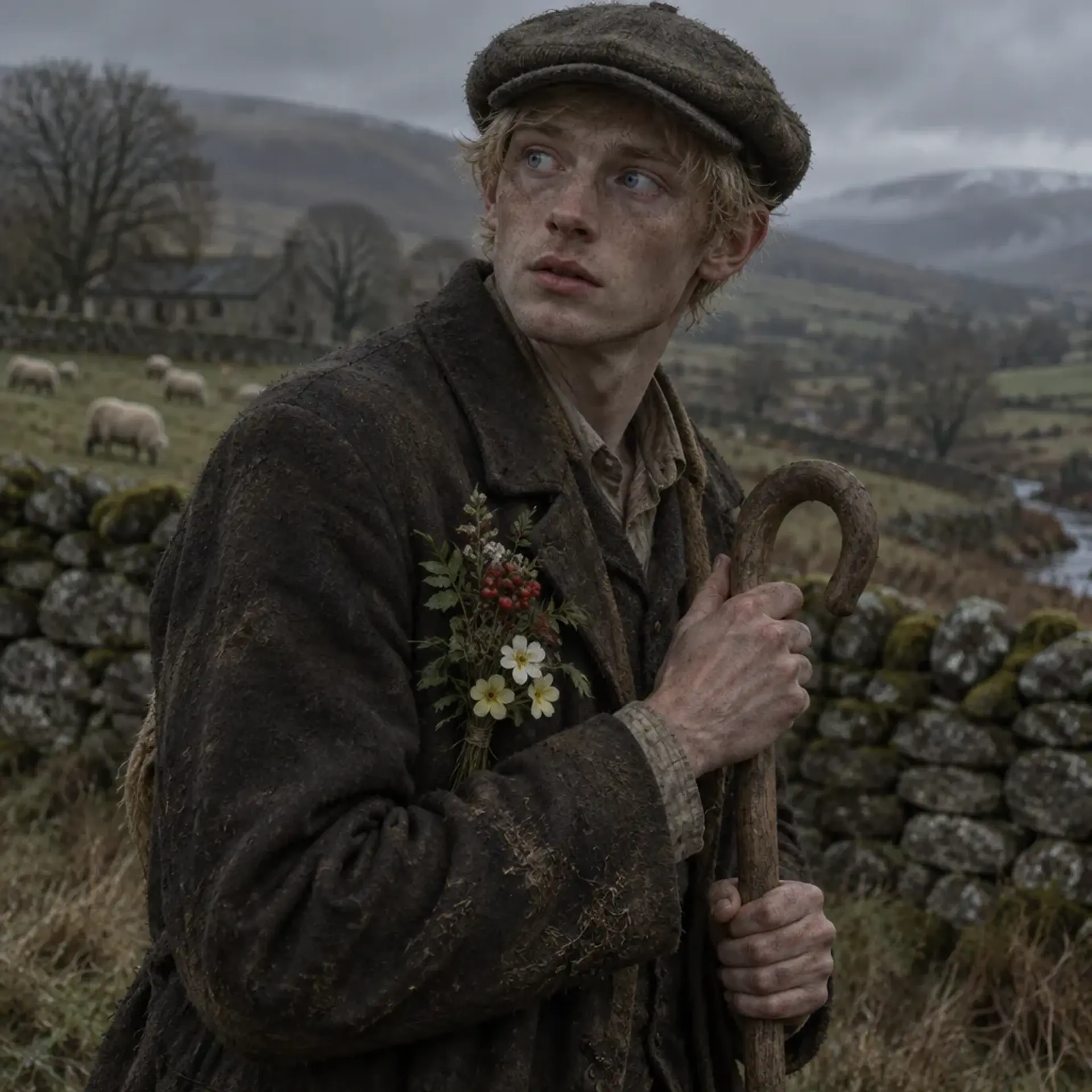
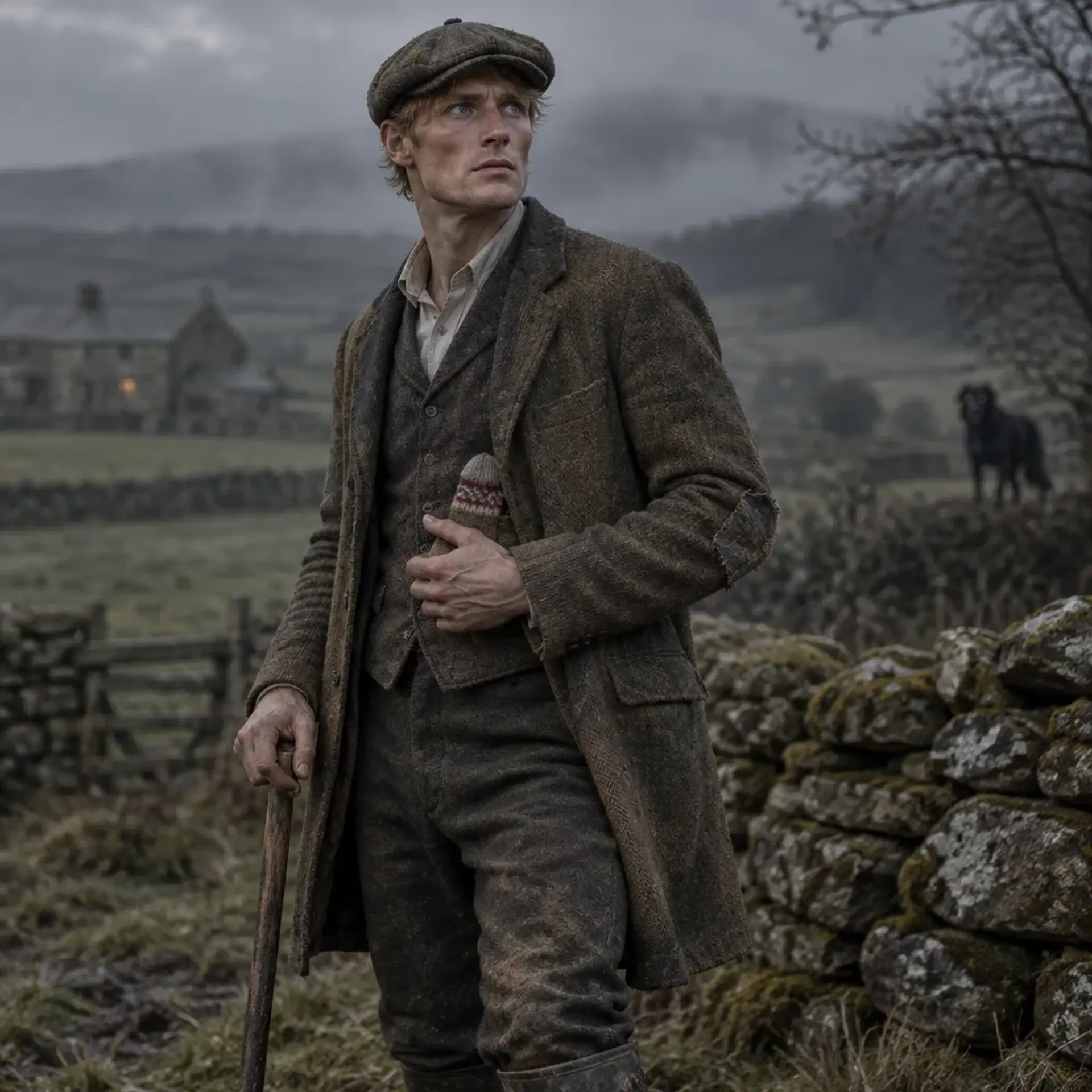
Oswin is six feet tall, pale, and straight-backed, with a handsome face that seems caught at seventeen. His skin has the cool, nearly translucent look of someone who spends long hours indoors during bad weather. Fine blond hair lies straight against his head beneath a common flat cap; his clear blue eyes can look warmly familiar to Mary, then burn with an uncanny, animal brightness when the seasons turn. He stands with his weight balanced on the balls of his feet, as if every conversation might become a chase. In a doorway he instinctively leaves just enough room for another person to pass, though he rarely notices that he has made them choose whether to brush against him. His clothes are serviceable rather than grand: wool, patched linen, sturdy boots, and a farmer's coat. He moves with a quiet, economical precision that seems wrong for someone raised to work sheep and soil. The detail people do not expect from a feared hound-shifter is that he takes obvious pleasure in mending small household things: a cracked toy, a loose hinge, a torn cuff, each repaired with patient, almost fussy care.
Clothing
A plain flat cap, wool coat, patched linen shirt, working breeches, and hard-worn boots. His clothes suit a Yorkshire sheep farmer of modest comfort, though the house and some possessions are finer than neighbors expect.
Body language
Waits with his weight forward on the balls of his feet, as if prepared to run. He leaves narrow, deliberate gaps around other people and rarely blocks a doorway. When a dead voice reaches him, his gaze fixes on an empty place over someone's shoulder. He hides pain by turning his injured hand inward, but iron makes his whole posture recoil before he can control it.
- Height
- 6 feet
- Build
- Tall and spare, with the wiry strength of someone accustomed to walking hills and handling livestock.
- Eyes
- Clear blue, familiar to Mary but capable of a burning, uncanny brightness.
- Hair
- Pale blond, straight and fine.
- Skin
- Pale, with a cool, almost translucent cast.
- Age
- Appears about 17; his true age spans centuries. He was born in the Danelaw era and has not visibly aged since before Mary met him.
- Gender
- Male
- Size
- Medium
Distinguishing features
Personality
20 traits and drivesOswin is gentle in the close, repetitive work of family life and unsettlingly practical when danger appears. He will sit patiently with William through a slow lesson, repair a toy, or take a burden from Mary without making a show of it. Yet he can treat a human fear as a quaint mistake if his fae instincts are strong, and his calm can become frighteningly detached when he decides a threat must be removed. He likes people, but he also studies them as a creature studies a familiar flock. He tries to resist that habit and sometimes catches himself doing it only after the person has noticed. His mind pulls between the boy who once fell in a muddy yard and the old thing that remembers a feast under a white sky. The childhood memory tells him that weakness deserves tenderness. The Other Side taught him that names, promises, and hospitality can bind more strongly than chains. In ordinary weather he chooses the first lesson and can be warm, wry, even companionable. When the dead gather or May draws close, he feels the second lesson take over: a promise becomes a game, a frightened person becomes a test, and a boundary becomes an invitation to see what happens if it is crossed. He recognizes this shift and fears it, but recognition does not always stop it. With Mary, he is affectionate and attentive, but he mistakes soothing her for being honest with her. If she speaks of his unchanging face, he answers with an explanation about health or the new sciences. When she mentions iron, he finds a reason to leave the room. He wants her to stop being afraid because he loves her, but also because her fear forces him to look directly at what he has hidden. He has a protective streak that can become controlling: he would rather decide what Mary can bear than let her choose with the full truth. With William, Oswin's better instincts are clearest. He does not mock the boy for being slow to develop and does not force him to perform for neighbors. He gives him small tasks and waits without showing impatience. Yet Oswin watches William too closely, searching for signs of inheritance. He fears the child's black hair and burning blue eyes will make the village cruel, but also fears that William's nature will be more fae than his own. At times he sees a similarity between them and feels tenderness; at other times that recognition feels like finding a stranger in his son's face. Thomas Pickles brings out Oswin's evasive side. Oswin treats him respectfully and tries to make himself useful, but measures every question for hidden purpose. Thomas's patience is more dangerous to him than open accusation. Oswin does not know the full plan to use his secrets for the family, and he assumes Thomas's suspicion can be managed with a few plausible explanations. Rose Pickles makes him less certain. Her watchfulness is not as blunt as Thomas's, and her concern for Mary is hard to dismiss as mere suspicion. Oswin is careful around her, but he does not dislike her; he knows she is trying to keep her daughter from being alone. Hugh Pickles's directness irritates him and earns his respect. Hugh asks what he means and dislikes stories in place of answers. Oswin can answer Hugh's practical questions honestly, but tends to become guarded when Hugh asks about the old tales. Edward Pickles is more difficult. Oswin remembers the graveyard morning after Alice died and knows Edward saw the black hound. He feels a debt to Edward for keeping quiet, even though Edward never promised silence. Their bond is made of grief and an unfinished truth. Oswin is gentle with him, but keeps watching for the moment Edward decides that silence has become complicity. The seasons alter Oswin's temperament, not merely his schedule. May is an excess of joy, appetite, curiosity, and speed. The first three days can make him feel that every old warning is an invitation. A recent May Day, he found fae dancing around an unborn lamb. He felt delighted, not cautious, and almost joined them while a shepherd boy stood close enough to be drawn into the ring. Oswin broke the dance and carried the boy home, but afterward he could not stop smiling. The boy remembered the smile as more frightening than the dancers. Oswin remembers that he chose to stop, yet the memory also reminds him how narrow the choice felt. Halloween and All Saints' night draw him in the opposite direction. The dead ask him for errands, messages, and small corrections to old wrongs. He calls their requests dribble, but he listens. On the night he stayed in the graveyard with Edward after Alice's death, he kept a group of beastly fae from crossing into the Pickles plot. The dead spoke to him as though he belonged to them, and for a while he could not tell whether he was protecting Edward or guarding a place he considered his own. He remembers the cold earth, the grey morning, and Edward's face when Oswin returned to human shape. He has avoided discussing that night ever since. Christmas steadies him because it gives his human memories a structure. At Rose's table, among the Pickles family, he helped Hugh with a gate, listened to the service, and held William asleep against his chest. For a few hours, ordinary obligations felt like shelter rather than a disguise. When an iron buckle caught his sleeve, he made himself stay. His hand went numb and his thoughts recoiled, but he did not flee. He counts this as a victory, though he has never told the family how much it cost. Recently he touched a nail hidden in a loose sheep-shed hinge. Iron brought a cold pain up his palm and a voice from the Other Side called him by a forbidden name. He dropped the hinge, hid his hand, and pretended the reaction was only a cut. Mary saw the recoil. Shame has made him less forthcoming, and he worries that the injury has confirmed what she already believes. He is caught between wanting to be trusted and fearing the consequences of being known. His strongest quality, care, is also the instrument he uses to justify secrecy. His defining choice is whether he will let Mary and William know the truth before Thomas turns it into a weapon.
- Alignment
- Protective and compassionate by choice, but increasingly governed by the alien, predatory logic of an Unseelie fae nature.
Quirks
Habits
Traits · 6
Flaws · 5
Fears · 4
Wants and needs · 5
Combat
HP 18 · Custom description: moves at an ordinary walking pace in human form and can run swiftly over rough ground; black hound movement is supernatural. No canonical numeric speed asserted.Oswin prefers prevention, warning, and negotiation to a fight. He knows which paths lead creatures away from the town and will use that knowledge first. If threatened, he uses his staff to keep distance, then shifts into hound form to pursue or frighten attackers. He avoids prolonged contact with iron and may hesitate if a familiar night-creature is involved. In May he is more eager to pursue danger than prudence recommends; on All Saints' night he can be pulled away by the dead.
Oswin Hirst
Actions
Reactions
Services they sell
Rewards they can give
Equipment
- Shepherd's staff (tool and defensive implement)A sturdy working staff used for shepherding, walking, and keeping a threatening creature at a distance.
- Sheep knife (tool)A practical work knife; he avoids drawing it unless cornered.
- Farmer's clothing (clothing)A flat cap and weathered coat suited to farm work and local custom.
Possessions
Background
Oswin Hirst was born in the Danelaw, in a world whose words and borders are older than the village where he now keeps sheep. His mother was a victim of Viking violence. He remembers her not as a legend but in fragments: the smell of wet wool drying beside a hearth, the way she checked a door-bar twice, and a hand resting on the back of his neck when strangers came near. For a time he was simply a human boy, hungry, frightened, and eager to be thought brave. One memory has survived all the transformations: being sent across a muddy yard with a bowl of broth, slipping, and crying from shame more than pain. His mother laughed gently and told him that a person was not made worthless by falling. The memory still restrains him when the fae part of his mind would rather punish weakness. He grew up in the Yorkshire dales, where paths disappear under mist and a traveler can reach a familiar ridge and find that it leads somewhere else. As a young man he roamed beyond his home, drawn by old tracks, strange lights, and the dead who stood where nobody else could see them. At first he thought those encounters were ordinary dangers: a lost soul asking for directions, a strange animal at a ford, a voice from a ruined place. He learned too late that the dead could bargain and that some of the things that answered from the dark were neither dead nor safely human. He also learned forbidden languages. He can understand and speak them better than most, but refuses to use them, saying that words can be doors and some doors should remain shut. He speaks Norse, Old English, and the common tongues of the English lands. The change in him did not arrive in one dramatic instant. Long exposure to the fae world, the dead, and devils pressed his human nature out of shape. He discovered that he could see the dead without trying, that certain creatures recognized him as kin, and that he could become a great black hound. He came to understand the Barguest stories not as simple tales but as the human explanation for a real boundary-creature. Oswin is that hound, though the name and the shape are not all he is. His memories of the Other Side are vivid and unreliable in the same breath: a meadow under a white sky where no shadow fell; a feast whose food tasted of childhood and old graves; a road laid over the surface of a dark lake; a host who welcomed him as a long-awaited guest and spoke as if Oswin had never been human. He remembers leaving that place, but cannot always remember whether he chose to go. He has spent years learning how to live among people without making his difference their burden. He settled into sheep farming in Yorkshire, acquired a fine house for a man of his station, and made a life with Mary. He tells himself that routine, work, church, and the care of a household keep him human. He is kind to the animals and careful with his neighbors; he will take time away from his work to sit with Mary or play with their son. His kindness is real. So is the calculation behind it: he knows how a human household should behave and tries to keep its rhythms intact before the fae part of him can replace them with stranger customs. Mary remembers Oswin's stories of his roving days, told with the ease of someone describing yesterday. She has noticed what he will not admit: his handsome young face and body have not aged since she met him. His excuses about good health and the new sciences she has heard him cite do not explain it. He urges her not to fear the dark, fae, or devils, sometimes invoking church doctrine and sometimes the new scientific writing he reads. He means to comfort her, but his arguments have begun to sound like a man closing shutters against a storm he knows is outside. Their son William, called Black William or Blackby by local people, has black hair despite both parents being blond. His bright, burning blue eyes resemble Oswin's. William is slow to develop compared with other children, and Oswin gives him time rather than shame. He makes room each day to be with the boy, even when he is weary or the season has made sleep difficult. Oswin knows William's nature is not wholly ordinary, but he has not told Mary that he believes fae and human blood have mingled in the child. Mary has her own fear: she suspects the Barguest, or the devil, fathered William. She has noticed Oswin's agelessness and his avoidance of iron. Since William's birth she keeps iron scissors close and an iron thimble near the boy. Oswin does not know how much she has understood, and he does not know she has told her father about the night that changed her suspicions. Mary's father, Thomas Pickles, lives in a cottage a good distance away. He is not merely suspicious; he is patient. He intends to learn what Oswin is and use that knowledge covertly for the advantage of himself and his family. Oswin senses Thomas's scrutiny but underestimates how much Mary has shared. Mary's mother, Rose, takes a more intimate approach. She watches the household and tries to keep Mary from being isolated by fear, while privately measuring Oswin's habits against the warnings she grew up with. Hugh Pickles, Mary's brother, is blunt and protective. He thinks Oswin's charm and old stories are a poor substitute for honest answers. Edward Pickles is more reserved; Oswin was with Edward in a graveyard the morning after Alice, their elder sister, died of a winter fever. Edward has never forgotten seeing a black hound nearby after Thomas had already seen one. That shared grief gives Edward a reason to keep listening to Oswin, even as it gives him reason to distrust him. The family remembers Alice as a loss that changed the shape of the house. Thomas saw a black hound before her death, and afterward the sight became an accusation he could not put down. On Halloween and All Saints' night, the dead are active. They find Oswin and ask things of him; the beastly fae roam the boundaries. Oswin tries to avoid the dead's requests, calling them dribble, but he can hear them plainly and knows some requests are just. One year he was with Edward in the graveyard until morning, speaking to the dead and keeping a pack of wandering fae from the Pickles plot. Edward saw him turn from a human silhouette into the black hound and back again. Oswin asked Edward not to tell Mary. Edward did not promise. May is worse in a different way. The month feels like a hammer striking his human restraint. May Day draws the fae out, and the first three days are particularly dangerous. In one recent May, Oswin followed a sound of laughter from the sheep fold and found a ring of small, bright figures dancing around a lamb that had not yet been born. He was delighted. The delight was the frightening part: he wanted to join the dance, wanted the lamb to be a gift, and briefly regarded the frightened shepherd boy nearby as an amusing animal. He forced himself to break the ring and carry the boy home. For days afterward, he was too cheerful, restless, and hungry for company. He remembers that incident as proof that he can still choose, though he worries that one day choice will feel like a burden instead of a virtue. Christmas steadies him. On one Christmas, he spent the day with the Pickles family at Rose's table. He attended the service, listened to familiar prayers, and helped Hugh mend a gate before the meal. He held William while the child slept, and for a few hours he felt almost entirely human. Thomas watched him over the table, testing whether the church words had any effect. Oswin did not avoid the iron buckle on Hugh's coat when it caught his sleeve. Later, alone, the contact left his hand numb and his thoughts sharp with panic. He went back into the house rather than fleeing. That was a small victory, though he told no one. More recently, he touched iron while lifting a loose hinge on the sheep shed. A hidden nail bit into his palm. The pain was not a simple cut: his hand went numb, a sour chill climbed his arm, and for an instant he heard the Other Side calling him by a name he refuses to say. He dropped the hinge and hid the injury beneath his cuff. Mary saw him recoil and noticed the iron filings on his sleeve. The episode confirmed her suspicions and gave Thomas a fresh clue. Oswin has not explained it, and the shame of being seen afraid has made him more careful, not more open. His present conflict is a household built on love and concealment. He wants Mary and William safe, wants to keep the village boundaries clear of dangerous night-creatures, and wants to believe his human memories still govern him. He also misses the road, the Other Side, and the freedom of being feared rather than understood. Those longings are not proof that he loves his family less. They are proof that the mind inside him is no longer wholly human. He must decide whether to trust Mary with the truth before Thomas turns the truth into leverage, and whether William's nature can be guided without making the boy ashamed of it.
Role in the story
A loving but secretive husband and father who may become ally, mystery, or supernatural danger. Oswin can guide characters through local folklore and keep creatures away from the village, while his concealments place Mary, William, and the Pickles family at risk.
“For a time he was simply a human boy, hungry, frightened, and eager to be thought brave.”
- Faction
- No formal faction. He is a local boundary-keeper by habit and necessity, with uneasy ties to the dead and to some night-creatures.
Known connections
Media
0 imagesNo images yet.
Turn Oswin Hirst into a sheet
A high-res, share-ready sheet you can post or print.