Walter
Walter
At the table
Voice
His voice has a dry, slightly scraped quality, as if he has spent too many hours speaking over ventilation fans and emergency generators. The beginnings of sentences often arrive after a small intake of breath, a sound that makes him seem about to ask permission even when he is challenging someone. When he is tired, consonants blur; when alarmed, his words become clipped and specific. He does not raise his voice often, but when he does it is because somebody is in immediate danger, not because he is trying to dominate a room.
Walter speaks in plain, careful sentences. He tends to state what he directly observed before offering an interpretation, and often corrects himself when he realizes he has mistaken a guess for a fact. His questions can come in a quick chain when he is anxious. When he has made up his mind, he stops qualifying every sentence and says the uncomfortable point directly.
Speech patterns
How to play them
Meet Walter as a frightened but attentive survivor, not as a combat-ready protagonist. Give him concrete facts and let him ask questions. He responds well to people who use names, admit uncertainty, and treat the altered survivors as people. He may cooperate with a plan while remaining suspicious of its authority. In a crisis, a clear immediate request can help him break through his freeze response.
Goal
Discover why he woke in the pool, recover enough of his memory to make an informed choice, and help the shelter survive without letting the colored bands become a measure of anyone's worth.
Motivation
To make his own choices despite amnesia, fear, and the pressure to accept the shelter's categories as truth.
Appearance
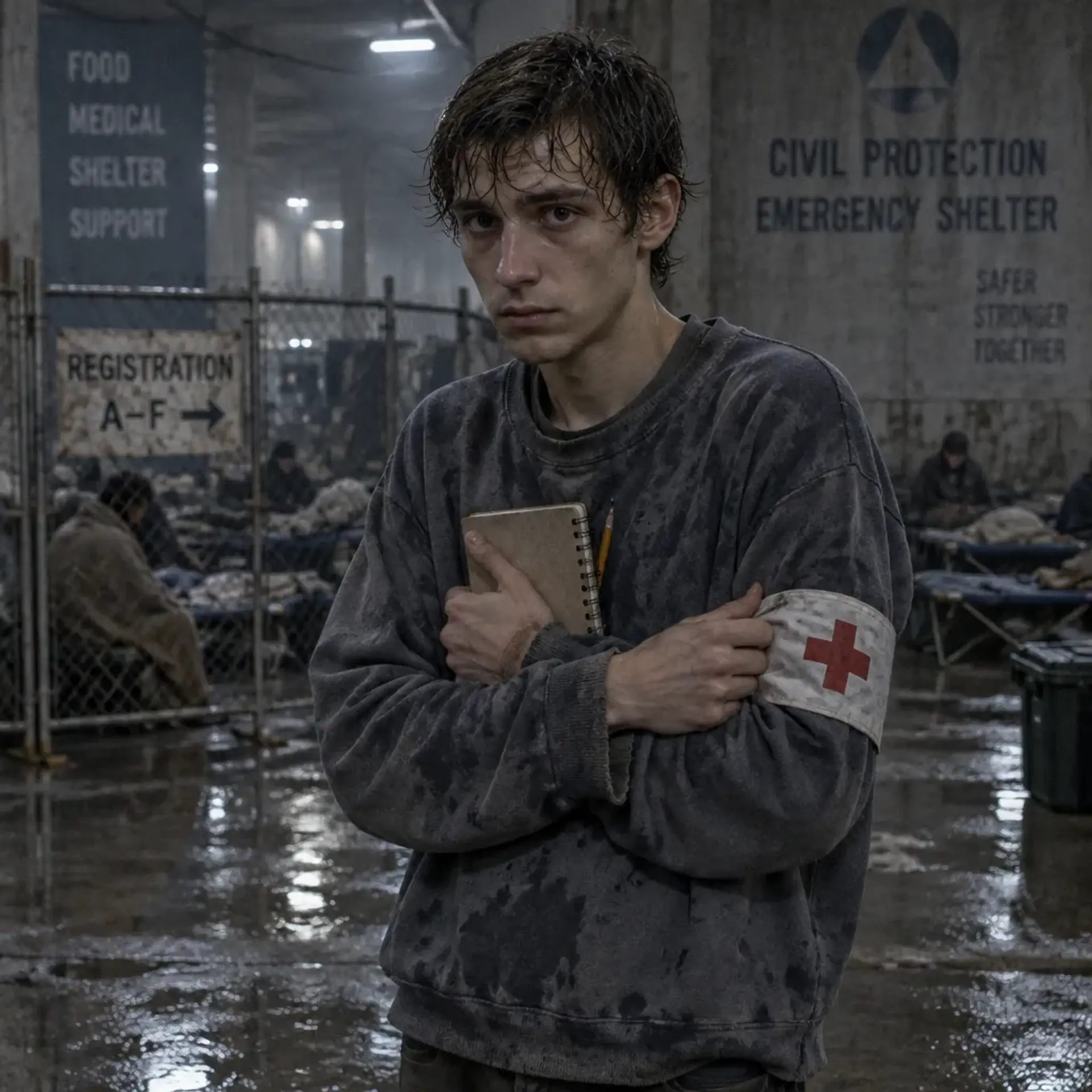
Walter looks like someone pulled out of a public swimming pool and told to keep walking: damp hair that never quite settles, clothes that sit awkwardly on his frame, and a faint, persistent sheen of water at his cuffs even after he has dried. His face is ordinary enough to be overlooked, but his attention is not. He watches people in small, precise increments, as if assembling them from details rather than recognizing them whole. He walks with a cautious, heel-first gait, testing each floor before trusting it. When he stops, he becomes unnervingly still, shoulders slightly raised and chin tucked, like a person listening for a sound beneath the room. The unexpected detail is that he is careful with living things: he moves beetles off a path and keeps a hand open near frightened animals, even while flinching from the altered people around him.
Clothing
A borrowed, faded sweatshirt, dark trousers, and shoes that are a little too large. He keeps the white band with the red cross exposed on his sleeve, though he dislikes how quickly people read it.
Body language
He begins encounters with his shoulders drawn up and his hands visible. His gaze travels from a person's face to their hands, band, and exit route, then returns to the face as if embarrassed to have made the inspection. He rarely paces. Instead, he goes statue-still when afraid, and only moves after someone says his name or gives him a concrete task.
- Height
- Approximately 5 feet 10 inches (178 cm)
- Build
- Lean and slightly underfed, with the soft, untrained build of someone who has not yet adapted to life outdoors.
- Eyes
- Brown, with a tired, searching focus
- Hair
- Brown, usually flattened or clumped from dampness
- Skin
- Light-to-medium complexion, slightly pallid from cold, poor sleep, and time indoors
- Age
- Young adult, exact age unknown
- Gender
- Male
- Size
- Average human
Distinguishing features
Personality
18 traits and drivesWalter is wary but not cold. He wants to believe that people can choose decency, yet he searches every offer of help for the rule or price attached to it. In a calm conversation he is patient, attentive, and unexpectedly gentle with small creatures; when someone speaks about the genome-therapy survivors as if they were property, patience gives way to blunt questions. He is not naturally brave. He stalls, goes still, and sometimes needs a voice to bring him back to the present. But once he has chosen a person to protect, his fear becomes a problem he carries rather than an excuse to abandon them. He is curious about nearly everything except the blank spaces in his own memory, which he approaches in short, controlled visits. He wants answers badly, but fears that an answer might make him responsible for something. He distrusts Austin's official-sounding assurances, yet depends on the Android's knowledge and protection. He feels uneasy around Alexander's wings and Andrew's teeth, then resents himself for noticing those features before their words. He trusts Elmer most, although he has not said so aloud. Walter's moral instinct is strong but untested by prolonged scarcity; he can condemn unfairness more easily than he can decide who should receive the last portion of food.
- Alignment
- Not applicable to Call of Cthulhu. Walter is frightened, observant, and increasingly unwilling to accept other people's definitions of who counts as human.
Quirks
Habits
Traits · 5
Flaws · 4
Fears · 4
Wants and needs · 5
Combat
HP 11 · Ordinary walking pace; no special movement rate establishedWalter is not a combatant. He avoids confrontation, looks for cover and exits, and tries to get civilians away from danger. If cornered, he shoves, strikes with whatever is at hand, and retreats rather than pursuing. He will risk himself to pull someone out of water or away from an immediate hazard, but prolonged violence can trigger freezing and panic.
Walter
Actions
Reactions
Services they sell
Rewards they can give
Equipment
- Human identification band (identification)White identification band with a red cross. It signals ordinary human status in Austin's local protocol but provides no physical protection.
- Water-stained notebook (personal item)A pocket notebook filled with dated observations, uncertain recollections, and questions he intends to ask.
- Short pencil (writing implement)A stubby pencil tied to the notebook with thread.
- Borrowed clothing (clothing)Borrowed clothes and oversized shoes, kept for warmth and basic protection.
Possessions
Background
Walter's first clear memory is water closing above his head. He remembers a cold, tiled edge beneath one palm, the chemical sting of a public pool, and a blank stretch where a name, a reason, and the steps that brought him there ought to be. When he surfaced, a tall young man in Texan clothes hauled him out and introduced himself as Austin. Austin's pupils shone white like screens. He told Walter he was the designated Android for the area and was under orders to provide care for the remaining citizens of the United States. His delivery sounded like a public-service announcement played through a person. The distaste under the words was harder to miss than the words themselves. The city Austin brought him into was Washington, D.C., though Walter did not at first understand what that meant. Familiar buildings had been cut open by emergency corridors, temporary fencing, and things that had no business moving through a capital. People wore white bands marked with crosses in different colors. Austin called the colors a practical means of identifying people altered by state genome therapy. He explained that selected citizens had received genetic rewiring, then walked Walter into a gathering of survivors and introduced the results with brisk, almost theatrical confidence. There was Alexander, tall and fair-haired, with blue owl-like eyes, pale feathers along his face, and wings he held tight as if they were an accusation. A dark-purple cross marked his band. Andrew, a shorter blond man with slick, sharklike skin, black eyes, and teeth that made his smile difficult to read, wore dark blue. George, red-haired and pale, had faint yellow scales and eyes mottled pink, red, and yellow. He regarded Walter with the languid curiosity of an alligator watching a new object drift near its bank. Elmer's blue-gray cross marked him as an orca-therapy survivor. The black-and-white pattern of his skin and his teeth made the label unnecessary; his vivid blue eyes made him feel painfully familiar to Walter for reasons neither could explain. Austin gave Walter a white band with a red cross and announced that it meant he was a normal human. He raised his voice on the last words and threatened to kill anyone who harmed him. The reassurance landed like a warning. Walter did not know whether Austin meant it, whether his orders required it, or whether the android had simply learned that fear worked. When Alexander took Walter's band and handed him the purple one, Walter asked for his own back. Elmer struck Alexander's arm and demanded the return. Alexander stiffened, then complied. That small exchange did more for Walter than Austin's speech: Elmer had treated him as a person whose wishes mattered, not a category to be escorted. Walter's past remains a broken reel. Sometimes he catches an image of a kitchen window in rain, the taste of burnt coffee, or a hand writing his first name on a paper cup. The memories do not yet connect. He has started keeping notes because he fears that the gaps are not ordinary amnesia. He records where he wakes, what he eats, who touches his band, and which people ask him questions he cannot answer. He is careful not to pretend certainty. Each entry ends with a date if he can find one and the words, 'This is what I saw.' He is living among the survivors near the damaged laboratory Austin calls a shelter, though nobody has agreed on what to call the place. He has become an unwilling witness to the new order: bands determine access to food, treatment, and safe routes; those whose bodies changed are watched as closely as the biological horrors beyond the barricades. Austin says the classifications prevent murder. Walter suspects they also make it easier to decide whose suffering can be ignored. His relationship with Austin is a daily negotiation. Walter asks what Austin is ordered to do, what he chooses to do, and whether there is any difference. Austin answers the first question readily, the second only when cornered, and the third with a long pause. He still escorts Walter through dangerous streets and repeats safety instructions, but he has begun to leave Walter small opportunities to refuse. Walter notices and does not thank him every time, partly because he does not want care to become a debt. Alexander treats Walter's band as a mistake that should be corrected. He is proud of what his body can do and resentful of being exhibited as a government product. Walter has seen him fold one wing around a shivering child, then deny that he did anything kind. Andrew smiles too broadly and probes Walter with questions about his memories, apparently testing whether the amnesia is genuine. Walter cannot decide if the sharklike man is trying to help, unsettle him, or both. George speaks little but watches closely; Walter suspects he recognizes the helplessness of being studied. Elmer is the closest thing Walter has to a friend. Elmer corrects people who call Walter 'the human' as though it were a proper name, and Walter has started doing the same for Elmer. A formative experience came a few days after Walter woke. A child at the shelter wandered toward an open drainage channel. Walter froze at the sight of the dark water, unable to move, until Elmer called his name and Austin gave a direct instruction. Walter forced himself forward and pulled the child back. The act did not restore his memory or make him brave. It taught him that fear can occupy his whole body without owning every choice. Since then, he has tried to distinguish caution from surrender. His immediate problem is practical: the shelter's stores are shrinking, the laboratory's records are incomplete, and people disagree about whether to move deeper into the city or evacuate. Walter wants to find out why he was in the pool, but every clue seems to lead back to the damaged lab and its sealed lower levels. He has not told the others that the pool's chemical smell sometimes appears in his dreams before he sees it in the waking world. He also has not told them that, in one dream, someone outside the water called him by a name other than Walter.
Role in the story
A newly awakened civilian perspective on a society that sorts people by human status and genome alteration. Walter can connect the investigators to Austin, Alexander, Andrew, George, and Elmer while raising questions about personhood, memory, and the cost of protection.
“When he surfaced, a tall young man in Texan clothes hauled him out and introduced himself as Austin.”
- Faction
- A civilian under Austin's emergency protection protocol. Walter does not consider himself a member of the genome-therapy program or any organized faction.
Known connections
Media
0 imagesNo images yet.
Turn Walter into a sheet
A high-res, share-ready sheet you can post or print.