Friedreich
Friedreich
At the table
Voice
A strong German-accented voice with a dry, clean onset and sharply shaped consonants. His ordinary voice sounds slightly distant, as though heard through a closed room. When embodied, the borrowed throat adds its own texture, but Friedreich's measured Prussian rhythm remains. Anger makes his delivery brisk and unsparing rather than quieter.
His German is strongly marked by a formal Prussian cadence. In English he chooses precise, somewhat old-fashioned phrasing and gives consonants a crisp edge. He speaks from military habit and a life of interrupted memory: dates, orders, and practical details come readily, while intimate explanations arrive in fragments. A borrowed face changes his mouth and vocal timbre, but not his characteristic pacing or clipped emphasis.
Speech patterns
How to play them
Treat Friedreich as a person whose courtesy is a practiced defense, not proof that he is harmless. Acknowledge him directly, ask before touching his Fetters, and do not demand that he reveal a face. He responds well to useful tasks, shared routines, football, honest questions, and invitations that do not presume he can eat or drink. If discussing Wilhelm or the wars, allow him to be angry without forcing reconciliation. Questions about the cathedral door may produce a sharp refusal or an unexpected fragment.
Goal
Recover enough of his past to understand the cathedral door and his relationship with Wilhelm, while building a present life that does not depend entirely on borrowed faces.
Motivation
To belong to the living world without surrendering his identity, to protect the coven, and to learn whether Wilhelm's silence hides guilt, mercy, or both.
Appearance
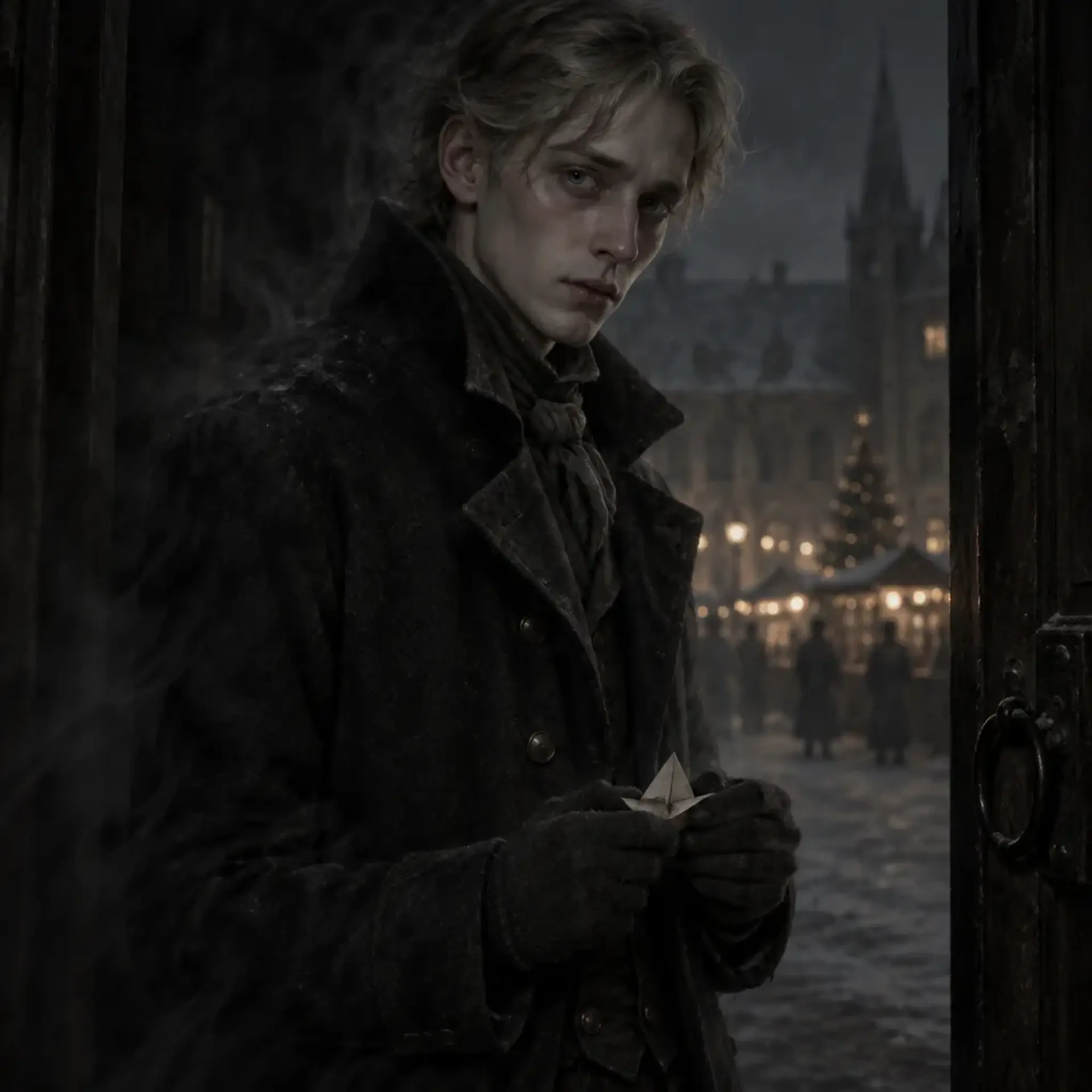
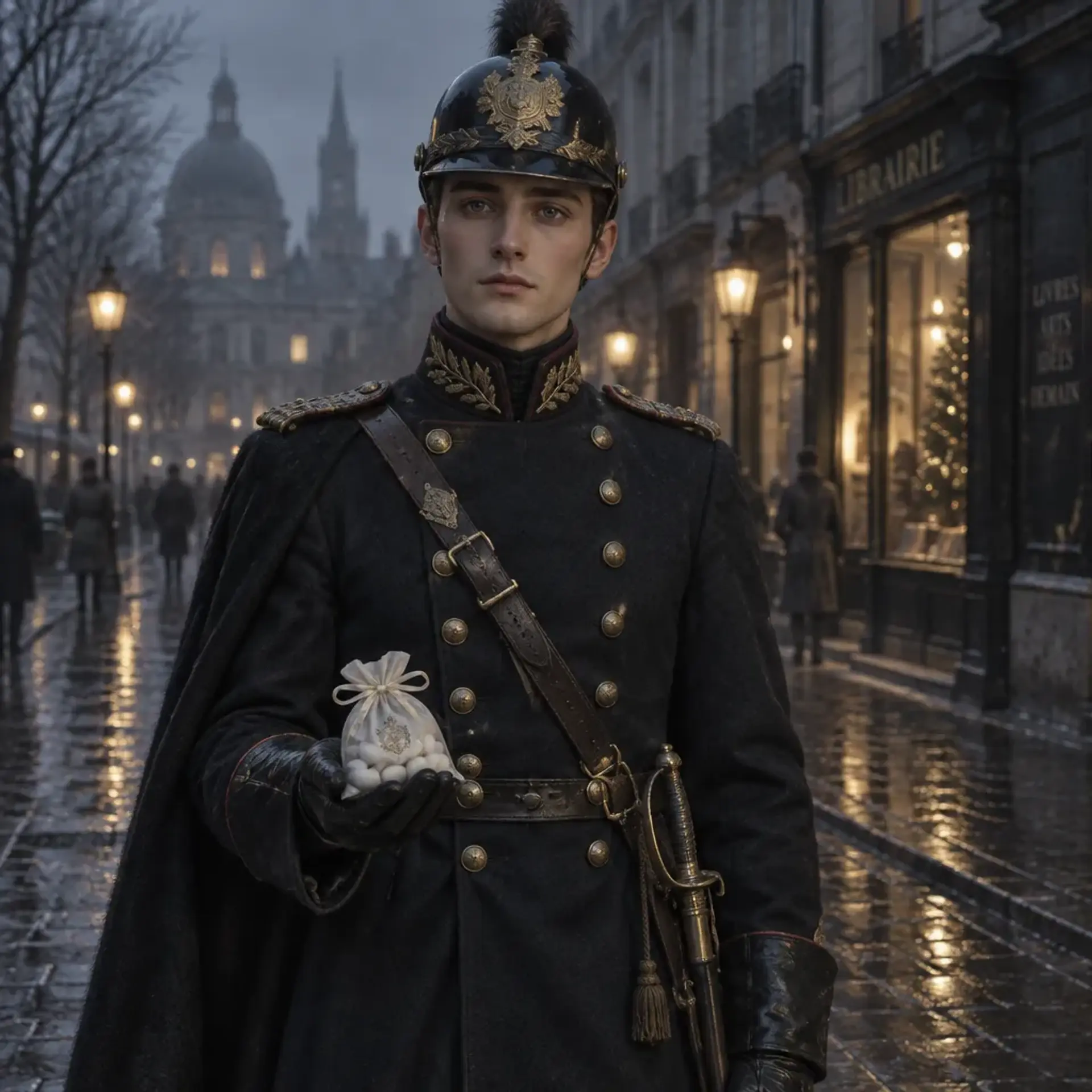
When he is visible without a borrowed face, Friedreich looks like a young Prussian officer preserved in the instant before a portrait was finished. His uniform is dark, stiff, and old-fashioned, with seams that look damp in some lights and dry as paper in others. The brass buttons have a dull, thumb-polished sheen. His helmet sits precisely level even when he turns his head. He is narrow through the shoulders, with the taut, economical posture of someone taught to stand inspection. When waiting, he puts his weight on the balls of his feet and keeps his hands behind his back, but his heels never quite settle. He walks in measured, heel-first steps that sometimes fail to make a sound; when he forgets himself, he takes a short marching pace that is too regular for a crowded modern street. His most unexpected detail is that he keeps a little paper packet of sugared almonds in his uniform and offers them with grave courtesy, though he cannot taste them unless embodied. On the rare days when the boundary loosens and he can be seen clearly, people notice how young he is before they notice the uniform.
Clothing
His default appearance is an old Prussian-style officer's uniform with a high collar, worn gloves, a service blade, and a helmet. The garments look more substantial in the Shadowlands than their age should permit. While embodied, he experiments with plain modern coats and ordinary shoes, but he often retains one old detail: polished buttons, gloves, or a rigid collar.
Body language
He stands as if waiting for inspection, hands behind his back, weight slightly forward. His head turns before his shoulders, and he watches doors, stairways, and the hands of strangers. In a borrowed body, he copies its casual gestures but the old drill returns when he is alarmed. When he is fond of someone, he positions himself between them and the nearest exit without appearing to notice he has done so.
- Height
- About 173 cm when he is clearly visible; borrowed faces vary.
- Build
- Lean and compact, with a trained, upright bearing more than obvious strength.
- Eyes
- Uncertain. Wilhelm says grey; Friedreich cannot verify it as his own.
- Hair
- Uncertain. Wilhelm remembers blond hair; Friedreich has no reliable independent memory of it.
- Skin
- Not reliably observable without a borrowed face; when visible, his skin appears pale and slightly translucent, like a face seen through cold window glass.
- Age
- Appears to be seventeen or eighteen; his exact age and mortal dates are uncertain.
- Gender
- Male
- Size
- Medium
Distinguishing features
Personality
21 traits and drivesFriedreich is courteous because he was taught that composure is a form of control, and because manners give him something to do when people cannot see him. The courtesy is real, but it is not softness. He can be exacting, proud, and capable of a sudden flash of temper when a conversation passes through him as though he were absent. He hates being pitied more than being feared. When he is hurt, he asks for facts and timelines; when he is afraid, he talks about duty. He can defend a friend with startling ferocity and then spend days wondering whether he acted from loyalty or from the pleasure of having a clear enemy. His feelings about Wilhelm are the contradiction at the center of him. He loves Wilhelm as a brother and can recognize the shame in his rare apology about the First World War. He is also furious about Wilhelm's crimes in the Second World War and refuses to let affection erase them. Wilhelm's unwillingness to explain makes Friedreich feel abandoned all over again. He suspects the vampire's guilt is sincere, but does not trust sincerity as a substitute for accountability. Sometimes Friedreich protects Wilhelm before he has decided whether Wilhelm deserves protection. Afterwards, he resents himself and then resents Wilhelm for giving him a reason to feel divided. Friedreich is less certain around Gunther and Klaus. Gunther's curiosity can delight him, especially when it treats his abilities as something strange but not shameful. It can also make Friedreich feel like a specimen. The failed possession experiment left him wary of turning friendship into an experiment, even though he was the one who proposed trying it. Klaus's evasions provoke him, yet Klaus's hesitation around him brings out a protective patience Friedreich does not show many others. He knows Klaus may be withholding crucial knowledge about the spirit that opened his Caul. He has not decided whether pressing him would be an act of trust or a betrayal of the fragile peace between them. Mila draws out his gentler, more openly human impulses. Because she can see and touch him without a face, he does not need to perform normality for her. He treats her as a younger sister, but not as someone helpless. His protectiveness is a promise he made to himself, not a judgment of her ability. At Christmas he becomes an earnest adviser on bargains, stalls, and gifts. He often recommends the food he wishes he could taste. If she notices, he changes the subject to prices. In good moods, he is dryly funny, attentive, and eager to join ordinary activities. He follows football with absolute seriousness, enjoys cards, and remembers who likes which drink even when he cannot share it. In a bad mood, his attention narrows to slights and threats. He can become rigid, suspicious, and overly formal, as if a perfect posture might prevent a painful truth from reaching him. When he has been unseen for too long, anger comes first; shame follows once he is able to recognize it. His face-stealing ability complicates his personality rather than solving it. He delights in breathing, eating, sleeping, bathing, and touching the world. The relief can become greed. He prefers faces that resemble the young man he imagines himself to have been: German, close to his apparent age, and connected to military service, police work, or old nobility. Each face is a temporary permission to exist, but each also raises the question of whether he is borrowing a life or hiding from his own. He makes records and rules because he is afraid of what happens when he stops asking where the borrowed person ends and Friedreich begins. He wants a job or a hobby group not merely as a disguise but as a routine that could continue. He is trying to learn how to be present without requiring crisis, a war, or a supernatural emergency to justify his existence. He is proud of the discipline that helps him practice. He is embarrassed by how much he wants simple things: a warm drink, a familiar seat, a pleasant conversation, a woman's smile, or a holiday spent as a guest rather than a guardian. That embarrassment makes him more formal than he needs to be. The greatest tension in him is between the officer he imagines and the young man who wants to be allowed to live. The officer wants a chain of command, a clear duty, and a final account of what happened. The young man wants affection without conditions and sensation without a borrowed name. Friedreich does not know which one is the real self. He fears that his original identity may have been cruel, cowardly, or complicit, and that recovering it will not free him. Yet he keeps searching, because he believes a person who refuses to know what he did is no better than Wilhelm when he refuses to speak.
- Alignment
- Not applicable as a Wraith: The Oblivion rules statistic. In ordinary terms, loyal and protective, but capable of lethal violence.
Quirks
Habits
Traits · 5
Flaws · 5
Fears · 6
Wants and needs · 5
Combat
HP 5 · Use the movement rules of the selected Wraith edition; no separate speed statistic is assumed.Friedreich avoids a fair fight when he can. He uses a borrowed face to pass unnoticed, reach an ally, or draw an enemy away. If combat becomes unavoidable, he uses cover, the blade, and deliberate interposition rather than bravado. He fights hardest when an enemy targets Wilhelm, Klaus, Gunther, or Mila. The listed dice pools are not supplied because Wraith editions and table-specific combat procedures vary; use his appropriate Attribute + Ability pool and the game's normal rules.
Friedreich
Actions
Reactions
Services they sell
Rewards they can give
Equipment
- Service blade (fetter and weapon)A worn officer's blade, carried as both a weapon and a personal Fetter. No special damage rating is assumed; use the table's weapon rules.
- Officer's helmet (fetter)An old military helmet that remains unusually tangible across the boundary between worlds. Its supernatural properties beyond that are left to the Storyteller.
- Officer's uniform (fetter)A carefully maintained uniform that anchors Friedreich to his remembered identity and is visible when he is not wearing a borrowed face.
- Face list (personal record)A folded private record of aliases, faces, locations, purposes, and the effects of each use. He changes names to protect his privacy.
- Paper packet of almonds (keepsake)Sugared almonds he offers to others. They are not a supernatural resource.
Possessions
Background
Friedreich remembers Brandenburg in fragments: a flat horizon, a road shining after rain, the smell of wool drying near a stove, and the repeated click of boots on a hard floor. He does not know whether these are memories of his childhood, an older life, or details borrowed from the people whose faces he has worn. Wilhelm once told him, bluntly, that Friedreich had blond hair and grey eyes. When Friedreich pressed him to explain how he knew, Wilhelm's expression closed. Friedreich has not decided whether the answer was truth, guilt, or a kindness made cruel by being withheld. He believes he was raised among old Junker expectations: rank, duty, land, and a habit of treating feelings as things to be kept behind a locked door. He remembers military drill more clearly than family. The memory of breathing during the First World War arrives with an almost unbearable force: air scraping his throat, damp wool against his chest, and the shock of realizing he had lungs. He remembers Wilhelm there too, and remembers Wilhelm leaving. Friedreich cannot reconstruct the circumstances. He knows only that Wilhelm has apologized for that desertion, and that this is the one subject on which Wilhelm's shame seems uncomplicated. Friedreich wants the missing explanation, but fears that knowing it will make his anger either more justified or less useful. The Second World War is harder. Friedreich was with Wilhelm as much as he could be, but the chronology has holes and the moral facts do not. Wilhelm committed crimes. Friedreich knows enough to be angry, and Wilhelm refuses to talk about what he did. Friedreich suspects that he helped him, failed to stop him, or both. His own role in the war is not clean simply because he was dead. He has killed to protect the people he calls family: one Get of Fenris who tried to kill Klaus, and three Hunters who were pursuing Wilhelm or the others. He has also fought vampires who threatened Wilhelm and changelings who threatened Gunther. He tells himself these were necessary acts. His Shadow asks whether necessity is merely the uniform he puts on violence. His death and the opening of his Caul are also incomplete in his memory. The account Klaus gave him was not a conventional rescue by a wraith, mage, or occultist. Klaus described a spirit of land and humankind, marked by the Wyld, born of the Weaver's blessed adopted children, bearing the Wyrm's spoils and a trace of Luna. Friedreich cannot tell whether this is accurate, metaphorical, or Klaus's way of concealing a simpler truth. The spirit hid its intentions. When Friedreich woke from his Caul, only a willow-wisp remained from the repetitive marching he had known before. He has since understood that his existence in the Shadowlands is not a simple continuation of human life. He is a wraith, and whatever opened his Caul did not explain what it had made of him. The memory he has kept from the coven begins with his gloved hand on a heavy door. Someone behind him begs him not to open it. The latch gives. Then come candle smoke, shouting, and violence above the nave of a cathedral during Walpurgis Night, April 30. He has told his friends the fragments he trusts, but not the door. He cannot tell whether it opened into the Skinlands or the Shadowlands, what passed through it, or whether the fight began because of his choice. He fears that remembering will reveal not only what happened, but who he was before he learned to call himself a victim of events. His first face-stealing was not a planned trick. A day came when the world seemed less tightly bound against the dead. Friedreich was frustrated by being unseen, and the distress of being unable to reach anyone was sharper than usual. He had found a young man who looked enough like his remembered self to hurt: German, close to his apparent age, with a serviceman's posture. The man was dead and no longer locally present, so Friedreich believed he could use the image without frightening or replacing him. He reached toward the remembered outline and, through an instinct he could not explain, drew it over himself. The first sensation was the weight of skin, then the sting of cold air in his nose. He breathed. He touched a door and felt the varnish. He spoke and heard a living voice come from his mouth. He wept when he could taste a sugared pastry. The experience was wondrous and terrifying, and he did not know whether this was ordinary for a wraith. He still does not. Friedreich now keeps a private list of faces, with aliases and notes about when each is safe to use. He prefers men near his apparent age, especially German men with military, police, or noble associations. He avoids faces belonging to people who might be recognized nearby; he checks whether the person is dead or away and changes the name in his notes to protect himself. One favorite is a dead reservist he calls Emil, used for errands and for sitting in a café without drawing questions. A former police trainee, listed as Rolf, lets him practice a watchful, ordinary manner and visit public places. A young man of old Brandenburg stock, renamed Hannes, lets Friedreich test the posture and speech that he imagines were once his own. He has a softer-faced stranger he calls Niko, used when he wants to flirt, usually with women he finds pretty, though he is unsure whether the affection belongs to him or the face. A final entry, marked only with a question mark, is a face he tried once and refuses to describe. He records each use, purpose, emotional aftertaste, and any moment when he felt the borrowed identity crowd out his own. The danger is not simply that someone will catch him. Long use can loosen his sense of self. The borrowed memories are not truly his, but moods and habits cling. Sometimes he feels envy toward the living person whose body he can inhabit, followed by anger at the person, the world, or himself. His remarkable embodiment tempts him to stay. He has begun experimenting with ordinary routines: shopping, riding public transport, sitting through a football match, and asking whether he might hold a part-time job or join a hobby group. He wonders if he could do honest work without letting a borrowed face become his whole life. Friedreich's companions form what they jokingly call a coven, though they are not a formal supernatural order. Wilhelm is a Tzimisce vampire from Mecklenburg, as disoriented about his pre-death life as Friedreich is about his. Friedreich regards him as a brother and is furious with him in ways he cannot reconcile with that love. Gunther is a changeling who spent much of his life in Arcadia before returning to the real world; he sells clothes made with moss. Klaus is a ronin Get of Fenris, or perhaps a skin-dancer, and refuses to clarify. He is passively cruel to most people, but hesitates around Friedreich. Friedreich once protected Klaus from a Get who meant to kill him. He suspects Klaus knows more about the spirit and the Caul than he admits. The group meets to play cards, hunt, fish, drink, and watch football. Holidays matter. More of the wider circle gathers then, especially to visit Mila, a mage from Bremen. Mila can see and touch Friedreich even when he has no face. Her kindness makes him feel both welcomed and painfully exposed. He thinks of her as a little sister and protects her because he feels responsible, not because he thinks she is weak. At Christmas markets he advises her on bargains, recommends gifts, and sometimes points out something he cannot have himself. He has tried church services, partly because he hopes for comfort and partly because he wants to learn what it means to sit among the living without pretending to be one. The possession experiments began from curiosity and affection. Friedreich wondered whether he could share sensation with Wilhelm, perhaps giving him the ordinary feelings Wilhelm's vampirism had taken away, or recovering memories by joining their minds. They agreed on limits, chose a card game as a focus, and kept alcohol nearby to test whether Wilhelm's body could react to it. Friedreich tried to enter Wilhelm while Wilhelm remained himself and consented. The attempt was difficult: the vampire's body felt like a fortress with a locked gate, and Friedreich's awareness seemed to catch on the body's unnatural stillness. When he did manage a tenuous union, he felt Wilhelm's cold bodily balance, an absence where hunger and ordinary appetite ought to have been, and a disciplined refusal of sensation. Wilhelm reported pressure, a second intention behind his eyes, and a flash of Friedreich's breath-memory. The cards became a focus for their separate attention. Wilhelm's hand moved before he consciously chose it, and Friedreich felt the action as if he were reaching through a glove. The alcohol did not restore human warmth or ordinary drunkenness; any response was a vampire's strange imitation of a living body's reaction, not the shared comfort Friedreich hoped to offer. The game ended with a spilled drink, a shaken Wilhelm, and Klaus abruptly standing between them as if expecting an attack. Gunther asked a dozen questions. Friedreich was embarrassed that he had wanted to make Wilhelm feel human and more embarrassed that Wilhelm had let him try. Later, Gunther volunteered for a similar experiment, wanting to know what separated their lives and whether they could share memories. The attempt went badly in a different way. Gunther's changeling nature made the boundary feel alive, responsive, and full of impossible associations. Friedreich felt a place that was not a place, brightness that seemed to argue with him, and a tumble of impressions that could not be sorted into his own senses. Gunther experienced an intrusive cold, military rhythm, and a momentary sense of being watched from behind his own face. Neither could tell which impressions belonged to whom. They stopped before it became a struggle. Friedreich's response afterward was immediate and emphatic: never again. Gunther apologized, then asked whether the strange feeling had been a memory. Friedreich could not answer. Friedreich and Wilhelm later made one final agreement to try once more. They chose a calm evening and set clear limits, intending to stop if either signaled distress. This time Friedreich focused on Wilhelm's consent rather than trying to push sensation into him. They reached a brief, controlled overlap, long enough for Friedreich to feel how carefully Wilhelm guarded his inner life and for Wilhelm to recognize the remembered breath as something more than an image. No lost biography returned. The experience did not absolve Wilhelm or settle the wars between them, but it changed their argument: Friedreich understood that Wilhelm's silence was not proof that he felt nothing, and Wilhelm could no longer pretend Friedreich's longing was only an inconvenience. They agreed that the experiment was finished. Friedreich's present life is a negotiation between a ghost's distance and an embodied person's appetite for ordinary things. He wants a job, friends who know him without a disguise, and a truth about Wilhelm that does not have to be guessed from silences. He fears that the truth behind the cathedral door will turn his careful loyalty into complicity. He fears, too, that a borrowed face will become easier to love than his own. His uniform and blade remain tangible Fetters, as if the dead world has preserved the very objects that bind him to a self he cannot fully remember.
Role in the story
A companion, moral witness, and uncertain historical clue. Friedreich can provide access to the Shadowlands, introduce the coven's relationships, or become the emotional center of a mystery about the cathedral door, Wilhelm's past, and the spirit that opened his Caul.
“He does not know whether these are memories of his childhood, an older life, or details borrowed from the people whose faces he has worn.”
- Faction
- A loose supernatural coven of friends, not a formal organization. Friedreich is a wraith associated with the Shadowlands and Stygia by his nature, but no formal Stygian office or faction rank is established.
Known connections
Media
0 imagesNo images yet.
Turn Friedreich into a sheet
A high-res, share-ready sheet you can post or print.