Ewan Armitage
Ewan Armitage
At the table
Voice
A plain Yorkshire voice, dry and lightly rough, shaped by cold hillsides and years of repetitive telephone work. He sounds friendly without sounding eager. When his composure slips, his breath catches and his words become sparse; he does not become softer or more courteous when angry, only more direct.
He speaks in a plain Yorkshire cadence, with the clipped rhythm of someone used to making himself heard over wind and livestock. His voice has a dry, slightly rough edge, as if worn by cold air and too many work calls. He peppers conversation with 'love' and matter-of-fact complaints. When disturbed, his breathing catches before his voice changes; old syllables sometimes crowd the start of a sentence, but he swallows them rather than speaking forbidden words.
Speech patterns
How to play them
Meet him on practical ground: ask about a job, a route, or the weather rather than demanding his history. He warms to people who accept help without making a ceremony of it. Pressing him about Mary, William, or his old names makes him joke, withdraw, or abruptly leave.
Goal
Keep his present life intact while finding out whether William survived and what became of him.
Motivation
He wants to believe ordinary kindness can still count for something, even after the life he built with Mary and William was taken from him.
Appearance
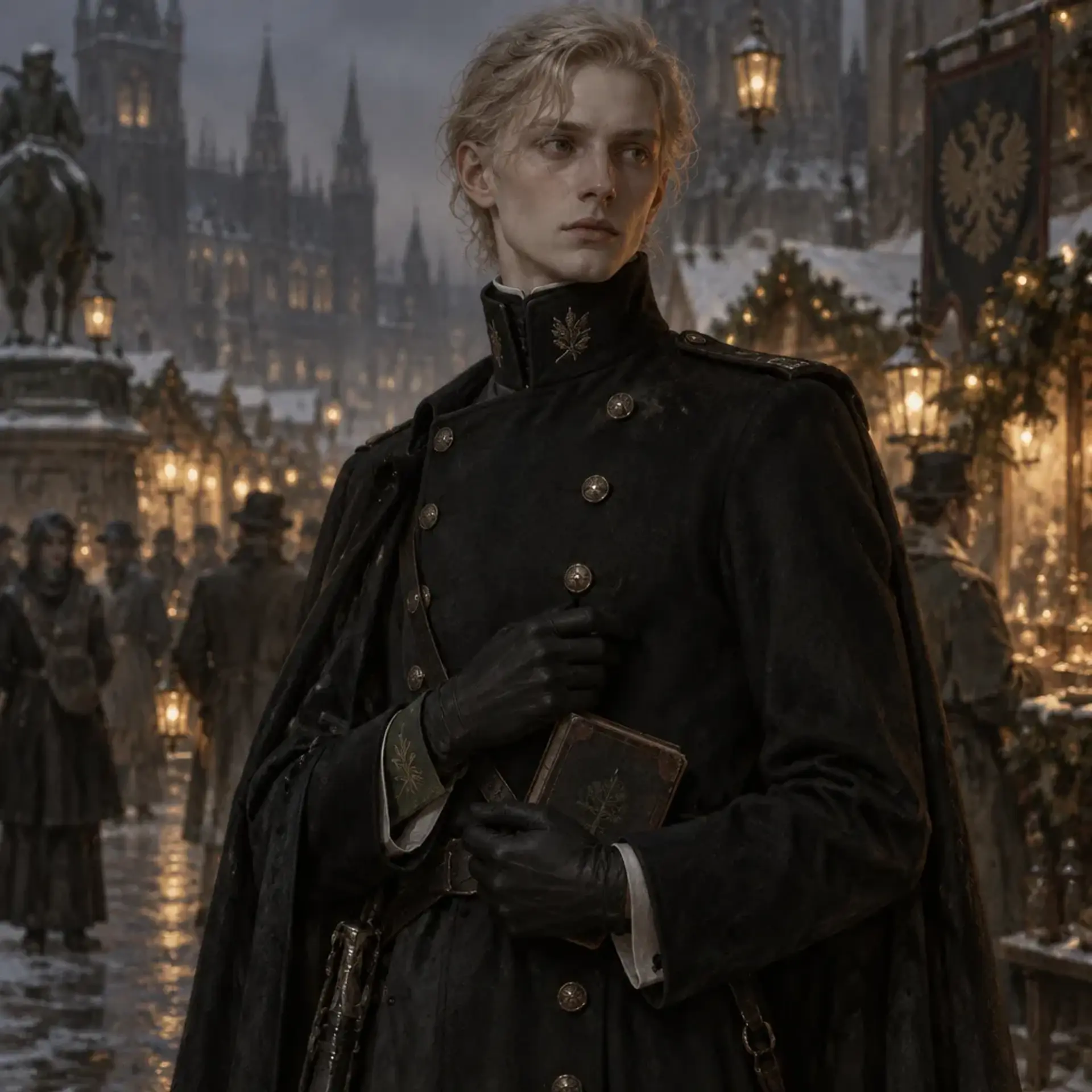
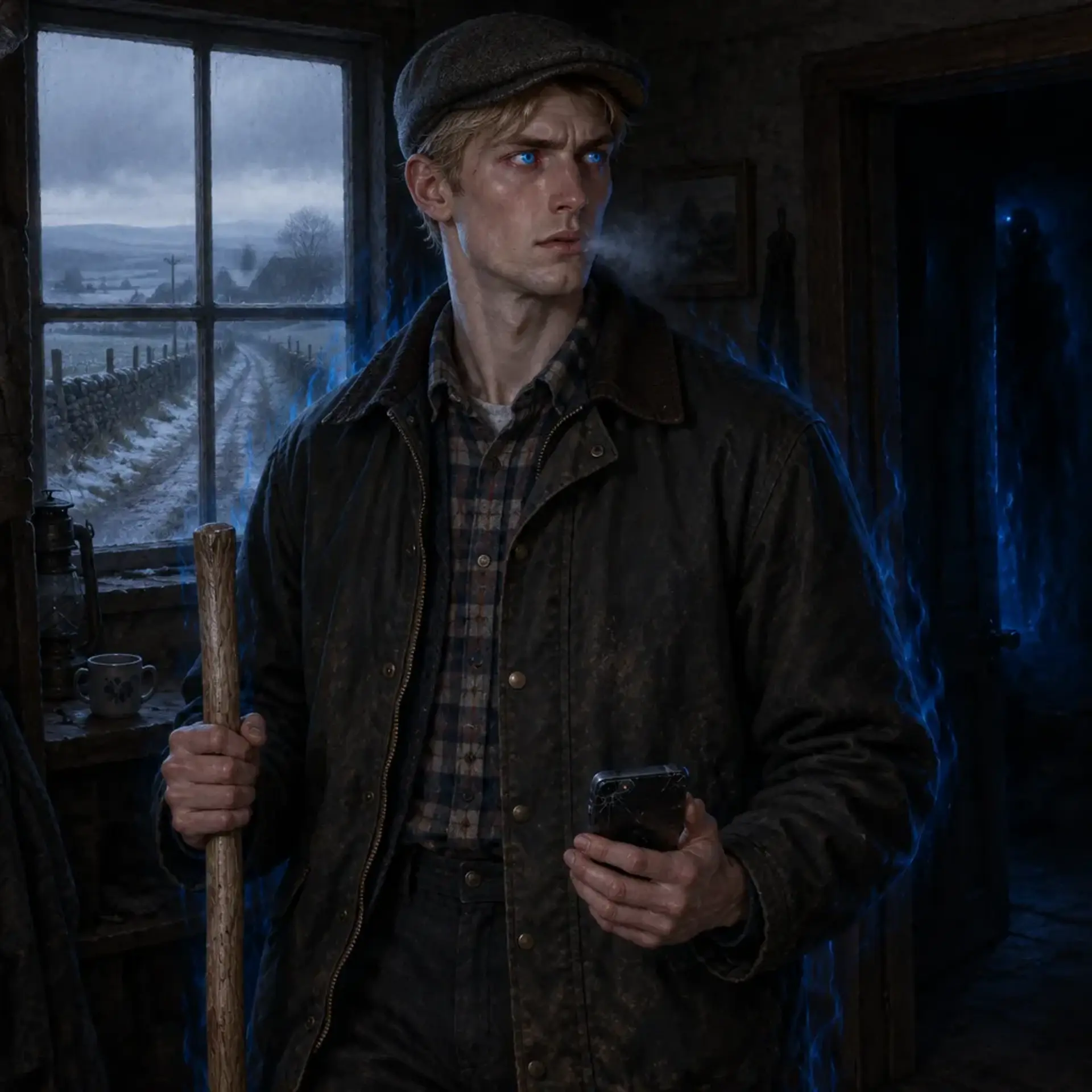
Ewan is a handsome young man just over six feet tall, pale as winter milk, with light blond hair kept neatly trimmed and burning blue eyes that seem to hold a reflection of a distant lane. In a room, his gaze keeps returning to doors, windows, and whoever stands nearest the threshold; when rattled, he barely blinks and his breath catches as if he has smelled snow. His face is clean-shaven and carefully kept, his clothes plain but chosen to sit well on him. He moves with a farmer's economical strength, placing his feet as though testing ground for bog or loose stone. In bad hours, his outline looks a fraction too long, and the light around his eyes turns red at the edges. He gives the impression of a decent, capable man who has learned to stand very still when something impossible is near.
Clothing
Modern clothes with the silhouette of a Yorkshire farmer: clean work boots, straight dark trousers, a checked shirt, a weatherproof jacket, and a plain wool cap. Everything is well-fitted, durable, and quietly flattering, never flashy.
Body language
He stands squarely, shoulders relaxed but ready, and keeps his hands occupied with a phone, mug, or coat cuff. His eyes track thresholds and corners before faces. When unsettled, his breath stops for a beat; he turns his head toward sounds before anyone else has heard them.
- Height
- 6 ft 1 in
- Build
- Tall, strong, and lean from years of hard work, with the practical balance of someone used to uneven ground.
- Eyes
- Burning blue
- Hair
- Light blond
- Skin
- Pale, with a cool undertone
- Age
- Appears 19 or 20; has lived since the 17th century.
- Gender
- Male
- Size
- Medium
Distinguishing features
Personality
15 traits and drivesEwan keeps to himself but is warm in small, practical ways, often calling people 'love' as he passes them a tool or takes their coat. He is shrewd and hardy, yet avoids direct questions about the past. In ordinary company he is dryly funny and prone to theatrical complaints; when haunted hours fall, humor drains away and he listens to every sound outside. He hates his job, but shows up reliably, as if routine were a wall he can keep repairing.
- Alignment
- Neutral, with a stubbornly protective streak.
Quirks
Habits
Traits · 4
Flaws · 4
Fears · 3
Wants and needs · 4
Combat
AC 15 · HP 61 · 30 ft.Ewan avoids a fair fight. He opens with control or a frightening spell, uses Eldritch Blast to keep enemies away, and shifts into Barguest Shape when pressed. He protects allies by obstructing pursuit and using terrain, but will withdraw rather than risk being trapped by iron or forced to reveal his full nature.
Ewan Armitage
Spells
Actions
Reactions
Services they sell
Rewards they can give
Equipment
- Ash staff (weapon)A sturdy ash staff he presents as a walking stick, useful for work and defense.
- Work phone (tool)A scuffed smartphone with a cracked corner, used for his telemarketing job and rarely trusted to hold a charge.
- Farmer's clothes (clothing)A plain wool cap and weatherproof jacket, both carefully maintained.
- Old family photograph (keepsake)A small, folded photograph of Mary and William, kept behind his phone case.
Possessions
Background
Ewan Armitage says he was born among the Yorkshire Dales, in a stone cottage where his father kept sheep and taught him to read weather in the clouds. He remembers the taste of peat smoke, the rasp of wool against his palms, and the way rain announced itself first along the western ridges. He can describe the family’s flock, the cottage’s broken latch, and the path down to the village with such confidence that people rarely think to question him. Some details are true. Others belong to older lives, laid over the story like patches on a coat. Ewan has told the tale for so long that he no longer always knows which memories are his. He was not born as Ewan Armitage, nor, as far as he can tell, was he born in any ordinary human sense. He is a Barguest, a spirit of lonely roads, field margins, and the uncertain country between one safe place and another. Once, he could cross distances no sensible traveler would attempt, appearing along a far-off lane as if the miles had simply lost their claim on him. In those older days, people knew better than to meet his gaze at a crossroads after dark. Some called him a warning. Some called him a guide. The names changed with the villages, and he learned to answer to most of them. The Hirst family belonged to one of those older lives. Ewan knew them closely, though he speaks of them only rarely and never explains how he came to share their name. He knows they are all dead now. He has learned this in pieces, from old records, scattered stories, and the empty places where familiar voices ought to have been. He does not search for their graves. He does not ask anyone to remember them with him. When the subject rises, he makes a joke about family trees being a poor place to hang anything useful, then finds a reason to leave the room. In the seventeenth century, Ewan tried to stop being a passing shadow and settle into a human life. He took a name, kept a home, and married Mary. Their son, William, gave the years a weight and shape that the road had never offered. For a while, Ewan believed that routine could make him ordinary. He mended gates, earned his keep, and learned what it meant to wait at home for a child’s footsteps. He was not an easy husband, but he loved Mary in the quiet, practical ways he still understands: bringing in fuel before the weather turned, repairing what broke, and staying near when words failed. Mary’s father, Thomas, discovered what Ewan was. He did not confront him with a pitchfork or a prayer. Thomas was more patient than that. He used what he knew to turn neighbors against Ewan, maneuvered him out of his home, and helped sever him from the family he had tried to claim. The loss left Ewan with no useful language for grief. Even now, he is quicker to complain about a bad chair than to admit that a human life can be taken from him piece by piece. William’s later confinement in an asylum became another wound he could not bring himself to examine directly. Ewan has never found a way to speak of his son without making the story smaller, turning it into a dry remark, or changing the subject. He can remember the sound of William’s voice more clearly than he can remember the words they exchanged. That is the kind of memory he distrusts most: the one that stays sharp when everything around it has blurred. During the First World War, Ewan served among men who thought of him as a hardy, quiet fellow with an odd sense of humor. He had already learned how to put on a human face, and the war gave him another set of papers and another name to carry. In those years he had a daughter. He keeps her existence carefully guarded, even from people who have known him a long time. She grew up in a world shaped by loss and uncertainty, and in the end she died close to madness, as William had. Ewan does not say that she was mad, nor does he explain what happened to her. If pressed, he makes a remark about families inheriting more than their eyes, then falls silent. He has never stopped feeling that he failed her, though he cannot say what he might have done differently. He served again in the Second World War. The memories of both conflicts are jumbled among the other lives he has lived, like badly filed papers in a cabinet no one dares to empty. He remembers mud, orders, the faces of men who did not return, and the strange comfort of having a task that began and ended with the day. He also remembers being someone else during those years. The names do not always come when he wants them, and sometimes arrive when he would rather forget. The old powers have faded. Long stretches of ordinary life have dulled the paths he once walked without effort. He cannot simply step across the miles as he used to, though the land still knows him in ways he does not trust. At certain hours and seasons, especially when the Dales lie under fog or the night draws out too long, roads shift around him. A familiar lane may lead somewhere it should not. The dead stir at the margins of his attention. He hears footsteps outside a room where no one is waiting, and humor drains from his voice as he listens for what comes next. In 2026, Ewan works on a cramped telemarketing floor, selling services he dislikes to strangers who have better things to do than listen. He hates the work, the lights, and the cheerful script pinned beside his desk. Still, he turns up reliably. Routine is a wall, and every morning he repairs another stretch of it. He passes people tools, takes their coats, and calls them “love” without making a performance of kindness. He complains theatrically about the coffee and the callers, then stays late if someone else needs help. He keeps to himself and avoids direct questions about the past. His warmth is real, but it comes in practical gestures, not confessions. Those who know him well understand that his jokes are not invitations to ask more. When the haunted hours arrive, Ewan stops joking. He sits very still and listens to every sound outside, as if the road might call him by one of his older names. His old companions insist that Ewan Armitage is only the latest person he has been. He does not argue with them. He knows the Hirst family is gone, knows his children are gone, and knows that some roads remain open long after everyone who once walked them has died.
Role in the story
A weary, unexpectedly kind guide and occult ally whose apparent ordinary life hides a centuries-old grief. Ewan can help the party navigate haunted roads, but his past may draw danger toward anyone who becomes important to him.
“He remembers the taste of peat smoke, the rasp of wool against his palms, and the way rain announced itself first along the western ridges.”
- Faction
- No formal faction. He keeps cautious ties with a scattered circle of old spirits and uncanny beings who recognize the Barguest beneath his human appearance.
Known connections
Media
0 imagesNo images yet.
Turn Ewan Armitage into a sheet
A high-res, share-ready sheet you can post or print.