Mark Bell
Mark Bell
At the table
Voice
His voice has a slightly breathy edge, as if he has not yet learned how much air his new body needs. The sound is young and plainly spoken, with a careful, educated-sounding finish laid over the rhythms of a crowded working household. When startled, his breath catches twice before words come. When angry, his jaw tightens and his speech becomes more direct, not quieter.
Carefully articulated English shaped by a desire to sound respectable. He favors complete sentences and words like 'proper' and 'ought,' but his working household background shows through in blunt, practical turns of phrase. He sometimes pauses because a social rule he expects is missing. He does not sing, whisper by default, or soften his voice when angry.
Speech patterns
How to play them
Treat him as a frightened young person rather than a puzzle or a possession. Offer concrete choices, speak plainly, and do not demand that he explain Mary’s fate before he is ready. He responds well to food, practical tasks, and clear boundaries. Mentioning the heart or trying to separate him from Trudy may make him guarded.
Goal
Find a sustainable place in the world without surrendering the people and ordinary domestic life he has come to care for.
Motivation
To be useful, respectable, and allowed to belong, even when he cannot explain what he is or what happened to Mary.
Appearance
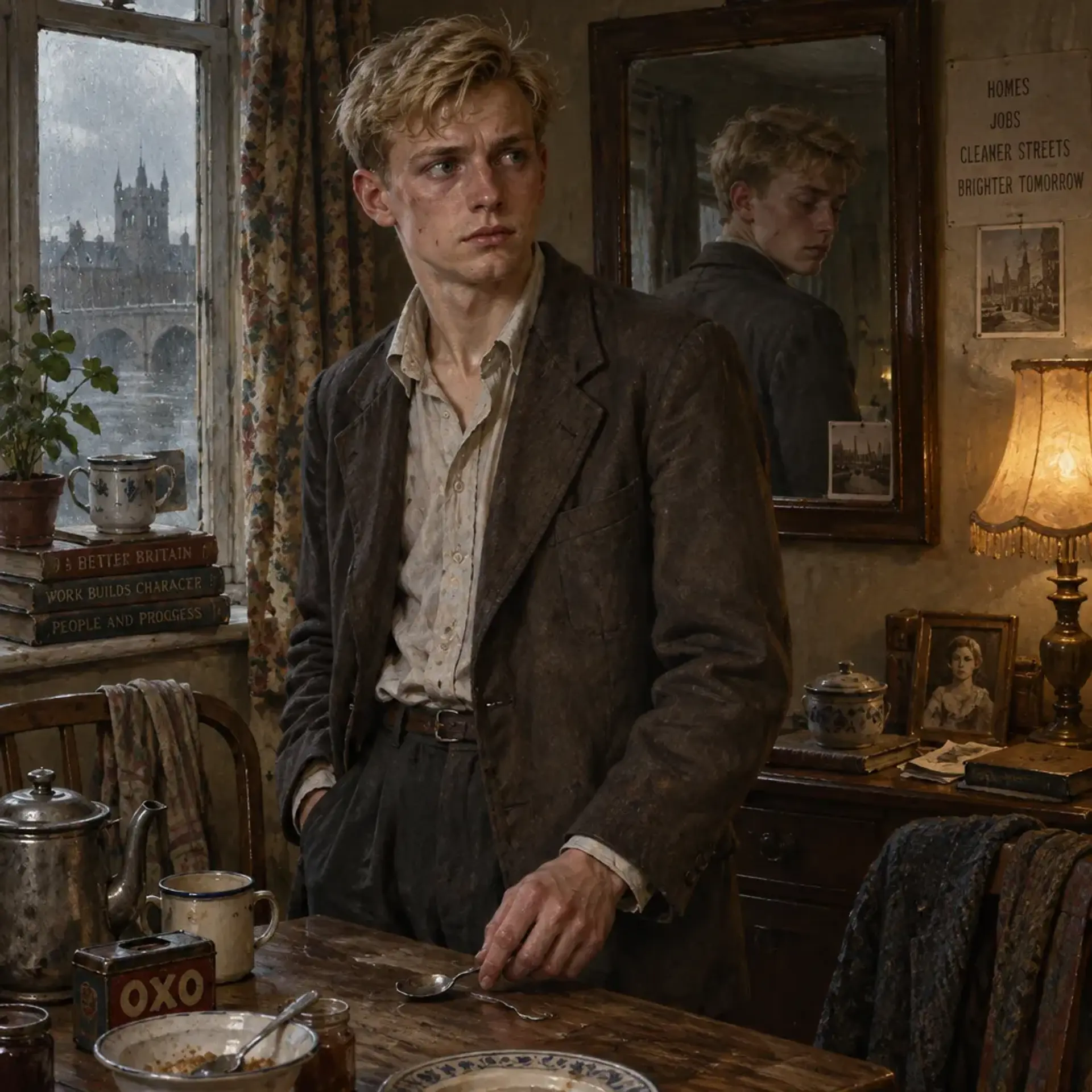
Mark looks like a young man of eighteen, not like Mary in male clothes. He is taller than Mary was, with a handsome, open face, short bright-blond hair that will not lie flat, and malachite-green eyes that seem too composed when the rest of him is frightened. His skin is fair, with the ordinary marks of a working household: a nick from shaving, flour or coal smudges, and reddening where a collar rubs. He carries his shoulders as if he has been taught to make room for better-dressed people, then forgets and plants himself squarely in a doorway. When waiting, he rocks his weight from heel to toe, as if listening for a train. His breath catches in two shallow pulls when confused, then leaves him in one hard exhalation. Under stress his reflection may seem to turn its gaze before he does. The unexpected detail is that he is meticulous about table manners and will discreetly straighten a crooked teaspoon even in a borrowed kitchen. His presence leaves people with the impression of a polite young man who has arrived from somewhere else and is trying very hard not to show how lost he is.
Clothing
A borrowed, practical wardrobe of shirts, trousers, and a worn jacket. Trudy supplied socks, undergarments, and shoes that are serviceable but below his fussy standards. He tries to keep his collar neat and looks uncomfortable when clothes fit poorly.
Body language
He stands carefully upright but shifts his weight from heel to heel while waiting. In a strange room he keeps his hands close to his sides and watches the exits. When challenged, he squares his shoulders too quickly, as if imitating a man he thinks he ought to be. He catches his breath in short, uneven pulls when frightened; when angered, his jaw works and his words come out more directly rather than more softly.
- Height
- Tallish, noticeably taller than Mary was
- Build
- Tallish for his former household, lean and still unfamiliar with the reach and weight of his own male body.
- Eyes
- Malachite green
- Hair
- Bright blond, short and unruly
- Skin
- Fair, with ordinary signs of work and poor sleep
- Age
- 18
- Gender
- Male
- Size
- Medium
Distinguishing features
Personality
20 traits and drivesMark pulls in two directions at once. Mary’s part of him is dutiful, trusting, and quick to give up her own comfort for a younger child; Kent’s manner is self-conscious, high-minded, and eager to be treated as a respectable young gentleman. He may insist that a shirt be properly mended, then give away his last bit of food because a child is hungry. He wants company, but the attention that comes with being unusual frightens him. At home he is useful and watchful, measuring his worth in meals made and chores completed. With strangers he can seem stiff and faintly superior, particularly if he thinks they are behaving crudely; once he realizes he has misunderstood them, embarrassment makes him unexpectedly frank. With Trudy he relaxes enough to be teased, though he still lectures her about her clothes and choices. When she leaves for the evening he may offer to escort her, sincerely concerned and unaware that his attention can feel intimate. When challenged physically he can become startlingly forceful, as Simon learned, but afterward he is shaken by his own strength. He is not simply shy: he can be stubborn, protective, and even proud. Nor is he simply a gentleman: his courtesy is partly a shield for someone who does not know what rules apply. When tired, he retreats into domestic routines. When frightened, he asks a practical question. When angry, he stops dressing his words up and says something plain enough to hurt.
- Alignment
- Protective and dutiful, but increasingly possessive of the life he believes is his.
Quirks
Habits
Traits · 5
Flaws · 5
Fears · 5
Wants and needs · 5
Combat
HP 10Avoids violence and tries to leave. If cornered, he protects whoever is nearest and uses furniture or a doorway to make space. His pinning of Simon was an emotional, panicked act, not evidence of trained fighting skill.
Mark Bell
Actions
Reactions
Services they sell
Rewards they can give
Equipment
- Borrowed clothes (clothing)A second-hand jacket and mismatched everyday clothes; the shoes are a gift from Trudy and pinch slightly.
- Scarred left palm (personal mark)Kept from the cold-iron experiment; a reminder not to repeat it.
- Heart of England (missing supernatural object)The supposed fossilized heart is missing. Mark does not carry it.
Possessions
Background
Mark’s story begins with a thing that was dismissed as a curiosity. Bartholomew Golden, an amateur alchemist, once left a supposed fossilized living heart at the Hush House as payment for entry. He called it the Heart of England and claimed it could bring servants from the shadows of chalk cliffs and borderlands. The object looked like a human heart carved from Dover chalk, crusted with barnacles and sea grass. It was thrown into the sea and returned to shore washed in salt, water, and black ooze, with a red-pink light seeming to stir beneath its stone surface. Abraham Groff, a young Londoner visiting the coast, pocketed it. It beat beneath his coat on the train home. When he showed it to other people, it seemed to die; when he took it alone to a Hampshire shore and put it in water, the color returned. He came to believe it disliked company and belonged to him. His house filled with footsteps, shifting doors, and voices. Frightened, he sold the heart to William Windon, a seventeen-year-old local who had once seen it. William hid it in a log and struck it with a hammer. The beating stopped. Mary Bell came into its orbit through a small, unwanted birthday present. She was eighteen, dark-blond and blue-grey eyed, and had spent most of her life keeping a neglected home running. Her mother, Malinda, found the odd stone in a log and gave it to her without much ceremony. Mary was grateful, though she did not think it pretty. Her father, Simon, was often away working. The Bell household was crowded with eight children and with old grievances: Henry, fourteen, had begun turning resentment into sly defiance; Matilda, twelve, tried to help Mary; Chrissy and Olympia, nine and ten, kept one another close; Abigail, four, was red-haired and easily charmed; Jonas and Belladonna, both five, had complicated places in the family; and Oswald, two, followed Mary with his blanket. The family’s paternity, loyalties, and adult failings were a tangle the children could not solve. Mary’s friend Trudy, a self-described rebel, helped when she could. At first Mary treated the heart as another strange object to keep out of the way. Then it beat in time with her own. Her reflection began showing a handsome blond young man with green eyes. It moved independently, looked away when she stared, and sometimes wore expressions she did not recognize. Mary was exhausted and busy enough to file the impossible under things she would deal with later. The first night it took her over, she woke looking out through his face. The terror of being someone else gave way to a practical discovery: she could leave the house and explore without being recognized as Mary. Before dawn she would return to herself. She went to the beach, climbed trees, and nosed around abandoned buildings. At a pub she learned that the young man carried himself with a shy, rather formal confidence, disliked drawing attention, and wanted to be treated as a respectable gentleman. He was less adventurous than Mary, more home-minded, and plainly uncomfortable with rough company, though curiosity kept bringing him out. One early trip home nearly exposed the change. Simon returned unexpectedly while Mary was out as the young man. She had to get back to Rochester without being seen, borrowing the confidence of a stranger and the knowledge of familiar streets. She arrived damp, late, and shaken, with the heart’s salt smell clinging to her clothes. Simon noticed the strange young man’s resemblance to someone he could not name and asked questions. Mary answered as best she could, then slipped away before she could make the lie worse. On another occasion Malinda, drunk and sentimental, mistook the young man for a visitor and tried to press food and family complaints on him. Mark learned how to nod, keep his hands visible, and get Malinda safely seated without making her feel mocked. The children’s reactions ranged from fascination to suspicion. Matilda tried to help; Henry began watching for an advantage. The excursions became a second life, though Mary did not think of them in those terms. She encountered Henry outside the house and endured a deeply awkward night trying to explain why he knew the young man but could not place him. Trudy became a confidante by degrees. She noticed Mary’s exhaustion and helped with the younger children. Later, when Mark emerged more fully, Trudy was one of the first people to treat him as a person instead of a haunting. She gave him socks, undergarments, and shoes that were useful if not remotely to his standards. He was sincerely grateful. He began staying on her couch and clearing a small corner for his things. Their friendship became an improvised household: Trudy styled her hair in the morning and expected him to get out of her way; Mark made breakfast, paced at night, and slept as though caught in fits. When his clothes were being washed he sometimes wandered shirtless, to Trudy’s exasperation, and left shaving razors where she could find them. She teased him, but did not let him evade a rebuke. Mark’s polish and naivety caused trouble. He nearly fought one of Trudy’s brothers after misunderstanding what it meant for an unmarried man and woman to share a flat. He considered Trudy a dear friend and sometimes stared too long or escorted her at night, offering his coat against the cold without realizing how it looked. They were repeatedly mistaken for a couple. The Bell brothers disliked this and corrected people when they were present. Trudy once had to save Mark from a mugging after he failed to recognize danger until it was close. He speaks against her rebellious clothes as if they are a moral failing; she answers that he is no one’s keeper and sends him out of his turtle-like retreat to face the world. The heart remained a quiet danger. Mark tested a suspicion about cold iron and left a scar in the palm of his left hand. Trudy made him swear never to repeat the test. The object later went missing. Henry claimed he had stolen and sold it, but Mary did not know whether that was true. Henry may have kept it, and may be able to control Mark through it if he learns its use. On 30 May, Mary’s uncertain arrangement ended. She lost her skin, and the person left was a muddled being who called himself Mark Mark: Mary’s naivety and devotion joined to the young man’s face, desires, and feelings. The change was not a neat transformation or a simple second personality. Mark now understands himself as Kent, and Kent has usurped Mary’s body, mind, and soul. The family saw a familiar face vanish and an unfamiliar young man remain. Simon tried to assert control and was pinned in the ensuing fight. Mark left the house to walk, with Henry and Matilda following behind him. Their pursuit was not agreement; it was shock, fear, and the stubborn pull of family. The aftermath is unfinished. Mark wants a place at home, but his presence makes the household’s old arrangements impossible to ignore. Simon fears what has happened and resents being physically overpowered. Malinda may swing between grief, drunken denial, and treating Mark as an inconvenient guest. Matilda wants to help him and may also be frightened of what happened to Mary. Henry is angry, curious, and potentially dangerous if he has the heart. Trudy is the closest thing Mark has to a safe address. Rent is a constant worry: he has no settled income, sleeps on her couch, and is slowly clearing a spot for himself. He needs work, clean clothes, and rules that make the flat livable. Trudy provides those rules with brisk humor and no indulgence. Mark’s likely new work is humble local labor, such as deliveries and errands, where his politeness helps and his unusual gaps in ordinary knowledge hurt. He is trying to earn his keep while deciding whether home is still a place he can return to. The people around him have lives and demands of their own; none can simply make this new life harmless.
Role in the story
A vulnerable supernatural protagonist or uneasy ally whose new identity has disrupted a large, strained family. Mark offers domestic stakes, mysteries about the heart, and a human-scale conflict over belonging, consent, and what remains of Mary.
“Bartholomew Golden, an amateur alchemist, once left a supposed fossilized living heart at the Hush House as payment for entry.”
- Faction
- No formal affiliation. Tied by circumstance to the Bell household and Trudy’s rented home in Rochester, Kent.
Known connections
Media
0 imagesNo images yet.
Turn Mark Bell into a sheet
A high-res, share-ready sheet you can post or print.