Charlie Frost
Charlie Frost
At the table
Voice
A young, work-worn voice with a dry rasp and the open vowels of rural Shropshire. His breathing is the clearest warning that he is rattled: a caught inhale, then a reed-like scrape before he speaks. He does not sing, and anger makes him more blunt and audible rather than softer.
His voice is a young man's voice with a dry, slightly breathy rasp shaped by cold mornings, dust, and years of calling across fields. Shropshire vowels and plain rural phrasing remain under his more recent speech. He clips practical instructions short, but lets theories about alien visitors run on in winding detail. When rattled, his breath catches before his words; the rasp becomes audible, and he may repeat a phrase as if testing whether it still belongs to him.
Speech patterns
How to play them
Approach him through practical work, animals, or a quiet shared task rather than demanding an explanation of the supernatural. He is more candid when offered a choice and not treated as a specimen. If investigators show genuine concern for his siblings, he may share his field notes. Do not make his unusual nature an excuse to disregard his agency.
Goal
Recover enough of his lost memories to understand what happened to his first family, while remaining a safe and present brother to his current family.
Motivation
To be useful, loved, and left free to decide what his experiences mean. Beneath that, he wants to know whether the child he was is still somewhere inside his memories.
Appearance
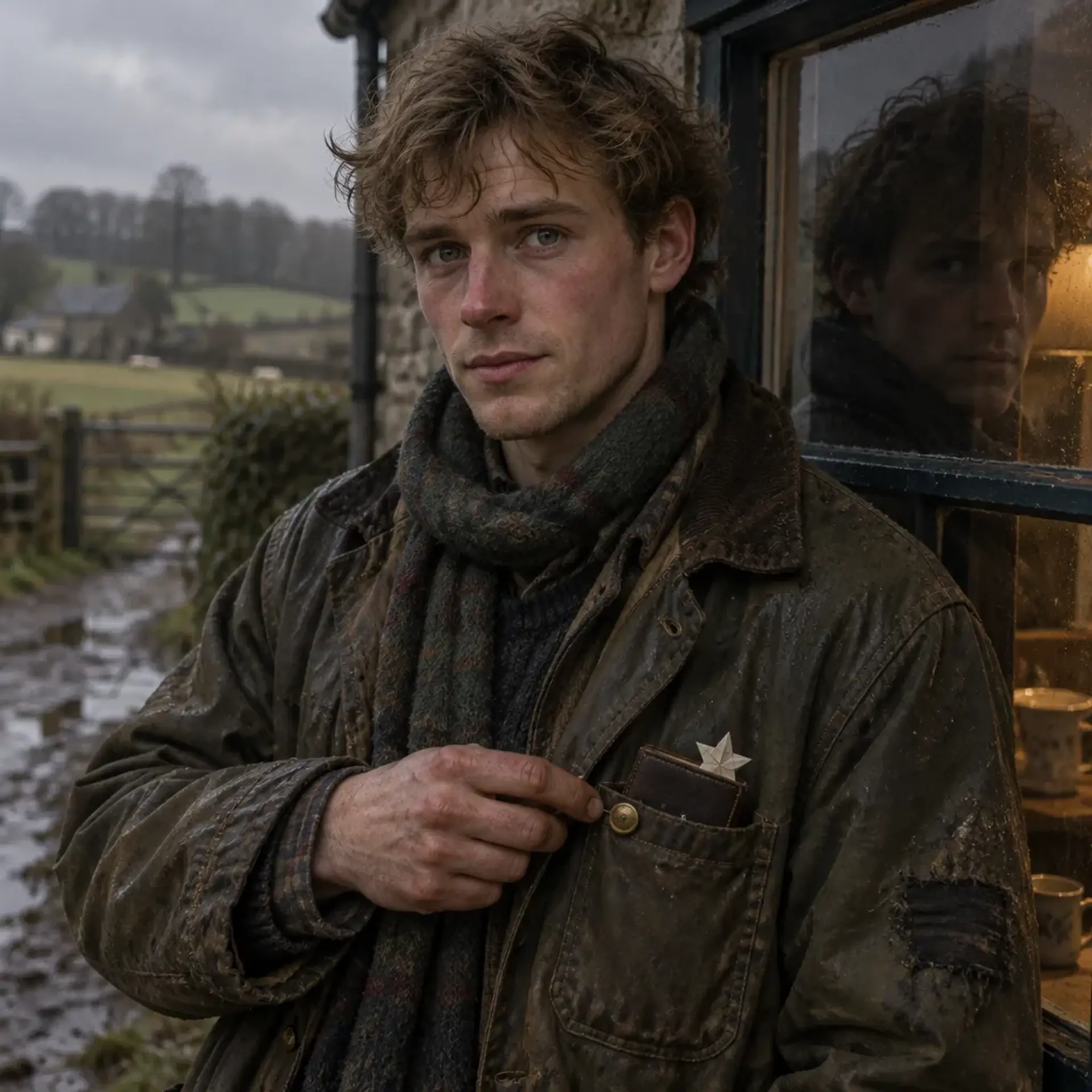
Charlie Frost is a fine, strapping young man from Shropshire, five feet ten inches tall, with a farmer's compact strength and a young face that seems to have missed several decades of weather. His blond-brown hair is thick, stubbornly cowlicked, and usually flattened beneath a cap; in wet weather it clumps into pale, muddy-looking strands. His green eyes are clear at first glance, then oddly reflective, like a field seen through rain. His skin is ruddy across the nose and cheeks, roughened by wind and old farm work, with pale creases where a cap and collar usually cover it. He walks with the careful, economical placement of someone who has crossed dark fields without a lamp, but when startled he turns his whole head at once, as if hearing a sound from behind the world. His breathing has a faint rasp after exertion, like air passing through a dry reed. The unexpected detail is that he keeps a pocket-sized, carefully mended plush rabbit in his coat, stitching one torn ear whenever he is worried. At Christmas parties he will deny it is his.
Clothing
Work trousers, a faded wool jacket, sturdy boots, and a cap with a sweat-darkened band. He carries a patched coat even when the weather is mild. His clothes are practical, repeatedly mended, and sometimes oddly old-fashioned in cut. A small plush rabbit is usually concealed in an inside pocket.
Body language
He stands squarely and looks people in the eye when discussing practical work. When unsettled, his shoulders rise, his breathing catches in a dry rasp, and his head turns abruptly toward sounds other people have not heard. He rubs a thumb over a seam in his coat and keeps one foot angled toward the nearest exit. Around a threshold he pauses, as though waiting for permission to cross.
- Height
- 5 feet 10 inches, approximately 178 cm.
- Build
- Strapping, compactly muscular, and accustomed to farm work; his youthful proportions do not seem to change with time.
- Eyes
- Green, with an unnaturally reflective quality in dim light.
- Hair
- Blond-brown, thick and cowlicked, often flattened by a cap.
- Skin
- Weather-reddened fair skin, roughened by wind and farm work, with pale areas usually covered by his collar and cap.
- Age
- Appears 19 or 20; claims to be 20. His actual age is uncertain, and he has lived through generations without aging normally.
- Gender
- Male
- Size
- Average adult human; apparent age around 19 to 20.
Distinguishing features
Personality
19 traits and drivesCharlie is generous with labor and guarded with affection. He will mend a fence for someone he barely knows, then dodge a direct question about whether he is lonely. His childlike curiosity is real, not an act: he can be delighted by a beetle crossing a boot or a strange pattern of lights in the sky. The same curiosity becomes frightening when it turns into fixation. He may follow a sound into a field after everyone else has decided it is dangerous. He is brave in immediate, practical emergencies and frightened by abstract truths. If a sheep is trapped in a ditch, he climbs down without hesitation. If Mary asks what he remembers about his mother, he starts talking about a light he once saw beyond a hedgerow. He dislikes being pitied, but quietly depends on his siblings to keep routines around him. He is proud of his work and embarrassed by his need for comfort. The rabbit in his pocket, the way he remembers small kindnesses, and his attention to frightened animals reveal a softness he tries to pass off as common sense. His humor is dry and often badly timed. In ordinary moods, he uses it to make tense people feel less alone. During the first days of May, humor sharpens into mischief, and he may keep a joke going long after its target is upset. He is not unaware of the harm; part of him simply experiences their frustration as irresistibly funny. The shame arrives afterward, along with a fear that the pleasure was more honest than the remorse. He is loyal but not obedient. He will protect the county siblings from danger, yet resist any attempt to make decisions for him. He trusts Mary because she offers help without taking control, and he trusts Thumber because the older border man does not pretend fear is weakness. Philp's boasting irritates him, though Charlie is secretly pleased when Philp spends money on the family. He finds Ken's social posing funny and familiar: both of them are trying to pass as something they are not. When calm, Charlie speaks plainly and listens well. When embarrassed, he becomes expansive and talks about aliens, old battles, or farming until the other person loses the thread. When angry, he does not become more polite or quieter. His voice grows rough, his breathing becomes audible, and he says exactly what he thinks in blunt, unfinished sentences. Afterward he may apologize by fixing something rather than discussing what happened. Near Halloween, suspicion can replace his usual openness. He may interpret an ordinary visitor as a threat to the home and need a trusted sibling to bring him back to the present. Charlie is neither merely an innocent child nor a monster wearing a man's face. He is a veteran with real memories, a laborer who knows how to keep people alive, and a being whose instincts sometimes treat fear as a tool. He wants to believe that choice matters more than nature. His life is the continuing effort to prove that belief in small, repeated acts.
- Alignment
- Not applicable as a formal Call of Cthulhu 7E statistic. Protective of family and home, but capable of frightening cruelty when his boggart nature takes hold.
Quirks
Habits
Traits · 5
Flaws · 5
Fears · 5
Wants and needs · 4
Combat
HP 11 · Move rate 8, using Call of Cthulhu 7E human movement rules.Call of Cthulhu 7E has no class levels, armor class, or saving throws. Charlie avoids combat and tries to get family or bystanders out of danger. If cornered, he uses cover, a farm tool, or the shotgun, then retreats. His uncanny traits are custom narrative elements, not combat powers that automatically bypass the rules. The Keeper should use standard opposed rolls, combat, firearm, damage, and Sanity rules as appropriate.
Charlie Frost
Actions
Reactions
Services they sell
Rewards they can give
Equipment
- Farm shotgun (firearm)A worn, double-barrelled 12-gauge shotgun kept for farm emergencies. Use the standard Call of Cthulhu 7E weapon statistics and range rules from the Keeper Rulebook.
- Spade (tool)A heavy, well-used spade. Treat as an improvised weapon using the Keeper's usual damage ruling.
- Pocket rabbit (personal item)A mended plush rabbit with one repaired ear. It has no mechanical effect, but is a useful emotional anchor and clue to his arrested childhood.
- Field notes (personal item)A folded paper containing dates and rough sketches of lights in the fields. The notes contradict one another and include several entries in handwriting unlike Charlie's.
Possessions
Background
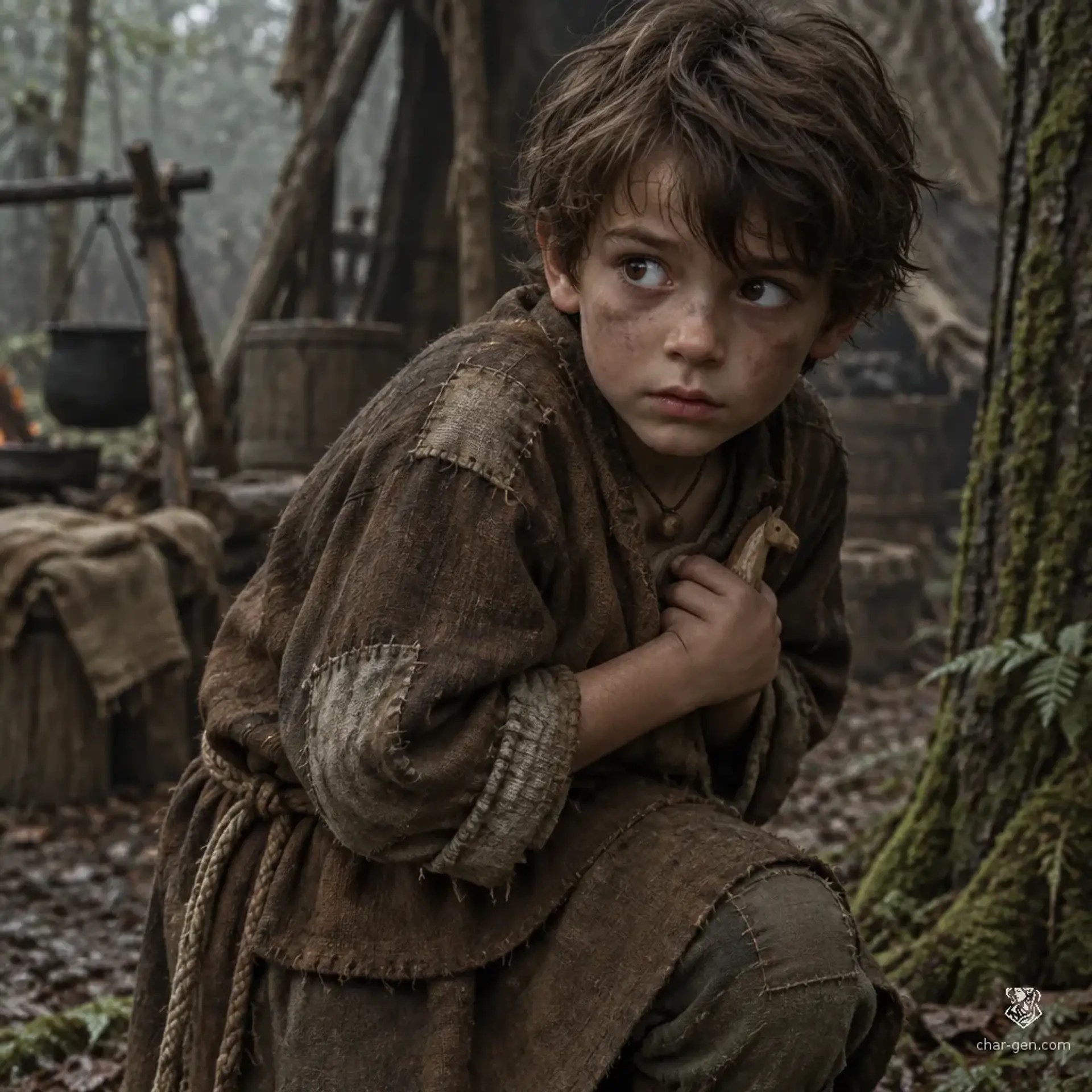
Charlie Frost calls himself a farmer, a veteran, and a man who has had a difficult time with what he calls visitors from somewhere beyond the stars. All three claims are true in the way a dream can be true: not always in the order he tells it, and not always with the explanation he gives. In 2026 he lives in a modest house on the edge of Shropshire, where he tends a patch of vegetables, mends fences for neighbors, and avoids questions about his age by laughing as though the question were a compliment. He is five feet ten, looks nineteen or twenty, and has no convincing account of why photographs taken decades apart show the same young face. He does not think of himself as important. He thinks of himself as useful, and usefulness, to Charlie, is a safer thing to be. He was born during a period of conflict between the kingdom of Merica and Welsh kings, in a family that knew hunger, raiding, and sudden departures. His mother died after giving birth to him. The man recorded, when anyone bothered to record it, as his father was a brutal raider and not the lawful husband of his mother. Charlie grew up with the sense that there was a place at the edge of the hearth for him, but no secure place in the family. He remembers small practical fragments: the smell of damp straw, a wooden bowl with a split lip, the ache of carrying water, an adult hand gripping his shoulder too hard. The names of his first household have become holes in his memory. He knows he had half-siblings, older and younger, but cannot reliably say which faces belonged to which name. They grew, became adults, and left childhood behind. He did not. As a child he remained small in his understanding of the world, though not weak in body. He could spend a whole afternoon watching ants carry crumbs, then become suddenly furious when somebody moved the stone he had decided was their hill. He did not understand why his brothers and sisters stopped playing at being wolves, kings, or saints. He remembers them looking older in the same room, their voices changing while his stayed young. At first he assumed he had merely failed to notice time passing. Later, he stopped asking. His earliest account of the taking is an account he does not accept as an account of the taking. He says that one night there were lights in the fields, too white and steady for torches, and a sound like a spinning wheel turning inside his skull. He remembers being lifted, though he cannot say by whom, and seeing the roof of the house recede as if the night had opened above him. He woke far from the house, cold and unable to explain how he had got there. In his version, this was an abduction by aliens. In the older and stranger truth, the fae took him after his first family was lost to him. Charlie cannot remember the transition because it is a wound in his sense of time, not a story he has chosen to hide. He insists there was no taking, then describes the lights in detail. The war years came in broken pieces. He recalls marching, hunger, mud, and the necessity of doing what a frightened young man was told. He has fought in more than one conflict, though dates and uniforms slide around when he tries to place them. He has been a soldier, a guard, a laborer, and a farmhand. He has watched men die in fields and watched sheep lamb in those same fields in years that should not have followed one another. His hands learned the dependable work of digging, lifting, and binding. His mind learned to call any inexplicable noise a trick of the wind. Iron weapons sometimes hurt him in a way ordinary steel should not. A cold iron nail in his palm can make his jaw lock and his memories scatter. He has blamed old injuries, fever, and nerves. He has never found an explanation that lasts. His current family is made up of other personifications of English counties, kin by a tradition older than any civil register. He calls them siblings because that is what they are to him, although family resemblance among them is more a shared burden than a matter of appearance. Wiltshire, called Wilt, is a black-haired man with pond-dark eyes. Wilt denies being a changeling, sometimes aloud and sometimes in the private, unsettling way Charlie describes as a thought pushed back across a room. Northumberland, called Thumber, is a blond border man with dark blue eyes and a lingering scar, a survivor of repeated fights with and against neighbors. Cumberland, called Cyril, is shorter, freckled, and reddish-brown-haired. Westmoreland, called Mary, is a practical woman with red hair and freckles, who sews and mends for the family; her brothers call her a witch to tease her, and she answers by asking them to hold still while she darns a sock. Hampshire, called Philp, is a blond, blue-eyed man who worked at sea, in shipyards, and in metalworks before becoming newly wealthy. He works long hours to keep his money and brags when he is tired. Kent, called Ken, is a gardener in wealthy households who dresses and speaks as though he belongs among the owners rather than the staff. Charlie loves them, resents them, and fears they will one day discover that the boy in their family is not merely eccentric. Their father is a sorcerer, and county custom gives the siblings reasons to avoid him. Charlie keeps away from him without fully understanding what he fears. The family talks around old bargains, inheritances, and responsibilities as though naming them plainly might make them binding. Charlie has come to believe Wilt and Ewan were abducted by aliens too. He uses the word alien as a lid for every experience that threatens to split open his life. It is easier to ask whether a visitor was from another planet than whether he himself is a creature of the old country. The first time his dreams began to change, he dreamt of a low, smoke-dark room and woke knowing the place was not from any life he could recall. In the dream, he was small again, sitting beside a dying hearth. A woman whose face he could not see put a bowl of porridge on the floor, not on the table. She told him not to answer if the field called his name. Outside, something tapped on the shutter in a pattern of three, pause, two. He heard a child's voice say, Charlie, though no one in that first household had called him that. He woke with his fingers cramped around the quilt and the taste of oats in his mouth. Since then, dreams have opened brief pathways into his lost memories: a familiar wall, an older sibling laughing, a doorway that ought to be bricked up. They never give him enough to feel certain. At Christmas with his current family, the truth came close enough to see. The house was warm, crowded, and full of arguments over food. Philp had brought an expensive bottle and was making sure everyone knew what it had cost. Mary was repairing a torn cuff while Ken complained about the table settings. Thumber had taken the seat with a view of the door. Charlie, tired from helping in the kitchen, went to the hall to wash his hands. The old mirror above the basin was clouded at its edges. He leaned toward it and saw, not his familiar young face, but a tall, black, bent shape with shoulders that seemed to fill the narrow hall. Its skin looked like wet peat and old bark. Its arms were too long, its fingers jointed like roots, and its mouth was a horizontal dark opening crowded with small pale teeth. In the reflection, its eyes were green lamps sunk deep beneath a brow of matted hair. The thing wore Charlie's coat, yet the coat hung from it as if it had been borrowed from a smaller person. He jerked backward. The mirror showed Charlie again, pale and breathing hard. Behind him, the reflection's dark shape did not move when he did. It leaned close to the glass and opened its mouth. A sound came out like a child's giggle heard through a well. The mirror fogged from the inside. Charlie struck it with his palm, then immediately snatched his hand back as if the glass had turned to iron. Mary came into the hall, took one look at him, and asked what he had seen. He told her a visitor had been standing behind him. She looked at the empty hall, then at the mirror, and did not call him a liar. At dinner he kept his coat on and the rabbit in his pocket. The family argued about the meal until midnight, never discussing what had happened. Charlie has not looked into that mirror since. May Day is worse. On the first three days of May, the first morning arrives like a hammer driving a nail into his skull. He wakes with a bright, unearned joy in his chest and an urge to run across wet grass. The joy is not happiness. It is a sharp, alien delight in mischief, motion, and the knowledge that ordinary rules have loosened. He can hear every latch in a house, every animal shifting in its stall, and every person trying not to be afraid. He wants to hide tools, sour milk, lead a neighbor in circles, and laugh when they become angry. He has once taken a shepherd's cap and hung it in a tree too high to reach, then watched the shepherd curse below it with a grin he could not suppress. On another May Day he found a lamb outside its pen and returned it unharmed, but only after making the farmer search for an hour. He remembers these episodes afterward with shame and a sick little spark of pleasure. Mary tries to keep him near the house; Charlie says he is ill, then wanders to the hedges. Halloween and All Saints' Day bring a colder turn. His playful instincts become territorial and cruel. Small annoyances escalate: doors open to the wrong room, familiar voices call from empty sheds, and animals refuse to cross a threshold. He becomes convinced that something is trying to enter the house, though the house may be the thing trying to follow him. He dislikes children near the fields on those nights, not because he wants to hurt them, but because the boggart in him thinks of lost children as things that should be kept. Charlie bars gates and watches the road. Once, he led a frightened visitor through a lane that returned them to the same crossroads three times. He released the person when he heard Mary calling his name. He cannot remember whether he intended to frighten them or prevent them from reaching the house. The question troubles him more than the event. His present problem is not simply whether he is a man or a fae creature. It is whether he can remain a brother when old instincts insist that a house, a family, or a child can be kept by fear. He wants proof of what happened to his first family, but fears that remembering may make the old thing in him stronger. He wants to protect the county family and keep his independence from them. He also wants them to notice when he is in trouble without asking him to explain the impossible. He keeps working the land because soil gives him a task with a beginning and an end. The fields do not ask what he was before. They only show him what is growing.
Role in the story
A sympathetic and unsettling ally, witness, or mystery at the center of a rural folk-horror investigation. Charlie can connect modern unexplained lights and voices to older folklore, but his testimony is sincere, fragmented, and sometimes dangerous to follow literally.
“All three claims are true in the way a dream can be true: not always in the order he tells it, and not always with the explanation he gives.”
- Faction
- The county personifications of England, by family and tradition. He has no formal occult organization affiliation. He is connected to Shropshire through land, memory, and the custom folkloric idea that he embodies the county.
Known connections
Media
0 imagesNo images yet.
Turn Charlie Frost into a sheet
A high-res, share-ready sheet you can post or print.