William Hirst
William Hirst
At the table
Voice
A small, dry-edged voice shaped by a childhood of careful listening and adults who often finish his sentences for him. His words come in measured bursts, with a faint catch of breath before a difficult answer. When rattled, he stops breathing for a moment, then speaks too quickly in clipped fragments; when at ease, the pauses fill with curious questions.
He speaks in short, carefully assembled phrases, with pauses while he searches for a word. He often points or shows what he means rather than struggling through a long explanation. When comfortable, he asks practical, unexpectedly specific questions.
Speech patterns
How to play them
Address William directly without making him perform for a crowd. Give him one clear question at a time, allow him time to answer, and notice what he does as well as what he says. He responds to patient demonstrations and practical tasks; avoid treating his slower speech as a lack of understanding.
Goal
To prove, through useful deeds of his own choosing, that he can belong in the Hirst family's future without pretending to be someone else.
Motivation
William wants to be trusted with real responsibilities, not merely praised or measured against an imagined heir.
Appearance
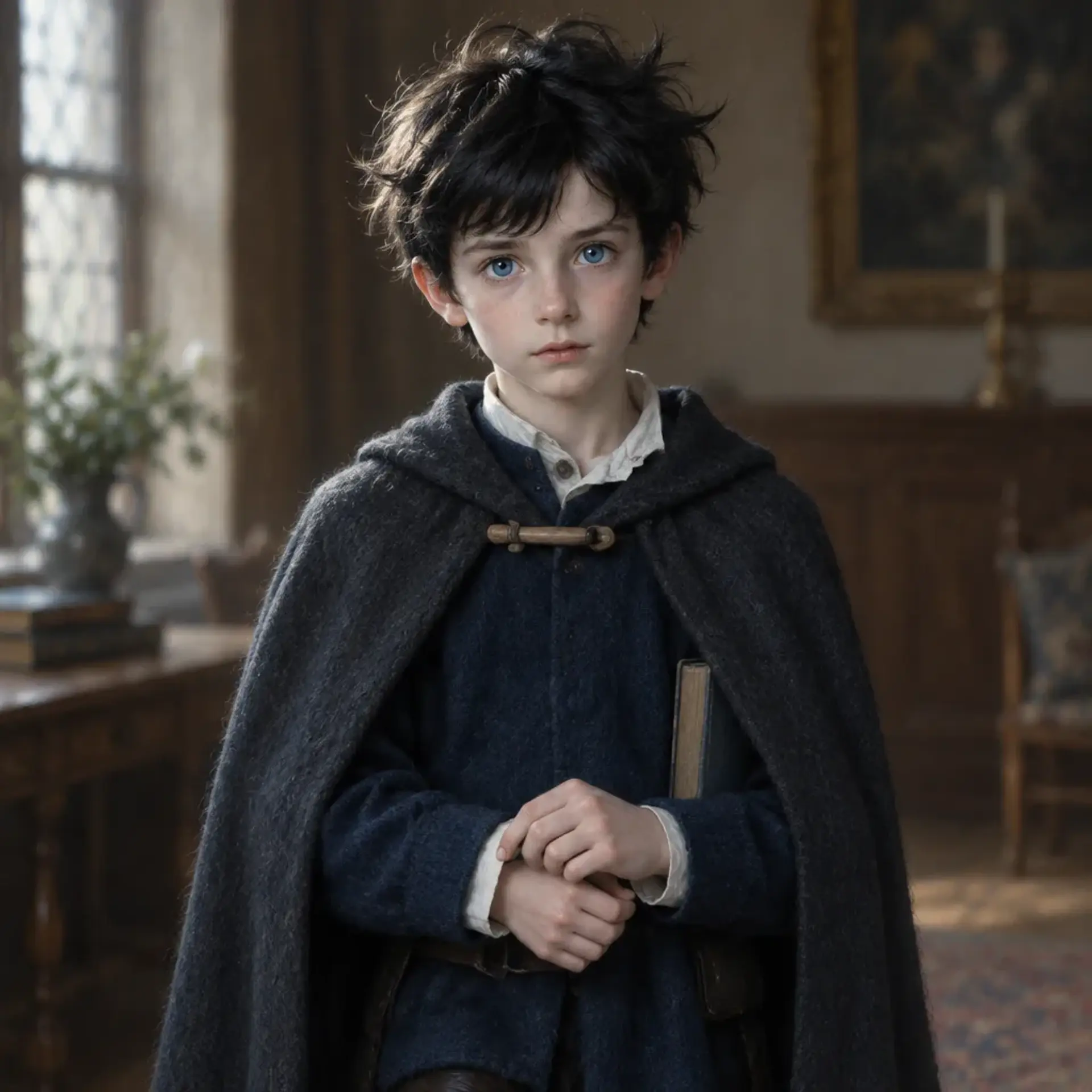
A very pale, slight boy with a shock of glossy black hair that refuses to lie flat, even after a servant has combed it. His burning blue eyes are unmistakably Oswin's, bright against the rest of his soft, solemn face. William moves with careful deliberation, as if each doorway requires a moment of thought; when startled, he draws a sharp breath through his nose and holds it until someone speaks gently. His grooming is unexpectedly meticulous: he smooths every cuff and keeps his boots brushed, even when the rest of his clothes are rumpled. People remember the contrast of that precise little ritual and his untidy hair.
Clothing
A dark blue wool tunic, neatly brushed boots, and a white collar that is often slightly crooked by midday. His cuffs are carefully smoothed, a habit he tends even when nervous.
Body language
He stands very straight when adults discuss his future, but his shoulders loosen around people who speak plainly. He watches a speaker's mouth closely, presses his thumb against the seam of his cuff when confused, and takes a sudden held breath when frightened.
- Height
- 4 ft. 2 in. (127 cm)
- Build
- Small and slight for his age, with narrow shoulders and a careful, measured gait.
- Eyes
- Burning blue
- Hair
- Glossy black
- Skin
- Very pale
- Age
- 10 years old
- Gender
- Boy
- Size
- Small
Distinguishing features
Personality
12 traits and drivesWilliam is observant but slow to put what he notices into words. He is cautious with adults who quiz him, yet unexpectedly bold when someone smaller or more vulnerable needs help. He wants to please his parents but resists being handled like a problem to solve. When relaxed, his curiosity comes out in practical questions; when embarrassed, he retreats into silence and makes his cuffs perfectly straight.
- Alignment
- Neutral Good
Quirks
Habits
Traits · 3
Flaws · 3
Fears · 3
Wants and needs · 3
Combat
AC 10 · HP 4 · 25 ft.William is a child with no combat training. He avoids violence, seeks a trusted adult, and hides behind furniture or runs toward familiar household staff if threatened. His statistics are a simple custom baseline for a level 0 child, not a player-class build.
William Hirst
Actions
Reactions
Services they sell
Rewards they can give
Equipment
- Practice sword (training equipment)A blunt wooden practice sword, intended for supervised lessons rather than real combat.
- Route book (personal item)A small cloth-bound book of household routes and copied words, marked with simple sketches.
- Child's cloak (clothing)A plain wool cloak sized for him, fastened with a wooden toggle.
Possessions
Background
William Hirst was born after a labor so long that the household stopped marking time by clocks and began marking it by the changes in Mary’s face. Oswin waited outside the chamber with his hands clasped behind his back, listening to hurried footsteps and instructions he could not answer. When he was finally allowed to hold his son, he did so with grave care. William was pale, black-haired, and blue-eyed. Mary reached for him whenever she could, keeping one hand near his cradle as though the warmth of her touch might keep the world from taking him away. He grew into a quiet child who watched more than he spoke. Lessons took patience and repetition, and questions meant to measure his progress often left him looking down, his fingers busy straightening his cuffs. His mother and father called him Will, or Willy when they hoped to coax a smile from him. In the village, where people were less careful with their tongues, he acquired other names: Black William, and, from children who thought it clever, Blackby. He learned that a name could be offered like a greeting or thrown like a stone. He seldom answered either way. The household had its own silences, and William learned to listen to those too. His uncles Edmund and Huge, and sometimes his grandfather, spoke of Oswin as if he were an old difficulty that had never been settled. They called him iron, stiff, and surly. In church, Oswin looked much the same: straight-backed, spare with his words, and careful not to touch the iron fittings on the doors or rails. Yet William had seen his father’s devotion in the way he never missed a service and in the stillness with which he listened. He wondered why a man so faithful seemed so ill at ease among the church’s ironwork. There were hours when Oswin seemed different. William first noticed it without knowing what he was seeing. As daylight thinned, or when the year turned toward bare branches and hard ground, his father might pause at a threshold as if the room beyond had changed. He slept badly during those seasons. William sometimes woke to find Oswin already awake, sitting alone or walking through the house at an hour when even the servants had gone quiet. On other nights, Oswin spoke in his sleep of the dales. The words came low and troubled, as if he were answering someone too far away for William to hear. Adults said that at certain hours, and in certain seasons, the boundaries blurred. They never explained which boundaries they meant. William kept the phrase carefully, like a tool whose use had not yet been shown to him. Mary noticed the changes too. When Oswin’s manner grew distant or severe, she did not challenge him at once. She watched his face, listened to the pace of his steps, and found small reasons to keep other people in the room. If they were alone, she might move nearer to a door or place a hand on the table between them. Sometimes she spoke to him with the careful gentleness she used around a skittish horse. At other times she went quiet and busied herself with William, smoothing his hair or checking a button that did not need checking. William could not tell whether she feared Oswin’s anger, his silence, or something she believed might be standing behind his familiar face. When Oswin returned to his usual manner, Mary did not always relax immediately. She studied him as if waiting for some small proof that he was himself. A change in his voice could make her fingers still. A sudden look from him might cause her to glance toward the nearest exit before answering. Yet she also cared for him, and there were moments when she reached for his hand without hesitation. William saw the conflict in her: affection drawn toward a man she knew, fear held in check by memories she could not set aside. The adults did not explain it to him. He learned that a room could feel unsafe to one person even when everyone else in it thought nothing had happened. He heard stories of the Barguest from other children, servants, and the occasional villager who thought a boy was too young to understand the danger in a tale. They said it roamed the dales and haunted crossroads, appearing where one path gave way to another and travelers had to choose their direction. Some described a dark, doglike shape pacing beside the road. Others spoke of a creature seen only at the edge of sight, or of a footfall that followed a lonely traveler without ever drawing near. The stories changed from mouth to mouth. Their warnings did not: do not call to it, do not follow it, and do not mistake a familiar voice for a safe one after dusk. The Barguest’s name was tangled with the story of William’s birth. Children said it had come on Mary and Oswin’s wedding night, when their marriage was to be consummated, and that what happened in the bedchamber was not truly Oswin. Some told it as a ghost story, some as a warning, and some with the relish of a cruel joke. Their accounts were crude, contradictory, and often spoken to provoke a reaction. William learned little from them except that the story described a violation, and that people had decided his existence gave them license to speculate about what had been done to his mother. No one told William the whole truth. Mary did not describe that night, and he did not ask her to repeat what the household would not say plainly. He knew that the tale made her face go still. If someone mentioned it within her hearing, she might leave the room without a word, or become so composed that William sensed the effort beneath her calm. Once, when a visitor made a sly remark about the Barguest and the wedding, Mary’s hand closed around the edge of the table. Oswin rose, but she touched his sleeve before he could cross the room. Her gesture was small and urgent. William understood that she wanted the insult stopped, but was afraid of what might happen if Oswin acted while his mood was changing. Mary’s fear was not only fear of a beast in the dales. William came to suspect that she feared what the Barguest had taken from her, and the possibility that it might return wearing a face she knew. She watched Oswin most closely at thresholds, at dusk, and during the seasons when his sleep failed. If he stood motionless before a doorway or answered a question in a voice that seemed not quite his, Mary’s attention sharpened. She would call him by name, sometimes softly and sometimes more than once, as though the sound itself could draw him back. When he responded, she watched for recognition. When he did not, she made certain William stayed beside her and kept him from approaching. There were other losses in the family’s history. Mary had lost two pregnancies, and a baby boy who lived only briefly. People spoke of the little one’s eyes in hushed, uneasy voices, calling them hellish. William was too young to remember his brother, but he knew where the adults’ voices lowered and which subjects made his mother turn away. He sometimes wondered whether the stories about the Barguest had been tied to the baby because people feared what they could not explain. He never found words for that thought. When Mary noticed him watching her, he would smooth his cuffs and stay close at her side. As William grew, he began to notice something else about his father. Oswin did not seem to change as other men did. Years passed, but his face kept much the same lines, his hair showed no new gray, and his shoulders did not acquire the stoop William saw in older men around the estate. Oswin rose from long journeys or hard labor without rubbing his joints or complaining of the aches that made the grooms groan on cold mornings. William watched him closely, waiting for some small sign of age, but it never came. Mary noticed too. Once, when she thought William was occupied with a book, she studied Oswin across the room with a look William could not read. She touched his hand and asked, very softly, whether he was tired. Oswin said he was well. Mary held his gaze a moment longer, then turned away. On another evening she asked him how long he had been awake. His answer came too quickly. She did not press him, but afterward she kept William near her until the servants had finished clearing the supper things. William could not tell whether Oswin’s unchanging youth comforted her or frightened her. The subject settled into the household’s silences beside the dales, the blurred boundaries, and the stories of the Barguest at the crossroads. Oswin understood William’s silences better than most, though his care could be clumsy. He sometimes answered for his son when William needed time, or tried to shield him so completely that there was no room to make a mistake for himself. William wanted to please him. He watched the way Oswin paused before difficult answers and rested a hand on a doorframe when a conversation was over. He wanted to learn how to be useful in that quiet, steady way. Mary, more openly affectionate, urged him to practice greetings, sit properly through visits, and answer when spoken to. She meant to prepare him for a world that would not always wait. William sometimes heard only that he was a problem everyone was trying to mend. His first clear proof that he could help came on a winter afternoon. A stable boy was pinned beneath a fallen rack, one arm caught at an awkward angle. William froze. He could see that the boy was hurt, but the words for it would not come quickly enough. The boy reached toward him. William took his sleeve and tugged, then hurried to find the nearest groom. He pulled at the man’s coat until the groom followed him, and stayed beside the injured boy while help was fetched and the rack was lifted away. He held the boy’s hand and did not leave when he began to cry. The adults praised William afterward for bringing help. He was embarrassed and spent the evening making his cuffs perfectly straight. The stable boy, however, remembered him without making a ceremony of it. Later, he gave William a small wooden horse carved from a scrap. William kept it near his bed. He had acted before he could explain himself, and the boy had not needed an explanation. That stayed with him. Since then, William has trusted what people do more than what they say in a hurry. He notices a servant favoring one leg, a younger child left out of a game, or someone trying not to cry while others are watching. He may be slow to speak, especially when adults gather around with their measuring questions, but when someone smaller or more vulnerable needs help, he can move with a certainty that surprises them. He will fetch help, step between a child and a scolding, or quietly lead someone away from a crowded room. The household’s expectations have grown heavier as William has grown older. Lessons, visits, and public appearances are treated as preparation for a future others have already chosen for him. He tries to do what his parents ask, but resists being handled like a puzzle whose answer belongs to everyone else. When he is relaxed, curiosity emerges in practical questions: why one horse needs a different bit, how a hinge keeps a heavy door from sagging, or whether a strap can be mended without making it weaker. When an adult presses him to explain what he feels or what he will become, he lowers his eyes and straightens his cuffs. William does not know whether he can become the heir his family hopes for, or what to make of the stories attached to his name and birth. He knows that his father wakes at strange hours, that the turning seasons seem to trouble him, and that the grown-ups speak of blurred boundaries as if they might open beneath one’s feet. He knows the Barguest is said to roam the dales and wait at crossroads, though he does not know whether anyone has truly seen it. He knows that his mother’s fear gathers around the creature’s tale, and that when Oswin’s manner shifts, she watches him with a care that is equal parts love and alarm. He knows, too, that Oswin seems untouched by the years, while Mary has begun to watch that fact with quiet concern. People call him Black William, while his parents call him Will. And when someone needs help, he knows he can choose to stay. For now, he listens, watches, and learns in his own uneven way, waiting for the words to catch up with what he has already seen.
Role in the story
A young member of the Hirst family whose uncertain place as a future heir exposes the family's competing fears, ambitions, and tenderness. William can become a quiet ally, a protected witness, or the emotional center of a succession conflict.
“Oswin waited outside the chamber with his hands clasped behind his back, listening to hurried footsteps and instructions he could not answer.”
- Faction
- The Hirst household; no independent faction.
Known connections
Media
0 imagesNo images yet.
Turn William Hirst into a sheet
A high-res, share-ready sheet you can post or print.