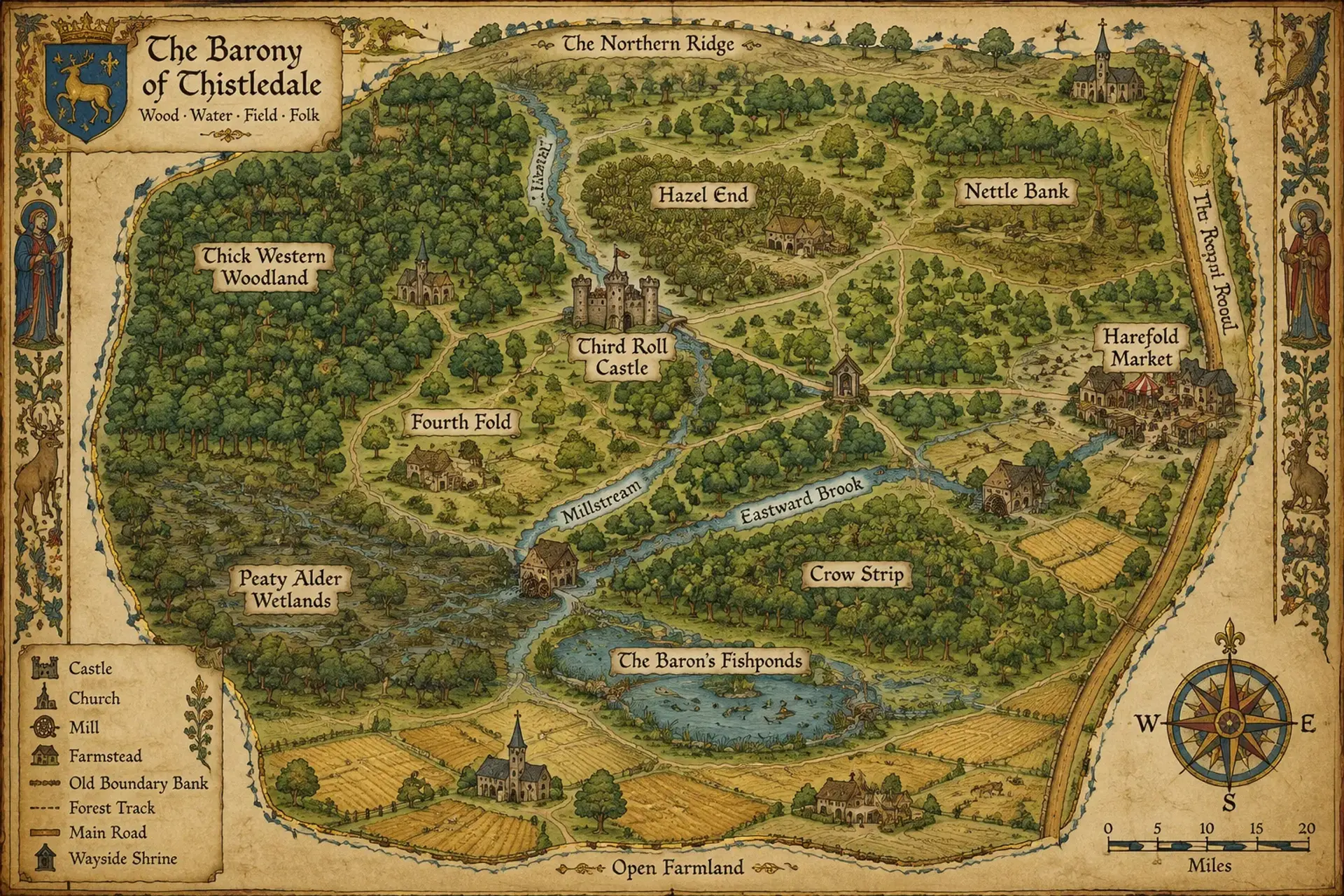
Where the baron's stone walls meet a forest that remembers its old paths.
HHarefold
Overview
Harefold is a small forest barony, broad enough to encompass a fortified seat, a busy market settlement, and scattered villages among its woods and clearings. The temperate landscape is shaped by timber, streams, and muddy roads, while common woodland rights sit uneasily beside the baron's laws. Thirteenth-century stonework at the castle contrasts with timber-framed homes, wattle fences, thatched roofs, and modest parish churches. Common magic appears in practical charms, healing, and village protections.
Cultures
The woodland commoners preserve shared rights to gather fallen branches and graze pigs beneath the trees.
Market families blend local customs with fashions and measures brought along the king's road.
The baron's household follows formal feudal customs shaped by service, rank, and seasonal obligations.
Places
6 settlements
Small · Castle with outer settlementThird Roll CastleBaronial seat and fortified crossingA compact stone keep, curtain wall, gatehouse, and timber outer borough reflect practical thirteenth-century fortification.
Medium · Market townHarefold MarketRegional market and craft centerA modest market green is lined with timber-framed houses, open-fronted stalls, workshops, and a small parish church.
Small · Forest-edge villageHazel EndCoppice work and subsistence farmingThatched timber houses stand beside hazel coppice and small strips of cultivated land.
Small · Roadside villageFourth FoldLivestock keeping and road hospitalityA few timber houses and barns cluster around a common pasture and a simple wayside cross.
Small · Farming villageCrow StripGrain, poultry, and woodland-edge farmingFarmsteads line narrow fields reclaimed from the forest, with timber barns and fenced kitchen gardens.
Small · Woodcutters' hamletNettle BankCharcoal and timber productionCharcoal burners' huts and rough timber sheds sit near managed coppice, with homes kept apart from the kilns.
How they spread
PatternThe market settlement stands on the main road, while the baron's castle and its outer borough command a nearby crossing. Smaller communities cluster around clearings, streams, and woodland work sites.
Common kinds
Castle and outer borough, Market settlement, Forest-edge village, Scattered farmstead, Woodcutters' hamlet
Trade routes
The royal road links the market to neighboring districts.
Forest tracks carry charcoal and timber to the main road.
Streamside paths connect farms and mill sites.
Dangers and hooks
3 threats
Most dangerous · HighThe Third Road BandHumanoid raidersA shifting band of armed robbers targets carts on lonely stretches of road.
The Boar RunsModerateWildlife
Wild boars raid crops and charge travelers in the deepest coppice.
The Hollow LightsVariableMagical phenomenon
Unexplained lights appear near old boundary banks and sometimes draw wanderers off the path.
Hazards of the land
Deep winter mud can trap carts and isolate outlying farms.
Fallen trees and flash floods make woodland tracks dangerous after storms.
Wild boars and hungry wolves threaten livestock and lone travelers.
Plot hooks
1
The Vanished MarkerInvestigation and negotiationA missing boundary stone has brought villagers and baronial officers close to violence over a tract of valuable coppice.Starts: The dispute is being heard at the market green.Reward: A legal woodland pass, coin, or local allies.
2
Tracks in the CoppiceRoadside threatA string of wagon attacks suggests that someone is guiding raiders through forgotten woodland paths.Starts: A damaged cart lies beside the eastern road.Reward: A share of recovered goods and a baron's favor.
3
Lights over the PondsMystery with magical dangerThe castle's fishponds are turning foul, and strange lights flicker over the water after dusk.Starts: The pond keeper seeks help near the outer gate.Reward: Payment, a minor enchanted charm, or access to the castle stores.
4
The Other RollPolitical investigationA reeve has uncovered a second copy of the old survey with a boundary that contradicts the accepted record.Starts: The reeve asks discreetly for escorts to a ruined woodland chapel.Reward: A valuable document, political leverage, or a granted favor.
The land
Climate and ground
ClimateTemperate, with mild wet springs, warm summers, crisp autumns, and occasional snowy winters.
TerrainRolling forest country cut by streams, muddy tracks, clearings, and small cultivated fields.
Biomes
Deciduous woodland
Managed coppice and clearings
Meadow and pasture
Wet alder groves
Waters and borders
Waterways
Alder Run, Millstream, The eastward brook, The baron's fishponds
Borders
A low ridge marks the northern approach.
Open farmland begins beyond the southern forest edge.
A broad royal road forms the eastern boundary.
Thicker woodland encloses the western border.
On the road
The main road is passable by wagon in most seasons, though winter mud slows travel.
Forest tracks are confusing after storms and are best followed with a local guide.
Crossing swollen streams can add hours or force travelers to wait for safer water.
Landmarks
The baron's stone keep rises above an outer settlement of timber-framed houses.
A market green sits beside the road, ringed by timber stalls and workshops.
Old boundary banks and ditches vanish beneath coppice growth.
A chain of fishponds supplies the castle household and nearby market.
A small wayside shrine stands where three forest tracks meet.
Landforms
Low wooded ridges
Stream-cut hollows
Broad forest clearings
Peaty wetlands
Gentle cultivated slopes
Resources
Oak, beech, and coppiced hazel
Iron-rich bog ore
Clay and sand
Freshwater fish and game
Power
Rule
GovernmentA hereditary barony within a larger kingdom, administered through the castle household, local reeves, and village courts.
SeatThe baron's stone castle and its walled outer settlement.
StabilityGenerally stable, though disputes over woodland rights and labor dues periodically strain relations between villagers and the baron's officers.
Laws
Forest law restricts hunting, timber felling, and charcoal burning without a grant.
Market weights and measures are inspected on trading days.
Tenants owe customary labor or rent to their local lord.
Travelers must surrender stolen goods and report armed bands.
Factions
The Harebound CommonsVillage league
Influence: Strong among village elders, woodcutters, and charcoal burners.They seek to preserve customary woodland rights while limiting new felling.
The Third RollBaronial officers
Influence: Strong near the castle and on the main roads.They want reliable tolls, labor dues, and obedience to the baron's forest law.
The Bramble WeighersMerchants' association
Influence: Moderate at the market and along the wagon roads.They seek safer routes and fair market measures for traveling traders.
Faiths
The Oak Rite
Influence: Strong in parish life and baronial ceremonies.The faith teaches duty, mercy, and the sanctity of oaths.
The Hare Observance
Influence: Common among villagers and woodland workers.Its followers leave small offerings for safe passage and a good harvest.
The Hazel Vow
Influence: Quiet but widespread among midwives and healers.The tradition honors springs, healing herbs, and the renewal of the seasons.
People and trade
Who lives here
How manyModerate around the market and forest tracks, sparse beneath the deeper canopy.
Main peoples
Human farmers and woodland villagers
Human craftspeople and traders
Baronial household retainers
Other peoples
Dwarven charcoal burners and smiths
Halfling peddlers and smallholders
Languages
Common, The local woodland dialect, Baronial court speech
Trade
WealthModest, with the baronial household and market merchants notably wealthier than most rural households.
Work
Mixed farming and livestock
Timber cutting and charcoal burning
Weaving, smithing, and market trade
Exports
Timber and charcoal, Wool and linen, Honey, wax, and smoked pork
Imports
Salt, Iron tools and fittings, Fine cloth and wine
Markets
Harefold Market, The castle's outer borough
History and secrets
The region grew around a guarded forest road and the baron's fortified seat. Early settlers cleared small fields while leaving much of the woodland under customary use. As the castle was rebuilt in stone, its outer settlement attracted smiths, bakers, and servants. A later royal survey formalized rents and forest dues, but its boundaries remain disputed where old paths, streams, and villagers' memories disagree.
Key events
Early baronial period
The First TimberworkA timber earthwork was raised to guard the forest road and oversee woodland dues.
Several generations later
The Stone EnclosureStone walls, a keep, and a gatehouse replaced the old earthwork as royal authority expanded.
The survey years
The Third RollA royal survey recorded woodland boundaries and helped establish the present pattern of rents and common rights.
Secret 1 · GM only
An abandoned guard post hides a passage built before the castle was rebuilt in stone.Found by: A charcoal burner's map marks a hidden entrance beneath a collapsed boundary bank.If found: The passage leads to a sealed store of old arms that could strengthen the baron or arm a rebellion.
Secret 2 · GM only
A clerk quietly altered the historic survey to transfer a valuable woodland tract to the baron's estate.Found by: Compare the oldest parish records with the royal survey's surviving scraps.If found: Proof of the altered record could overturn several rents and ignite a lasting dispute.
Media
0 images
No images yet.
Visual sheet
Turn Harefold into a sheet
A high-res, share-ready sheet you can post or print.