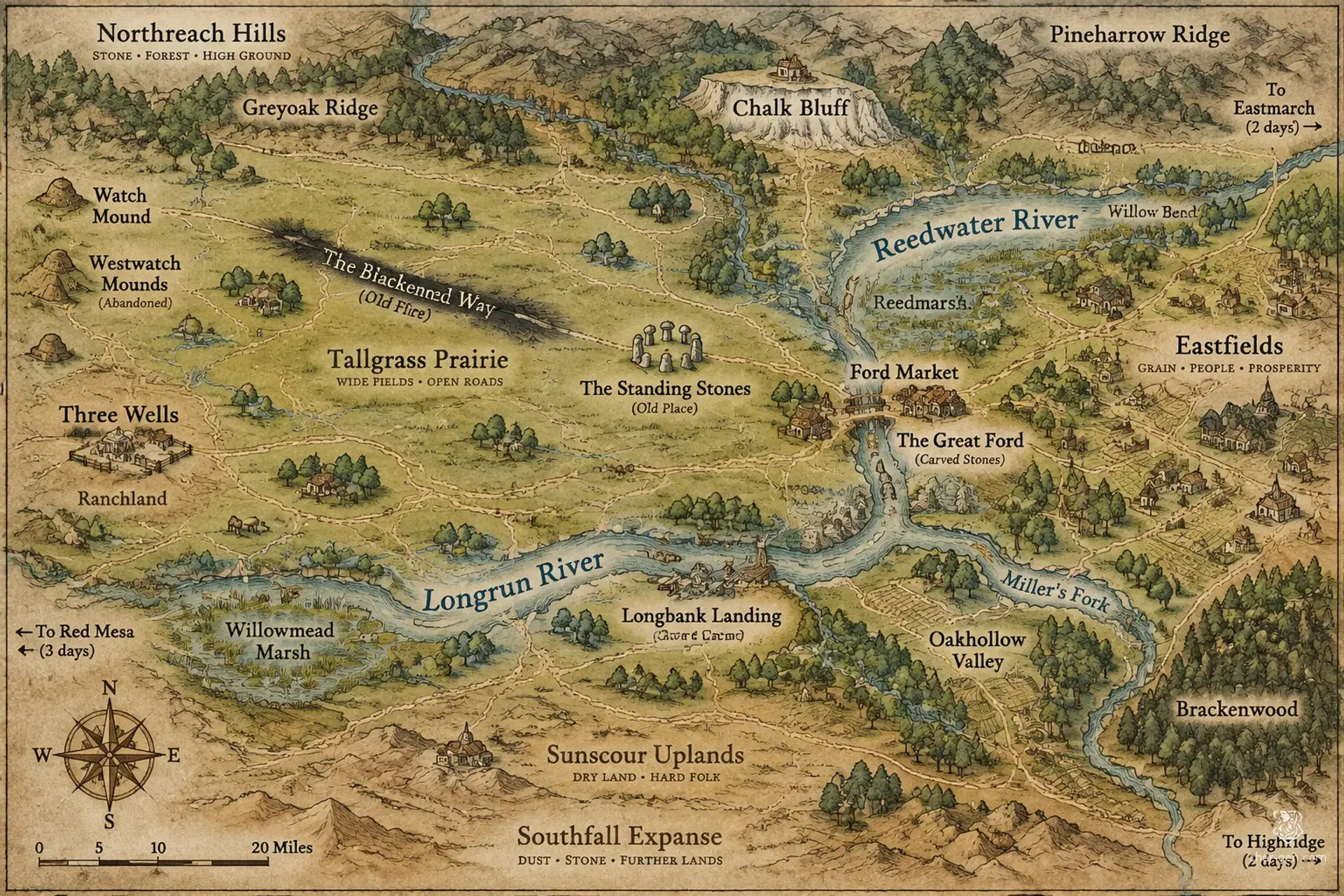
Where the grass runs to the horizon, every crossing has a price and a story.
TRThe Longgrass Reach
Overview
The Longgrass Reach is a broad frontier of open prairie, farmsteads, river crossings, and unsettled western range. Its temperate seasons support crops and cattle, though floods and fires make travel uncertain. Common magic is woven into ordinary work, from warded granaries to charms against stormlight. Councils and trading posts offer thin protection, while old ruins, rival land claims, and vast distances leave room for danger and opportunity.
Cultures
Open-grass homesteaders value shared labor and practical hospitality.
River traders blend customs from distant ports and inland farms.
Frontier companies prize personal pledges over distant authority.
Places
4 settlements
Large village · Market townFord MarketTrade and mediation centerA busy crossing town with a public council hall and a crowded weekly market.
Small town · Landing villageLongbank LandingRiver port and supply depotRiver barges unload beside warehouses built on raised timber platforms.
Large village · Hill villageChalk BluffQuarry and farming centerQuarry workers and farmers share a wind-battered settlement above the floodplain.
Small village · Ranching villageThree WellsRanching and livestock exchangeA cluster of ranches grew around three reliable wells and a guarded stockyard.
How they spread
PatternSettlements cluster along waterways and dependable crossings, then thin into isolated farms and ranches westward. Most communities rely on nearby neighbors rather than distant officials.
Common kinds
Market villages at river crossings
Farmsteads clustered around shared wells
Ranching camps near open grassland
Waystations on wagon roads
Trade routes
The Ford Road follows the main river crossings toward eastern grainlands.
The Grass Track links ranch country to southern markets.
The Reedwater Run carries goods between river landings.
Dangers and hooks
3 threats
Most dangerous · HighStormlight DistortionsArcane hazardUnpredictable magical squalls recur near the standing stones and western range.
Floodplain Mire BeastsHighMonsters
Large predators hunt in reed beds after seasonal floods.
Range Claim GangsModerateBanditry
Armed crews intimidate homesteaders across disputed grazing lanes.
Hazards of the land
Sudden floods can erase ford markers overnight.
Grass fires race ahead of wind and trap travelers.
Unstable magical weather sometimes distorts direction and distance.
Plot hooks
1
The Ford BelowExplorationA flood reveals a stone-lined chamber beneath the main ford, and several factions race to claim what lies inside.Starts: Ford MarketReward: A share of recovered coin and a useful magical charm.
2
Fire Against WindSurvivalA grass fire advances against the wind, driving settlers toward a road where something unseen blocks the way.Starts: A roadside farmsteadReward: A deed to safe lodging and a favor from the local council.
3
The Changing LinesInvestigationA survey crew vanishes near the blackened strip, leaving behind maps that redraw themselves at night.Starts: Longbank LandingReward: A rare map and payment from the Lantern Survey.
4
Stones in the GrassNegotiationRanchers and farmers accuse each other of moving the boundary stones that define their shared grazing lanes.Starts: A disputed pastureReward: Livestock, local standing, or a negotiated land grant.
The land
Climate and ground
ClimateTemperate, with warm summers, cold winters, and frequent spring storms.
TerrainWide open plains broken by shallow valleys, low ridges, and river cuts.
Biomes
Tallgrass prairie, Riverine woodland, Wet meadows, Scattered oak groves
Waters and borders
Waterways
The Reedwater River, The Longrun River, Miller's Fork
Borders
Low ridge country to the north
The settled grainlands to the east
Dry uplands to the south
Unmapped grass sea to the west
On the road
Wagon travel is easy in dry weather but bogs down after heavy rain.
Seasonal grass fires can close roads and obscure landmarks.
Local guides know which river crossings remain safe after floods.
Landmarks
A ring of standing stones hums faintly before storms.
A broad ford exposes carved stones at low water.
A miles-long strip of blackened earth never grows tall grass.
Abandoned watch mounds overlook the western trails.
Landforms
Long rolling grass ridges
Shallow river valleys
Low chalk bluffs
Floodplain marshes
Resources
Fertile dark soil
River clay and reeds
Grazing land
Chalk and ironstone
Power
Rule
GovernmentA loose network of settlement councils, land stewards, and voluntary defense pacts.
SeatNo single seat governs the region; councils meet at whichever market town can host them.
StabilityUneven but workable, with local cooperation strained by land claims and distant expansion.
Laws
Disputes over land must be witnessed by neighboring claimants.
Ferries may charge posted tolls but must aid stranded travelers.
Anyone who finds an unclaimed magic relic must report it to a local council.
Factions
Ford MootCivic council
Influence: Strong around major roads and market settlements.The Crossing Moot seeks predictable tolls and mutual defense agreements.
Grassward CompactRanchers' league
Influence: Broad among ranchers and frontier families.The Grassward Compact protects grazing access and resists land surveys.
Lantern SurveyArcane company
Influence: Growing through hired mages and survey crews.The Lantern Survey wants to chart old magic and claim useful discoveries.
Faiths
Hearthward Tradition
Influence: Common among settled farming communities.The Hearth Below honors home, harvest, and the spirits of thresholds.
Skywheel Faith
Influence: Strong among travelers and weather-watchers.The Turning Sky teaches that storms and seasons carry signs worth reading.
Quiet Measure
Influence: Growing around survey camps and old ruins.The Quiet Measure seeks balance between magic, land, and mortal ambition.
People and trade
Who lives here
How manySparse overall, with denser clusters near rivers, crossings, and defended market towns.
Main peoples
Humans of scattered farmsteads and market villages
Halfling caravan families along the river roads
Orcish and half-orcish ranchers on the western grasslands
Other peoples
Dwarven surveyors and smiths
Elven herbalists and seasonal visitors
Languages
Common, Dwarvish, Halfling, Orc
Trade
WealthModest, with fortunes concentrated among caravan houses and large landholders.
Work
Grain farming and cattle ranching
River transport and ferry services
Timber cutting and quarrying
Exports
Wheat and barley, Hides and wool, Reed paper and river clay
Imports
Iron tools and weapons, Fine cloth and salt
Markets
Ford Market, Longbank Landing
History and secrets
The region was once crossed mainly by seasonal herders and river traders. New farms and market settlements spread along its waterways, while common magic made old ruins and strange weather both useful and dangerous. Local councils grew from practical needs rather than royal design. Recent arrivals have reopened disputes over land, grazing rights, and the ownership of discoveries.
Key events
First Settlement
The Flood MootsSettlers formed river councils after repeated floods left isolated farms without aid.
Recent Past
The Lantern RushA surge of magical lights drew surveyors and prospectors into the western grasslands.
Present Generation
The Open Range AccordRanchers and farmers agreed to shared grazing lanes after a season of costly feuds.
Secret 1 · GM only
The standing stones are part of an ancient flood-control network, not a monument.Found by: At dawn, the standing stones cast shadows toward a buried entrance.If found: The chamber holds a device that can redirect floods, making it a prize and a threat to every downstream settlement.
Secret 2 · GM only
The scorched strip marks the edge of a concealed magical fault.Found by: Compare old grazing maps with the blackened earth after a night of stormlight.If found: The boundary disputes were engineered to keep settlers away from a powerful buried source of magic.
Media
0 images
No images yet.
Visual sheet
Turn The Longgrass Reach into a sheet
A high-res, share-ready sheet you can post or print.