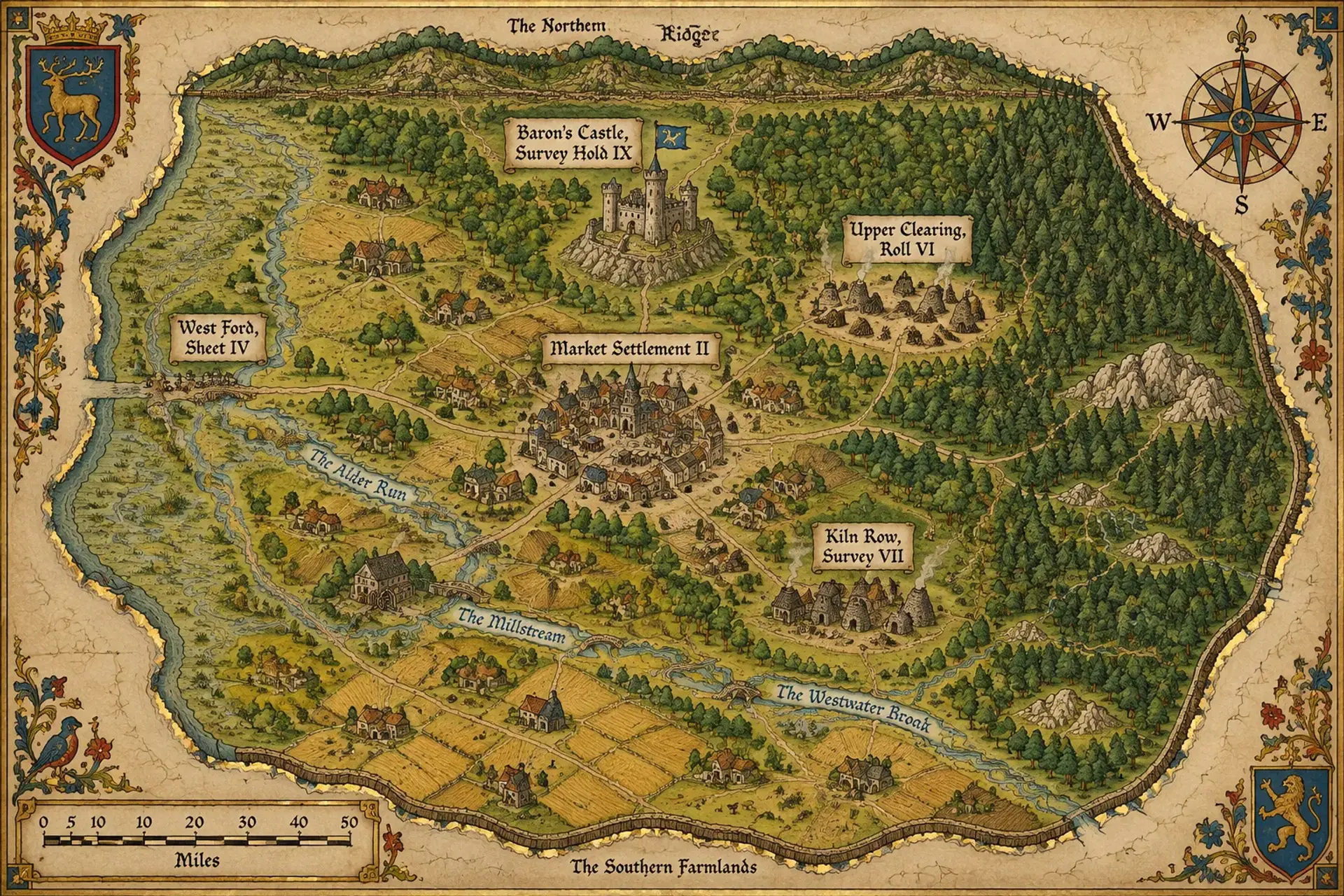
A forest barony where every track leads to a toll, a market, or an old claim.
HMHundred-Sheet March
Overview
Hundred-Sheet March is a forested barony spread across a broad patchwork of clearings, farms, and wooded ridges. Its compact thirteenth-century castle watches a road linking a busy market settlement with scattered villages and woodland work sites. The region feels settled but never fully tamed: tracks vanish under leaves, old boundary rights invite argument, and common magic is woven into practical life. At this zoomed-out scale, the March is a landscape of routes, local loyalties, and many small communities rather than one dense town.
Cultures
Forest-edge village customs shaped by shared grazing and seasonal labor.
Baronial household traditions focused on service, dues, and sworn obligations.
Market-town customs influenced by visiting carters, clerks, and craftspeople.
Places
5 settlements
Small fortified residence · CastleBaron's Castle, Survey Hold IXBaronial seat and local defensive centerA historically grounded thirteenth-century stone stronghold with a gatehouse, curtain wall, domestic hall, and service buildings.
Medium · Market townMarket Settlement IIRegional exchange and gathering pointA medium-sized settlement with a weekly market, workshops, inns, and a parish church.
Small · VillageWest Ford, Sheet IVRiver crossing and farming communityA small riverside village maintains a ford and collects tolls under local custom.
Small · HamletUpper Clearing, Roll VIAgricultural settlementA cluster of farmsteads supplies grain, wool, and seasonal labor to the market.
Small · HamletKiln Row, Survey VIIWoodland craft and fuel productionWoodcutters and charcoal burners work nearby clearings and sell fuel through the market.
How they spread
PatternOne medium-sized market settlement anchors the road network, while numerous small settlements cluster along streams, clearings, and woodland edges. The castle and its demesne occupy a defensible rise near the main route.
Common kinds
Market settlement
Small farming villages
Woodcutters' hamlets
Manorial farms
Isolated mills and charcoal clearings
Trade routes
The Forest Road connects the market to the western valley.
The River Track follows the Alder Run between farms and mills.
The Ridge Path links outlying woodland clearings to the baronial demesne.
Dangers and hooks
3 threats
Most dangerous · ModerateThe Unmarked TrackersHuman banditsThey lurk along lesser forest paths and strike isolated travelers or charcoal crews.
The Horned BoarModerateBeast
A huge, unnaturally bold boar raids farms and charges anyone approaching its lair.
The Drowned HollowLowMagical wilderness hazard
Strange lights and marsh creatures appear in wet hollows after prolonged rain.
Hazards of the land
Winter floods can wash out fords and low bridges.
Falling branches and unstable timber threaten workers in logged areas.
Poachers and desperate outlaws sometimes ambush isolated travelers.
Plot hooks
1
The Crooked BoundaryInvestigationA boundary ditch has been shifted, placing a village's grazing ground inside the baron's demesne.Starts: The village reeve asks the party to inspect the disputed markers before the court convenes.Reward: A lawful woodland pass and a modest purse.
2
The Returning WheelMysteryA cart carrying iron tools vanished on the forest road, but its tracks circle back toward the market.Starts: The merchant's factor offers a fee at the market green for news of the missing cargo.Reward: Recovered tools, coin, or a favor from local traders.
3
Names in the KilnSupernaturalA charcoal burner's kiln has begun producing embers that whisper names after dark.Starts: Workers at a woodland clearing seek help before the baronial forester closes the site.Reward: A share of the charcoal sale and a useful magical charm.
4
Timbers Before the FloodUrgent taskA damaged bridge threatens the market's supply road just as floodwater rises upstream.Starts: The market reeve calls for help from anyone willing to reach the bridge and find its missing timbers.Reward: A public reward and lasting goodwill in the market settlement.
The land
Climate and ground
ClimateTemperate, with wet springs, mild summers, and cold winters that occasionally bring snow.
TerrainRolling forested ground cut by streams, small clearings, and cultivated strips around villages.
Biomes
Temperate broadleaf forest
Mixed conifer woodland
Cleared farmland and pasture
Wet meadow and riverside thicket
Waters and borders
Waterways
The Alder Run, The Millstream, The Westwater Brook
Borders
A low ridge marks the northern edge.
A larger forest tract continues eastward.
Open farming country begins beyond the southern boundary.
A shallow river valley defines the western approach.
On the road
Forest tracks become slow and muddy after heavy rain.
The market road is easiest to follow by day, while lesser paths are poorly marked.
A loaded cart can cross the region in a day or two when bridges and fords remain passable.
Landmarks
A compact stone castle with a gatehouse, curtain wall, and household buildings.
A weekly market green beside the main road.
Old charcoal platforms hidden among the trees.
A worn boundary ditch separating demesne woodland from common land.
Landforms
Low wooded ridges
A broad river valley
Small marshy hollows
Scattered limestone outcrops
Resources
Mature oak and beech timber
Iron-bearing stone in limited seams
Clean streams and meadow grazing
Honey, wax, and medicinal plants
Power
Rule
GovernmentA local barony within a larger kingdom, administered through a castle household, manor courts, and village reeves.
SeatBaron's Castle, Survey Hold IX
StabilityGenerally stable, though woodland rights and uneven rents regularly strain relations between tenants and the baronial officers.
Laws
Forest pannage and timber rights are governed by customary dues.
The baron's court hears disputes over land, rents, and minor offenses.
Market weights and tolls must be publicly declared.
Armed hunting in the lord's demesne requires permission.
Factions
Baronial Household, Roll IFeudal household
Influence: Strong around the castle and dependent villages.Maintain customary rents, protect the manor's rights, and keep the forest road passable.
Market Guild, Roll IIIMerchant association
Influence: Strongest in the market settlement and among local traders.Secure fair weights, predictable tolls, and safe access to the market.
Commoners of Survey Strip VVillage compact
Influence: Widespread among forest-edge communities.Preserve shared woodland rights and resist unauthorized timber claims.
Faiths
The Lantern Rite
Influence: Strong in the market settlement and the baronial household.A lawful faith honoring oaths, hospitality, and the care of the dead.
The Green Vow
Influence: Common in villages and among foresters, often practiced alongside formal worship.Local reverence for woodland springs, boundary stones, and seasonal renewal.
The Quiet Rule
Influence: Maintained by a small religious house and consulted during illness or dispute.Contemplation, healing, and the keeping of written records.
People and trade
Who lives here
How manyModerate near the market and river roads, sparse beneath the deeper woodland.
Main peoples
Human tenant farmers and woodland villagers
Human baronial household and retainers
Itinerant traders and craftspeople
Other peoples
Dwarven charcoal burners, Elven foresters
Languages
Common, Local woodland dialect, Liturgical Latin
Trade
WealthModest overall, with a small concentration of wealth among the baronial household and market merchants.
Work
Timber cutting and charcoal burning
Grain farming and animal husbandry
Market crafts and woodland gathering
Exports
Oak timber and charcoal
Grain, wool, and hides
Honey, wax, and gathered herbs
Imports
Salt and iron tools, Fine cloth and wine
Markets
Market Settlement II, The baronial toll yard
History and secrets
The region grew around a forest road where woodland clearings supplied timber, charcoal, and food to nearby estates. A modest baronial castle developed from an earlier earthwork during the thirteenth century, controlling local dues rather than commanding a vast territory. A market settlement later became the chief meeting place for surrounding villages. Old rights over grazing, pannage, and fallen wood remain important, and disputes over them still shape everyday politics.
Key events
Early 13th century
The First HoldA timber palisade and earthwork were raised to guard the road and collect dues.
Mid 13th century
The Mason's SurveyStone walls, a gatehouse, and a residential tower replaced the earlier defenses in the manner of a modest baronial castle.
Late 13th century
The Market WritA weekly market gained formal protection after merchants agreed to maintain the bridge and road approaches.
Secret 1 · GM only
A copied survey quietly shifted the boundary of the baron's demesne into land once held in common.Found by: Compare the oldest boundary ditch with the marks on a damaged tax roll.If found: The castle's claim to part of the common woodland may rest on a later alteration rather than a lawful grant.
Secret 2 · GM only
One old charcoal site covers a sealed chamber that reacts to spoken names and nearby magic.Found by: Listen for the same whispered names at the charcoal platform and examine the stones beneath its ash bed.If found: The phenomenon may reveal a buried cache or awaken a dangerous presence if exploited carelessly.
Media
0 images
No images yet.
Visual sheet
Turn Hundred-Sheet March into a sheet
A high-res, share-ready sheet you can post or print.