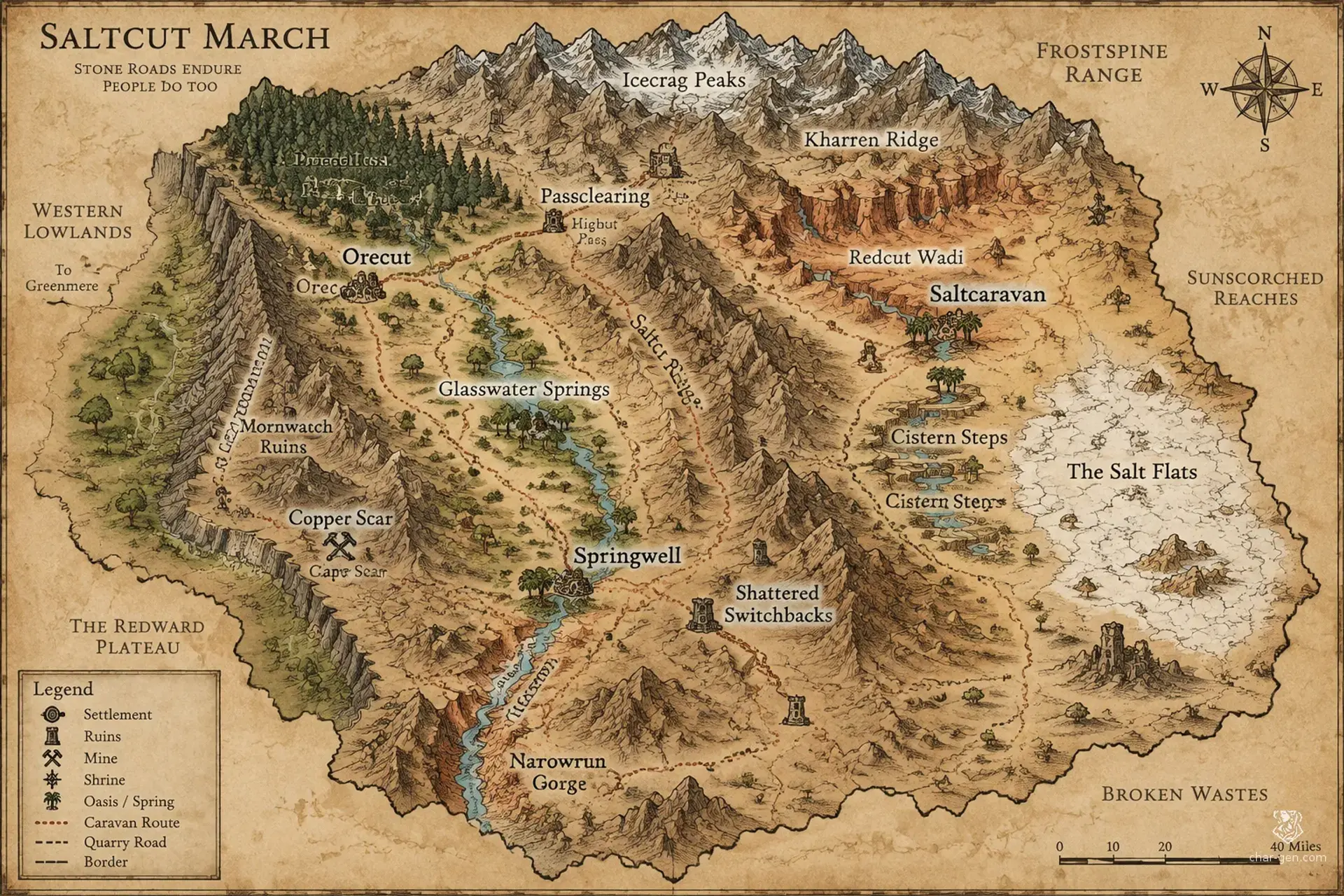
Where every road is cut from stone and every drop has a price.
SMSaltcut March
Overview
The Saltcut March is a rugged border region spanning a hundred miles of dry mountains, high passes, and scattered basins. Its people live by mining, caravan work, and careful use of scarce water. Ordinary magic shapes daily life, from warded cisterns to route charms, yet the old roads remain perilous. Neighboring powers covet its mineral wealth and crossings, while local councils guard their hard-won autonomy. Settlements are numerous but small, clustered around springs, mines, and defensible routes.
Cultures
Pass-keepers preserve customs shaped by toll collection, caravan law, and mountain hospitality.
Wadi farmers blend terrace agriculture with seasonal herding.
Mine and quarry communities maintain guild traditions and shared water rights.
Places
4 settlements
Large town · Market townOrecutMining and metal-trade hubIts market square fills with ore wagons during the dry season, and its guild hall arbitrates mining claims.
Small town · WaystationSaltcaravanCaravan waystationIts shaded pens and repair yards serve caravans crossing the eastern flats.
Medium town · Fortified marketPassclearingPass market and council meeting placeBuilt where workers cut a broad shelf into the mountain, it hosts seasonal fairs and toll offices.
Large village · Spring villageSpringwellAgricultural village and water stopA ring of terraces and cisterns surrounds the settlement's guarded spring.
How they spread
PatternSettlements cluster around reliable water, workable ore, and defensible crossings. Many smaller hamlets shift seasonally as herders and miners follow pasture or new claims.
Common kinds
Spring villages.
Mining camps and smelter towns.
Caravan waystations.
Fortified pass markets.
Trade routes
The Salt Road links eastern flats with southern caravan country.
The Ore Trail carries metal west toward lowland markets.
The High Pass circuit joins northern mines to the central spring chain.
Dangers and hooks
3 threats
Most dangerous · HighShattered Switchback WardsEnvironmental and magical hazardUnstable magical effects flare along the broken high road, especially during storms.
Ridge BasilisksHighMonstrous predators
Small hunting groups lurk around warm caves and exposed trail ledges.
Claim-JumpersModerateHuman conflict
Armed prospectors appear wherever a new seam or abandoned shaft is reported.
Hazards of the land
Sudden wadi floods can sweep away camps and bridges.
Unstable mine galleries collapse without warning.
Heat haze and dust storms disorient travelers on exposed plateaus.
Plot hooks
1
The Thirsting VaultInvestigationA cistern ward has begun drawing water from nearby wells, and the settlement councils accuse one another of tampering.Starts: The Cistern Steps, where a public reservoir has turned bitter overnight.Reward: A share of the recovered water rights and a charm that purifies one waterskin daily.
2
Tracks Above the RoadRescue and explorationA caravan vanished on a route marked safe by the Pass Wardens, leaving fresh tracks that climb straight up a cliff.Starts: The Saltcaravan waystation, where anxious merchants offer a map and pack animals.Reward: A magical route marker and a negotiated share of the caravan's recovered cargo.
3
The Spring Below StoneDungeon explorationMiners broke into a sealed chamber whose walls whisper directions toward a buried spring.Starts: The Orecut market town, where the guild hires discreet escorts to inspect the mine.Reward: Mining scrip, a minor enchanted tool, and the guild's favor.
4
Toll at the Old MarkerDiplomacyA rival border patrol has occupied a watch post and claims an ancient treaty grants them the pass.Starts: The Pass Wardens' road camp, where negotiators fear a fight will close the trade route.Reward: A formal travel writ, a modest purse, and goodwill among the wardens.
The land
Climate and ground
ClimateArid, with scorching days, cold nights, brief violent storms, and snow on the highest peaks.
TerrainA rugged mountain belt of narrow passes, stony plateaus, ravines, and isolated basins.
Biomes
Arid mountain scrub.
High-elevation alpine meadows.
Dry pine slopes.
Wadi oasis groves.
Waters and borders
Waterways
The Redcut Wadi runs only after storms but feeds several cisterns.
The Glasswater Spring chain sustains the central settlements.
The Narrowrun stream descends from snowmelt through a steep gorge.
Borders
The western escarpment descends toward fertile lowlands.
The northern ridge divides the region from colder uplands.
The eastern salt flats mark a harsh frontier.
The southern dry basin opens onto caravan country.
On the road
Most safe routes follow old quarry roads and spring chains.
Flash floods can erase wadi crossings after distant storms.
Travelers need local guides to distinguish maintained paths from dead-end mining tracks.
Landmarks
The Cistern Steps are a centuries-old chain of public water vaults.
The Shattered Switchbacks still bear magical scars from a storm.
The Copper Scar exposes a vivid seam across a mountainside.
The Glasswater Springs glow faintly under moonlight.
Landforms
Sawtooth ridges divide the valleys.
Dry basins collect salt and storm runoff.
Steep ravines cut through the central range.
Terraced slopes cling to sheltered hillsides.
Resources
Copper and iron ore.
Rock salt and mineral pigments.
Hardy herbs used in medicine and warding.
Power
Rule
GovernmentA compact of valley councils, mine guilds, and pass wardens governs through seasonal assemblies.
SeatA rotating council meets at the largest seasonal market, with no permanent regional capital.
StabilityUneasy but functional; shared dependence on water and trade restrains open conflict.
Laws
A traveler may draw from public cisterns after contributing labor or coin.
Unmarked claims to mines and springs are invalid.
Armed feuds are forbidden within market grounds.
Pass tolls must be posted before a caravan enters a warded road.
Factions
Orecut GuildMining consortium
Influence: Strong around mines and smelters, with growing leverage in local councils.The Orecut Guild controls mine leases and seeks safer, cheaper routes for its shipments.
Pass WardensCivic militia
Influence: Broad along major passes and limited in remote valleys.The Pass Wardens keep routes open, collect lawful tolls, and prevent feuds from closing the crossings.
Salt CartersCaravan league
Influence: Moderate at markets and caravan stops.The Salt Carters protect their trade privileges and quietly move forbidden magical goods.
Faiths
Cistern Keepers
Influence: Strong among farmers and cistern tenders, with shrines at public reservoirs.The Keeper Below is honored as guardian of springs, buried water, and promises made over shared wells.
Orefire Fellowship
Influence: Common among miners, smiths, and caravan guards.The Three Fires teach endurance, honest craft, and respect for the dangerous gifts of the earth.
Roadside Vow
Influence: Widespread among travelers and market communities.The Open Road venerates safe passage, hospitality, and the spirits believed to inhabit crossroads.
People and trade
Who lives here
How manySparse overall, with denser clusters around springs, mines, and defensible passes.
Main peoples
Human caravan clans and settled farmers form the largest population.
Dwarven miners maintain several highland communities.
Halfling traders and muleteers connect the scattered settlements.
Other peoples
Goliath shepherd families range along the upper ridges.
Tiefling spellworkers serve as guides and ward-makers.
Languages
Common is used in markets and councils.
Dwarvish is common in the high mines.
Halfling cant is heard among caravan crews.
Trade
WealthUneven; mining and caravan houses prosper, while isolated villages often barter for essentials.
Work
Copper and iron mining.
Caravan transport and pass tolls.
Terrace farming and goat herding.
Exports
Copper ingots and iron tools.
Salt cakes and medicinal herbs.
Mule teams and enchanted route markers.
Imports
Grain and preserved fruit from the southern lowlands.
The borderlands grew around mines, springs, and the difficult passes between richer neighbors. Early settlements survived by sharing cisterns and maintaining roads, while disputes over ore and tolls repeatedly threatened the compact. Common magic helped mark routes and protect water stores, but it also made old workings dangerous. Today, the region remains independent in practice, dependent on trade, and divided by competing claims.
Key events
Old Road Era
The Cistern CompactA chain of stone cisterns linked isolated hamlets and established shared rules for water access.
Founding Generations
The Orecut ClaimsA rich copper seam drew miners, merchants, and rival valley councils into a long dispute over claims.
Three Generations Ago
The Shattered SwitchbacksA magical storm shattered several high roads, forcing communities to rebuild the pass system together.
Secret 1 · GM only
The Cistern Compact was built over a buried magical engine that can redirect underground water between valleys.Found by: A repeating chill in a disused shaft leads to a hidden door behind an ore chute.If found: The chamber contains an ancient water engine that could end local shortages or give its controller immense leverage.
Secret 2 · GM only
A forgotten treaty shows that neighboring powers once agreed to keep the mountain passes neutral.Found by: The oldest toll ledgers use marks that do not match any known council seal.If found: Proof of the pact could undermine current borders and invite outside claimants to intervene.
Secret 3 · GM only
A hidden pass crosses beneath the central ridge and was sealed after a magical disaster.Found by: At dusk, the Copper Scar casts a shadow shaped like a road that is absent from every map.If found: The route may lead to a lost mine, but its wards awaken when anyone carries worked metal.
Media
0 images
No images yet.
Visual sheet
Turn Saltcut March into a sheet
A high-res, share-ready sheet you can post or print.