Across the white silence, every warm light is a promise.
hhellvick-ludovny
Overview
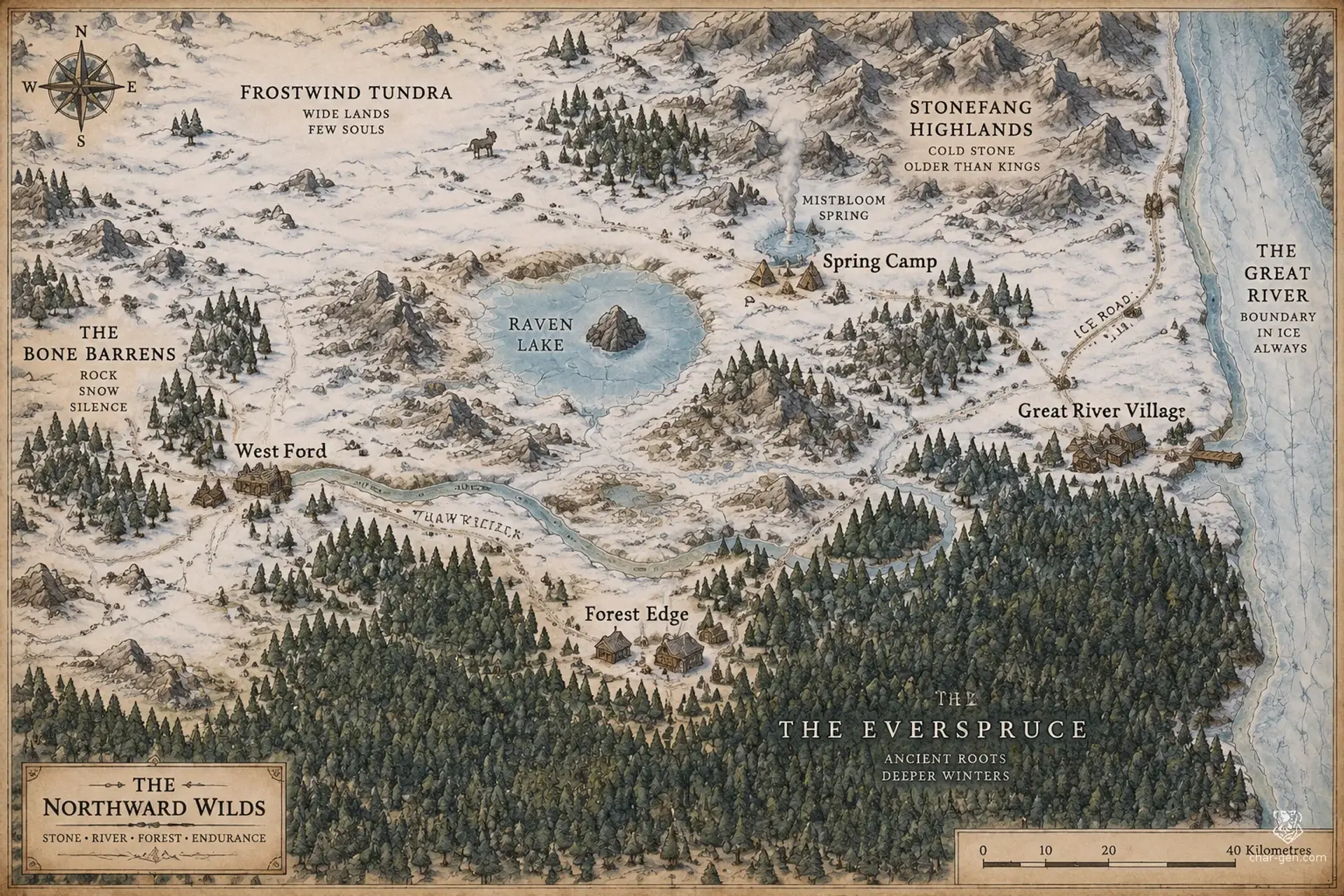
Hellvick-Ludovny is a regional frontier of sub-arctic tundra, stretching west to east between a small river settlement and a village on a broad frozen river. A third village stands south of the midpoint where open snow meets an ancient conifer forest. Eskers, bogs, boulder fields, scattered spruce, and thawing pools make every journey uncertain. Magic is common, but distance, weather, and dwindling supplies remain stronger forces than any spell.
Cultures
Riverbank winter-trading customs shaped by seasonal travel and shared stores.
Forest-edge traditions prize careful hunting, woodcraft, and reciprocal shelter.
Frontier newcomers bring distant legal and magical practices adapted to local hardship.
Places
4 settlements
Hamlet · River settlementWest FordWestern entry point and fishing stopA small river settlement with a landing, smokehouses, and a rough storehouse for travelers.
Small village · Forest-edge villageForest EdgeTimber, hunting, and woodland exchangeA compact village overlooking the ragged northern margin of the ancient forest.
Small village · River villageGreat River VillageEastern trade and river crossingA frontier village on a firm bank above the frozen river, busy during winter crossings.
Small camp · Seasonal campSpring CampSeasonal refuge and source of medicinesA loose cluster of shelters used by healers, trappers, and travelers near the steaming ground.
How they spread
PatternPermanent settlements cling to rivers, the forest margin, and dependable winter crossings. Camps shift with game, weather, and the changing safety of the bogs.
Common kinds
Small river villages, Forest-edge hamlets, Seasonal trapping camps, Prospector shelters
Trade routes
A winter track links West Ford to the midpoint forest village.
The eastern ice road follows the great river and its safer banks.
A southern woodland trail connects scattered camps to the ancient forest.
Dangers and hooks
3 threats
Most dangerous · HighMire-lurkersPredatory beastsThey haunt unfrozen brown pools and follow the sound of struggling animals.
IcebreakersHighAquatic monsters
Large river predators gather beneath weak ice near bends and winter crossings.
The Hollow GaleModerateMagical weather
This unnatural whiteout sweeps the open plains without warning and carries misleading voices.
Hazards of the land
Whiteouts can strand travelers within sight of shelter.
Unfrozen mire and bog pools can swallow sleds and pack animals.
Ice on the great river shifts and fractures near bends and rapids.
Plot hooks
1
Tracks Beneath the IceInvestigationA route-marker crew finds fresh footprints leading across a bog that has been frozen solid for generations.Starts: The southern forest-edge villageReward: A share of recovered goods and a charm that steadies footing on ice.
2
The Warm Ground StirsEnvironmental mysteryThe hot spring has begun steaming more heavily, and nearby pools are opening beneath the snow.Starts: A trappers' camp near the springReward: Local goodwill, rare medicinal moss, and a modest bounty.
3
The Claim in the TreesFaction conflictProspectors claim an old iron seam, but their maps place it beneath protected forest ground.Starts: A meeting of the village councilsReward: A legal claim, a negotiated share, or favor with the forest wardens.
4
Light Under the RiverRescue and explorationA supply sled vanished on the great river, leaving only a broken harness and a line of blue light under the ice.Starts: The eastern river villageReward: Recovered trade goods and a magical token from beneath the river.
The land
Climate and ground
ClimateSub-arctic polar conditions bring long, severe winters, short cool summers, and sudden whiteouts.
TerrainA broad west-to-east wilderness of tundra, bog, eskers, boulder fields, scattered groves, and forested southern ground.
Biomes
Wind-scoured tundra
Frozen peat bogs and thawing mire
Sparse spruce and birch groves
Dense ancient conifer forest
Low rocky hills and gravel ridges
Waters and borders
Waterways
The great frozen river flows south-east along the far eastern reaches.
A narrow west-running river supports the western settlement and its fishing camps.
Black pools and small thaw channels punctuate the bogs and mires.
A small frozen lake surrounds a rocky island near the region's center.
Borders
Western approaches fade into open, sparsely wooded uplands.
The northern edge gives way to colder, nearly treeless wastes.
The southern and south-eastern reaches are enclosed by ancient forest.
Eastern highlands rise beyond the great frozen river.
On the road
Eskers offer the safest winter paths, but drifting snow can erase familiar tracks.
Brown mires hide thin crusts over deep pools and are dangerous even in hard frost.
The forest and eastern river provide shelter and routes, though both conceal hazards.
Landmarks
A steaming spring warms a bare patch of ground amid the frozen wastes.
A rocky island rises from a small frozen lake.
The ancient conifer forest fills the south and south-east, with ragged groves scattered northward.
The great river forms a broad frozen route through the far east.
Landforms
Long, winding gravel eskers cross the tundra.
Low rounded hills cluster toward the east.
Grey boulder fields interrupt open snow plains.
Irregular frozen bogs and brown thawing mires spread through hollows.
Resources
Furs, hides, and smoked fish
Spruce timber, resin, and medicinal plants
Bog iron and useful gravel
Power
Rule
GovernmentA loose compact of village councils, river wardens, and customary forest elders.
SeatNo single seat governs the region; seasonal councils meet at whichever settlement can host them safely.
StabilityWary but functional, with cooperation holding through common danger and disputes rising over timber, claims, and scarce supplies.
Laws
Travelers must register at settlements before taking a marked winter route.
No one may cut living timber within the forest's protected heart without consent.
Food stores are shared by rule during a declared winter emergency.
Factions
Crossing KeepersSettlement compact
Influence: Strong in western settlements and influential with passing traders.Keep the river crossing open and ensure fair distribution of food and fuel.
The Greenward KinForest wardens
Influence: Strong along the southern forest edge and respected among local hunters.Protect traditional access to the forest and prevent reckless cutting.
The Deep ClaimProspectors' league
Influence: Growing near the eastern hills, but limited by harsh travel and local suspicion.Find ancient workings and claim the region's buried metal deposits.
Faiths
The Hearthward Way
Influence: Common in river settlements and among travelers who depend on communal shelter.Honoring hearth, kin, and the spirits of safe passage.
The Root Covenant
Influence: Strong among forest-edge communities and influential with local wardens.Keeping balance with old forest powers through offerings and restraint.
The Pale Lantern
Influence: Practiced by scattered camps, especially during long nights and dangerous crossings.Reading winter stars and treating cold as a test of endurance and honesty.
People and trade
Who lives here
How manyVery sparse, with scattered hamlets and isolated winter camps separated by long stretches of wilderness.
Main peoples
River settlers
Forest-edge hunters and gatherers
Seasonal trappers and prospectors
Other peoples
itinerant dwarven prospectors
Small bands of elven woodland guides
Languages
Common, Skaldic trade cant, Old woodland speech
Trade
WealthPoor in coin but rich in essential materials, with wealth measured in stores, boats, and winter gear.
Work
Fur trapping and hidework
Fishing and river transport
Timber cutting and resin gathering
Exports
Furs and smoked fish, Spruce timber and resin, Bog iron and medicinal moss
Imports
Grain and preserved vegetables
Iron tools and lamp oil
Markets
West Ford, Great River Village
History and secrets
Hellvick-Ludovny began as a scattering of river camps and forest-edge shelters, linked by tracks that changed with each season. The great eastern river gradually became a winter road, drawing traders and prospectors into the interior. The settlements remain small and far apart, held together by shared rules for food, travel, and timber. Recent thawing has exposed old ground and unsettled routes once thought dependable.
Key events
Founding years
The First LandingThe first families built a small river landing and began seasonal fishing and trapping.
A generation ago
The Ice RoadSettlers discovered that the eastern river offered a reliable winter road and established a permanent village there.
Recent past
The Long ThawA thaw opened black pools across the southern bogs, swallowing stores and forcing a new route toward the forest edge.
Secret 1 · GM only
The central lake's island conceals a buried refuge built before the present settlements.Found by: A line of warm stones beneath the rocky island leads to a sealed shaft.If found: The shaft opens onto an ancient underground refuge whose magic can alter the region's water and weather.
Secret 2 · GM only
The eastern river once marked a pact between the forest's ancient guardians and an older people.Found by: Old carvings appear on exposed stones near the eastern hills after a deep thaw.If found: The river villages may be founded over a forgotten boundary, making the prospectors' claims legally and magically dangerous.
Media
0 images
No images yet.
Visual sheet
Turn hellvick-ludovny into a sheet
A high-res, share-ready sheet you can post or print.