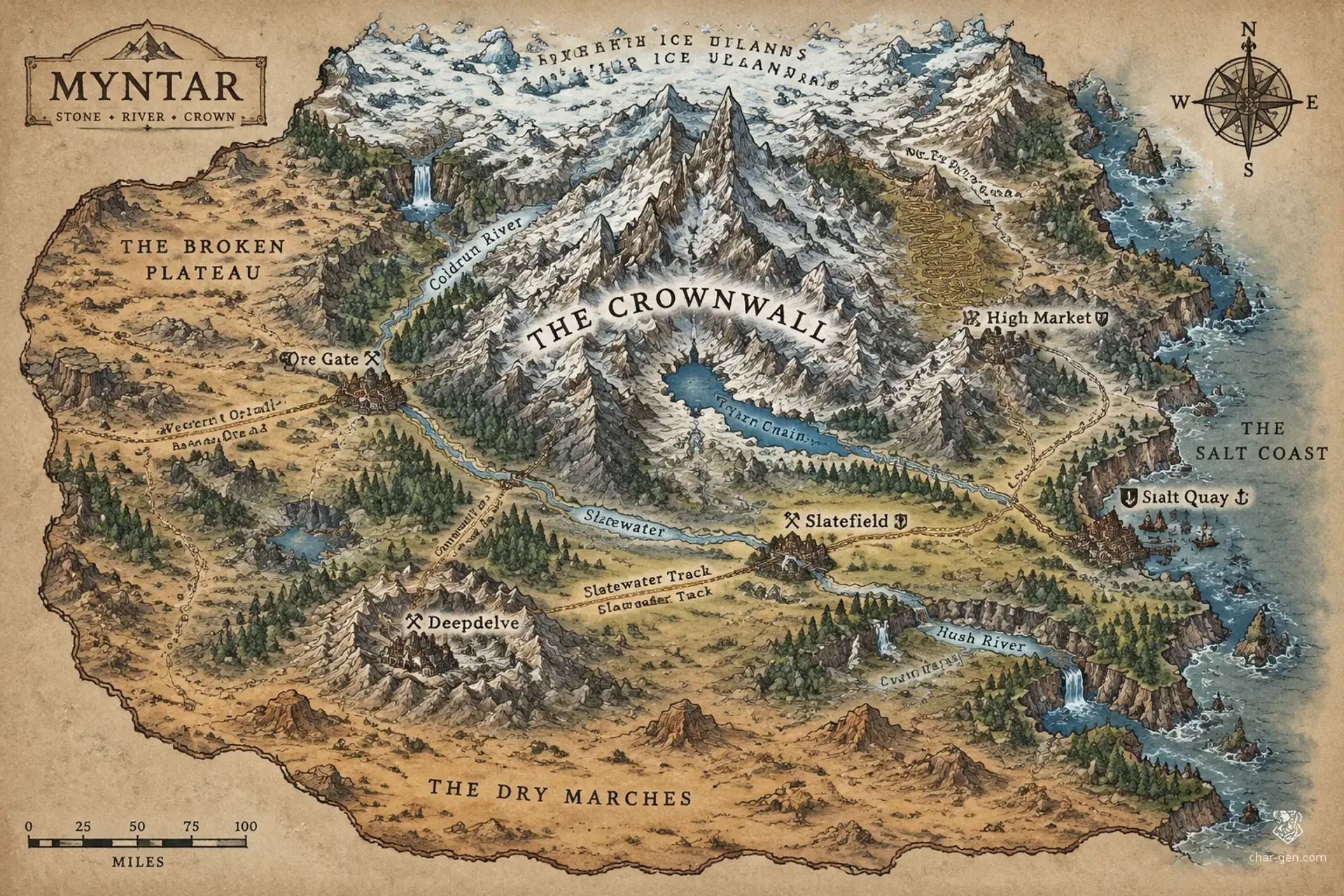
Where the old roads vanish beneath snow, stone, and silence.
MMyntar
Overview
Myntar is a frontier region on the scale of a nation, spanning hundreds of miles of dry valleys, immense mountain chains, and a rugged eastern coast. Its ancient dwarf holds lie beneath snowbound peaks, while most valleys and uplands remain sparsely settled or wholly wild. Settlements cluster around dependable springs, mines, and a handful of difficult passes. Travel is slow, the old roads are precious, and every distant smoke may mark a refuge, a mine camp, or a threat.
Cultures
Dwarven holdfast communities preserve deep craft guilds, stone law, and ancestral halls.
Valley farmers and herders follow seasonal water and market calendars.
Passwardens blend frontier customs with caravan traditions from distant lowlands.
Places
5 settlements
Large · Market townOre GateMajor trade and ore-registration hubA walled market town built beside a mine-road junction, with crowded assay halls and caravan yards.
Medium · Pass townHigh MarketSeasonal caravan exchangeIts open-air stalls operate only when the pass is clear, and winter stores are guarded closely.
Small · Harbor townSalt QuayCoastal trade outletA small coastal harbor exchanges salt fish and sea goods for metal, wool, and stone.
Small · Valley villageSlatefieldFood producer and river crossingA scattered cluster of farms and herders uses stone-lined channels to share scarce river water.
Large · Mountain holdDeepdelveDwarven craft and mining centerIts inhabited halls occupy a fraction of a much older underground complex whose lower levels remain sealed.
How they spread
PatternSettlements occupy sheltered basins, spring-fed slopes, and the mouths of workable mines. Vast highlands between them have no permanent habitation.
Common kinds
Dwarven hold towns, Valley farming villages, Mining camps, Caravan stations
Trade routes
The Crownwall Road links central holds to the eastern coast through guarded passes.
The Slatewater Track follows southern grazing valleys between farms and market towns.
The Western Ore Trail crosses the plateau to isolated mines and prospecting camps.
Dangers and hooks
4 threats
Most dangerous · HighThe WhitefallEnvironmental hazardSeasonal avalanches sweep the Crownwall routes, sometimes carrying signs of movement from above the ridges.
Deep Hollow ThingsHighUnderground monsters
Unidentified creatures appear around abandoned shafts and follow mine tunnels toward the surface.
Ridge ClansModerateRaider bands
Small bands shadow isolated caravans and defend high grazing grounds against trespassers.
Dry Season FeudsLowLocal conflict
Disputes over wells and river diversions flare in the southern valleys during drought.
Hazards of the land
Sudden avalanches bury trails and entire camps.
Rockslides and flash floods cut off valleys without warning.
Waterless stretches and exposed ridges exhaust unprepared travelers.
Plot hooks
1
Tracks Beneath the SnowRescue and investigationA caravan carrying food and winter medicine vanished after taking a supposedly safe pass road.Starts: A worried factor at High Market offers the last known route and a damaged trail marker.Reward: A share of the recovered cargo and a durable mountain guide's kit.
2
The Knocking ShaftDungeon explorationA sealed mine has begun sending warm air and rhythmic knocks into a nearby settlement.Starts: Miners at Ore Gate seek a crew willing to inspect the newly exposed shaft.Reward: A choice of recovered metalwork, a guild favor, or a share of the claim.
3
A River DividedNegotiation and mysteryTwo valley communities accuse one another of diverting the Slatewater before the planting season.Starts: A Passwardens mediator asks the party to inspect the upstream channels.Reward: A formal safe-conduct charter and payment from both communities.
4
Road Below the RidgeWilderness expeditionA trail survey uncovers a buried road leading toward a hold erased from every known map.Starts: A prospecting camp near the western plateau has found carved stones and fresh footprints.Reward: A relic from the lost hold and the right to present its findings to the councils.
The land
Climate and ground
ClimateArid mountain climate with scorching, dry valley summers, cold winds, and heavy snow at high elevations.
TerrainA vast knot of interconnected ranges, deep valleys, steep cliffs, and narrow passes descending toward a rugged eastern coastline.
Biomes
Snowbound alpine peaks
Barren rocky highlands
Conifer forests in sheltered valleys
Dry grasslands and scrub foothills
Waters and borders
Waterways
The Coldrun River drains the central glaciers through forested gorges.
The Slatewater flows south across broad grazing valleys.
The Hush River descends eastward through waterfalls to the coast.
The Tarn Chain links high lakes beneath the western peaks.
Borders
The northern ice uplands, The western broken plateau, The southern dry marches, The eastern salt coast
On the road
Caravan roads follow river valleys and switchback over a few guarded passes.
Snowfall can close high routes for months, while summer storms trigger rockslides.
Beyond the marked valleys, reliable water and shelter are rare.
Landmarks
The Crownwall peaks dominate the central skyline.
The Tarn Chain forms a string of cold lakes in high basins.
The Nine Turns is a precarious road of switchbacks above a deep gorge.
The eastern escarpment breaks into sea cliffs and narrow coves.
Landforms
Jagged snow-capped ranges and high alpine ridges
Deep forested gorges and steep ravines
Wide grassy basins between barren uplands
Glacial lakes, cliffs, and waterfall-fed valleys
Resources
Iron, copper, silver, and scattered gold
Durable building stone and slate
Wool, hardy pack animals, and mountain herbs
Power
Rule
GovernmentA loose frontier compact of dwarf hold councils, valley assemblies, and pass authorities.
SeatAuthority shifts among the major hold councils, which convene at Ore Gate for regional disputes.
StabilityPragmatic but fragile, with old treaties strained by new claims and unreliable routes.
Laws
Marked roads and wells are protected by common right.
Unclaimed ore must be registered at the nearest recognized assay hall.
Caravan feuds and blood debts may not be pursued through neutral settlements.
Factions
Deepdelve CompactDwarven guild confederation
Influence: Strong within the oldest holds and influential among miners.Protect ancestral claims while reopening sealed mines and recovering lost craft records.
PasswardensFrontier road league
Influence: Widespread along the main caravan routes.Keep pass roads open and secure fair tolls, water rights, and safe conduct.
Red Ore SyndicateMining consortium
Influence: Growing in the outer valleys and new camps.Claim unregistered mineral seams before rival prospectors or distant investors can reach them.
Faiths
The Anvil Below
Influence: Strong among dwarf holds and respected in mining towns.Craft, endurance, and the duty to remember the dead.
Way of the High Water
Influence: Common among valley folk and caravan travelers.Mountain springs, seasonal change, and safe passage through wild places.
The Open Hand
Influence: Visible in pass shrines and civic gatherings.Oaths, measured judgment, and communal care for roads and wells.
People and trade
Who lives here
How manyVery sparse overall, with concentrated populations in sheltered valleys, mines, and guarded passes.
Main peoples
Dwarves of the ancient mountain holds
Human valley settlers and caravan folk
Mixed frontier communities of miners, herders, and guides
Other peoples
Goliath clans of the high ridges
Halfling orchard and pack-train communities
Languages
Dwarvish, Common, Pass Cant, Old Myntari
Trade
WealthUneven; wealthy mining halls and caravan towns contrast with poor, isolated homesteads.
Work
Mining and stoneworking
Metalcraft and weapon forging
Mountain herding and valley agriculture
Exports
Iron, copper, and silver ore
Dwarven tools and worked metal
Salt, wool, and cut stone
Imports
Grain and preserved food
Timber and medicinal herbs
Fine cloth and finished tools
Markets
Ore Gate, High Market, Salt Quay
History and secrets
Myntar was shaped by dwarf kingdoms whose halls and roads once joined the mountains into a single network. The collapse of several deep mines weakened that order, leaving isolated holds and disputed claims. Human valley settlements grew around surviving wells and caravan routes, while old dwarf law remained the region's common language for treaties. Today, prospectors push into wilderness that has never been fully mapped.
Key events
Deep Age
Opening of the UnderwaysThe first great dwarf halls were carved into the central range, joining scattered clans through shared roads and water rights.
Ash Years
The Blacked ShaftsA succession of collapses and fires sealed several mines and scattered their surviving workers into the valleys.
Treaty Age
The Pass CompactCaravan leagues and hold councils agreed to maintain the main passes in return for regulated tolls and safe conduct.
Secret 1 · GM only
The oldest dwarf roads were built to connect a vast underground aquifer system, not merely the mines.Found by: Old dwarven survey marks appear beneath newer road stones near the Crownwall.If found: A buried watercourse could revive dry valleys, but its gates lie inside a sealed ancestral hall.
Secret 2 · GM only
One mine collapse was deliberate, and its sealed workings contain evidence of what the miners uncovered.Found by: Fragments of ore from the Blacked Shafts show a metallic sheen unlike any known Myntar seam.If found: The source may be valuable enough to restart the old rivalries or dangerous enough to threaten the holds.
Media
0 images
No images yet.
Visual sheet
Turn Myntar into a sheet
A high-res, share-ready sheet you can post or print.