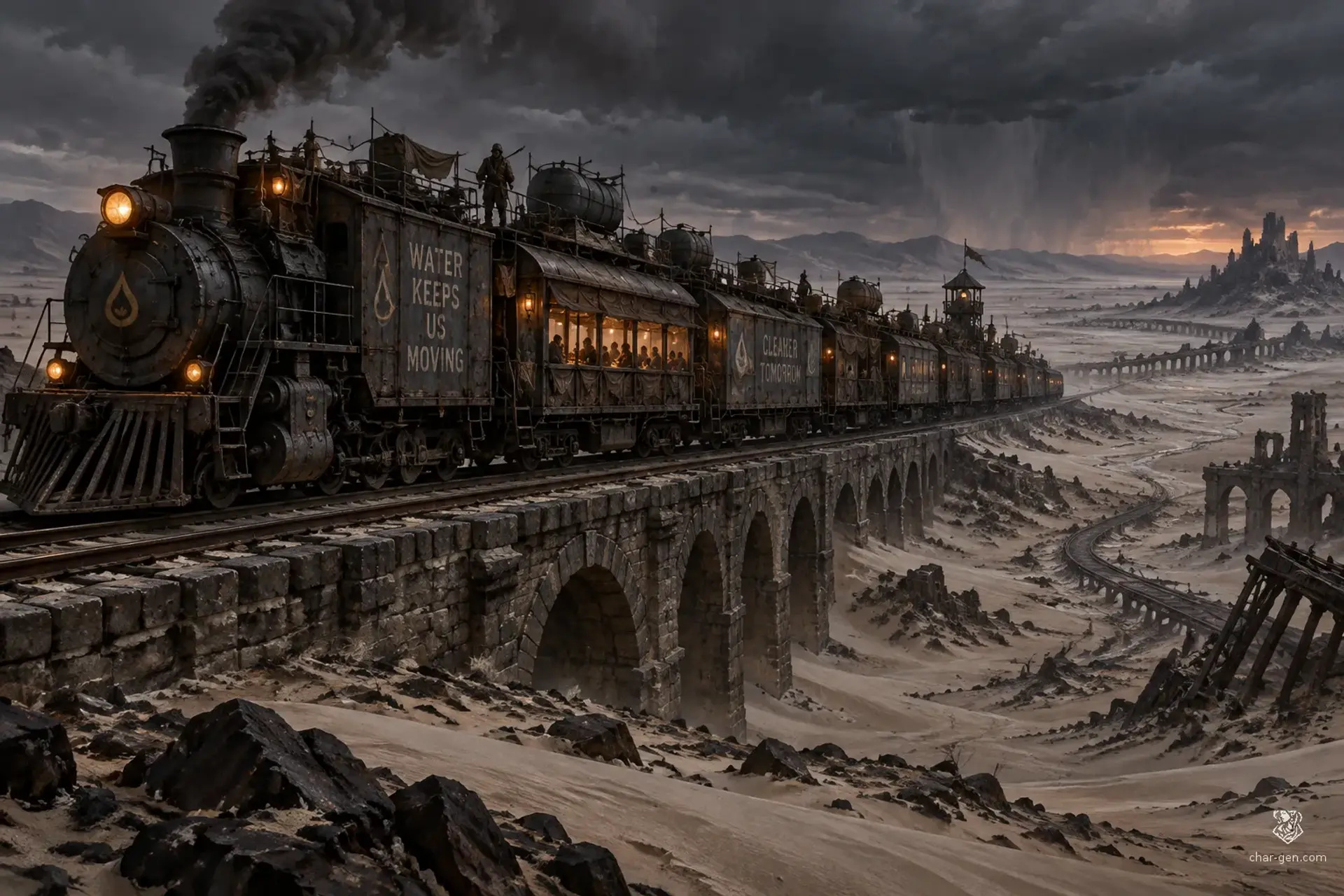
The Cistern Line
The Cistern Line is a train that serves as a moving settlement across a desert where fixed wells have failed. Its passengers sleep in converted freight cars, work the engine or trade, and share a dining car that doubles as council hall, market, and court. The train's route follows old water-hauling tracks. It keeps moving because no one agrees who owns the only working cistern beneath its engine.
The Cistern Line
- Population
- About eighty people…
- Rule
- Tamas Kett
- Wealth
- Poor overall
- Defence
- The Line Guard
Overview
The Cistern Line is a train that serves as a moving settlement across a desert where fixed wells have failed. Its passengers sleep in converted freight cars, work the engine or trade, and share a dining car that doubles as council hall, market, and court. The train's route follows old water-hauling tracks. It keeps moving because no one agrees who owns the only working cistern beneath its engine.
Atmosphere
The Cistern Line never stops long enough to feel like a town, but its dining car is where everyone comes to learn who still has water. At night, oil lamps gutter over scarred tables while rain and ash stripe the windows. The rain is rare, the ash is not. Nobody sits with their back to the sealed water hatch, and nobody asks why the train keeps running when the wells ahead are dry.
Culture
- Ancestor rites practiced at the empty cisterns
- Austere sun worship among the engine crew
Human, Dwarf, Halfling, Orc
Economy
Rail maintenance, Water rationing, Salvage, Dining and lodging
Engine repair, Filtered water, News from the route
Coal, Grain, Lamp oil, Replacement parts
Geography
Ways in and out
Places to see
- The Route PlateA faded rail marker beside the dining car records the original water-hauling route. Its last line has been scratched away, though the groove still shows beneath the soot.
- The Name CarAn empty freight car holds cracked jars, old blankets, and a wall of names carved by passengers who died on the route. New names appear after every long stop.
Power
2 factionsGovernment
Laws
Trouble
- A false water tally is about to become a crisis.The public water ledger shows enough for another month, but the engine's hidden cistern is nearly empty. Tamas Kett has concealed the shortfall, while Szel Heth is organizing passengers to demand the hatch be opened. A confrontation could stop the train in open desert, but continued secrecy will leave the passengers unprepared for the next ration cut.Involves
Tamas Kett, Szel Heth, Ildik Varga
Factions
- The Line GuardSecurity and crewThe Line Guard are crew and veterans who keep the train intact through threats, disputes, and breakdowns. They accept that rationing is cruel but believe disclosure would lead to panic and sabotage.GoalsKeep the engine running and preserve the current water allocation, which conflicts directly with the Cistern Claimants' demand to open the hatch.Allies
Tamas Kett
RivalsCistern Claimants
- Cistern ClaimantsPassenger movementPassengers, mechanics, and water clerks who believe the hidden cistern belongs to everyone aboard. Their meetings happen in the dining car after the lamps are turned low. Some want a public accounting; others would uncouple the engine's water feed and force the issue.GoalsOpen the hatch and make the cistern's water a shared resource, directly opposing the Line Guard's control.Allies
Szel Heth
RivalsThe Line Guard
Defences
- Iron shutters on the passenger cars
- A locked water hatch with two separate keys
- A reinforced engine cab
Law and order
People and places
7 entriesConductorTamas Kett Human Male
Tamas Kett has a clipped voice and a habit of turning his brass whistle over in his hand when passengers argue. He wants to keep the train moving long enough to reach a working well, but he fears that admitting the true water count will bring a riot before then. He presents the ledger as proof of his care, though he altered it himself.
Water clerkSzel Heth Halfling Female
Szel Heth, a halfling clerk, keeps her hair tied with a strip torn from an old ration book. She wants the cistern opened and the water divided by need rather than rank. She fears that the engine will stop if the passengers force the hatch, but believes the crew will never change course voluntarily. Her soft voice carries well in the dining car.
Filter washerShuka Orc Female
Shuka makes a habit of counting lamp flames whenever the train stops, then loses count on purpose if anyone watches. She wants to keep her family supplied with clean drinking water without taking sides in the dispute. She fears that either faction will make an example of her if they learn she has carried messages between them. Her careful neutrality is starting to look like guilt.
Retired track workerBert Human Male
Bert has a stiff left leg and scratches a small rail line into the table whenever someone tells the official story of the train. He wants the crew to acknowledge that the train once left people at a working well. He fears being dismissed as an old man inventing blame, especially since the proof he carried was lost in a fire.
Salvage and repairThe Water Haul Counter Kept by KataA shuttered freight compartment turned into a repair counter, packed with wire, filter cloth, bent nails, and jars of salvaged screws. The keeper speaks in prices but watches every exchange for signs of a stolen part. She wants enough clean filter cloth to protect her family and fears the next ration cut will make that impossible.
TavernThe Water Haul Table Kept by DoruThe dining car's tables are bolted to the floor, and its windows turn black at night with rain, ash, and the reflection of the lamps. Meals are served beside the water hatch. The keeper wants to keep the car open as neutral ground, though she fears the next argument will turn into a fight that closes it for good.
Engine roomThe Water Engine Run by Ildik VargaThe engine cab is a cramped iron room of gauges, damp rags, and oil stink. Its floor conceals the hatch to the cistern, guarded by two different locks. The crew claim the hatch is unsafe, but they have never produced an inspection record. A narrow window lets the conductor watch the cars without leaving the controls.
Events
Lately
- A water tally vanished from the dining car ledger.Passengers now suspect the crew of hiding a ration cut.
- Ash clogged the engine filters during the last storm.The train is running slower and using more water per mile.
Calendar
- First day of the dry seasonThe Cistern CountThe water tally is read aloud in the dining car. Every household receives its allocation, and every shortfall gets written beside a name. This year, the tally is already missing a page.The twist · GM only
- Last night of the monthFilter BurningThe crew clean the ash filters and burn the collected dust in a barrel behind the engine. Children watch from the freight steps, hoping the sparks will spell a name.The twist · GM only
History
The Cistern Line began as a water-hauling train and became a home when settlements along the rails failed. Its official history praises the crews who kept people alive by moving on. The old worker's note complicates that story: at least once, the train left a working well and its people behind. Few aboard want to know whether that was necessity or a decision made for the crew's benefit.
- FoundingThe First HaulA water-hauling crew built the first cars to carry cistern water between failing settlements. Their descendants still call the engine's water store the old well, though no one has seen it opened.
- Thirty years agoThe Empty StationThe official account says the last fixed settlement on the route was abandoned after a drought. A surviving rail worker's note says the crew shut its well and left people behind to keep the train moving.
- Eight years agoThe Dining Car CouncilAfter a boiler fire, the crew moved the dining car beside the engine and made it the place for ration hearings. The arrangement made meals warmer and gave the conductor a convenient audience.
Secrets
2 secrets · 3 rumours- Secret 1 · GM only
- Secret 2 · GM only
Rumours
Plot hooks
3- 1The Names in the LedgerSzel Heth asks the characters to witness a public reading of the water ledger, hoping their presence will stop the crew from intimidating passengers. The reading reveals that several allotments were logged under the names of dead travelers. The hidden complication is that those entries kept the engine's true consumption off the books, and proving the forgery could cause the guard to arrest the wrong clerk.
Investigation and political crisis · Starts with Szel Heth · Reward: A private water allotment and access to the route maps
- 2The Hairline CrackTamas Kett asks the characters to inspect the cistern feed before the next ration hearing. He expects a simple repair and wants the passengers kept away from the engine. The hidden complication is that the pipe's leak follows an old cut, not wear, and the cut points toward deliberate sabotage by someone hoping to force the hatch open.
Investigation and difficult choice · Starts with Tamas Kett · Reward: A safe place to sleep and a crew escort across the desert
- 3The Station Left BehindBert asks the characters to find the old station and retrieve a marker he says proves the well was usable when the train left. The marker is there, but so is a small community still living around the well. If the characters bring proof back, the Line Guard may lose authority; if they bring the community aboard, the cistern cannot support everyone.
Moral dilemma and expedition · Starts with Bert · Reward: A share of recovered water and the community's route knowledge
Media
0 imagesNo images yet.
Turn The Cistern Line into a sheet
A high-res, share-ready sheet you can post or print.
