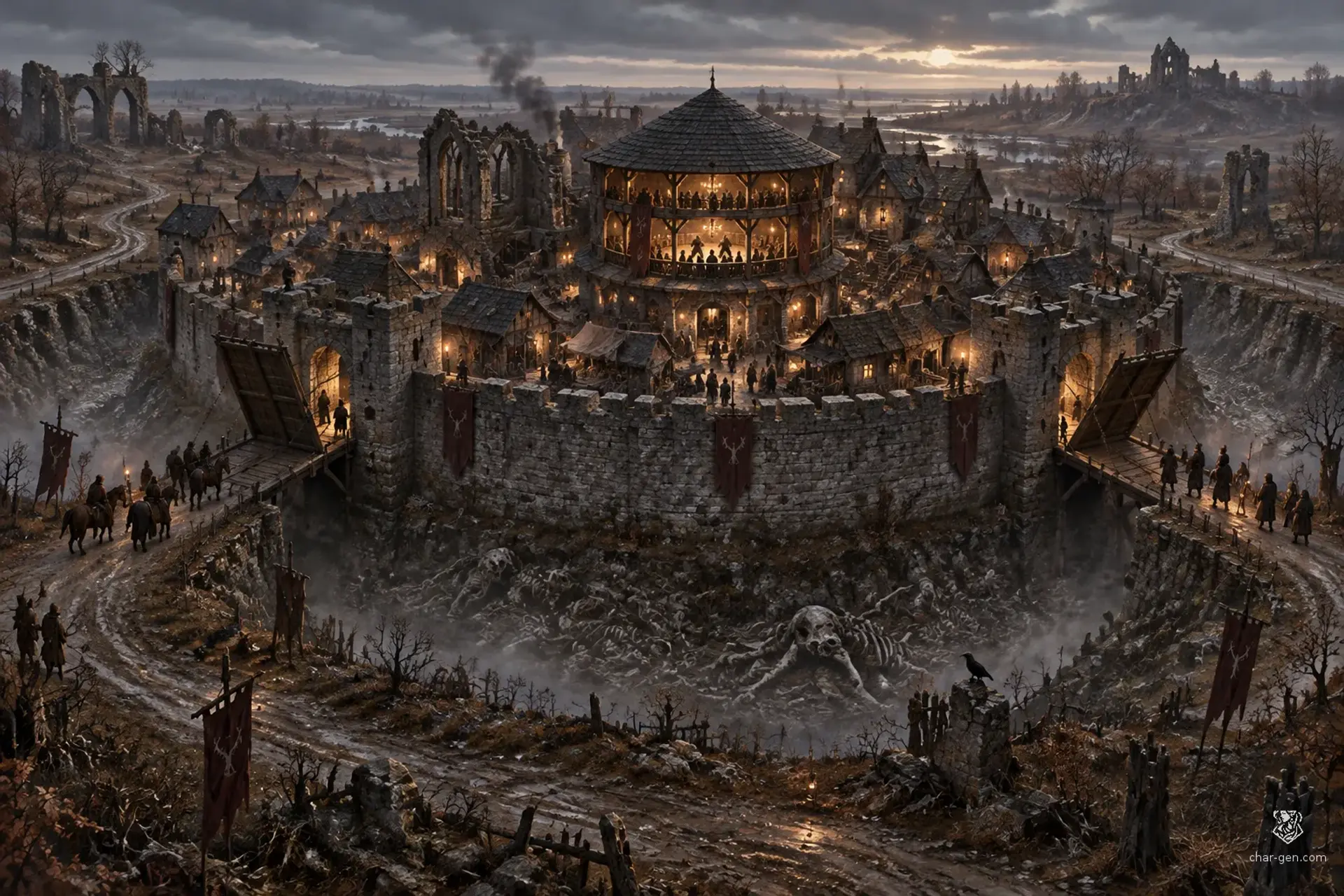
The tavern
The village stands at a crossroads where two trade roads meet on a low rise. Its round wall encloses close-packed homes and the busy three-story tavern, whose central fighting pit is visible from every gallery. The remains of older buildings surround the tavern and serve as rough lodging. Beyond the wall, dead bodies fill a broad pit. Trees nearby still carry leaves, though every leaf is brown and lifeless.
The tavern
- Population
- 430
- Rule
- Mayor Hessa Vale
- Wealth
- Poor overall
- Defence
- Low
Overview
The village stands at a crossroads where two trade roads meet on a low rise. Its round wall encloses close-packed homes and the busy three-story tavern, whose central fighting pit is visible from every gallery. The remains of older buildings surround the tavern and serve as rough lodging. Beyond the wall, dead bodies fill a broad pit. Trees nearby still carry leaves, though every leaf is brown and lifeless.
Atmosphere
At dusk, brown leaves scrape around the round wall while the two drawbridges clatter shut. The bone pit smells of wet chalk and old earth, and nobody here calls it a moat. Travelers crowd the three-story tavern built around its open fighting pit, where every floor can watch the bouts. The surrounding ruins offer beds under patched roofs. The village is busy, watchful, and quietly afraid of its own dead.
Culture
Ancestor veneration, The Hearth Mother
Humans, Dwarves, Halflings
Economy
Caravan services, Metal repair, Tavern lodging and bouts
- Repaired wagon fittings
- Road guides
- Fighting-bout wagers and services
Grain, Lamp oil, Iron tools, Fresh timber
Geography
Ways in and out
Places to see
- Bone PitA circular hollow filled with bones and broken grave markers surrounds the village wall. The dead trees lean over its edge, their brown leaves never falling completely. Some bones are visibly newer than the council claims, and the pit's bottom cannot be seen from the bridges.
- Turning StoneA wide clearing on the east road is the only place where caravans can turn their wagons around before approaching the bridge. Traders leave chalk marks on a standing stone to signal whether the road ahead is safe.
Power
3 factionsGovernment
Laws
Trouble
- Living villagers are being entered into the death ledger to control who may cross the bridges.The council's death ledger now lists living residents as dead. Hessa insists the entries are clerical errors, but the bridges have begun opening only after the listed people surrender their names and leave town. The Open Bridge League is preparing to challenge the law publicly, while the Bridge Watch has orders to stop anyone carrying a copy of the ledger.Involves
Hessa Vale, Sumi, Taro
- A bout injury threatens to turn a dispute over bridge access into a riot.A traveling fighter was badly injured in a bout, and the Ring Keepers claim the council barred the healer from reaching him. The council says the healer was crossing without proper papers. If the fighter dies, the crowd may attack the gatehouse; if he lives, he may reveal why the match was fixed.Involves
Riku, Hessa Vale, Sumi
Factions
- Ledger CouncilCivic authorityThe Ledger Council consists of the village's elected household heads, though its meetings are dominated by the mayor. It maintains the names of the dead and authorizes bridge openings. Its members claim the bones are the price of safety, a claim few residents can openly challenge.GoalsKeep the death ledger secret and preserve the rule that each bridge crossing requires a name entered among the dead.Allies
Bridge Watch
RivalsOpen Bridge League
- Open Bridge LeagueReform movementThe Open Bridge League includes caravan hands, traders, and residents with relatives beyond the wall. Its members believe the council's ledger is a tool for controlling movement, not a safeguard. They have begun quietly collecting testimony from families who lost people to the pit.GoalsExpose the ledger's purpose and abolish the rule that makes residents surrender a living name to cross the bridges.Allies
Traveling traders
RivalsLedger Council
- Ring KeepersTavern guildThe Ring Keepers run the tavern's bouts, manage wagers, and keep the crowds from spilling into the old ruins. They profit from the village's isolation but dislike the council's control of the bridges, which keeps fighters and customers from arriving freely.GoalsWin the right to open the bridges on bout nights without the council's approval.Allies
Traveling fighters
RivalsLedger Council
Defences
- A circular stone wall with two drawbridge entrances
- A bone-filled pit surrounding the wall
- A locked chain winch at each bridge
Law and order
People and places
9 entriesMayorHessa Vale Human Female
A human with silver hair pinned tightly behind her head, she taps a ring against the council table whenever someone disagrees. She wants the village to survive without admitting the ledger is failing, and fears that acknowledging the truth will bring the whole council down.
Caravan factorSumi Dwarf Female
A dwarf trader with a blue thread tied around one wrist, she wants families to travel freely between the roads. She fears that pushing too hard will make the council declare the League a threat and close both bridges.
HealerShin Human Female
A human healer with a shaved temple and a pouch of chalk, she wants the village's sick treated without bridge permissions. She fears that the council will make her choose between saving a patient and obeying its rules.
Fighter and bout organizerRiku Halfling Male
A halfling fighter with a flattened nose and a habit of rolling a coin across his knuckles, he wants to win one clean bout before his knees fail. He fears being made a spectacle by the council, which has been using his matches to distract the crowd.
SmithyRoundrise Ironwork Kept by NuraA narrow repair shop near the north gate, crowded with wagon rims, buckles, and bridge-chain links. The owner takes urgent work first, which often means the council's needs jump ahead of everyone else's.
General goodsCrossroad Stores Kept by JoriA cramped stall selling trail food, lamp oil, rope, and whatever the latest caravan brought. The shelves are arranged by road rather than by goods, making it easy to buy supplies for a particular journey.
TavernThe Roundhouse Kept by OhtoThe three-story building is hollow through its center, with galleries looking down into a fighting pit on the ground floor. The rooms and tables crowd the outer ring, while the ruin lodgings sit just beyond its walls. Every shout carries upward, and a private argument is rarely private for long.
FortificationNorth Gatehouse Run by TaroThis squat stone gatehouse controls the northern drawbridge and stores the watch's crossbows. Its walls predate the current village, and one sealed room contains old toll marks that do not match the council's history.
Travelers' lodgingThe Ruin Lodgings Run by Miko SadeA broken ring of stone rooms surrounds the tavern. The roofs are patched with boards and canvas, and travelers sleep in separate alcoves arranged by how long they intend to stay. Some walls are older than the village and bear faded marks resembling names.
Events
Lately
- Several living residents found their names in the council's death ledger.Families are hiding from the watch, and the Open Bridge League is gathering witnesses.
- A fighter was seriously injured during a heavily wagered bout.The tavern crowd is angry, and the next bout may draw more people than the watch can control.
Calendar
- First thawChainwashingResidents clean the drawbridge chains and lay flowers on the bone pit. The custom is presented as remembrance, but it also gives the council a chance to inspect names entered in the death ledger.The twist · GM only
- Midsummer, third nightThe Open RingA week of fighting bouts brings traders, wagers, and crowds to the hollow center of the tavern. The bridges stay open late, and the ruins fill with visitors sleeping beneath old stone arches.The twist · GM only
History
The village began as a practical stop on two roads and grew around a defensible rise. The bone pit and bridge rules came later, after sickness and political fear blurred together. The council's official history treats each restriction as a response to danger. Evidence in the surrounding ruins suggests that some dangers were invented after the restrictions were already in place.
- FoundingThe Ring on the RiseRoad merchants built a walled stop on the rise because it was the only dry ground where the two routes met. The first wall was a simple ring of timber, and the original name referred to the bare, round hill.
- The Fever YearsThe Bone DitchAfter a fever swept through the settlement, the dead were buried in a trench beyond the wall. Later accounts say the pit was filled to keep raiders from reaching the bridges. Older residents recall that the first bones were gathered from a battlefield miles away.
- Thirty years agoThe Closed BridgesThe council claims the bridges were first closed to stop a bandit army. A surviving toll sheet in the ruins shows the bridges were already shut for weeks before the supposed invasion, and lists payments to council members for keeping residents inside.
Secrets
2 secrets · 3 rumours- Secret 1 · GM only
- Secret 2 · GM only
Rumours
Plot hooks
3- 1A Name for the BridgeSumi asks the party to escort a family across the north bridge before the council can seize them. The crossing requires a name to be added to the death ledger. The family insists nobody should be sacrificed, but the bridge has begun refusing to lower until a name is offered.
Moral dilemma and investigation · Starts with Sumi · Reward: A trader's safe-conduct papers and a share of caravan earnings
- 2The Bout That Must Be LostRiku wants the party to find who arranged the fighter's injury and bring the proof to the crowd before the next bout. The culprit is not a council member but a League courier, who fixed the match to buy passage for a family listed as dead. Exposing the truth could save one fighter and ruin the League's public cause.
Conspiracy and public pressure · Starts with Riku · Reward: A purse from the bout wagers and a favor from the Ring Keepers
- 3The Old Toll SheetHessa asks the party to retrieve old toll records from the North Gatehouse before the Open Bridge League finds them. The records show the council profited from keeping residents inside, but also reveal that the bridges were raised to keep a fever outbreak from spreading. Destroying the evidence preserves order while leaving the current abuses untouched.
Investigation with competing claims · Starts with Hessa Vale · Reward: A lawful travel charter and access to the council's stores
Media
0 imagesNo images yet.
Turn The tavern into a sheet
A high-res, share-ready sheet you can post or print.
