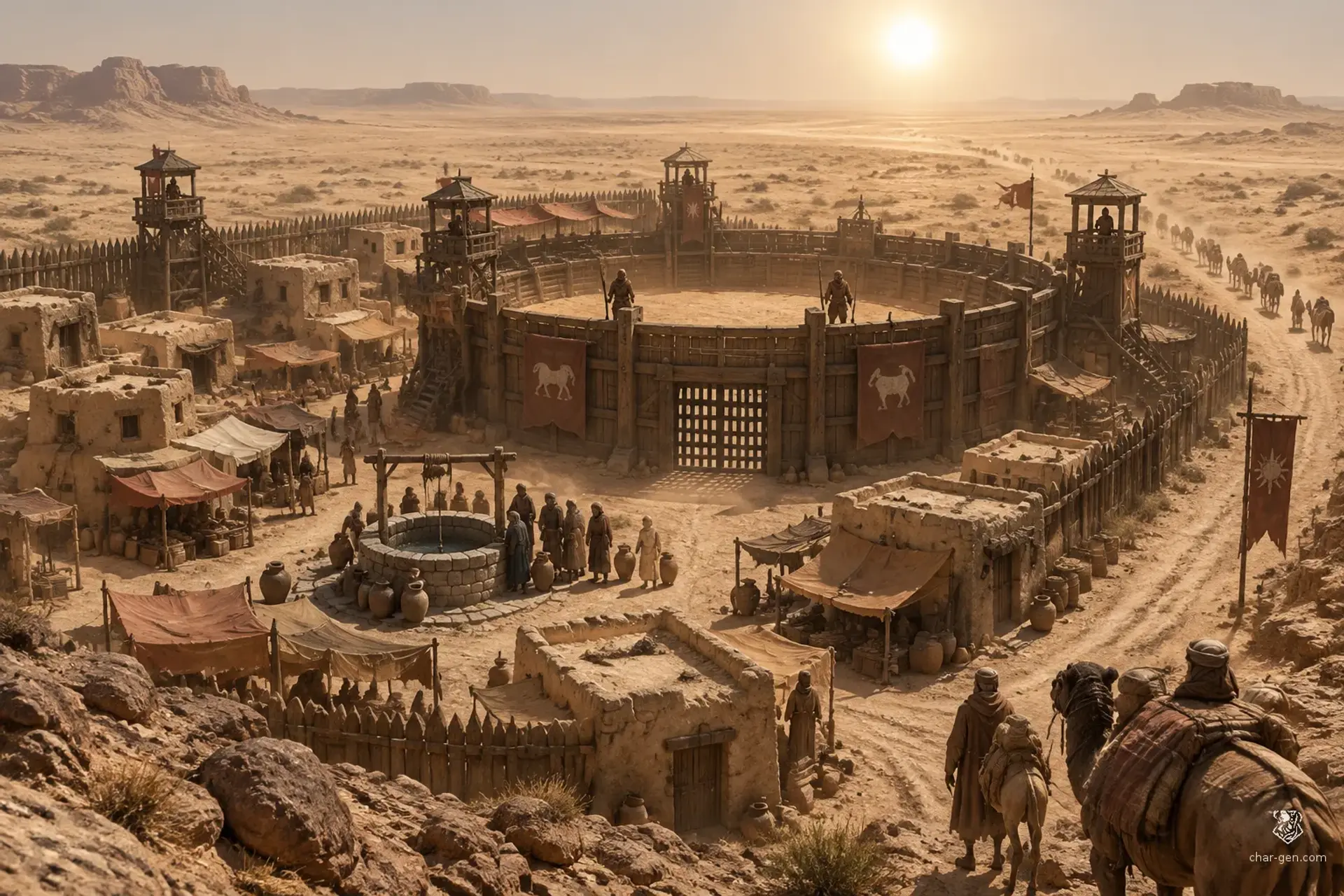
Slaver Arena
Dry Plank is a desert village built around a deep well and a central wood arena. The arena is kept in unnerving good repair, its rails scrubbed and its gates oiled, because it is both the town’s chief attraction and the captain’s instrument of rule. Captured people and creatures fight there for a promised freedom that is rarely simple. Merchants come for wagers and water; residents endure the trade because refusing the captain is dangerous.
Slaver Arena
- Population
- 430
- Rule
- Captain Geth Karr
- Wealth
- Poor for most residents
- Defence
- Captain’s Guard
Overview
Dry Plank is a desert village built around a deep well and a central wood arena. The arena is kept in unnerving good repair, its rails scrubbed and its gates oiled, because it is both the town’s chief attraction and the captain’s instrument of rule. Captured people and creatures fight there for a promised freedom that is rarely simple. Merchants come for wagers and water; residents endure the trade because refusing the captain is dangerous.
Atmosphere
At noon, the arena boards crack in the heat and the crowd keeps its shade while captives fight below. Dry Plank survives by selling water, wagers, and the promise that a victor can walk free. Everyone knows that promise has conditions. The town’s woodwork is carefully maintained, its wells closely watched, and its people speak softly whenever the slave captain’s riders pass.
Culture
- Oryx, worshiped by the captain and his officers
- Household ancestor rites practiced quietly by many residents
- Humans
- Orcs
- Dwarves
- Captured creatures of many kinds
Economy
Well keeping and water sales, Caravan repair, Arena bouts and betting
- Arena wagers and public bouts
- Caravan water
- Leather harness and repaired tack
Grain, Timber, Iron tools and weapons, Medicines
Geography
Ways in and out
Places to see
- The Deep WellThe well is ringed with stone brought from a distant ridge. Its shaded lip is polished by generations of water jars, while a locked iron grate protects the draw mechanism. A queue forms before sunrise. Guards record every household that fills a jar, and the people waiting can usually tell from the bucket’s sound whether the water level has fallen.
- The Plank ArenaThe arena is made from carefully fitted desert timber, with a broad fighting floor, high rails, and narrow gates that can be barred from outside. Scratched animals decorate the lower boards. The crowd sees them as decoration; captives sometimes use the carvings to mark safe hiding places or pass messages between bouts.
Power
2 factionsGovernment
Laws
Trouble
- The water ledger does not match the cistern.Water has been diverted from the public cistern to keep the arena’s captive pens supplied. The official ledger blames evaporation, but households are already receiving smaller shares. Captain Geth Karr fears admitting the diversion will make him look weak to Oryx, while the Wellkeepers’ Circle threatens to publish its own tally.Involves
Geth Karr, Tamsin Reed, Pell Vard
- A public victory is being erased from the record.A captive creature that won its bout has not been released, despite the crowd witnessing the victory. Tamsin Reed has hidden the signed bout record, and Geth Karr is searching for it. If the record surfaces, the arena crowd may demand a release the captain cannot grant without defying Oryx’s orders.Involves
Geth Karr, Tamsin Reed, Kest
Factions
- The Captain’s GuardMilitary authorityThe captain’s officers and their local informants enforce Oryx’s authority, collect a portion of wagers, and decide who may leave. They present the arena as a lawful trial rather than a market in captives. Their reach depends on controlling the well and on residents fearing punishment more than they resent the system.GoalsKeep the arena operating and preserve the rule that the captain alone decides what counts as freedom.Allies
Captain’s Guard
RivalsWellkeepers’ Circle
- Wellkeepers’ CircleCivic associationWell clerks, water haulers, and residents who manage the cisterns quietly share records and protect the village’s supply. They are not all abolitionists; some merely want the captain to stop diverting water to the arena. Their influence comes from knowing which households can survive a dry week and which cannot.GoalsMake water allocations public and prevent the captain from using the well to compel captives and residents.Allies
Several caravan households
RivalsThe Captain’s Guard
Defences
- A timber palisade surrounds the well and store yards, with gaps left for carts.
- The arena's high plank walls can be barred from outside.
- Two watch platforms overlook the road and the nearest dry wash.
Law and order
People and places
7 entriesArena sergeantKest Orc Male
A broad-shouldered orc with a shaved scalp and a leather tally strip tied at his wrist. He wants to prove that control of the arena keeps the village stable, but fears Oryx will blame him if the captives revolt. He privately respects a clean contest, which makes falsified bout results harder for him to ignore.
Arena clerkTamsin Reed Human Female
A human record keeper with ink-stained fingers and a habit of tapping twice before answering. She wants the public victory record restored, but fears that exposing the captain will cost her the only leverage she has. She remembers every fighter by name, an unusual kindness in a place where captives are commonly recorded as property.
Caravan brokerBryn Dwarf Male
A dwarf caravan broker whose beard is bound with plain cord instead of jewelry. He wants the village’s water trade to remain open to caravans, but fears the captain will close the road to hide the shortages. He speaks gently to frightened people and keeps a slate of debts that includes favors, not just coin.
Water haulerMair Human Female
A human water hauler with a sun-bleached scarf and a missing front tooth. She wants the concealed cistern opened to residents before the next hot spell, and fears a public revolt will leave the well guarded by Oryx’s harsher troops. She is brave in work and cautious in politics, hauling extra jars only when the watch changes.
General goods and repairHard Ground Goods Kept by EiraA shaded stall selling rope, jars, leather straps, and repaired caravan gear. The shelves are sparse, but the owner keeps a careful stock of water skins and knows which traders can be trusted. Captives are not allowed to shop here; Mair sometimes buys supplies for them using her own ration.
TavernThe Dry Turn Kept by DafyddA low room built around a shaded yard, with benches close enough that strangers hear one another’s business. The keeper serves small measures of drink and keeps a water bowl by the door for animals. People come after the arena bouts to argue over what they saw, then lower their voices when a guard enters.
Civic officeThe Well Office Run by Pell VardA low timber counting house beside the well, with a shaded porch where residents queue for their daily allotments. The ledgers are kept behind a barred inner door, and the Guard can watch the line from the arena wall. It is the only place where household water shares can be formally disputed, though decisions rarely favor anyone without influence.
Events
Lately
- The last public victor was not released, despite the crowd seeing the bout end.The arena’s promise of freedom is openly doubted, and Kest has been ordered to identify anyone spreading the signed result.
- Several households received smaller water shares after a cistern inspection.The Wellkeepers’ Circle is comparing private tallies, while Geth Karr has warned that unauthorized accounting is theft.
Calendar
- First cool evening after the hottest weekOpen BoutThe annual Open Bout fills the arena with local challengers and captives. The captain announces one guaranteed release, drawing wagers and desperate volunteers. Residents bring water to the fighting floor, where the crowd can see whether the victor is truly freed.The twist · GM only
- Last market day before the dry-season windThe Well ReckoningWater allotments are counted aloud at the well. The public tally usually settles arguments over use, but this year the numbers do not match the cistern marks. Anyone who questions the clerk risks losing their household’s allocation.The twist · GM only
History
Dry Plank began as a useful water stop and became valuable to Oryx’s realm because its well could support a garrison and its arena could display the captain’s power. The official story says the bouts offer captives a fair path to freedom. Residents remember a different origin: the first celebrated release covered an escape, and the promise was turned into policy afterward.
- Before Oryx’s ruleThe First DrawCaravan hands dug the well beside a stand of hard ground where carts could turn without sinking. Their first shelters became Dry Plank, and the well’s depth made the site a dependable stop between longer crossings.
- Early occupationThe Three BoutsThe captain’s predecessor built the arena from imported timber and announced that any captive who won three bouts could leave. Residents remember the first winner walking out. The official account says he was released as a reward; older water haulers say he escaped during a sandstorm and the captain needed a story to cover it.
- Current ruleThe New LedgerOryx’s officers appointed Geth Karr after the previous captain vanished. Karr restored the arena and tightened water rationing, claiming the village had grown wasteful. Since then, no recorded victor has received an unconditional release.
Secrets
2 secrets · 4 rumours- Secret 1 · GM only
- Secret 2 · GM only
Rumours
Plot hooks
3- 1The Missing WaterPell Vard asks the party to verify the cistern tally before the Guard confiscates his duplicate ledger. The figures point to the arena yard, where Mair knows the hidden intake lies. The water is real, but opening the cistern in public will leave the captive pens without supply and may trigger a dangerous uprising before anyone can organize it.
Investigation with a public-choice complication · Starts with Pell Vard · Reward: A caravan’s safe passage, water for the party, and access to the village’s trade contacts.
- 2A Victory on PaperTamsin Reed wants the party to retrieve a signed bout record before Geth Karr burns it. Kest can identify where it is hidden, but the document also proves the Guard quietly changed the terms of several earlier victories. Making it public could free one fighter while giving Oryx’s officers evidence to punish the whole village.
Political intrigue with a moral complication · Starts with Tamsin Reed · Reward: A release writ for one captive and a favor from the arena’s fighters.
- 3Two Names on the RoadBryn asks the party to escort two people carrying forged release papers to the southern road. One is a captive who won a bout; the other is a resident who forged the papers to save a family member. The captain’s patrol has already been told to search for only one fugitive, and the second person’s identity is being concealed by someone close to the Guard.
Escort and investigation · Starts with Bryn · Reward: A share of caravan goods and a guide through the dry wash.
Media
0 imagesNo images yet.
Turn Slaver Arena into a sheet
A high-res, share-ready sheet you can post or print.
