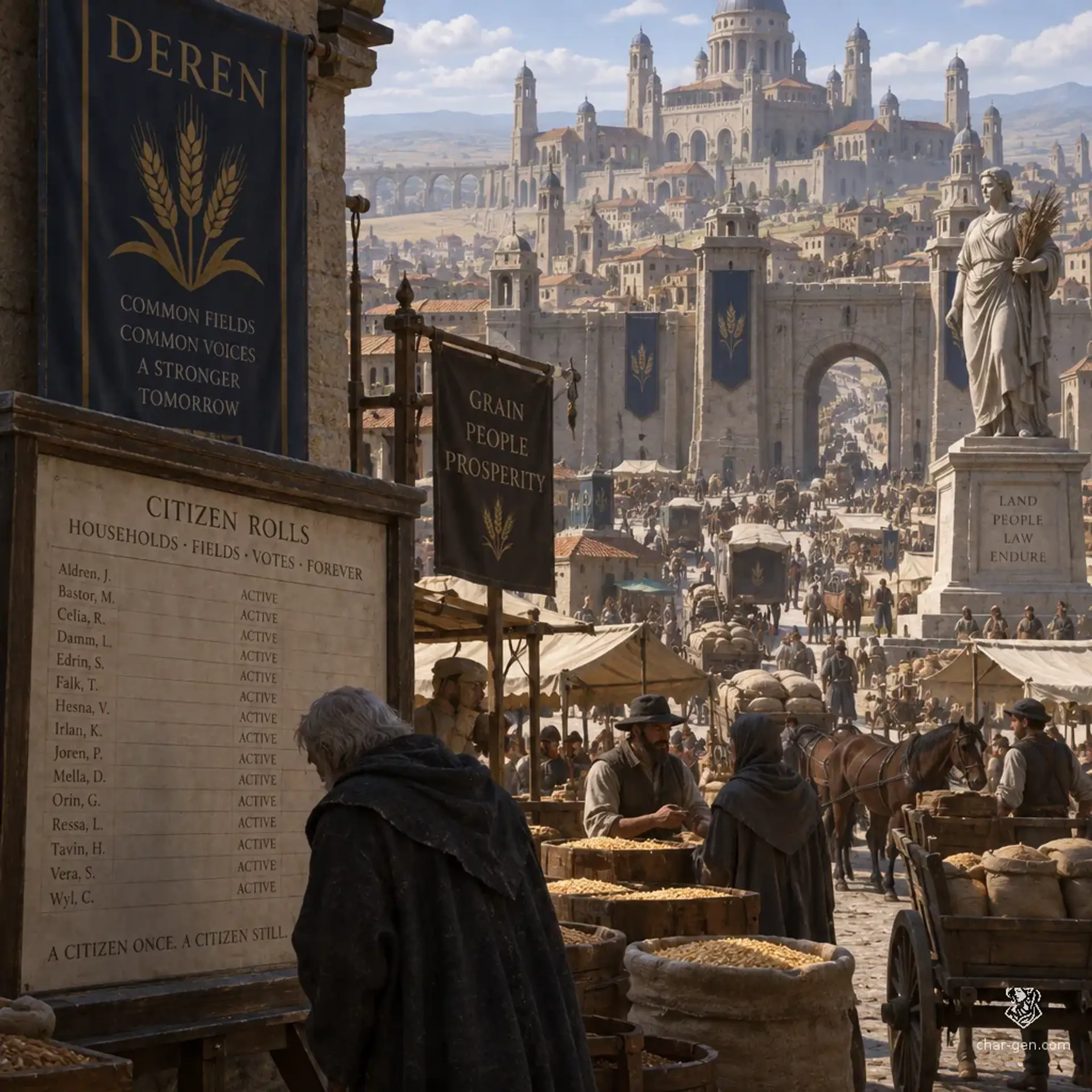
Deren
Deren is a sprawling plains metropolis whose grain markets, courts, and wagon yards draw people from a week of travel in every direction. Its founding charter gives every registered household a vote and a share in the common fields. The charter never says that a citizen's vote ends at death. Generations of officials have left deceased residents on the rolls, and the city now runs on a legal fiction everyone depends upon and no faction can safely expose.
Deren
- Population
- 48,000
- Rule
- Chief Magistrate Bence…
- Wealth
- Prosperous
- Defence
- The Gate Watch
Overview
Deren is a sprawling plains metropolis whose grain markets, courts, and wagon yards draw people from a week of travel in every direction. Its founding charter gives every registered household a vote and a share in the common fields. The charter never says that a citizen's vote ends at death. Generations of officials have left deceased residents on the rolls, and the city now runs on a legal fiction everyone depends upon and no faction can safely expose.
Atmosphere
At noon, clerks read names from brass-bound ledgers while grain carts queue outside the counting halls. The city is loud, prosperous, and careful about paperwork: a missing stamp can cost a family its home. Everyone knows the dead remain on the civic rolls, though people disagree about whether that is reverence, fraud, or simply how Deren keeps its charter. Street musicians play near the courts, but stop when the names are read.
Culture
Household ancestor rites, The Lantern Mother, The Open Hand
Humans, Dwarves, Halflings, Orcs, Elves
Economy
Grain storage and milling, Caravan trade, Textile production, Legal and clerical services
Grain, Flour, Wool cloth, Wagon parts
Timber, Iron, Salt, Fine dyes
Geography
Ways in and out
Places to see
- The First StakesA raised stone marker at the meeting of the old roads, scratched with survey marks attributed to Deren's forgotten first road crew.
- The High GrassA wind-scoured rise outside the west gate where caravans gather before entering the city and travelers can see the grain fields in every direction.
Power
3 factionsGovernment
Laws
Trouble
- A false grain count is becoming a real famine.The grain reserve is nearly empty, but the books show enough stock for another month because dead households retain their allotments. A public audit could prevent hunger, yet would expose how the council has maintained its majority.Involves
Bence Orvay, Kezia Noll, Oloya Saren
- Conflicting orders may trigger a street fight.Two ward captains have received contradictory militia orders, both bearing valid seals. One order places the Gate Watch around the archive; the other sends them to clear the grain market. Magistrate Orvay refuses to act until he knows which document is authentic.Involves
Bence Orvay, Drazek Varo
Factions
- The Charter KeepersPolitical and civicA circle of archive clerks and established landholders who insist the old charter must be interpreted as written, even when the records have become absurd.GoalsPreserve the civic rolls and the votes attached to them, preventing a new census from changing land shares or council seats.Allies
The Gate Watch
RivalsThe Open Ledger
- The Open LedgerReform movementA coalition of younger clerks, tenant farmers, and working families demanding a living census and public review of the city's grain accounts.GoalsRemove the dead from the rolls and redirect their recorded grain allotments to residents who are actually hungry.Allies
The Grain Court
RivalsThe Charter Keepers
- The Grain CourtCommercial associationWarehouse owners and contract brokers who profit from the current allocation system. Some are personally generous, but their books rely on the same disputed figures.GoalsKeep the grain allotment rules unchanged until the coming harvest, even if that means suppressing the current shortage.Allies
The Charter Keepers
RivalsThe Open Ledger
Defences
- A broad earthwork and timber palisade encloses the old city and its grain yards.
- Four stone gatehouses hold the main roads across the plains.
- The bell tower above the civic archive signals fire, attack, and an unscheduled Roll Reading.
Law and order
People and places
9 entriesTenant farmer and organizerOloya Saren Halfling Woman
A tenant organizer with a flour-white sleeve and a habit of tapping each doorframe before entering.
Watch captainDrazek Varo Orc Man
A broad-shouldered watch captain with a nicked ear and a whistle he turns over in his fingers.
Former market measurerPiroska Deme Human Woman
An elderly grain measurer with a silver cap on one tooth and a cloth-bound notebook tucked into her apron.
Council memberEzequiel Aponte Elf Man
A smooth-speaking councilor who wears a different colored glove on each hand and never sits with his back to a door.
StationerMera's Paper Room Kept by MeraA narrow shop of stacked ledgers, reed pens, wax, and cheap sealing clay. The owner keeps a bench outside for customers who cannot pay for a seat indoors and knows which clerks will accept a document without a fee.
SmithyKlak's Forge Kept by Klak VeszA wagon-yard smithy where spare axles, hinges, nails, and simple tools hang beside the forge. The place is always busy before dawn, when caravans want repairs without paying the day's full rate.
TavernThe Old Marker Kept by SefuA long, low taproom built from reused wagon boards, with a stable yard out back and a chalkboard listing road conditions. Conversation stays easy until someone mentions the grain count, then the room tends to divide by ward.
Civic archiveThe Civic Archive Run by Kezia NollA low, sprawling records hall of patched stone and timber, with a public chamber, sealed vaults, and a roof full of pigeon nests. Residents come here to register births, challenge allotments, or find out whether the city considers a relative alive.
Market hallThe Grain Court Run by Gorven TuskA broad roofed market hall where grain contracts are weighed and witnessed. Farmers can dispute measures here, but the official scales belong to the council and are guarded whenever prices rise.
Events
Lately
- A public grain measure showed less than half the reserve recorded in the council books.Families have begun buying flour in small amounts, while the council insists the shortage is temporary.
- A list of names was found pasted inside a watch post, each marked for a militia call-up.Several listed citizens have been dead for decades, and the discovery has made the roll dispute impossible to ignore.
Calendar
- First day of FloodwaneThe CountingThe annual Roll Reading gives every registered household a chance to challenge a death, birth, or change of address before the city magistrates.The twist · GM only
- Last market day of GrainwaneSack MeasureCarters and farmers bargain over next season's storage fees in the open square, with the largest contracts witnessed by the grain court.The twist · GM only
History
Deren grew where reliable wells, high ground, and intersecting caravan roads made a permanent market possible. Its charter turned household registration into a source of land, grain, and political power. When famine and war damaged the archive, officials preserved the roll rather than admit how much had been lost. The dead began to remain citizens by omission. Every council since has inherited the convenience, the fraud, and the danger.
- FoundingThe First StakesThe first caravan yard and wells were established beside a reliable spring on the rise above the plain. Later settlers named the place for Deren, a surveyor whose practical road markers outlasted his office.
- Charter yearsThe Household CompactThe city charter promised each registered household a voice and a portion of common land. The charter's authors did not define how a household ceased to exist, and later councils found that ambiguity useful.
- The Lean YearsThe Archive FireThe official account says a fire destroyed the old census during a siege, forcing clerks to rebuild it from memory. A surviving baker's ledger suggests the archive was burned deliberately after officials removed living tenants from disputed plots.
Secrets
2 secrets · 4 rumours- Secret 1 · GM only
- Secret 2 · GM only
Rumours
Plot hooks
3- 1The Missing MeasureOloya Saren asks the party to escort her and three families to the archive with proof that their grain allotments have been diverted. The documents are genuine, but one family has knowingly used a dead relative's name to keep its home. A public hearing could expose the fraud and evict the very people Oloya means to help.
Investigation and social conflict · Starts with Oloya Saren · Reward: A share of recovered grain, lodging in the tenant ward, and the families' lasting trust.
- 2Two Seals, One StreetDrazek Varo needs help identifying who issued two sealed orders before rival watch units meet at the market. The trail leads through clerks, council offices, and a family using a deceased member's vote. The orders are not forgeries: both were lawfully signed under separate emergency powers, and choosing either one will leave another district unguarded.
Political intrigue · Starts with Drazek Varo · Reward: A formal favor from the Gate Watch and access to restricted city streets.
- 3What the Fire MissedKezia Noll asks the party to retrieve a ledger rumored to have survived the Archive Fire, hidden in a warehouse slated for demolition. The ledger could prove that the census was deliberately altered. Its final pages also show that several current reformers' families benefited from the same fraud, giving the Charter Keepers an effective weapon if the evidence is released.
Investigation with a moral choice · Starts with Kezia Noll · Reward: Access to sealed records and a written claim to any lawful property recovered from the investigation.
Media
0 imagesNo images yet.
Turn Deren into a sheet
A high-res, share-ready sheet you can post or print.
