West Notch
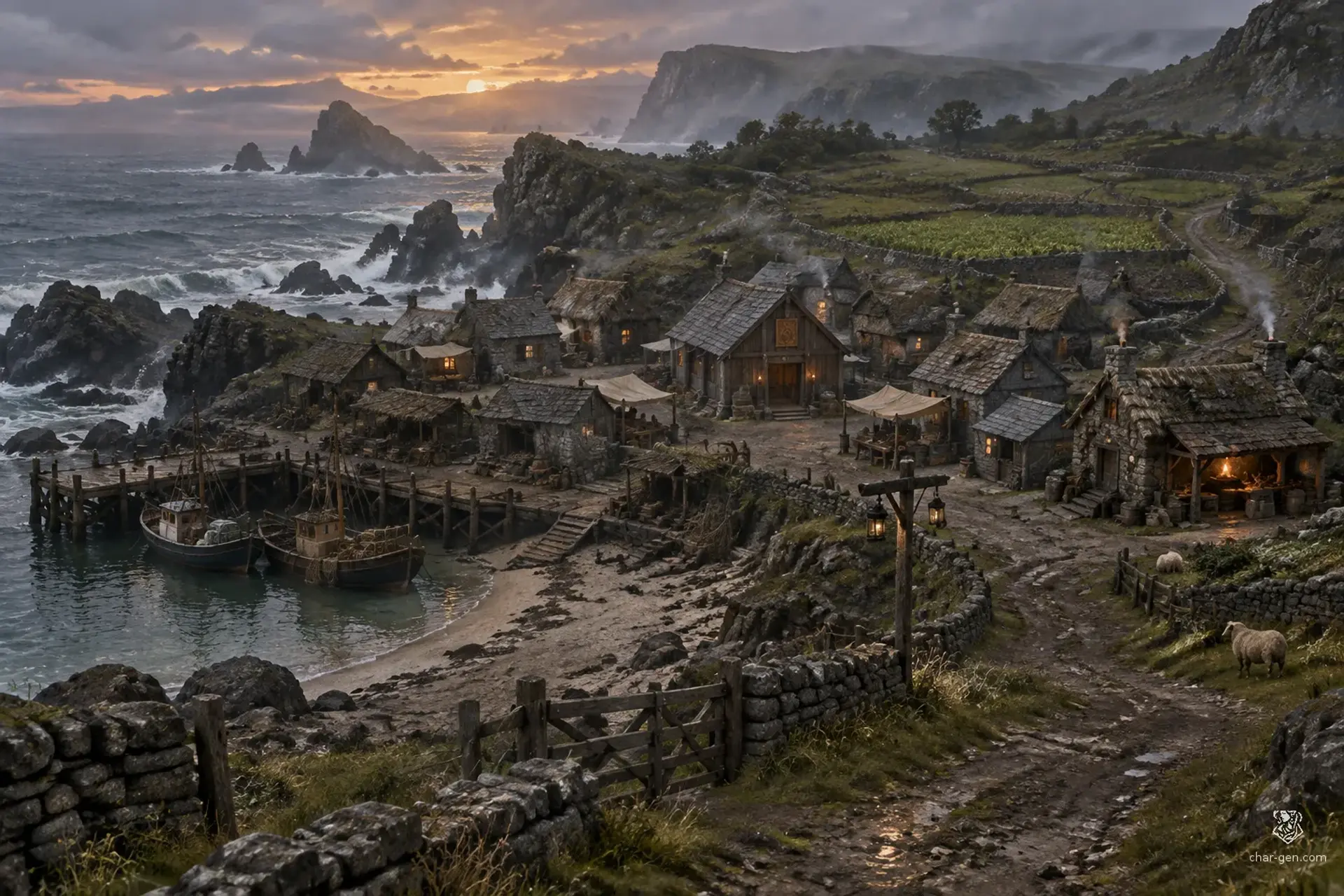
A small coastal hamlet sits where a patch of workable ground meets a west-facing shore of uneven rock and narrow sand. Its dock holds only two medium fishing boats, so the village’s livelihood depends on weather, careful repairs, and an orderly sailing schedule. The town hall and produce stands occupy the center; a blacksmith, small armory, and tavern serve the surrounding homes. Three farms mark the outskirts, set back from salt spray.
West Notch
- Population
- About eighty…
- Rule
- Council speaker Heddan…
- Wealth
- Poor
- Defence
- Low
Overview
A small coastal hamlet sits where a patch of workable ground meets a west-facing shore of uneven rock and narrow sand. Its dock holds only two medium fishing boats, so the village’s livelihood depends on weather, careful repairs, and an orderly sailing schedule. The town hall and produce stands occupy the center; a blacksmith, small armory, and tavern serve the surrounding homes. Three farms mark the outskirts, set back from salt spray.
Atmosphere
The hamlet smells of wet stone, fish scales, and woodsmoke. People watch the western water while pretending to listen at the market stands. Two boats fit the dock, so the town hall’s tide ledger decides who sails and who waits; its marks are treated like law, though nobody agrees what the oldest marks mean. Evenings are sociable but careful. A disagreement over a line in the ledger can empty a tavern table in moments.
Culture
- Household offerings to sea and weather spirits
- A small local practice of honoring ancestors at the shore
Humans, Halflings, Dwarves
Economy
Coastal fishing, Small-scale farming, Net repair and smithing
Salted fish, Dried seaweed, Root vegetables
Iron bars and tools, Grain, Lamp oil
Geography
Ways in and out
Places to see
- The West NotchA narrow western notch between shelves of dark rock shelters the village’s two fishing boats. At low tide, a strip of sand appears beside the landing, crowded with repair timber and drying nets. The water changes quickly here, and locals read the swell before they look at the sky. Scratches on the rock mark past high tides, though the oldest marks are disputed.
- The Three FieldsThree small farms lie beyond the last homes, where the soil is less salty and a low rise breaks the worst of the wind. Their fields grow hardy vegetables and a little grain, with shared fences patched from whatever timber can be spared. A footpath joins them to the market stands. In a poor season, these plots are the difference between buying imported food and going hungry.
Power
2 factionsGovernment
Laws
Trouble
- A disputed ledger entry may decide who gets the next safe sailing window.Two crews say the ledger was altered before the next fishing season. Heddan Pike wants to postpone a hearing until after the first catch, but a delay would effectively deny one crew its turn. Nessa Oru has found signs of scraping on the oldest page, while Bera Sile fears that open accusations will split the village before the weather improves.Involves
Heddan Pike, Nessa Oru, Bera Sile
- The hamlet’s already thin defenses are weaker than the council admits.The armory’s stores are short, and Tovin Bell has been asked to keep the shortage quiet until replacement supplies arrive. He has no proof that anyone took the missing bolts, but the timing coincides with a night when the town hall records were accessible. If the council announces the shortage, residents may demand that the dock schedule be suspended until the shore watch is better equipped.Involves
Tovin Bell, Heddan Pike
Factions
- The Ledger KeepersCivic associationThe Ledger Keepers are a loose group of households who maintain the town hall’s fishing order and defend its authority. Their records help prevent dangerous crowding at the tiny dock, and their members genuinely fear that abandoning the schedule will bring injury and hunger. Some, however, use its inherited claims to secure first sailing rights for their kin.GoalsPreserve the existing tide ledger and keep fishing access assigned by its inherited marks.Allies
Heddan Pike, Bera Sile
RivalsThe Open Dock
- The Open DockReform coalitionThe Open Dock is a small coalition of crews and farm families who want the sailing order decided publicly, season by season. They are not careless about safety; several members have lost relatives to rough water. They believe the old ledger gives advantage to families whose original claims may be false, and they want its evidence examined before another season begins.GoalsReplace inherited dock priority with a public draw and shared review of the ledger’s original claim.Allies
Nessa Oru, Tovin Bell
RivalsThe Ledger Keepers
Defences
- No walls; the rocky shore and narrow approach from inland offer limited natural obstacles.
- A bell and signal pole beside the town hall warn of danger from the water.
- The armory keeps a few shields, spears, and crossbows for emergencies.
Law and order
People and places
8 entriesCouncil speaker and former boatmanHeddan Pike Human Man
The council speaker is an experienced boatman who knows the sheltered notch better than most residents. Heddan wants the next fishing season to begin without a public quarrel, and fears losing the trust that lets him lead. He rubs a thumb over a pale scar on his jaw whenever the ledger is questioned. His habit of postponing hard decisions has become a problem in its own right.
FarmerDael Halfling Nonbinary
A farmer from the inland edge of the hamlet, Dael grows onions, beans, and hardy greens on a small family plot. Dael wants a fair share of the dock’s limited access for the family’s occasional fishing work, and fears a failed harvest that leaves them dependent on others. He presses a thumb into the soil while listening, even at the town hall. He supports reform but dislikes being treated as its public face.
Retired clerkSiofa Human Woman
A retired clerk who once maintained the town hall records, Siofa remembers older forms of the sailing order. She wants the village to admit that tradition changed over time, and fears that people will mistake uncertainty for proof of a conspiracy. She speaks softly, then repeats important words with careful emphasis. Her old ink-stained cuffs are still mended with thread from the hall’s supply cupboard.
Produce marketThe Market Stands Kept by Nessa OruA short row of tables stands beside the town hall, sheltered by patched awnings and weighted with stones against the wind. Nessa sells vegetables from the farms and knows which households are running low before they ask. She wants the stands to remain a place where people can bargain without being watched by the council, and fears that the ledger dispute will make neighbors refuse one another’s produce.
TavernThe Rock and Sand Kept by OshaA low-ceilinged room with a hearth and benches, built close enough to the shore that wet coats steam by the door. People come for a hot meal as much as a drink, and the keeper serves the late returning crews first when the weather has been rough. She wants the room to stay open to everyone, and fears the ledger dispute will turn a shared table into rival camps.
Town hallThe Notch Hall Run by Bera SileA plain timber building near the settlement’s center, with a broad table, tide charts, and the ledger kept in a locked chest. Residents gather here for disputes, seasonal announcements, and the council’s unhurried meetings. Its west window faces the dock, making it easy to check the sea and harder to ignore who is waiting for a berth. The building has no grand seal, only a carved notch in its doorframe.
BlacksmithThe Split Rock Forge Run by Iri TalA squat stone-and-timber forge sits close enough to the shore for smiths to repair boat fittings without carrying them far. Its bellows are patched and its workbench is crowded with nails, hooks, and bent tools awaiting a second life. People bring their own scrap when they can. The smith’s work is dependable, though new iron is scarce and jobs are scheduled around urgent repairs to the dock.
ArmoryThe Low Shelf Run by Tovin BellThe armory is a narrow storehouse near the inland track, kept dry with raised shelves and a slate inventory board. It has no guardroom and no formal garrison, only equipment set aside for a warning bell or a dangerous landing. Its modest contents are a reminder that this is a working village, not a fortified town. Residents know the door, but few know how much is actually inside.
Events
Lately
- The town hall posted a revised sailing order, moving one crew below the usual turn.The Ledger Keepers say the change follows old precedent; the Open Dock has begun asking residents to inspect the records.
- A squall tore boards from the outer edge of the dock.The boats can still land, but repairs will consume scarce iron and make the two-berth limit tighter.
Calendar
- First low tide after the spring equinoxThe Seed MeasureThe three farm families bring seed, onions, and last winter’s stores to the stands beside the town hall. Neighbors settle small debts and trade labor before planting. The ledger keeper also reads the next month’s fishing order aloud, a ceremony people claim is merely practical. This year, two households insist their names were moved, and both have brought witnesses.The twist · GM only
- Last calm evening before midsummerThe Net SupperFishing crews mend nets along the rocky shore and share a meal at the tavern. The custom began as a memorial for people lost in a storm, but it now doubles as the one night when crews can ask for changes to the sailing order in public. The town hall clerk attends, though she says she is there only to listen.The twist · GM only
History
The village began because a sheltered notch offered the coast’s rare safe place to haul boats, with fields nearby enough to support a few farms. Its tide ledger began as a practical turn-taking list. Over time, a claim connected to an offshore wreck was treated as a founding right, and the council built its authority around that interpretation. The official story is neat; the memories people pass over at supper are not.
- Founding yearsThe First BerthsThe first households settled around the sheltered notch, where boats could be hauled above the tide and the inland ground could support three small farms. A shared list of turns kept crews from fighting over the only usable landing. The present town hall stands near the spot where that first list was reportedly kept, though nobody can say who wrote it.
- Several generations agoThe Wreck ClaimA storm wrecked a vessel offshore. The official account says its surviving passengers gave the hamlet a claim to their cargo in return for rescue. Older residents remember that the survivors were already dead when the first boats reached the wreck, and that the ledger’s oldest sailing marks were copied from a salvaged chest.
- Two generations agoThe Dock RebuiltAfter a winter of poor catches, residents rebuilt the dock together and agreed to preserve a two-boat limit. The council later cited this compromise as proof that the ledger was always intended to assign permanent family rights. The original agreement, according to a retired clerk, only set a temporary order for that winter.
Secrets
2 secrets · 3 rumours- Secret 1 · GM only
- Secret 2 · GM only
Rumours
Plot hooks
3- 1The Mark in the LedgerNessa Oru asks the party to witness a public examination of the tide ledger and keep the meeting from being derailed. She wants a fair hearing, not a riot. The hidden complication is that the page appears to have been altered, but the marks may be repairs made after seawater damage. A careless accusation could strip a household of its only livelihood before anyone finds the original record.
Investigation and civic dispute · Starts with Nessa Oru · Reward: A share of the next safe catch, local favors, and access to the council’s records.
- 2The Mooring GivesA sudden squall damages a boat at the dock, and Heddan Pike needs help bringing its crew ashore before the tide turns. The party discovers that the armory is short of bolts and the dock’s emergency mooring has been cut. Tovin Bell fears blame, while Iri Tal insists the damaged fitting was weakened long before the storm. Finding who is responsible will mean deciding whether the village needs a culprit or a repair plan first.
Rescue and investigation · Starts with Heddan Pike · Reward: A repaired piece of equipment, a modest payment, and the gratitude of the rescued crew.
- 3What the Tide LeftDael asks the party to search a stretch of shore after finding a weatherproof scrap with a mark matching the old ledger. The scrap may lead to evidence from the wreck claim, but it is also being sought by a household that fears losing its inherited dock turn. The hidden complication is that the nearby wreck site is unstable and still contains a sealed cargo chest. Bringing it back could strengthen the old claim rather than disprove it.
Shore exploration and social dilemma · Starts with Dael · Reward: Fresh produce, a share of recovered goods if the council permits it, and a credible voice in the village dispute.
Media
0 imagesNo images yet.
Turn West Notch into a sheet
A high-res, share-ready sheet you can post or print.
