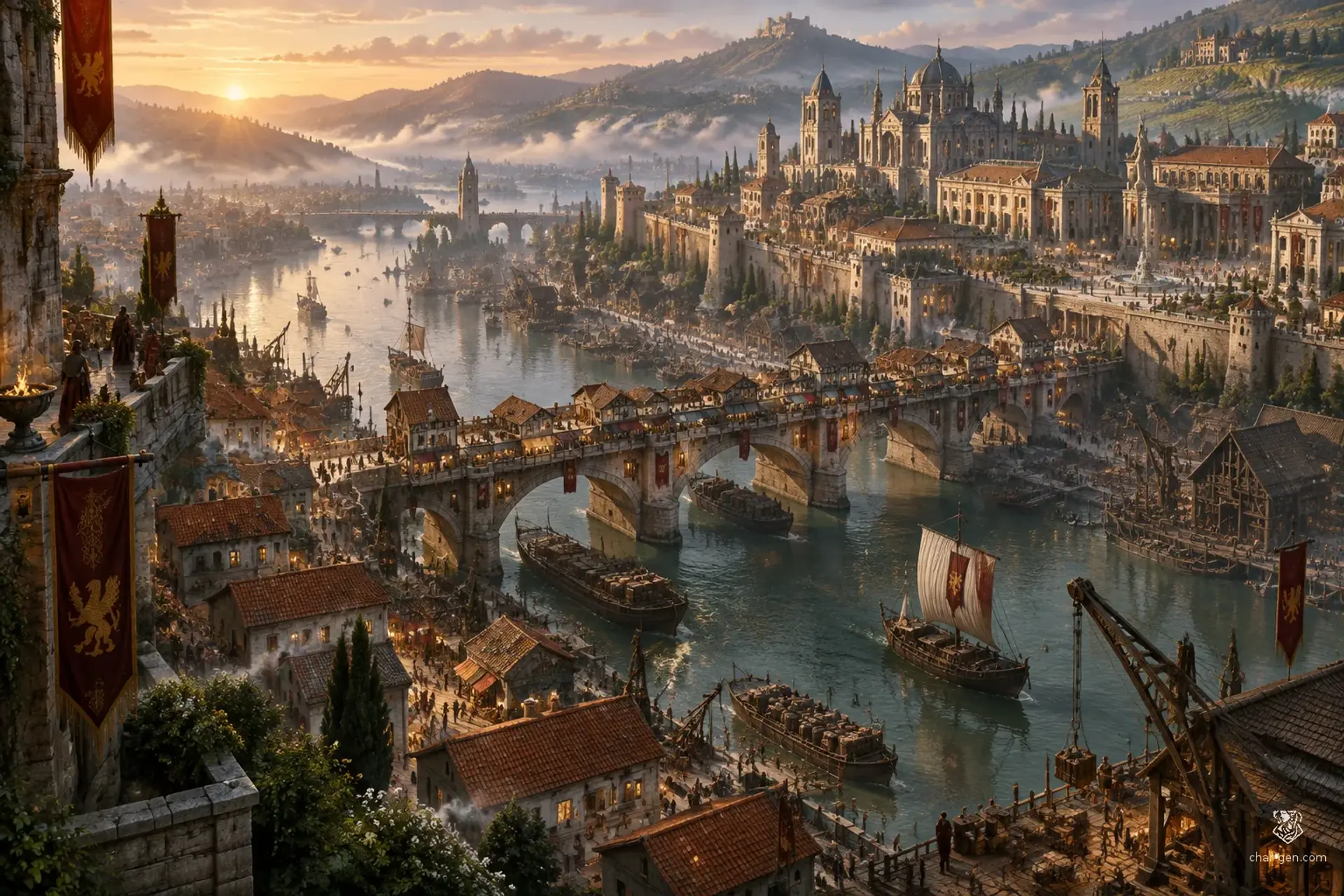
The city
The city is an independent merchant republic built on both banks of a broad, slow river that carries ships down to the sea. Its bridge is lined with shops and crowded with carriers, clerks, and messengers. Ancient walls enclose old streets, red roofs, limestone facades, and fortified family towers. Beyond them, vineyards, orchards, and farms climb prosperous hills. Wealth is visible everywhere, but so is the labor that maintains it.
The city
- Population
- Large
- Rule
- Chief Magistrate Aven…
- Wealth
- Exceptionally wealthy…
- Defence
- The Civic Watch
Overview
The city is an independent merchant republic built on both banks of a broad, slow river that carries ships down to the sea. Its bridge is lined with shops and crowded with carriers, clerks, and messengers. Ancient walls enclose old streets, red roofs, limestone facades, and fortified family towers. Beyond them, vineyards, orchards, and farms climb prosperous hills. Wealth is visible everywhere, but so is the labor that maintains it.
Atmosphere
The city smells of river mud, hot bread, lamp oil, and dyed wool. Bells mark the hours over the clatter of cranes, while barges queue beneath the bridge and clerks argue over cargo seals. In the bright districts, continual magic keeps fountains clear and silk colors true. A few streets away, workers climb unlit stairs to crowded rooms. Everyone knows the city is beautiful; nobody agrees who gets to keep it that way.
Culture
- Several established temples and cathedrals with distinct local traditions
- Household devotions brought by visiting merchants
- No single faith or pantheon governs the city
- Humans
- Dwarves
- Elves
- Halflings
- Gnomes
- Other travelers and residents
Economy
- International river and maritime trade
- Banking and wartime lending
- Cargo insurance and customs brokerage
- Textiles, fine silks, and clothing
- Shipbuilding, art patronage, and magical scholarship
- Fine wool and dyed silk
- Jewelry and worked precious metals
- Paintings, sculpture, and printed books
- Ship fittings and river craft
- Loans, insurance, and financial services
- Grain and timber
- Spices, dyes, and luxury goods
- Metals and finished tools
- Foreign books, relics, and scholarly materials
- Sailors, seasonal laborers, and mercenary companies
Geography
Ways in and out
Places to see
- The Shop BridgeThe main bridge carries shops, shrines, counting rooms, and a constant stream of carts. Its central span offers a clear view of both harbors, but the narrow shop fronts make passage slow. At dusk, richer businesses light their signs with licensed magic while poorer stalls rely on oil lamps.
- The Measure PlazaA marble plaza with a public fountain, surrounded by old family towers and newer merchant residences. Council proclamations are read here, and disputes often begin before the speaker reaches the final sentence. The fountain's clean water is a civic pride and a quiet reminder of who pays for the pipes.
- The Lower QuaysThe crowded lower quays hold cranes, ropewalks, shipyards, warehouses, and customs sheds. Dock crews can identify ships by the creak of their rigging. Smugglers use legitimate cargo traffic as cover, while watch officers favor inspections that inconvenience competitors of their patrons.
- The Hill RoadThe ancient wall road climbs past vineyards and orchard gates, then turns toward farms that supply the city. Carters bring produce through the gates before dawn. The hills look peaceful from the rooftops, but landowners argue over water rights and the ever-growing demand for warehouses.
Power
3 factionsGovernment
Laws
Trouble
- A concealed lending arrangement is about to become a public political crisis.Aven must decide whether to publish a disputed loan ledger before the next council vote. The book suggests the city has quietly financed both sides of a foreign war, and its release could trigger bank runs, expose illegal magical fees, or give one faction leverage over the others. Aven wants a clean record; he fears the panic that honesty might cause.Involves
Aven Orti, Brannik Vero, Coris Dema
- A dangerous undercity inspection is stalled by rival claims of safety and authority.The council has ordered an inspection of the old watercourses beneath the eastern bank after a sinkhole swallowed a cart. The Bellward Chapter claims the tunnels are unsafe and consecrated; guild crews say the closure is being used to protect private access. Each day of delay risks another collapse, while opening the passages may reveal why the river toll accounts include repairs to a route no one admits exists.Involves
Dema Varo, Aven Orti
Factions
- The Ledger HousesBanking and merchant allianceA loose alliance of major lenders, cargo insurers, and merchant families. Its members do not always trust one another, but they coordinate when a council vote threatens credit, shipping privileges, or repayment of foreign loans. Their counting rooms are more influential than their public speeches, and their servants often know a ship's destination before its captain does.GoalsKeep the river tolls predictable and preserve the hidden double-book system that lets the city lend to opposing foreign powers without public scrutiny.Allies
The Council of Measures
RivalsThe Open Seal Guilds
- The Open Seal GuildsGuild coalitionTextile workers, printers, shipwrights, and smaller traders who object to magical licensing being administered by wealthy patrons. They are not united on every issue: some want cheaper permits, while others want the licensed system abolished. They can turn out crowds, slow production, and make a council session impossible to ignore.GoalsOpen spell permits and customs records to public review, directly challenging the Ledger Houses' control of finance and the council's privileged licensing process.Allies
- Several neighborhood guild lodges
RivalsThe Ledger Houses, The Bellward Chapter
- The Bellward ChapterReligious and civic institutionSenior religious officials who oversee charitable stores, burial grounds, bells, and the civic licenses for certain magical practices. Their houses provide education and relief, but they also guard access to old foundations below the city. Their public arguments concern safety and moral duty; their private concern is whether buried passages can be controlled without exposing old institutional bargains.GoalsRetain authority over licensed magic and prevent the Open Seal Guilds from opening sealed undercity routes to public inspection.Allies
The Ledger Houses
RivalsThe Open Seal Guilds
Defences
- Ancient stone walls enclose the oldest districts and connect to newer gates on the hill roads.
- Chains can be raised across selected harbor channels, though they inconvenience lawful shipping as readily as hostile vessels.
- Fortified family towers overlook narrow streets and the bridge approaches.
- Riverside watch posts signal with bells and colored lamps.
Law and order
People and places
9 entriesSenior partner in a banking houseBrannik Vero Dwarf Male
Brannik never sits with his back to a door and carries an old brass tally token from his first dock job. He wants the Ledger Houses to keep lending to both sides of the war until the city can collect its debts. He fears that the public will learn how much risk rests on ordinary cargo deposits. His manner is blunt, but his arithmetic is rarely wrong.
Licensed architect and surveyorDema Varo Halfling Female
Dema wears a copper key on a cord and taps walls with the end of her walking stick. She wants the old watercourses opened and mapped before another street collapses. She fears the Bellward Chapter will have her arrested for trespass, and that the tunnels contain proof of her family's involvement in sealing them. She trusts measurements more than official assurances.
Printer and guild organizerEttan Gnome Male
Ettan wears a square of blue cloth in his lapel, the old sign of a printer's apprentice. He wants small guilds to see the licensing books and make their own case in council. He fears that wealthy patrons will destroy the printing presses before the next public vote. He jokes when anxious, but carefully records who buys paper, ink, and silence.
Senior religious officialFylia Sern Human Female
Fylia wears a plain iron bell on a chain and rings it once before refusing a request. She wants the Chapter to retain control of dangerous underground routes and magical practice. She fears that opening the tunnels will expose graves and old bargains that the faithful have kept quiet for generations. Her charity kitchens are well run, and she insists that public service is not a confession.
Stationer and printing suppliesEdda's Paper Room Kept by EddaA narrow shop on the bridge sells ink, paper, seals, and small printing jobs to merchants who need a contract copied quickly. Its shelves are arranged by paper weight rather than price, and the counter has a hidden slot for confidential work. Edda keeps the shop respectable in public and quietly supports printers who cannot afford a license.
JewelerFenn's Brass and Silver Kept by FennThe workshop displays rings, brooches, and small devotional pieces in a bright front window, while the back room handles repairs and discreet valuations. Customers include foreign captains, wedding parties, and families settling inheritances. Fenn prefers to work from a clear sketch and a clear account of ownership. He does not ask where an heirloom came from unless its weight does not match its story.
TavernThe Net and Ledger Kept by GallaA noisy riverside house where the floor is sanded each morning and the windows are kept open even in cold weather. Crews leave chalk marks beside their names on a departure board, and nobody is asked to sing unless they first buy a round for the table. Galla uses the room to connect sailors with missing work and families with news from upriver.
Government hallThe Hall of Two Banks Run by Aven OrtiThe civic hall occupies a broad plaza between the river approaches. Its public rooms are stone and orderly; its back stairs are crowded with petitioners, messengers, and servants carrying sealed notes. The council chamber has windows on both banks, an architectural claim that the republic speaks for the whole city. In practice, people who can pay for a private audience rarely wait in the public queue.
CollegeThe College of Measures Run by Coris DemaThe library and lecture rooms stand within sight of the busier customhouses, but their courtyards are quiet enough for careful experiments. Scholars study navigation, healing, languages, and the magical preservation of cargo. A public board lists licensed practitioners and approved fees. The names are often out of date, which is convenient for patrons who want an expert without a permit and inconvenient for anyone injured by one.
Events
Lately
- A sinkhole opened in an eastern street after heavy rain, revealing worked stone below the foundations.The council has delayed construction permits nearby while the Chapter and guilds dispute who may inspect the passage.
- A foreign ruler missed a repayment date on a large wartime loan.Merchant houses have tightened credit for smaller shippers, and the council fears a rush to withdraw deposits.
- Several licensed magical lamps failed in a wealthy district on the same evening.The licensing office blames poor maintenance; guild printers claim the failures followed a test of a new unregistered spell.
Calendar
- First week of springThe Opening of AccountsThe council publicly opens the river toll accounts, and guild delegations fill the plaza to dispute what each bank owes. The ceremony includes bread, bells, and a formal reading of last year's ship losses. Poor families watch the figures closely because toll changes reach the price of grain within days.The twist · GM only
- MidsummerThe River Cloth FestivalHouseholds hang colored cloth between windows, and neighborhood choirs compete from balconies on both riverbanks. Wealthy patrons hire musicians and illuminate their courtyards with licensed light spells. The celebration is meant to honor safe passage on the river, but its practical purpose is also to remind crews that the city can reward or refuse their next berth.The twist · GM only
- Last market day of autumnThe Cloth MeasureThe textile guilds display their finest bolts in public, then auction short-term contracts for winter work. Apprentices, buyers, and household agents crowd the streets, and disputes over colors or measures are settled by guild weighers. The event draws visitors from nearby farms, whose harvest carts make the narrow lanes especially difficult to cross.The twist · GM only
History
The city began as a guarded landing place and grew because river traffic could be taxed, stored, insured, and financed here. Its republic emerged from the merger of two rival banks, each with its own tolls and trading families. The civic version praises agreement; the older labor songs recall coercion. Wealth and custom have accumulated ever since, but the settlements that made the city prosperous also left private debts embedded in public law.
- Early settlementThe First WallThe first riverside wall was built around a customs landing and grain store. Later generations enlarged it, but the old stones remain visible where the street dips toward the water.
- Founding of the republicThe Joined AccountsTwo banks that had charged competing tolls were joined under one council after a long trade dispute. The official story says merchants peacefully agreed to unite. A surviving workers' song says river crews were locked out of both customhouses until the agreement was signed.
- Several generations agoThe Grain CreditDuring a famine year, the city borrowed grain money from neighboring rulers and repaid the loans with shipping privileges. The public record celebrates civic ingenuity, but the arrangement gave private lenders a lasting say in foreign policy.
- Recent generationsThe Lower Bank CollapseA section of the old lower district sank after a flood, and officials sealed several wells and cellars. Repairs restored the streets above, but some maps still show a watercourse continuing beneath the rebuilt blocks.
Secrets
3 secrets · 4 rumours- Secret 1 · GM only
- Secret 2 · GM only
- Secret 3 · GM only
Rumours
Plot hooks
3- 1The Stair Under the WarehouseA dockside accident exposes a sealed stair beneath a warehouse, and Dema Varo asks the party to help document it before the site is filled in. The stair appears to connect to a forgotten watercourse. The complication is that the warehouse owner has a valid council order to seal the opening, and the route is currently being used to bring food to a neighborhood cut off by flood damage.
Investigation and civic dilemma · Starts with Dema Varo · Reward: A paid survey contract, introductions to guild leaders, or an architectural favor
- 2Two Copies of the Same DebtA printer offers the party a copy of a disputed loan ledger and asks them to verify its seals before it goes to the council. If genuine, the document could expose the city financing opposing sides of a war. The complication is that a second copy has already been altered, and the easiest proof of authenticity would identify a clerk who will be punished for taking the original.
Political investigation · Starts with Ettan · Reward: A share of a printing contract, a debt forgiven by a guild, or leverage in a council hearing
- 3A License for the LivingA licensed healer hires the party to escort a witness to a public hearing about unregistered magical practice. The witness can prove that an unauthorized spell stopped an outbreak among dockworkers. The complication is that the healer also caused an earlier injury while working without a permit, and the witness plans to reveal both acts, risking the livelihood of the only clinic serving the district.
Legal and moral dispute · Starts with Coris Dema · Reward: A favor from the College, a useful healing service, or support from the Open Seal Guilds
Media
0 imagesNo images yet.
Turn The city into a sheet
A high-res, share-ready sheet you can post or print.
