Keld
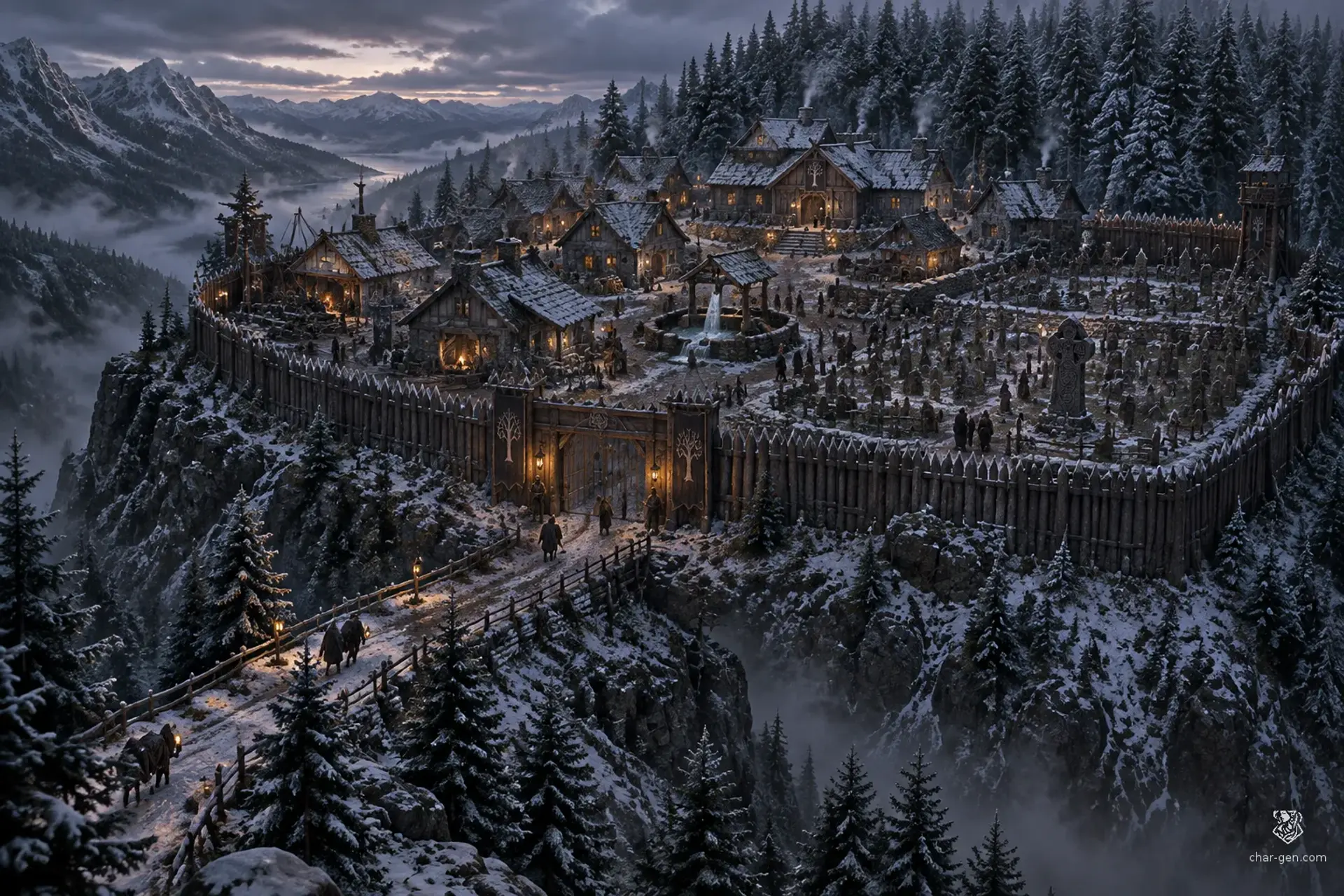
Keld is a small town on a broad, forested mountain summit, where the snow rarely amounts to more than a pale dusting. It stands here because the ridge offers a dependable spring, a defensible approach, and a meeting point for old timber trails. A wooden wall and gate enclose homes, work yards, and a graveyard larger than the town’s busiest street. The dead hold the oldest land claims, and their recorded wishes still shape local rule.
Keld
- Population
- 430
- Rule
- Reeve Hesta Korr
- Wealth
- Modest
- Defence
- Wall Watch
Overview
Keld is a small town on a broad, forested mountain summit, where the snow rarely amounts to more than a pale dusting. It stands here because the ridge offers a dependable spring, a defensible approach, and a meeting point for old timber trails. A wooden wall and gate enclose homes, work yards, and a graveyard larger than the town’s busiest street. The dead hold the oldest land claims, and their recorded wishes still shape local rule.
Atmosphere
A thin crust of snow catches on the wall’s rough planks and the dark firs beyond it. Smoke lies low when the wind drops, and every few minutes someone crosses town carrying a lantern toward the graveyard. People speak plainly in the street, then lower their voices near the council house. The town feels busy rather than bleak, but nobody treats the dead as merely dead.
Culture
Ancestor veneration, The Hearth Mother
Humans, Dwarves, Halflings
Economy
Forestry, Charcoal burning, Trail guiding, Grave-marker carving
Cut timber, Smoked venison, Mountain herbs, Charcoal
Grain, Salt, Iron tools, Lamp oil
Geography
Ways in and out
Places to see
- Summit GraveyardThe graveyard occupies a sheltered shelf inside the wall, with older markers clustered around the spring and newer plots along the uphill edge. Residents leave small carved chips beside graves when a family claim is under review.
- The Cold SpringA clear spring rises from a crack in the summit rock and feeds a stone trough. The town’s earliest homes gathered around it, and anyone drawing water after dusk must carry a lantern.
- The Closed East TrackA narrow track disappears into thick firs on the eastern side. The council says a rockfall made it impassable, though locals still find fresh marks on the old trail posts.
Power
3 factionsGovernment
Laws
Trouble
- Dead owners still control land, and the living need those plots before winter.The council has discovered that several empty plots are still listed under the names of dead owners. Hesta wants to grant them to families who maintain them, while the Grave Register says the old claims remain valid. The next winter stores depend on deciding who may cut timber from the disputed slopes.Involves
Hesta Korr, Mirek Doss, Tovik
- A disputed grave threatens the town’s winter supply route.A fresh mark appeared on a grave belonging to a family with no known descendants. Its claim would block the only reliable route for hauling grain to the storehouse. Hesta has ordered the marker left untouched, but the Leaseholders are preparing to move it before the next snowfall.Involves
Hesta Korr, Mirek Doss, Gana
Factions
- The Grave RegisterCivic and hereditaryThe Grave Register is a loose association of clerks, grave tenders, and families who maintain the town’s records of burial, inheritance, and land. They insist every claim be supported by a marker and a witnessed entry.GoalsPreserve the dead landholders’ legal claims and prevent the council from assigning any disputed ground to the living.Allies
Mirek Doss
RivalsSummit Leaseholders
- Summit LeaseholdersEconomic and politicalThe Leaseholders are living households who maintain the wall, trails, and shared spring. They argue that people doing the work should control the land, rather than wait on signatures and old family claims.GoalsTransfer abandoned plots and common land to residents who can prove they maintain them.Allies
Hesta Korr
RivalsThe Grave Register
- Bell WatchCivic defenseThe Bell Watch is made up of residents who patrol the forest edge and keep the gate. They have no formal political platform, but their control of access gives them influence over every dispute.GoalsKeep the gate under watch control and prevent either land faction from using the wall as leverage against the other.Allies
Tovik
RivalsSummit Leaseholders
Defences
- A timber palisade circles the homes and graveyard, patched each spring with forest pine.
- A barred gate faces the steepest safe approach; a narrow postern serves the woodcutters.
- A bell platform gives a view of the forest road and the summit trail.
Law and order
People and places
9 entriesReeveHesta Korr Human Woman
The reeve wears a patched red scarf and keeps a slate tucked under one arm. She can organize a timber crew in minutes, but her need to appear certain has turned a manageable land dispute into a public test of authority.
Grave tenderMirek Doss Halfling Man
Mirek tends the graveyard with a small hand brush and knows the position of every old marker. He is courteous to visitors but exacting with residents, particularly anyone who calls a grave an empty plot.
CarpenterGana Human Woman
Gana wears a leather apron with a dozen wooden wedges tucked into its pockets. She can tell the age of a beam by tapping it, and she dislikes the town’s habit of calling maintained land ownerless.
Hunter and watch volunteerSefu Human Man
A broad-shouldered hunter with a chipped front tooth, Sefu brings news from the forest before anyone else hears it. He rarely sits with his back to a door and is more comfortable discussing tracks than council votes.
CarverMarkerwright Kept by TaliA cramped workshop selling carved grave markers, door lintels, and sturdy wooden household goods. The shop’s back room is stacked with unfinished memorial pieces, each labeled with a family name and a date.
General goodsSummit Stores Kept by PakoA combined supply store and dry goods counter where residents buy rope, needles, lamp oil, and whatever can be spared for the mountain road. Goods are kept behind a waist-high counter, with the most expensive items locked in a wall cabinet.
TavernThe Charcoal Cup Kept by IkenaA warm, narrow public room with a hearth built from stones hauled up the mountain. The benches are scarred with old trail marks, and the keeper leaves one seat empty during council nights for any traveler who needs to speak.
Civic hallThe Mark House Run by BerenA low timber hall where the council meets, stores land records, and keeps the town’s winter accounts. The floor is worn smooth near the clerk’s table, where residents queue to dispute old claims.
Watch postThe Wall Shed Run by TovikA long shed beside the palisade where the watch stores spare planks, ropes, and tools. Its roof is patched with mismatched shingles, and the best view of the forest road comes from its loft.
Events
Lately
- A grave marker was found newly carved with a name absent from the council rolls.The Grave Register has demanded an inquiry, while the Leaseholders want the adjacent timber plot opened before winter.
- A cart of grain failed to arrive from the valley after a storm.The council has begun rationing stores, making the dispute over the shortest hauling route urgent.
- Someone has been cutting timber beyond the northern wall at night.The watch is under suspicion, and Tovik has doubled the gate patrol.
Calendar
- First thawThe Reading of NamesFamilies clear snow from grave markers and read aloud the names of those whose land shares are due for renewal. Visitors are welcome, but only residents may witness the readings.The twist · GM only
- Midsummer eveGate MarketThe town gathers inside the wooden wall for a night market of smoked meat, woven goods, and forest herbs. A watch patrol keeps the gate shut until the last bell.The twist · GM only
- Last harvestWinter MeasureHouseholds bring a portion of their stores to the council for winter accounting. The clerk records each contribution beside the names of the dead whose old holdings support the town.The twist · GM only
History
Keld began as a timber camp around a reliable summit spring. After a deadly winter, families recorded land claims beside their dead, and the council accepted those claims as a safeguard against dispossession. The arrangement gave the town stability, but no one agrees how long a claim should last. The official history calls the east trail a natural casualty of a rockfall; surviving records suggest the council chose to close it.
- Founding yearsThe First WallA timber camp grew around the summit spring, serving crews who felled trees and burned charcoal for the valley. The first palisade was built to keep wolves from the stores.
- The lean wintersThe Summit CompactA winter slide killed several early families. Their surviving relatives recorded land claims beside the graves, saying the dead had earned a lasting share through their labor. That custom became law.
- Thirty years agoThe Closed TrackThe official account says the old east trail was abandoned after a rockfall. A woodcutter’s account, hidden among the council papers, says the trail was deliberately closed after it exposed land claims that contradicted the Compact.
Secrets
3 secrets · 4 rumours- Secret 1 · GM only
- Secret 2 · GM only
- Secret 3 · GM only
Rumours
Plot hooks
3- 1The Name Under the StoneHesta asks the characters to witness a review of an abandoned claim before the council grants the plot to a family who needs timber. The marker is genuine, but the grave beneath it may not belong to the person named. The review could settle the town’s law or expose that its founding record was altered.
Investigation and civic conflict · Starts with Hesta Korr · Reward: A winter lodging place, local supplies, and the right to cut a modest load of timber.
- 2The Track They BuriedSefu asks the characters to check the closed east trail after he finds tracks where no one should be traveling. The trail leads to a cache of old council papers and a family still living in the forest. They claim their ancestors were driven out to protect the Summit Compact, and they want their land restored.
Exploration and negotiation · Starts with Sefu · Reward: A share of hidden stores and the gratitude of a family with knowledge of the mountain paths.
- 3A Claim at the GateTovik hires the characters to guard the gate during a council meeting, fearing that someone will force it open. The real threat is not an attack: a group intends to carry a coffin through the gate and claim the dead person’s signature as proof of inheritance. The deceased may have been alive when the claim was made.
Protection and legal intrigue · Starts with Tovik · Reward: Payment in food, a repaired piece of equipment, and access to the watch loft.
Media
0 imagesNo images yet.
Turn Keld into a sheet
A high-res, share-ready sheet you can post or print.
