
Dornruh
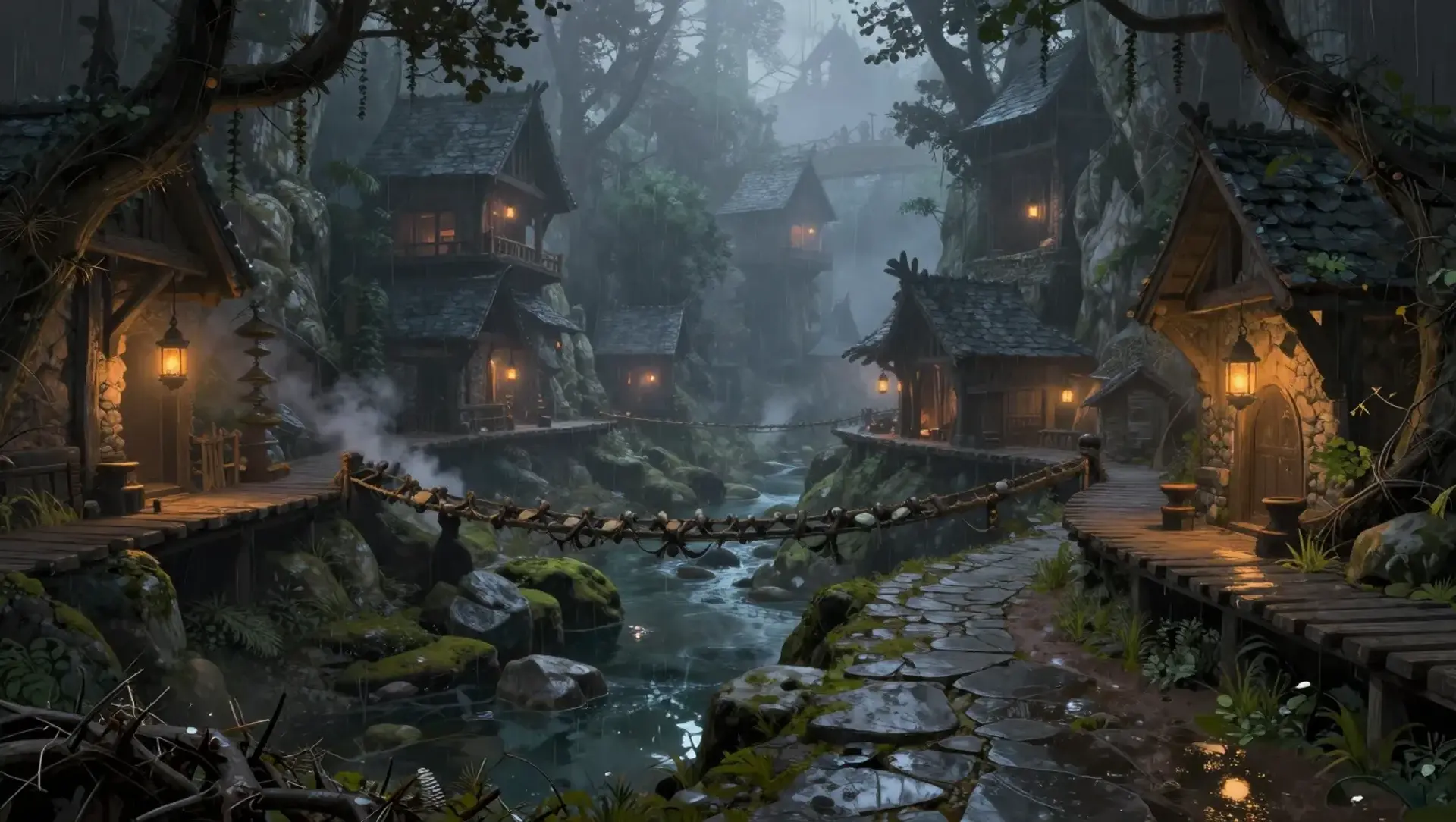
Dornruh is a small woodland refuge built where an old stone road crosses a reliable spring deep inside ancient, mist-covered forest. Its founders were charcoal burners, herbalists, escaped soldiers, and wandering traders who needed a place beyond the reach of armies and tax collectors. Three generations later, the settlement rests on raised walkways above wet ground, protected by ravines, thorn walls, and a strict promise that its location must remain hidden.
Dornruh
- Population
- Approximately…
- Rule
- Elder Mara Venn
- Wealth
- Modest but stable by…
- Defence
- The Lantern Watch
Overview
Dornruh is a small woodland refuge built where an old stone road crosses a reliable spring deep inside ancient, mist-covered forest. Its founders were charcoal burners, herbalists, escaped soldiers, and wandering traders who needed a place beyond the reach of armies and tax collectors. Three generations later, the settlement rests on raised walkways above wet ground, protected by ravines, thorn walls, and a strict promise that its location must remain hidden.
Atmosphere
Dornruh feels like a held breath beneath dripping branches. Lanterns hang from every walkway, their glass smoked black on the upper half so their glow cannot be seen from beyond the thorn line. Travelers speak softly, boots are dried beside communal braziers, and every stranger is watched until someone local claims responsibility for them. Beneath the hospitality lies a growing fear that the forest has begun choosing who may leave.
Culture
- The Hearth Mother, honored through the communal braziers
- The Green Warden, a local forest spirit regarded with wary respect
- Ancestor reverence centered on the founding dead
Humans, Dwarves, Halflings, Half-elves
Economy
- Foraging and herbal medicine
- Hunting and smoking meat
- Charcoal burning
- Woodcutting and carpentry
- Guiding travelers along hidden roads
- Discreet trade with merchants and pilgrims
- Smoked venison and boar
- Dried mushrooms
- Medicinal herbs and tinctures
- Honey and beeswax
- Timber and charcoal
- Guided passage through the forest
Salt, Grain, Iron tools, Cloth, Bowstrings and weapon parts, Glass lanterns and lamp oil
Geography
Ways in and out
Places to see
- The Lantern SpringA clear spring surrounded by flat gray stones. Coins, ashes, and small carved lanterns are left here by travelers seeking a safe departure. At night, ripples sometimes form against the current.
- The Bell WalkA raised timber platform overlooking the eastern ravine. Its bell is rung for fire, attack, missing travelers, and underground sounds, each with a different pattern.
- The Old Wayside ShrineA collapsed roadside shrine covered in moss and white fungus. The shrine-keepers say its statue was removed long ago, but a stone footprint remains beneath the altar.
- The Briar RingA dense wall of thorn trees that grows in a near-perfect circle around the settlement. The thorns open for locals carrying marked lanterns and close behind them before strangers can follow.
- The Buried HallA sunken patch beneath the meeting hall where ancient stone foundations rise through the mud. The stones are warm during rain and bear shallow carvings of roads converging on a single black door.
Power
4 factionsGovernment
Laws
Trouble
- The shifting paths are turning Dornruh's secrecy into a logistical crisis.Travelers are disappearing between the outer markers and the settlement, while forest paths lead back to places nobody recognizes. The council must decide whether to close Dornruh completely, ruining its food and oil supply, or continue receiving strangers under increasingly weak safeguards.Involves
Elder Mara Venn, Joren Pike, Lysa Bell, Tomas Reed
- The settlement's government is fracturing over whether the buried ruin is a threat or a covenant.A locked stone stair has appeared beneath the meeting hall. Mara Venn wants it sealed and hidden, while Sister Elian Thorn believes the ruin is awakening because the founding pact has been neglected. Both have enough followers to split the council.Involves
Elder Mara Venn, Sister Elian Thorn, Sella Crow, Hobb Rusk
- Shortages are turning old suspicion into a fight over who gets to decide Dornruh's future.Salt, iron, and lamp oil are running out after two supply parties vanished. Merchants demand open roads, while the watch accuses visiting traders of theft. If no compromise is reached, the council may lose control of the gates.Involves
Joren Pike, Lysa Bell, Tomas Reed, Hobb Rusk
Factions
- The Veiled CouncilGoverning councilThe Veiled Council consists of the settlement's senior representatives and insists that Dornruh survive by remaining difficult to find. They want fewer visitors, stricter route permits, and an investigation into the ruin beneath the meeting hall before anyone disturbs it.GoalsPreserve Dornruh's secrecy, close the forest routes temporarily, and keep the sealed ruin untouched.Allies
The Lantern Watch, The Hearthkeepers
RivalsThe Open Road Fellowship, The Ashen Root Circle
- The Open Road FellowshipMerchant and guide networkA loose alliance of merchants, guides, and inn servants who believe Dornruh can become a prosperous waystation without losing its character. They quietly maintain extra trail markers and invite travelers through routes the council has closed.GoalsOpen more roads, attract regular caravans, and turn Dornruh's hidden location into a profitable secret shared among trusted traders.Allies
Traveling traders, The Millstone Inn
RivalsThe Veiled Council, The Lantern Watch
- The Ashen Root CircleMystic and religious factionThe Ashen Root Circle believes the ruin beneath Dornruh is not merely a threat. They interpret the returning ash, altered dreams, and underground bells as signs that an ancient pact is being renewed. Some members want to communicate with the buried presence rather than destroy it.GoalsDiscover what was sealed beneath the settlement and restore the original pact before the forest paths collapse completely.Allies
The shrine-keepers, Several herbalists
RivalsThe Lantern Watch, The Open Road Fellowship
- The Lantern WatchDefensive militiaThe Lantern Watch is split between practical defenders and frightened traditionalists. They blame outsiders for vanished supplies because strangers are easy to track politically, even when evidence points toward the old foundations and the forest itself.GoalsControl movement through Dornruh, identify the cause of the disappearances, and prevent panic from becoming an excuse for reckless exploration.Allies
The Veiled Council
RivalsThe Open Road Fellowship, The Ashen Root Circle
Defences
- A timber palisade concealed behind thorn thickets and fallen spruce
- Raised walkways linking watch platforms, storehouses, and the main gate
- Two narrow gates that can be blocked with timber beams and iron chains
- Hidden rope bridges across the eastern ravine
- Moss-covered stone foundations that form a partial inner ring around the oldest homes
Law and order
People and places
10 entriesCouncil speaker and retired herbalistMara Venn Human Female
A thin older woman with silver braids, ink-stained fingers, and a habit of counting doorways whenever she enters a room.
Hunter, trail marker, and member of the Lantern WatchSella Crow Half-elf Female
A wiry woman with a red scarf, muddy boots, and a collection of carved bird bones tied to her belt.
Master woodcutter and representative of the timber workersHobb Rusk Dwarf Male
A heavyset man with a wooden hand, a spotless green cloak, and the habit of tapping twice before speaking a difficult truth.
Shrine-keeper and keeper of the founding ritesSister Elian Thorn Human Female
A narrow-faced woman with ash-gray hair, a bell on a cord around her neck, and pale scars circling both wrists.
Caravan broker and traveling merchantJoren Pike Human Male
A clean-shaven traveler with a red ledger, polished boots, and a habit of smiling without looking at the person addressed.
Herbalist and apothecaryCrow's Herb House Kept by Nell Crow
A cramped herbalist's shop attached to a drying shed, with bundles hanging from every beam. Sella Crow brings in fresh plants, while travelers receive stern instructions about dosage and side effects. The proprietor is more interested in identifying the source of the shifting forest than in selling remedies.
Timber yard and supply shedRusk's Timber Yard Kept by Bram Rusk
A long shed where woodcutters stack charcoal, planks, resin, and split kindling beneath a rainproof roof. Hobb Rusk oversees the work and gives discounts to anyone repairing public walkways. He wants the shed to become a proper trade depot, which puts him at odds with the council's secrecy laws.
TavernThe Millstone Inn Kept by Lysa Bell
The settlement's only true common room is warm, crowded, and built over older stonework. Guests sit beneath blackened lanterns while Lysa Bell serves stew, smoked meat, mushroom bread, and honey beer. The tavern is friendly until someone boasts about discovering Dornruh's location. Then every local conversation stops at once.
InnThe Millstone Inn Run by Lysa Bell
A broad timber inn built around a moss-covered stone foundation. Its common room stays warm even when the hearth is cold, and travelers sleep in curtained alcoves above the stable. The cellar contains old road stones arranged in a pattern no mason recognizes.
Smithy and workshopThe Bent Nail Run by Tomas Reed
A low shed with a forge at one end and a repair bench at the other. Tomas fixes wagon rims, buckles, knives, lamp hinges, and hunting traps. He refuses to work after sunset because he once heard hammering answer him from beneath the foundations.
Events
Lately
- Two supply runners vanished on a route that should take half a day, then returned three nights later without their packs or memories of where they had been.Salt and lamp oil are being rationed, while suspicion has fallen on travelers and the Open Road Fellowship.
- The underground bell rang three times beneath the meeting hall during a clear afternoon.Sister Elian Thorn gained followers, and Elder Mara Venn quietly ordered the old foundations covered with fresh planks.
- A merchant's map showed Dornruh one mile from its true location, while a second map showed the settlement beside a river that does not exist.Guides no longer trust inherited maps, and every departure requires two independent route witnesses.
Calendar
- 3rd of EmberwaneThe DimmingThe Lantern Dimming marks the settlement's founding. Every household extinguishes its lamps for one minute while the shrine-keepers recite the names of the first settlers.The twist · GM only
- 17th of RainmootSpring MootHunters and woodcutters compete to bring the finest smoked venison, honey cakes, and carved walking staffs to the spring market. Travelers may buy passage tokens for the forest roads.The twist · GM only
- Last night of LongdarkThe Ash OathThe council renews the secrecy oath at the stone spring. Each adult places a pinch of ash in the water and swears not to reveal Dornruh's location without unanimous council approval.The twist · GM only
History
Dornruh was founded as a refuge from authority and survived by keeping its location secret. Its founders built over older stonework and sealed away a ruin they could not understand. Every generation has repeated the story that the seal protects the settlement. The oldest surviving records suggest the opposite may be true: Dornruh exists because its founders agreed to maintain a bargain with the thing beneath it.
- Three generations agoThe First LanternsCharcoal burners, herbalists, escaped soldiers, and wandering traders found a clear spring beside a ruined stone road. They raised the first shelters under the trees and agreed that no founding family would rule the others.
- The first generationThe SealingThe founders claimed they discovered only a collapsed roadside shrine and empty foundations. Old family songs, however, describe a stone door beneath the spring and a bargain made with something that answered from below.
- Two generations agoThe Lost CompanyA squad of soldiers searching for deserters reached the forest and vanished. Officially, the woods killed them. Dornruh's oldest watch records say the soldiers found the buried door and were deliberately led into the ravines.
- Twenty-one years agoThe Black Lantern FireA fire destroyed half the settlement after a merchant attempted to reveal Dornruh's location to a regional lord. The official story blames careless charcoal burners, but the fire began inside the meeting hall and left the old stone foundations untouched.
- The present yearThe Roads That TurnIn recent months, travelers have returned from short journeys with unfamiliar memories, while paths bend toward the spring regardless of their starting point. The first underground bell was heard during a rainstorm last autumn.
Secrets
3 secrets · 6 rumours- Secret 1 · GM only
- Secret 2 · GM only
- Secret 3 · GM only
Rumours
Plot hooks
5- 1The Road That Walks AheadThe characters are hired to escort a medicine caravan from the eastern road. The route seems safe until the guide's trail marks begin appearing ahead of the group, carved into trees they have not yet passed. The hidden complication is that the caravan's cargo includes a sealed stone fragment that is calling the paths toward Dornruh.
Escort and supernatural investigation · Starts with Lysa Bell · Reward: Food, lodging, medicinal supplies, and a permanent passage token
- 2The Voice Beneath the SpringA young traveler disappears after leaving the Millstone Inn, and the watch wants the characters to search the ravines before the council blames another outsider. The hidden complication is that the missing person has willingly entered the ruin after hearing a dead relative calling from below.
Search, rescue, and moral choice · Starts with Sella Crow · Reward: A repaired set of gear, local guides, and access to restricted trail maps
- 3The Man Who Chose the ThornsJoren Pike asks the characters to find a missing buyer who carried a large payment in coin and trade bars. The buyer is alive inside a thorn-choked hollow, but refuses rescue because the forest has shown him a vision of Dornruh's future. He claims the settlement can only survive if the characters expose its location to the outside world.
Recovery mission with conflicting testimony · Starts with Joren Pike · Reward: Coin, trade goods, and a share in a profitable caravan contract
- 4The False FoundationMara Venn secretly asks the characters to inspect the old foundations without informing the council. The hidden complication is that the sealed stair is not opening from below. Someone in Dornruh has been removing stones from the inside of the meeting hall and replacing them with convincing copies.
Investigation and political conspiracy · Starts with Elder Mara Venn · Reward: Council favor, rare herbs, and permission to use Dornruh as a safe base
- 5Three Lanterns in the MistSister Elian Thorn offers the characters a ritual that may return the vanished travelers, but it requires carrying three lanterns along paths that change whenever the bells ring. The hidden complication is that each returned traveler will bring back a fragment of the buried presence, slowly transforming the settlement's people and animals.
Ritual expedition and dangerous bargain · Starts with Sister Elian Thorn · Reward: Healing, ritual knowledge, and the return of one missing person
Media
0 imagesNo images yet.
Turn Dornruh into a sheet
A high-res, share-ready sheet you can post or print.