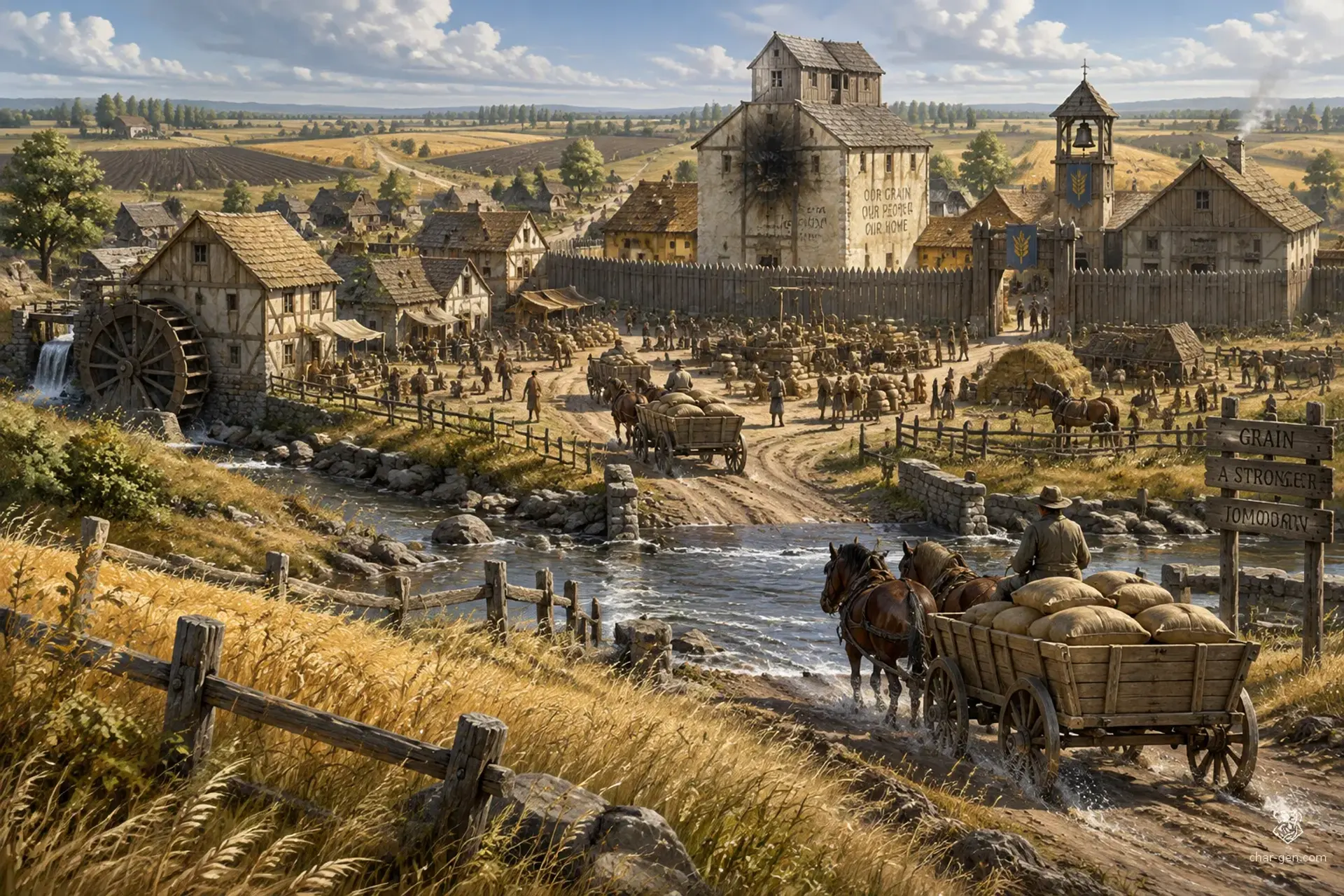
Larkfall
Larkfall is a grain town built on open prairie, where the road crosses a shallow seasonal stream and the soil holds water after spring rains. Its wealth comes from farms, teamsters, and the public granary, but its founding account is disputed: the town claims its first settlers made empty land productive, while a handful of families insist that their ancestors' fields were seized. That quarrel shapes council votes, harvest measures, and who is believed.
Larkfall
- Population
- 1,100
- Rule
- Reeve Vuk Drah
- Wealth
- Modest
- Defence
- The Furrow Watch
Overview
Larkfall is a grain town built on open prairie, where the road crosses a shallow seasonal stream and the soil holds water after spring rains. Its wealth comes from farms, teamsters, and the public granary, but its founding account is disputed: the town claims its first settlers made empty land productive, while a handful of families insist that their ancestors' fields were seized. That quarrel shapes council votes, harvest measures, and who is believed.
Atmosphere
At noon, the town sounds like hammers and arguments. Grain carts crowd the main road, while neighbors watch one another weigh every sack. The old bell rings once when the council meets, twice when a vote is disputed, and never for fire, a custom that visitors mistake for indifference. People are hospitable in practical ways, but no one offers a promise without asking who will witness it.
Culture
- Household ancestor rites
- The Hearth-and-Harvest faith
- Small shrines to local field spirits
Humans, Halflings, Dwarves
Economy
Grain farming, Milling, Wagon transport, Livestock raising
- Wheat and barley
- Dried beans
- Wool
- Wagon axles and harness repairs
- Iron tools
- Salt
- Lamp oil
- Fine cloth and medicinal herbs
Geography
Ways in and out
Places to see
- The Moving FordA shallow stream crossing whose stones shift after heavy rain. Old fence posts can be seen beneath the water when it runs low, and their carved marks do not match the council's account of the town's first boundaries.
- The Long FurrowA broad shared pasture on the eastern edge of town. The grass grows in long, straight strips that locals attribute to old plowing, though no one admits to knowing who worked the land before the first recorded farms.
Power
3 factionsGovernment
Laws
Trouble
- The public measure is false, and the coming levy may be challenged.A filed-down public weight has made the grain levy suspect. Reeve Vuk Drah wants a quiet replacement before the next measure, while Tessa Shale believes the discrepancy could expose the original seizure of land.Involves
Vuk Drah, Tessa Shale, Mira Szel
- A boundary dispute is damaging crops and may close the road.A fence has been driven across an old drainage cut, flooding two tenant fields and threatening the southern road. The First Furrow calls the fence lawful; The Open Ledger says the boundary was never legitimate.Involves
Vuk Drah, Tessa Shale, Boros Kelm
Factions
- The First FurrowLandholding associationA circle of established landholders who treat the founding account as the legal basis for their deeds. They fund the town watch and support the granary, but they resist any inquiry that could reopen old boundaries.GoalsKeep the existing land records and founding account accepted as final.Allies
Councilor Drah
RivalsThe Open Ledger
- The Open LedgerCivic reform circleClerks, tenant farmers, and descendants of the people said to have been displaced. They want old claims heard in public rather than settled through private council meetings. Some members want restitution; others mainly want the town to stop calling their families liars.GoalsPublish the original land records and reopen the boundaries around the oldest farms.Allies
Tessa Shale
RivalsThe First Furrow
- The Cartwright CompactTrade associationTeamsters and grain measurers who depend on the town's reputation for fair trade. They fear that either faction will turn market disputes into a land struggle and drive away buyers.GoalsKeep the public measures and trade roads under neutral town control, frustrating both the landholders and reformers.Allies
Mira Szel
RivalsThe First Furrow, The Open Ledger
Defences
- A timber palisade around the granary and council hall
- Shallow ditches along the southern approach
- A bell tower used to watch for prairie fires and approaching riders
Law and order
People and places
10 entriesReeveVuk Drah Human Male
A human reeve with a neatly trimmed beard who taps a finger against his cup before answering. He wants to keep the harvest levy functioning and fears a council split will leave the town without reserves. His caution looks like fairness until a decision is overdue.
Tenant farmer and civic organizerTessa Shale Human Female
A human tenant farmer with a pale scar across one knuckle, Tessa keeps a folded list of names in her apron. She wants the old boundaries examined in open council and fears that a public confrontation will cost her family its lease before the evidence is ready.
Grain measurer and teamsterMira Szel Halfling Female
A halfling teamster with a brass measuring rod tucked through her belt, Mira checks every cart wheel before loading. She wants the town's weights trusted by outside buyers and fears that a land fight will make merchants bypass Larkfall. She smiles when angry, which locals know means the argument has only begun.
Farmer and landholderBoros Kelm Dwarf Male
A broad-shouldered dwarf farmer who carries a broken fence staple as a worry charm, Boros wants the disputed drainage cut restored before the next rain. He fears that reopening the deeds will undo his family's claim and believes order is kinder than uncertainty, even when the order favors him.
Singer and oral historianShirin Human Female
A human singer with a rasping voice, Shirin performs work songs at fairs and collects verses from older residents. She wants to sing the version of the founding story she heard from her grandmother and fears being driven from town for repeating it. Before difficult conversations, she twists a copper ring around her thumb.
Harness and wagon repairThe Burnt Wheel Shop Kept by OlekA narrow workshop filled with leather straps, axle pins, and the smell of waxed thread. Its owner repairs equipment quickly but keeps a list of unpaid jobs pinned beside the door. She would rather see dependable roads than earn a premium from desperate travelers.
General goodsThe Salt Ledger Kept by JarekA cool, dim shop with shelves of salt, dried herbs, lamp oil, and imported iron fittings. The proprietor marks every shortage in chalk rather than raising prices without warning. She wants the town to store more necessities locally and fears that a bad harvest will make neighbors blame one another for scarcity.
TavernThe Ash Harvest Kept by ZoraThe common room is built around a broad hearth, with benches scarred by knife points and wagon grease. The keeper lets people speak their minds but stops anyone from blocking the door. A board near the fire lists the prices paid for grain that week.
TavernThe East Field Table Kept by PavelThe dining room has clean whitewashed walls and a view of the eastern fields. Its food is simple but dependable, and the owner keeps one table reserved for anyone bringing a written dispute before the council. Travelers often mistake this custom for hospitality; locals know it is a way to make witnesses stay.
GranaryAsh Store Run by SavaThe building began as a communal storehouse after the Ash Harvest and still smells of dry grain and old smoke. Two clerks sit at a raised table to witness measures, while the watch keeps a clear view of the doors. Residents can inspect most records during daylight, though the oldest deeds are kept in a locked cabinet.
Events
Lately
- The public grain measure was found to be lighter than its recorded weight.Farmers are withholding some grain until the council explains the levy.
- A newly moved fence has blocked a drainage cut after spring rain.Two tenant fields are waterlogged and the southern road is at risk.
- A singer has announced a new version of the founding account for the midsummer fair.The First Furrow has asked the reeve to forbid the performance.
Calendar
- First day of PlantingThe Open MeasureHouseholds bring seed grain to be measured publicly before sowing. The measure is meant to prevent disputes about the council's grain levy, and families keep a sharp eye on the brass weight.The twist · GM only
- MidsummerThe Long Furrow FairA day of races, bread ovens, and formal readings of the town's founding account. Children compete to carry a grain sack around the common without spilling it.The twist · GM only
- Last harvest wagonThe Last CartThe final loaded wagon is paraded through the square before stores are sealed for winter. The town counts its stores aloud, an old practice intended to reassure the poor and shame hoarders.The twist · GM only
History
Larkfall grew around a reliable stream crossing and fertile fields. Its civic habits were shaped by a fire, a flood, and the need to store grain against hard winters. The official story credits industrious settlers with making empty prairie useful. That account is convenient for the families who now hold the oldest farms, and the surviving evidence suggests the land was not empty when the town began.
- Founding generationThe First FurrowThe council's official account says settlers cut the first fields from untouched grass. Old family stories say the streamside plots were already cultivated by a small group who were driven away after refusing a grain levy.
- Thirty years agoThe Ash HarvestA prairie fire destroyed the first grain store. Neighbors rebuilt it together, and the council began requiring public measures so no household could be accused of hiding grain without evidence.
- Eleven years agoThe Moving FordA spring flood moved the stream crossing and exposed buried fence posts. The council declared them remnants of an abandoned ranch, but several posts bear marks matching the oldest disputed deeds.
Secrets
2 secrets · 4 rumours- Secret 1 · GM only
- Secret 2 · GM only
Rumours
Plot hooks
3- 1The Short MeasureMira asks the characters to determine who altered the public grain weight before the levy is collected. The obvious suspect is a reformer, but the person who filed it down was trying to expose a longstanding surplus skim. Naming them may restore trust in the measure while implicating a respected council member.
Investigation and civic dilemma · Starts with Mira Szel · Reward: A season of free wagon service and the right to inspect the town's trade accounts.
- 2Water Across the RoadFloodwater is eating into the southern road after a disputed fence blocks the drainage cut. Vuk wants the road reopened before merchant wagons arrive. The fence owner offers to move it if the characters endorse the family's deed, but the buried posts beneath the water suggest the deed was altered.
Negotiation and urgent repair · Starts with Vuk Drah · Reward: A cash payment from the council, lodging, and a public hearing for one claim of the characters' choosing.
- 3The Song at MidsummerShirin asks the characters to protect her during the fair as she performs the older founding account. She has not told them that the song identifies a household still living in town. The performance may give the Open Ledger a witness, but it could also expose a family that had no part in the original seizure.
Protection and public truth · Starts with Shirin · Reward: A copy of a family songbook and the trust of several tenant households.
Media
0 imagesNo images yet.
Turn Larkfall into a sheet
A high-res, share-ready sheet you can post or print.
