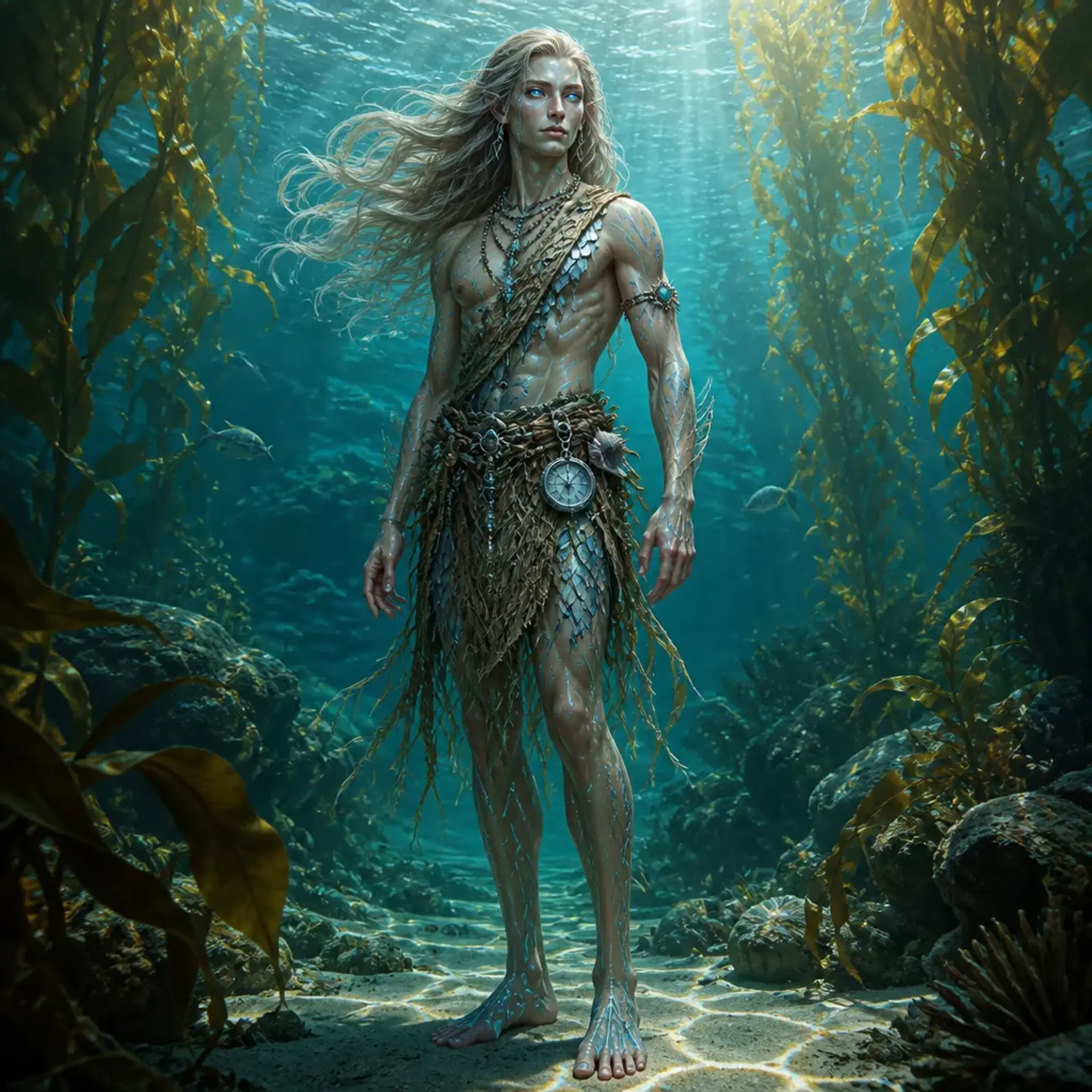
Homo pelagicus mutabilis
Common in the deep and rare in the daylight, merfolk are the hidden heirs of old sea-born bloodlines.
At a glance
Darkvision 60 ft.
Languages Common, Aquan
Height 5 to 6 feet tall in leg form; 7 to 8 feet long in tail form
Weight 120 to 180 pounds
Lifespan 90 to 120 years
At the table
Your body can function beneath the waves and in open air. You can breathe both air and water, and you do not suffer ordinary discomfort from moving between them.
You can alter your lower body at will, changing from leg form to tail form or back again. In tail form, your movement is swift in water, and your skin takes on a light blue hue. In leg form, you can travel and mingle on land with ease. This transformation is a hallmark of your people and often the first skill children learn after swimming.
You are at home in the sea. You have a natural swimming speed, and you move through water as though it were a familiar road rather than an obstacle.
Your life among reefs, wrecks, and deep channels has sharpened your senses. You are especially adept at noticing subtle motion, sound, or pressure changes in your environment.
Your hidden heritage is part instinct, part discipline. You have advantage on checks made to keep your merfolk nature concealed, to pass for a surface-born folk while in leg form, or to control your transformation in stressful situations.
Common, Aquan
Merfolk tend toward Constitution and Wisdom, with many also favoring Dexterity for the grace of the deep. Their bodies are built for long dives, steady currents, and patient vigilance, though their cultures prize adaptability as much as physical hardiness.
They favor luminous fins, quick reflexes, and messenger traditions. Reef merfolk are the most socially gregarious of their kind and often serve as scouts, guides, and diplomats.
Reef merfolk dwell among coral cities and sunlit shallows. They are the most visible branch of the people, though still skilled at hiding when danger approaches.
Common in the deep and rare in the daylight, merfolk are the hidden heirs of old sea-born bloodlines. They can walk among surface folk in leg form, return to the water by choice, and keep their heritage concealed until the tide is right. To meet one is to meet a traveler between worlds, equal parts diplomat, hunter, scout, and secret-keeper.
Merfolk are graceful humanoids descended from mermaids, adapted for lives that alternate between sea and shore.
In their leg form, they resemble slender folk with bright eyes, fluid posture, and hair that often drifts as if still in water. In tail form, their legs fuse into a strong fishlike tail, and their skin shifts to a light shade of blue, a change many families consider as natural as breathing. They breathe both air and water with equal ease, and this dual life has given them a reputation for vanishing into one world while standing in the other. Their hands are dexterous, their feet narrow and well-suited to wet stone, and their voices carry an almost musical clarity.
Aquatic
Young merfolk are quick, curious, and often indistinguishable from human children when on land, save for a lifelong comfort with water and a habit of watching currents the way others watch roads.
By adolescence, merfolk master tail-to-leg shifting, choose their first work or calling, and are trusted with errands that cross both reef and shore.
Adults carry family duties, civic labor, and the burden of keeping their hidden communities unseen. Many become divers, guides, heralds, healers, or tide-watchers.
Elders are treasured as historians and judges of seasonal change. Many remain active until very late in life, slowing in body long before they lose sharpness of mind.
Merfolk culture balances concealment with hospitality.
Many communities are organized around kin-clans that share food, songs, and watch duties, with status earned through service, seamanship, and memory rather than wealth alone. Storytelling is central to daily life, especially stories that encode currents, hazards, and historical betrayals. Because many merfolk can live ashore when needed, they often maintain double lives, one public and one protected. Their festivals are tied to tides and moon phases, and the most respected guests are those who can keep a secret without being asked to swear one.
Merfolk faith tends toward reverence for tides, moon cycles, deep places, and ancestral memory.
Many worship or honor sea deities, guardian spirits, or local currents rather than distant cosmic law. Their outlook is usually pragmatic and communal, which often pulls them toward neutrality, though their strongest traditions reward compassion, reciprocity, and defense of the vulnerable. A merfolk who breaks faith is usually thought to have abandoned balance, not simply custom.
Merfolk usually treat outsiders with careful courtesy.
Surface folk are often seen as powerful, short-lived neighbors who must be handled with tact, while other aquatic peoples may be welcomed as allies or watched as rivals, depending on old reef borders and resource disputes. They prefer negotiated trust over open conflict, but they are capable of fierce loyalty and quiet vendettas. To those who respect boundaries, they are generous hosts. To those who poison waters, dredge sacred beds, or pry into hidden coves, they become patient and relentless adversaries.
Merfolk homelands are usually built where reef, kelp forest, and current meet.
Their cities favor arches of coral, woven sea-grass walls, and buoyant stone linked by channels wide enough for swimmers and narrow enough to discourage predators. In shallows and along coasts, they often maintain hidden tide houses disguised as wrecks, boathouses, or caves. Their architecture values curves, water flow, and acoustics, with chambers shaped to carry voice and song cleanly through the blue.
No images yet.
A high-res, share-ready sheet you can post or print.
