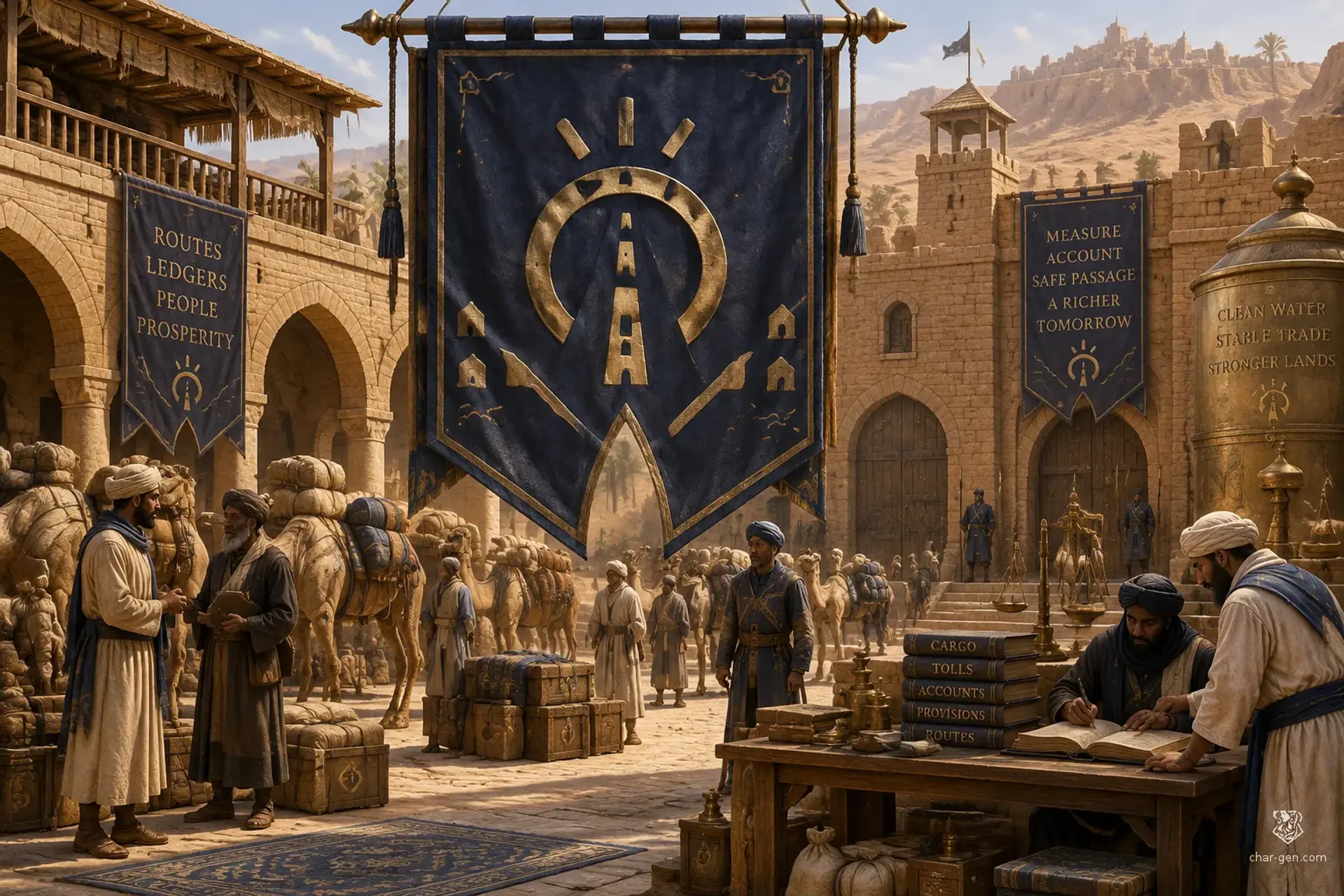
The Brass Road Factors
The consortium's founding compact united seven caravan houses around shared markers, scouts, and cistern maintenance. For its first two decades, it was a loose service association, respected for keeping the main route open. Its first great triumph came during the Three Dry Seasons, when its drivers coordinated water deliveries between isolated oases and prevented several settlements from being abandoned. Prosperity brought disputes over who paid for wells and whose caravans received priority. The watershed moment came 41 years ago, during the Brass Marker Judgment. After a toll station was burned in a house feud, the regional governor threatened to revoke every private toll right. The seven houses presented a unified ledger, accepted collective liability, and offered a single tariff in exchange for an enforceable charter. The agreement saved the route system but transformed the consortium from a partnership into an authority capable of directing trade. In the following decades, the Factors built or financed stations along the main routes and steered merchants toward markets where their member houses held shares. They also improved weights and dispute resolution, earning a reputation for dependable dealings. The cost was a widening gap between marked roads and remote dunes, where independent traders received little protection but still faced pressure to buy permits. The most recent setback was the Drought of Split Wells, eleven years ago. The consortium redirected water and grain toward the main route to preserve its contracts. Several remote camps suffered, and the official ledger understated the losses. The organization survived, but its promise to serve the whole desert became difficult to defend. Today, younger Factors argue for fairer access; established houses fear that reform will break the charter and invite confiscation.
The Brass Road Factors
- Type
- Merchant consortium and…
- Size
- 524 members
- Reach
- High along the main routes…
- Base
- Tamarisk Wells, a major oasis settlement on the eastern main route
Overview
The consortium's founding compact united seven caravan houses around shared markers, scouts, and cistern maintenance. For its first two decades, it was a loose service association, respected for keeping the main route open. Its first great triumph came during the Three Dry Seasons, when its drivers coordinated water deliveries between isolated oases and prevented several settlements from being abandoned. Prosperity brought disputes over who paid for wells and whose caravans received priority. The watershed moment came 41 years ago, during the Brass Marker Judgment. After a toll station was burned in a house feud, the regional governor threatened to revoke every private toll right. The seven houses presented a unified ledger, accepted collective liability, and offered a single tariff in exchange for an enforceable charter. The agreement saved the route system but transformed the consortium from a partnership into an authority capable of directing trade. In the following decades, the Factors built or financed stations along the main routes and steered merchants toward markets where their member houses held shares. They also improved weights and dispute resolution, earning a reputation for dependable dealings. The cost was a widening gap between marked roads and remote dunes, where independent traders received little protection but still faced pressure to buy permits. The most recent setback was the Drought of Split Wells, eleven years ago. The consortium redirected water and grain toward the main route to preserve its contracts. Several remote camps suffered, and the official ledger understated the losses. The organization survived, but its promise to serve the whole desert became difficult to defend. Today, younger Factors argue for fairer access; established houses fear that reform will break the charter and invite confiscation.
How it began
Eighty-three years ago, seven caravan houses pooled their brass route markers after a season of raids and failed wells. Their first agreement was practical: share scouts, maintain common cisterns, and pay one negotiated toll rather than seven separate bribes. The name The Brass Road Factors began as a clipped local phrase for the brokers who kept the road markers in brass; no one remembers the longer original wording. The consortium grew by making its services difficult to refuse. It financed wells, hired guides, and standardized weights, then charged for the security and predictability it had helped create.
How to know them
Oxidized brass, Indigo, Dune-white
- Brass route markers
- An open-bottomed road sign
- Indigo ledger cords tied around official account books
Standing
What they say they want
What they are doing now
Where it leads
A desert where every recognized route, market, and well operates under one dependable system of measures, permits, and arbitration. The public version promises safe passage for all. The private version gives the consortium enough leverage to decide which settlements prosper.
How others see them
To established merchants, The Brass Road Factors are reliable, organized, and expensive. Oasis communities value their wells and escort contracts but distrust their control of the roads. Remote travelers see a distant power that charges for safety it does not always provide. The consortium insists that tolls pay for shared infrastructure, not privilege.
People
5 ranks
First Factor
Patient, precise, and adept at making every side believe it has been heard. She is neither cruel nor sentimental, and treats stability as a moral good even when it excuses harm.
- The Seven Measures7 members
The governing council of the oldest and wealthiest member houses. It sets tariffs, approves major contracts, and elects the First Factor. Decisions require five votes, but each house may delay an emergency measure once.
- Route Factors19 members
Regional managers who negotiate with oasis authorities, assign patrol contracts, and supervise toll stations. They can make local agreements but must report any change in rates.
- Tollkeepers and Ledger Hands112 members
Clerks, weighers, assessors, and station officers who record cargo, collect fees, and maintain the route accounts. Many know the true workings of the consortium better than its public spokespeople.
- Road Companions340 members
Drivers, scouts, guards, animal handlers, and well tenders under contract. Most are not voting members, though long service can earn sponsorship.
- House Apprentices46 members
Junior clerks and negotiators learning weights, local customs, and commercial law. They are assigned to a sponsoring house and often become its most loyal informants.
Other key members
- Brek Tzun Route Factor responsible for the western stations
- Mina Senior Ledger Hand and potential whistleblower
- Jasiri of Tamarisk Wells Captain of the caravan escorts
- Q'illu Sapan Apprentice negotiator and emerging political rival
How they are organised
- A sponsor among a member house or a Route Factor
- A witnessed period of service in trade, transport, station work, or account keeping
- An oath to preserve route records and report disputes involving consortium property
- A bond, labor pledge, or guarantor acceptable to the sponsoring house
- Acceptance that voting membership belongs to houses, not individual workers
Relations
8 factionsThe oasis councils rely on the consortium to keep grain and water moving, while the consortium needs their wells. The relationship strains whenever tolls rise during a drought.
Operations
What they do
How they do it
Services for hire
- Marked-road passageNegotiated fee, often a cargo share or route surchargeA licensed guide, escort, and route information for travel along marked roads. Protection is strongest near staffed stations and not guaranteed in remote dunes.
- Station storageDeposit plus storage feeSecure holding for cargo at major stations, with a written inventory and arbitration terms for disputes.
- Caravan advanceInterest, collateral, and a sponsoring FactorCredit for established merchants or promising caravans. Defaults can lead to seized cargo, route restrictions, or long-term labor contracts.
- Road accountSmall fee for members; higher fee for outsidersAccess to recent price lists, well conditions, and registered route warnings. Information about unmarked paths is deliberately excluded.
What they can do
What they have
Where they are weak
Territory
Headquarters
Tamarisk Wells, a major oasis settlement on the eastern main routeA low, square caravanserai of sun-baked brick wrapped around a shaded counting court. Brass markers, polished by generations of hands, are set into its doorways. The public hall is open to visiting merchants, while the inner rooms hold ledgers, sealed route maps, and a cistern guarded by company watchmen.
Lands they hold
Outposts
- First MarkerThe eastern approach to Tamarisk WellsRecords caravans, collects entry tolls, and directs visitors to the headquarters.
- Saffron ShadeA busy crossing on the western main routeMaintains a cistern and escort station while monitoring traffic toward the Saffron Cut.
- The Late BellA remote market at the edge of the reliable wellsActs as a small trading post and listening station. Its bell is rung at dusk to warn travelers when the water count is low.
Secrets
Plot hooks
4 hooks- 1The Page That Does Not BalancePersonal, social and investigativeReward: A sponsor's favor, access to hidden accounts, or a dangerous political debtA character who works as a driver, clerk, or merchant is asked to carry a sealed ledger page to Kivuli Daro. The page proves that their sponsor's house profited from the falsified drought accounts. The sponsor offers money and protection if it disappears.
- 2Water Under BondLocal, negotiation with possible pursuitReward: Local allies, supplies, or evidence against a member houseA remote settlement hires the party to recover a water cart seized for unpaid tolls. The seizure was lawful under the charter, but the cart carries medicine and the settlement has no other supply. A Route Factor offers a legal release if the party can expose who diverted the original delivery.
- 3A Marker Before the LawRegional, factional and exploratoryReward: A route contract, a new ally, or influence over the charter reviewThe Saffron Cut has become the fastest safe route, and the consortium is erecting a toll station before its rights are settled. The governor asks the party to delay construction; Kivuli Daro offers a contract to protect it. The Far Tracks know that an unmarked well lies beneath the proposed site.
- 4Two Ledgers, One Missing HandCampaign-scale investigation and divided loyaltiesReward: Proof of the consortium's central secret and a choice over who receives itMina disappears after requesting two copies of the Drought of Split Wells ledger. The council calls her a thief, while the Road Companions suspect she was taken by a member house. Finding her first could decide whether the evidence becomes public, is traded, or vanishes.
Work they offer
What gets in the way
Rumours
Media
0 imagesNo images yet.
Turn The Brass Road Factors into a sheet
A high-res, share-ready sheet you can post or print.
